Energy availability is the foundation that every other nutrition variable depends on. Understanding why the order in which protein, fat, and carbohydrate targets are set matters changes how each one works in practice.
The fuelling hierarchy establishes the sequence in which nutrition variables are set for training athletes. Energy availability, the dietary energy remaining after exercise expenditure, is set first and should be targeted above 45 kilocalories per kilogram of fat-free mass per day to support health, performance, and body composition. Protein is set second and is non-negotiable, with a target of 1.6 to 2.2 grams per kilogram of bodyweight per day at maintenance, increasing toward 2.0 to 2.4 grams per kilogram during a calorie deficit. Dietary fat is set third to a minimum threshold of 0.5 grams per kilogram of bodyweight per day to sustain hormone synthesis and fat-soluble vitamin absorption. Carbohydrate fills the remaining calories after energy availability, protein, and fat floors are established, scaling with training volume from 2 to 4 grams per kilogram for low-volume training up to 4 to 6 grams per kilogram for high-volume training. Getting protein right while energy availability is too low produces a different outcome from the same protein intake with adequate energy underneath it, which is why the order matters.

Most nutrition conversations for athletes focus on macronutrient targets in isolation: how much protein, how many carbohydrates, and where to set dietary fat. These are useful questions, but the order in which the variables are set, and the foundation on which they are all placed, is at least as important as the specific numbers.
The fuelling hierarchy positions energy availability as the variable that every other nutrition decision depends on, because when it falls too low the body makes trade-offs across hormonal output, recovery, and adaptation to training before any obvious symptoms appear. Getting protein right while energy availability is insufficient produces a different outcome from the same protein intake with adequate energy availability underneath it. The same applies to fat and carbohydrate. The hierarchy captures that interaction and provides a practical sequence for building a nutrition approach that is structurally sound.
The thresholds and targets in this framework are population-level references rather than individual prescriptions, and the right figures shift with training volume, phase, body composition, and how someone responds across time.
Why Energy Availability Is the First and Most Important Variable
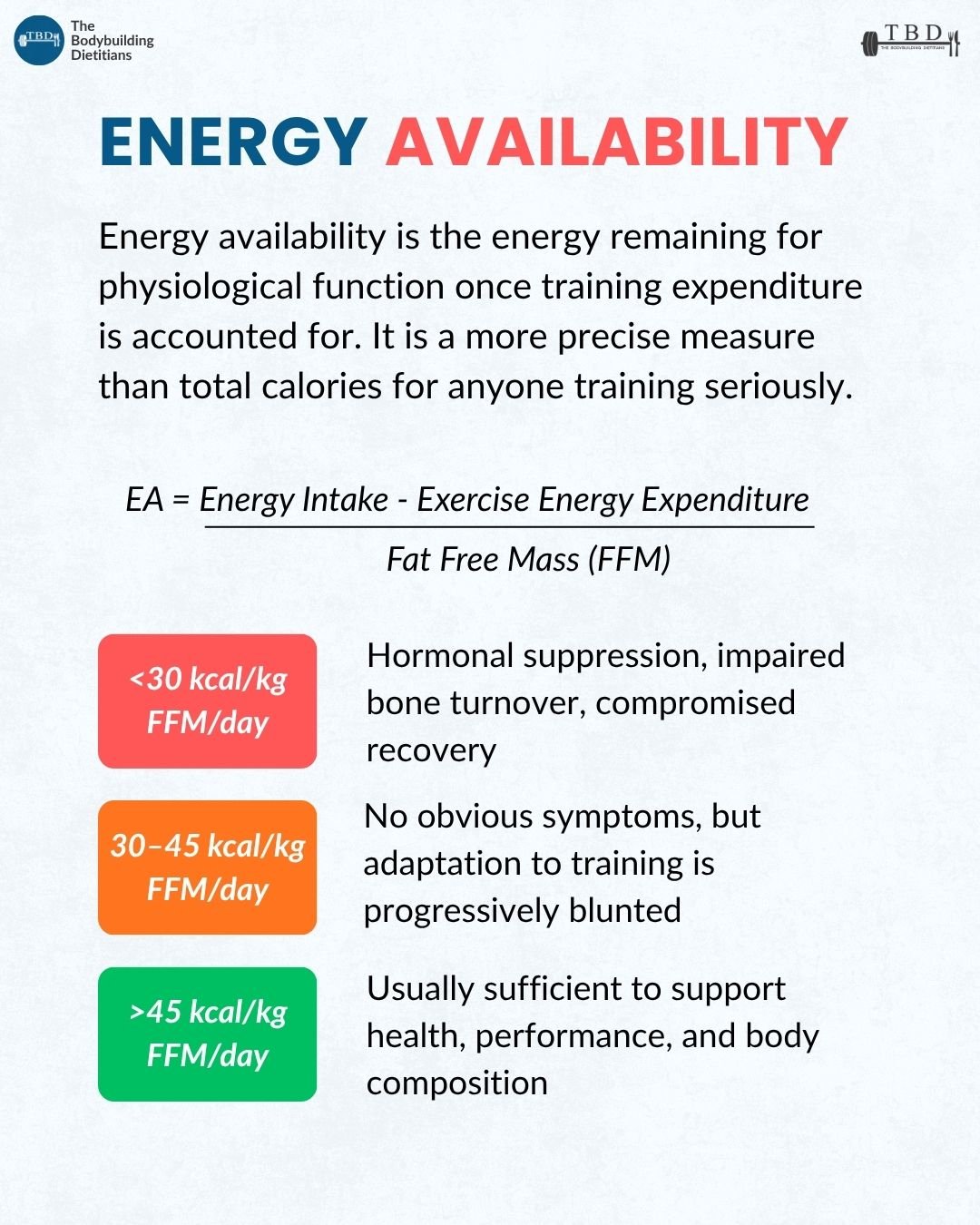
Energy availability is the dietary energy remaining for physiological function after the energy cost of exercise has been subtracted, expressed relative to fat-free mass. The formula is energy intake minus exercise energy expenditure, divided by fat-free mass in kilograms, expressed as kilocalories per kilogram of fat-free mass per day.
This measure is more precise than total calorie intake for anyone training seriously, because total calories do not account for the energy diverted to training that is unavailable for physiological maintenance and recovery. Two athletes eating the same number of calories but training at very different volumes can have substantially different energy availability, and the physiological consequences of that difference are meaningful and measurable.
Above 45 kilocalories per kilogram of fat-free mass per day is generally sufficient to support health, performance, and body composition for most training individuals. At this level, the body has adequate substrate for hormonal function, immune activity, bone maintenance, tissue repair, and adaptation to training.
Between 30 and 45 kilocalories per kilogram of fat-free mass per day represents a zone where no obvious symptoms are typically present, but training adaptation becomes progressively blunted. Protein synthesis, hormonal signalling, and recovery capacity are all operating at reduced levels relative to adequate energy availability, and the effect compounds across weeks and months of sustained training in this range.
Below 30 kilocalories per kilogram of fat-free mass per day is associated with more significant consequences: suppression of reproductive hormones including LH and FSH, impaired bone turnover increasing bone stress injury risk, compromised immune function, and meaningfully reduced recovery capacity. These consequences can develop before any obvious symptoms appear, which is why athletes who believe their nutrition is well-managed may still be experiencing the effects of chronically low energy availability.
Energy availability is genuinely difficult to calculate precisely in practice because accurate measurement of exercise energy expenditure is difficult, and fat-free mass requires body composition assessment. The value of understanding it lies more in the concept and the thresholds than in the exact figure. An athlete in a fat loss phase who is simultaneously increasing training volume may cross into insufficient energy availability without it being apparent from calorie intake alone, and the result tends to be attributed to overtraining or inadequate sleep rather than the underlying fuelling deficit. The relationship between energy availability and recovery capacity is covered in our article on recovery priorities for lifters.
Why Protein Is Set Second and Is Non-Negotiable
Protein is set second in the hierarchy and described as non-negotiable because the consequences of chronic protein insufficiency are direct and compound rapidly, particularly during energy restriction.
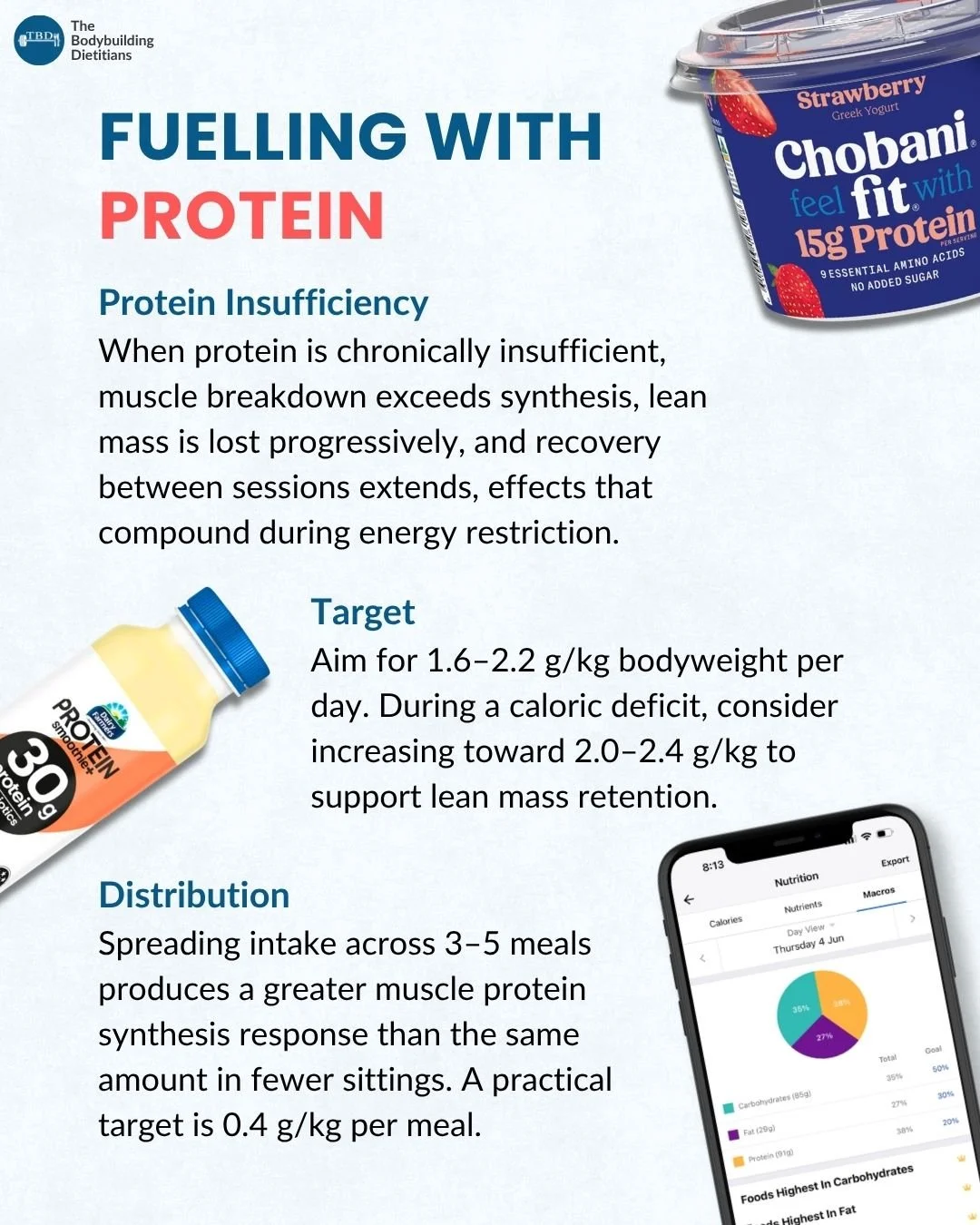
When protein intake falls chronically below what is needed to support muscle protein synthesis, muscle breakdown exceeds synthesis and lean mass is progressively lost. Recovery between sessions extends as the amino acids needed for tissue repair are insufficient. These effects compound during energy restriction because the body's tendency to use amino acids for energy accelerates when total calorie intake is reduced and glycogen availability is limited.
The target range for most resistance-trained individuals is 1.6 to 2.2 grams of protein per kilogram of bodyweight per day during maintenance or improvement season conditions. During a calorie deficit, increasing toward the higher end of 2.0 to 2.4 grams per kilogram provides a more robust buffer against lean mass loss and helps manage the appetite effects of reduced energy intake, since protein is the macronutrient with the strongest satiety effect per calorie.
Distributing protein intake across 3 to 5 meals rather than concentrating it in fewer sittings produces a greater cumulative muscle protein synthesis response across the day. A practical per-meal target of approximately 0.4 grams of protein per kilogram of bodyweight, distributed across meals, covers both the total intake and distribution requirements without requiring precise meal-by-meal calculation.
The position of protein at the second tier, after energy availability rather than first, reflects an important physiological reality: adequate protein cannot compensate for insufficient energy availability. Muscle protein synthesis requires not just amino acid substrate but also adequate energy to proceed, and chronically low energy availability impairs the anabolic response to dietary protein even when protein intake is within the recommended range. Setting energy availability first and protein second reflects that dependency. The specific evidence base for protein targets and distribution is covered in our article on how to set your daily macro targets.
Why Dietary Fat Has a Minimum Threshold That Is Set Third
Dietary fat occupies the third tier of the hierarchy because it has a minimum threshold that must be met for physiological function, below which health and performance consequences develop gradually, but it is also the macronutrient that, once above that minimum, can be adjusted most flexibly in either direction depending on phase and calorie budget.
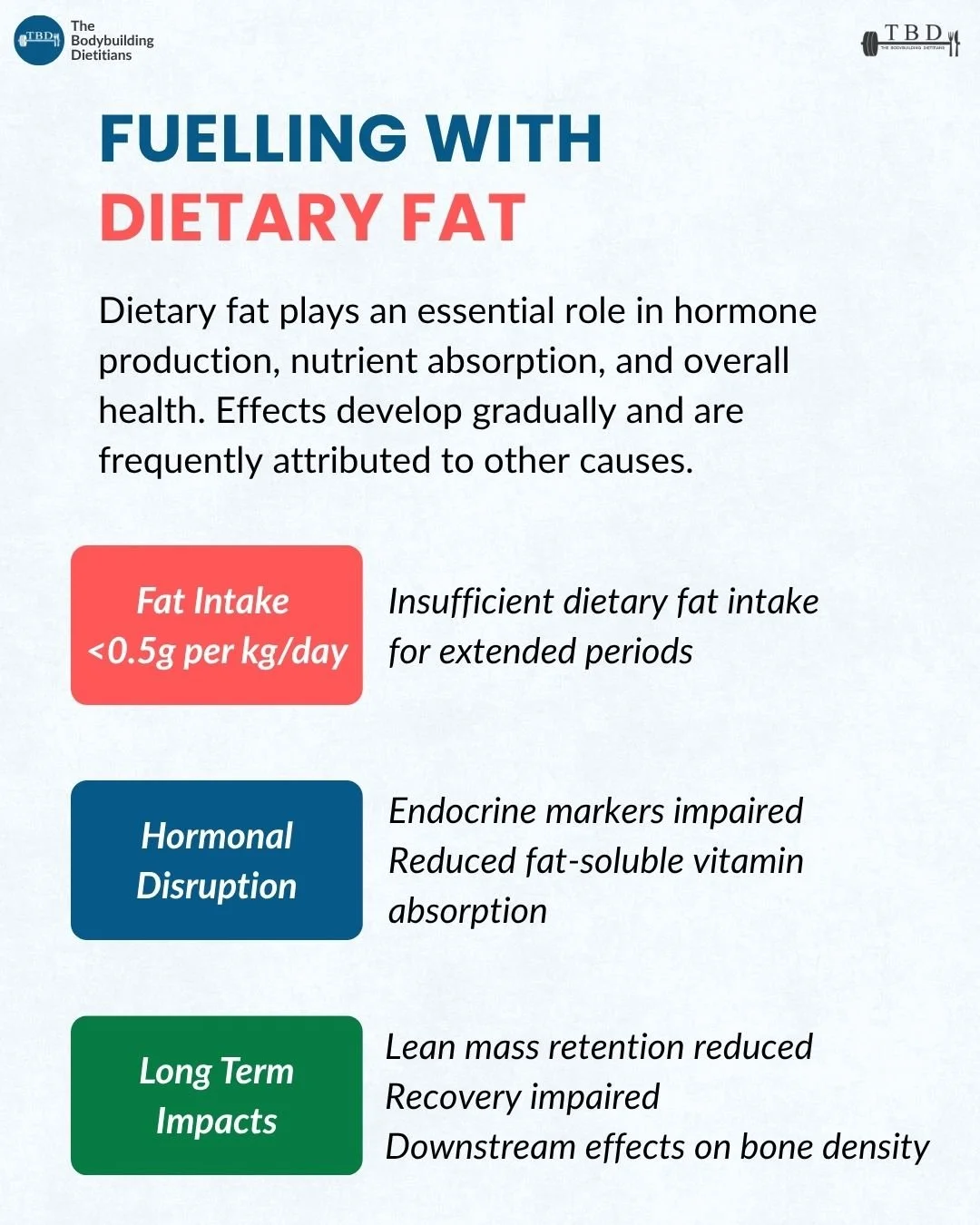
The minimum threshold is approximately 0.5 grams of dietary fat per kilogram of bodyweight per day. Below this level, maintained for extended periods, the consequences include hormonal disruption through impaired steroid hormone synthesis, since testosterone, oestrogen, and cortisol are all derived from cholesterol and require adequate dietary fat for their production. Fat-soluble vitamin absorption, including vitamins A, D, E, and K, is also impaired when dietary fat is insufficient, since these vitamins require fat in the meal for adequate absorption from the gut.
The consequences of insufficient dietary fat are particularly relevant during aggressive fat loss phases, where the drive to reduce calories can result in fat being cut below the physiological floor. The effects develop gradually and are frequently attributed to other causes, such as overtraining or sleep disruption, because the timeline between dietary fat reduction and hormonal consequences spans weeks to months rather than days. Lean mass retention becomes progressively harder, recovery between sessions worsens, and downstream effects on bone density can accumulate across longer periods of insufficient intake.
Above the minimum threshold, fat intake can be positioned between 0.5 and 1.5 grams per kilogram depending on phase and total calorie availability. During a fat loss phase, keeping fat toward the lower end of this range after meeting the minimum threshold preserves more calorie budget for carbohydrate, which has a more direct relationship with training performance. During a building phase, fat can sit comfortably higher within total calorie targets.
Why Carbohydrate Is Set Last and Fills the Remaining Budget
Carbohydrate occupies the top of the hierarchy as the most flexible variable, set last after energy availability, protein, and fat minimums have been established, and filling the remaining calorie budget.
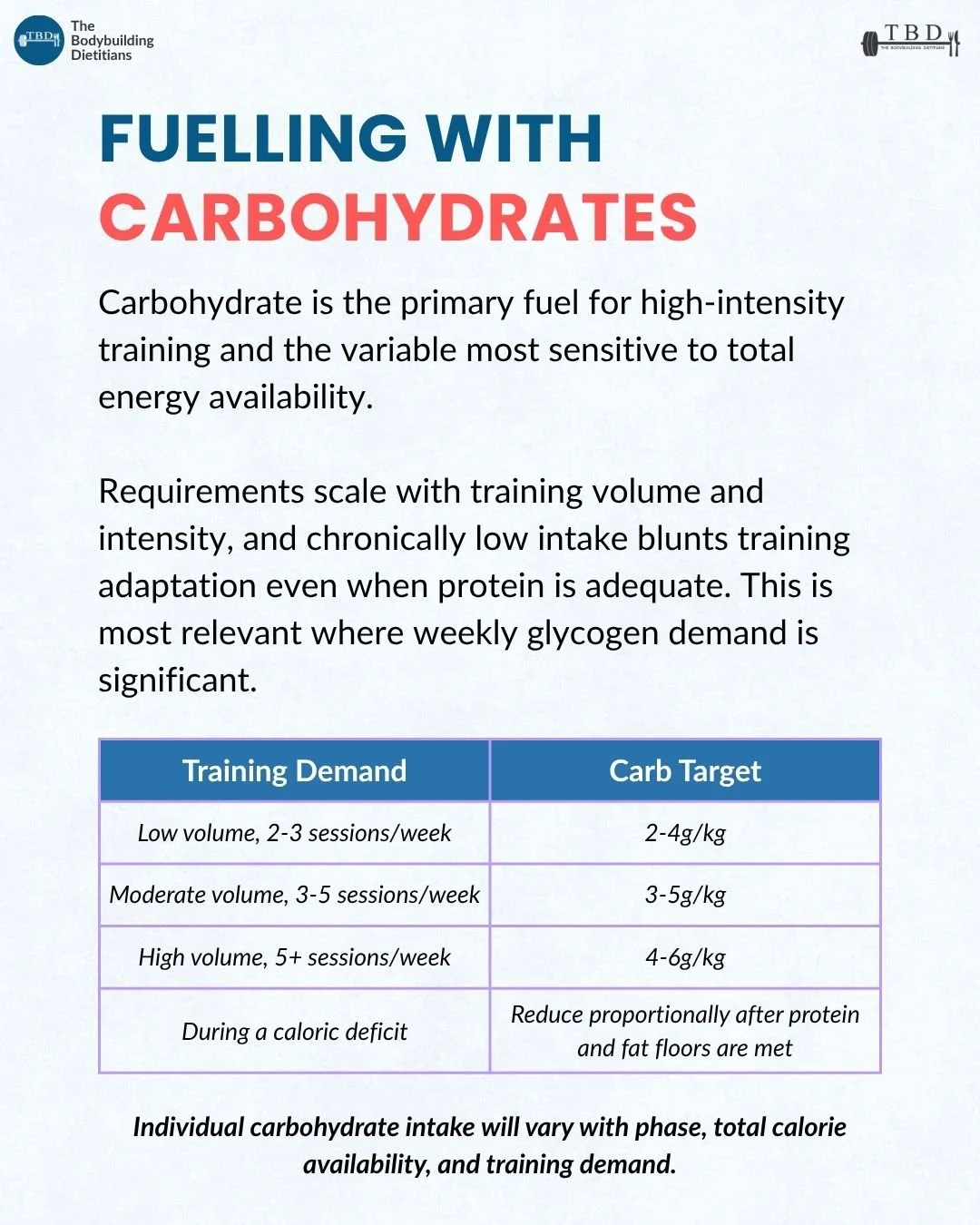
This positioning does not reflect carbohydrate's importance to training performance, which is substantial. Carbohydrate is the primary fuel for high-intensity resistance and cardiovascular training, and it is the variable most sensitive to total energy availability. Chronically low carbohydrate intake relative to training demand blunts training adaptation even when protein is adequate and adequate energy availability is otherwise maintained, because glycogen depletion impairs the capacity to sustain intensity across training sessions.
Carbohydrate requirements scale with training volume and intensity across a predictable range. For low-volume training of 2 to 3 sessions per week, a target of 2 to 4 grams per kilogram is appropriate. For moderate-volume training of 3 to 5 sessions per week, 3 to 5 grams per kilogram. For high-volume training of 5 or more sessions per week, 4 to 6 grams per kilogram. During a calorie deficit, carbohydrate is reduced proportionally after protein and fat floors are met, meaning carbohydrate absorbs the calorie reduction rather than protein or fat falling below their respective minimums.
The reason carbohydrate is set last is that it has no fixed minimum equivalent to protein's role in lean mass preservation or fat's role in hormone synthesis, and it scales with energy availability in a way that the other macronutrients do not to the same degree. When energy availability falls during a deficit or a period of reduced intake, carbohydrate is the variable most appropriately reduced to accommodate that change, while protein and fat minimums are held constant. This sequencing is what distinguishes a well-structured deficit from an indiscriminate reduction across all macronutrients.
Carbohydrate intake in the context of a fat loss phase and its specific application around training is covered in our article on pre-workout nutrition.
How the Hierarchy Changes Across Different Phases
The specific targets within each tier of the hierarchy shift with training phase, body composition goal, and individual response, while the order in which variables are set remains constant.
During an improvement season with a calorie surplus, energy availability is comfortably above threshold, protein sits toward the middle of its range, fat is positioned within the 0.5 to 1.0 gram per kilogram range based on food preference and calorie budget, and carbohydrate is abundant to support training demand and glycogen replenishment.
During a fat loss phase, the primary adjustment is a reduction in total energy intake. The hierarchy directs where that reduction should come from: protein moves toward the higher end of its range to protect lean mass, fat is maintained at or above the minimum threshold, and carbohydrate absorbs the calorie reduction to create the deficit while minimising the impact on protein and fat adequacy.
During a contest prep phase where the deficit deepens further, all variables are under pressure. Energy availability may sit in the 30 to 45 kilocalories per kilogram of fat-free mass range, which is an accepted trade-off for the duration of the prep but is not sustainable indefinitely. Protein targets at the high end of the range protect lean mass as aggressively as possible, fat is held above the minimum threshold despite the constrained calorie budget, and carbohydrate becomes very lean relative to training demand.
Setting these variables in the right order across different phases and goals, and deciding when and how to adjust them as the body responds, is a central part of how we structure nutrition in our coaching practice.
Practical Takeaways
Energy availability, the dietary energy remaining after exercise expenditure, is the foundation on which every other nutrition variable operates. A target above 45 kilocalories per kilogram of fat-free mass per day is generally sufficient to support health, performance, and body composition.
Energy availability below 30 kilocalories per kilogram of fat-free mass per day is associated with hormonal suppression, impaired bone turnover, and compromised recovery, and these consequences can develop before obvious symptoms appear.
Protein is set second and is described as non-negotiable. The target range is 1.6 to 2.2 grams per kilogram during maintenance, increasing toward 2.0 to 2.4 grams per kilogram during a deficit. Distribution across 3 to 5 meals with approximately 0.4 grams per kilogram per meal produces the strongest cumulative muscle protein synthesis response.
Dietary fat has a minimum threshold of 0.5 grams per kilogram per day that supports hormone synthesis and fat-soluble vitamin absorption. Falling below this threshold for extended periods produces consequences that develop gradually and are frequently attributed to other causes.
Carbohydrate is set last, filling the remaining calorie budget after energy availability, protein, and fat minimums are established. Requirements scale from 2 to 4 grams per kilogram for low-volume training to 4 to 6 grams per kilogram for high-volume training. During a deficit, carbohydrate is the variable reduced to create the calorie deficit after protein and fat floors are maintained.
Getting protein right while energy availability is too low produces a different physiological outcome from the same protein intake with adequate energy availability underneath it. The order of the hierarchy matters.
Frequently Asked Questions
What is energy availability and why does it matter?
Energy availability is the dietary energy remaining for physiological function after the energy cost of exercise has been subtracted, expressed relative to fat-free mass in kilocalories per kilogram per day. It is a more precise measure than total calorie intake for training athletes because it accounts for the energy diverted to training that is unavailable for physiological maintenance and recovery. When energy availability falls too low, the body makes trade-offs across hormonal output, bone turnover, immune function, and recovery capacity before obvious symptoms appear.
What happens if energy availability falls too low?
Energy availability below 30 kilocalories per kilogram of fat-free mass per day is associated with suppression of reproductive hormones, impaired bone turnover that increases bone stress injury risk, compromised immune function, and reduced recovery capacity. Between 30 and 45 kilocalories per kilogram, no obvious symptoms are typically present but training adaptation is progressively blunted. These effects develop before overt signs appear, which means athletes may experience reduced performance, impaired recovery, and progressive lean mass loss without recognising the cause as insufficient energy availability.
Why is protein set before fat in the hierarchy?
Protein is set before fat because the consequences of protein insufficiency are more direct and rapid than those of fat insufficiency, particularly during training and energy restriction. When protein falls short, muscle breakdown exceeds synthesis and lean mass is progressively lost, effects that compound quickly during a calorie deficit. The consequences of fat falling below its minimum threshold are real but develop more gradually, typically over weeks to months, and are frequently attributed to other causes. Both have minimum requirements that need to be met, but the urgency of getting protein right first reflects the rate at which its insufficiency affects body composition and recovery.
How much carbohydrate do I need for training?
Carbohydrate requirements scale with training volume and intensity. For low-volume training of 2 to 3 sessions per week, 2 to 4 grams per kilogram of bodyweight is a practical target. For moderate-volume training of 3 to 5 sessions per week, 3 to 5 grams per kilogram. For high-volume training of 5 or more sessions per week, 4 to 6 grams per kilogram. During a calorie deficit, carbohydrate is reduced proportionally after protein and fat floors are met, meaning carbohydrate absorbs the calorie reduction rather than the other two macronutrients falling below their minimums.
Can I follow a low-fat diet while training seriously?
Maintaining dietary fat below approximately 0.5 grams per kilogram of bodyweight per day for extended periods produces hormonal disruption, impaired fat-soluble vitamin absorption, reduced lean mass retention, and downstream effects on bone density. These consequences make persistent fat restriction below the minimum threshold incompatible with optimal training performance and health over time. Fat can be positioned flexibly above the minimum threshold depending on phase and calorie budget, but the minimum should be maintained regardless of how aggressive the deficit is.
Does the hierarchy change when I am in a fat loss phase?
The order of the hierarchy remains constant across phases, but the specific targets within each tier shift. During a fat loss phase, protein moves toward the higher end of its range to protect lean mass, dietary fat is maintained at or above the minimum threshold of 0.5 grams per kilogram, and carbohydrate absorbs the calorie reduction to create the deficit. Energy availability will be lower than during a building phase, which is an accepted trade-off of a fat loss phase, but extended periods below 30 kilocalories per kilogram of fat-free mass carry the consequences described above and require management through diet breaks and phase planning.
Setting these variables in the right order for a specific individual across different phases and goals is a key part of what our coaching involves. If you want a nutrition approach built around this framework and calibrated to your training, body composition, and phase, you can enquire about coaching or book a consultation to get started.