Stage-ready physiques represent a fraction of what contest prep actually involves. The mindset, the years of training and refinement, the sacrifices, the support network, and the relationship with the process are the variables that build the physique long before the competition itself.
Contest prep involves substantially more than the work that is visible on competition day. The visible elements, the physique and the stage presentation, are the product of twelve underlying variables that develop across years rather than weeks: a disciplined and resilient mindset, years of consistent training, a coach and support network, periods of being highly goal-oriented, meticulous nutrition, passion for the process, true commitment, posing practice and refinement, the willingness to say no when needed, being a student of the sport, prioritising training performance, and the capacity to navigate genuine discomfort. Understanding these variables changes both how the sport is appreciated and how realistic expectations are set for anyone considering competing.
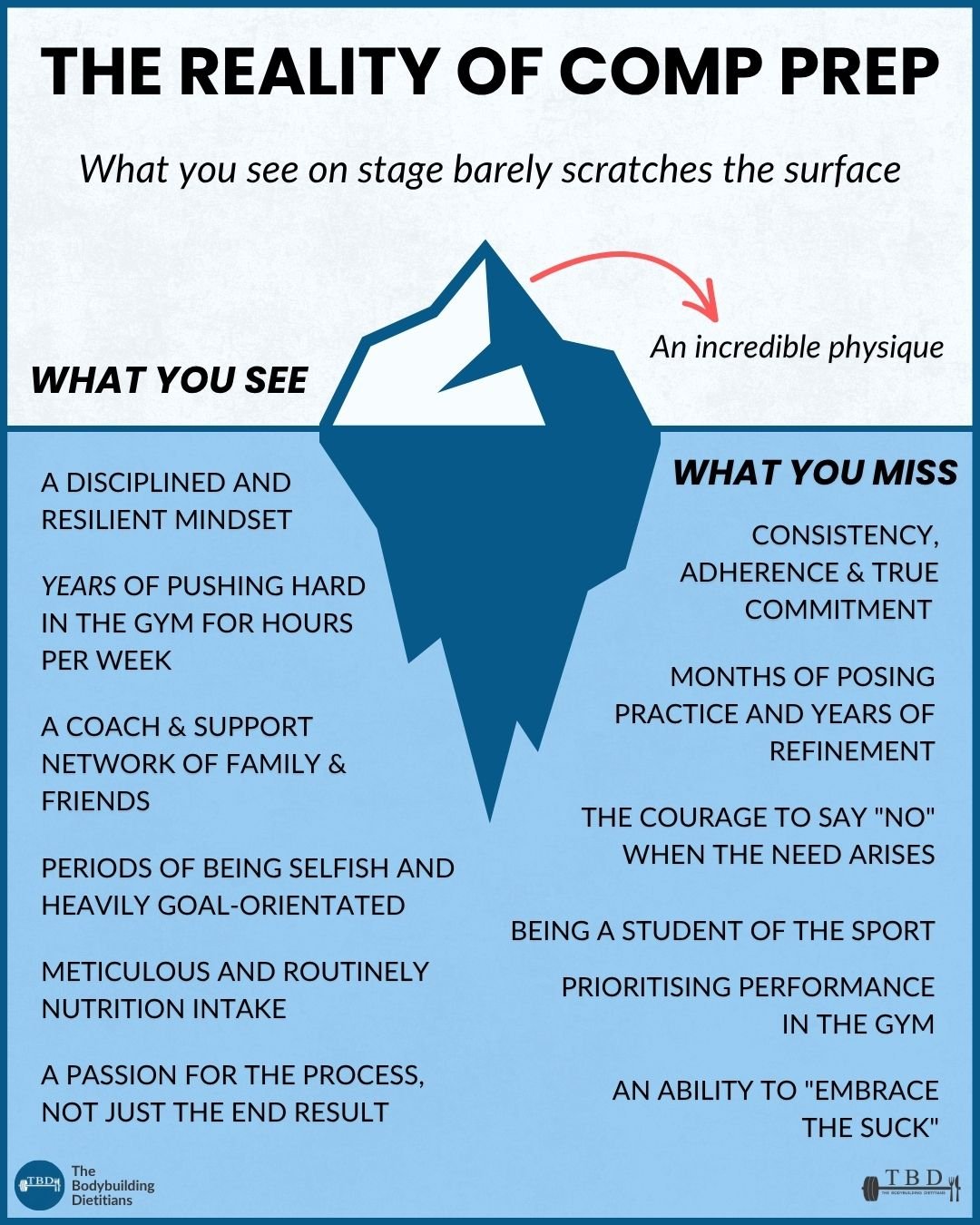
The visible outcome on competition day is the product of twelve underlying variables that develop across years of consistent work outside the stage.
A competitive bodybuilder on stage represents the visible portion of a much larger body of work. The conditioning, the muscle development, the structural balance, and the stage presentation that the audience sees are real and meaningful achievements, but they constitute only a small fraction of what produced them. The twelve variables described in this article are the ones that build the physique across years of work that no one sees, and they are worth understanding both for anyone considering competing and for anyone trying to make sense of what serious competitive bodybuilding actually involves.
For someone inspired by what they see on stage, the more honest and useful response is to look beneath the surface at what produced the outcome. The visible physique is the result of the underlying variables, and approaching the sport with realistic expectations about those variables is part of how productive competitive careers are built.
Why Mindset Sits at the Foundation of Contest Prep
The mental and emotional demands of contest prep are substantial, and the capacity to sustain a structured process across many months under progressive physiological and psychological pressure is one of the defining variables of competitive success. A disciplined and resilient mindset is not a personality trait competitors are born with. It is a developed capacity that comes from years of structured training, repeated exposure to the difficulty of the process, and the gradual building of the cognitive and emotional frameworks that allow continued action through extended discomfort.
The discipline element involves the daily and weekly consistency required to maintain the training, nutrition, sleep, and recovery practices that support the goal. The resilience element involves the capacity to continue when progress is slow, when motivation is low, when stress from other areas of life compounds with the demands of prep, and when the experience of the diet itself becomes increasingly difficult in the later stages. Both are developed through repeated experience rather than acquired through intention alone, and the competitors who reach high levels in the sport are generally those who have built these capacities across years of training before their first competition.
The capacity to embrace genuine discomfort sits alongside resilience as a related but distinct variable. Contest prep involves periods where the day-to-day experience is uncomfortable in ways that do not necessarily correlate with poor execution. Hunger, fatigue, social friction, training that demands consistent intensity despite low energy availability, and the cognitive load of continuous dietary management all generate discomfort that is part of the process rather than a sign that something has gone wrong. Recognising this distinction and continuing forward through it, rather than interpreting discomfort as feedback that the approach needs changing, is part of how serious preps get completed.
What the Time Investment in Training Actually Looks Like
Building the underlying physique that contest prep reveals requires years of consistent training rather than months. The competitor who appears on stage at year three of their career will have accumulated thousands of training sessions across those years, and the development that the prep reveals is the cumulative product of progressive overload, structural balance work, recovery management, and weak point development sustained across many training cycles.
Hours per week of training across years is a meaningful figure when considered cumulatively. A competitor training five to six hours per week of resistance training, plus additional cardiovascular work, plus the daily time investment in meal preparation, nutrition tracking, and recovery, is committing a substantial portion of their available time to the sport across an extended period. This is not unique to bodybuilding; serious competitive engagement in any sport requires comparable time investment. But it is worth recognising explicitly when assessing whether contest preparation aligns with current life circumstances.
The training itself benefits from being approached as a long-term progressive process rather than as a series of short prep cycles. The relationship between off-season training and what prep can reveal is covered in our article on the structure of a bodybuilding career, and it is worth emphasising that the visible stage outcome is the product of cumulative training years rather than the specific prep period itself.
How a Coach and Support Network Shape the Outcome
Competitive bodybuilding is not a solo endeavour, despite the fact that the athlete is the one on stage. The coach, the training partners, the family and friends who support the lifestyle, and the broader community of competitors who share the experience all contribute to whether a prep can be completed effectively.
A coach provides external decision-making capacity at points in the prep where the athlete's own judgement is most compromised. As prep progresses and energy availability falls, cognitive resources for nutrition decisions, training adjustments, and recovery management decline alongside everything else. Having an external party who can make decisions based on objective data rather than the athlete's increasingly hungry and fatigued perspective is a significant practical advantage. The coach's role is not just expertise but also emotional buffering and decision support across a period when those things are genuinely difficult to provide for oneself.
The support network of family and friends shapes the prep in less visible but equally important ways. The capacity to maintain a structured eating pattern in environments where most people eat differently, the cognitive space to focus on training and recovery without continuous conflict over food choices and time commitments, and the emotional support across periods when the experience is difficult, all depend on the surrounding people's capacity to accommodate what prep involves. A supportive network does not mean everyone needs to share the goal, but it does mean the goal needs to be respected and accommodated by those closest to the athlete.
What Periods of Selfishness and Goal-Orientation Actually Mean
The phrase "selfish" in the context of contest prep is a useful shorthand for the genuine and inevitable trade-offs that an extended structured prep requires. Prioritising training, nutrition, sleep, and recovery at the level a serious prep demands means deprioritising other things, including social events that disrupt routine, work or family commitments that compete for the relevant cognitive and physical resources, and spontaneity in food choices and time use.
This is not selfishness in the colloquial sense of disregarding others' needs. It is the deliberate, time-bounded prioritisation of a goal that requires a substantial portion of the athlete's available resources to pursue effectively. Most competitive athletes in any sport go through periods of this kind, and competitive bodybuilding is no different. The honest acknowledgement that prep involves trade-offs, and the capacity to communicate those trade-offs with the people around the athlete, is part of what makes the period sustainable rather than a source of ongoing conflict.
The corresponding skill is saying no when the need arises. Maintaining a structured eating pattern, training schedule, and sleep routine across an extended prep requires regularly declining invitations, modifications to social events, and requests on the athlete's time that would otherwise disrupt the relevant variables. This is not antisocial behaviour but a practical requirement of the goal, and it tends to become easier to do without explanation or apology with experience.
What Meticulous Nutrition Actually Involves
The nutrition component of contest prep is often described as restrictive, but the more accurate description is meticulous. A well-managed prep involves consistent tracking of food intake, attention to protein distribution across meals, food selection that supports satiety and adherence within the calorie budget, hydration management, and ongoing adjustments based on progress data.
The level of detail required scales with the stage of prep. In the early weeks, a moderate deficit with a reasonably flexible food approach may be sufficient. As prep progresses, the margin for error narrows, food choices become more structured to manage hunger and adherence, and the consistency of execution day-to-day matters more. By the final weeks, the nutrition approach is typically more detailed than at any other point in the athlete's year, with attention to specific meal composition, micronutrient adequacy, and the subtle physiological changes that the depleted state produces.
This level of nutritional attention is sustainable for a defined period but not as a permanent lifestyle pattern, which is part of why the recovery phase after competition matters. How nutrition is structured across the different phases of a competitive career, including the deliberate flexibility of improvement season and the meticulous attention of late prep, is covered in our article on the structure of a bodybuilding career.
Why Passion for the Process Is What Sustains the Long Timeline
The competitors who build successful long-term careers in the sport are generally those who find genuine satisfaction in the process itself rather than only in the eventual outcome. Stage day is a single occurrence at the end of a long structured period, and the daily experience of training, eating, recovering, and managing the lifestyle is what fills almost all of the time.
A relationship with the process that draws meaning from the daily work, the gradual improvement, the engagement with the sport's technical aspects, and the development of the underlying capacities, sustains motivation across periods when the outcome is far away and progress is slow. A relationship with the sport that is built primarily on outcomes, on stage placings, and on the visible result of prep tends to struggle with the long stretches between competitive moments where the work is largely invisible and the rewards are deferred.
Being a student of the sport is the related capacity to continue learning across years, refining the approach based on what each prep teaches, engaging with the evolving science and practice of training and nutrition, and developing the technical knowledge that allows for better decision-making over time. The competitors who continue improving across years are generally those who continue learning, and the sport rewards this orientation more than it rewards static repetition of past approaches.
What Posing Practice and Stage Presentation Actually Require
Posing is a meaningful component of competitive bodybuilding that is often underweighted by athletes early in their careers. The presentation of the physique on stage, the angles selected, the transitions between poses, the conditioning of the muscles being displayed, and the ability to sustain the relevant muscular contractions across an extended stage time, all directly affect how the underlying physique is evaluated.
Months of posing practice across the prep is a standard requirement for athletes presenting at a high level, and years of cumulative refinement across multiple competitive seasons produce meaningfully better stage presentation than any single prep cycle can develop. The competitor who has built strong physique development over years but neglected posing will present worse than the equivalent physique with stronger stage presentation, and the work involved in developing the latter is not trivial.
Posing also serves a training function. The intensity of muscular contraction required to hold competition poses, particularly under stage conditions, demands a level of muscular control and conditioning that is itself a developed capacity. Athletes who incorporate regular posing practice into their training across the year tend to present better on stage and also derive training benefit from the practice itself.
Why Prioritising Training Performance Matters Throughout Prep
Training performance is sometimes treated as a variable that takes a back seat during contest prep, with the assumption that the deficit and the cardio are the primary drivers of stage outcome. The actual relationship is more nuanced: maintaining training performance is one of the central tools through which lean mass is preserved during the deficit, and a sustained decline in performance is an early indicator that the deficit has become too aggressive or that nutritional status is insufficient.
Prioritising training performance during prep means making decisions that support the capacity to sustain training quality, including managing the deficit at a rate that preserves performance, structuring meals around training to support glycogen availability, and adjusting training volume and intensity as the prep progresses rather than maintaining the off-season approach into a state where the body cannot recover from it. The relationship between training performance monitoring and prep management is covered in our articles on RPE and reps in reserve and recovery priorities.
How to Think About Whether Competitive Bodybuilding Aligns With Your Circumstances
This article is not an argument for or against competing. It is a description of what the process actually involves, written for the audience that finds value in seeing the underlying variables before forming expectations. The decision to compete is personal and depends on factors that no general article can address: current training history, life circumstances, support structure, personal relationship with food and body image, and the specific goals that competition would serve.
What the article can offer is an honest acknowledgement that the visible stage physique is the product of substantially more than the prep period itself. Competitors who reach a high level have generally spent years building the underlying physique, the technical knowledge, the supporting relationships, and the personal capacities that allow extended periods of structured work. Approaching competitive bodybuilding with realistic expectations about this timescale produces better outcomes than approaching it as a short-term project, and the conversations we have with new competitive clients reflect this in how we structure their early development.
Practical Takeaways
The visible stage physique is the product of underlying variables that develop across years rather than weeks. Years of consistent training, accumulated technical knowledge, and developed personal capacities precede the visible outcome.
A disciplined and resilient mindset is a developed capacity that comes from sustained training experience, not a personality trait. It is built through repeated exposure to the structured demands of training and the gradual capacity to continue through discomfort.
A coach provides external decision-making capacity at points where the athlete's own judgement is most compromised by the physiological demands of prep. A supportive network of family and friends shapes the practical sustainability of the lifestyle.
Periods of being highly goal-oriented during prep involve genuine trade-offs with other areas of life. The honest acknowledgement of these trade-offs, and the capacity to communicate them, is part of what makes prep sustainable.
Meticulous nutrition during prep is sustainable for a defined period rather than as a permanent lifestyle. The level of attention scales with the stage of prep, and the recovery phase after competition matters partly because of how concentrated the late-prep nutritional demands are.
Passion for the process, rather than focus only on the eventual outcome, is what sustains motivation across the long timelines that competitive bodybuilding requires. Being a student of the sport produces continued improvement across years.
Posing practice and stage presentation are meaningful components of the outcome that develop across months of practice within prep and years of refinement across competitive seasons.
Maintaining training performance throughout prep is one of the central tools through which lean mass is preserved during the deficit, and a sustained decline in performance is an early indicator that the deficit needs adjustment.
Frequently Asked Questions
How long does it take to prepare for a bodybuilding competition?
A single contest prep typically runs 16 to 24 weeks, but the underlying physique that prep reveals is the product of years of training. Most competitors who place at a high level have been training seriously for at least three to five years before their first competition, and the development that produces a genuinely competitive stage physique generally spans 12 to 24 or more months of improvement season between competitive cycles. Approaching contest prep as a short-term project rather than the visible expression of a long-term process generally produces stage outcomes that reflect that misalignment.
How much time per week does competitive bodybuilding actually require?
The training itself is typically five to six hours per week of resistance training, plus cardiovascular work that increases through prep. Beyond training, the time investment includes daily meal preparation, nutrition tracking, posing practice that becomes more frequent in the months before competition, recovery management, and the cognitive load of continuous lifestyle structure. The cumulative time commitment is substantial and worth assessing honestly before committing to a competitive cycle, particularly the first one where the timeline and demands may not yet be fully understood.
Is a coach necessary for contest prep?
A coach is not technically required for contest prep, but the value of external decision-making capacity becomes meaningful as the prep progresses and the athlete's own judgement is compromised by hunger, fatigue, and the cognitive load of continuous dietary management. Coaches also provide expertise in areas the athlete may not have developed, including peaking protocols, troubleshooting, and the technical aspects of stage presentation. For first-time competitors particularly, a coach can shortcut a great deal of trial-and-error that would otherwise compromise the prep outcome.
How does contest prep affect your social life?
Contest prep involves regular trade-offs between social activities and the structured demands of training, nutrition, and recovery. Maintaining a consistent eating pattern across an extended prep often means declining social events that disrupt routine, modifying participation in events that involve food, and adjusting the time commitments that compete with training and recovery. This is not antisocial behaviour but a practical requirement of the goal. The capacity to communicate these trade-offs clearly with family and friends, and to have a support network that respects them, is part of what makes the lifestyle sustainable across the prep period.
Is posing practice really that important?
Yes. The presentation of the physique on stage directly affects how it is evaluated, and a strong physique poorly presented will place worse than a comparable physique presented well. Posing practice across months of prep develops the muscular control, the transitions between poses, and the capacity to sustain the relevant contractions across stage time. Competitors who underweight posing relative to the training and nutrition components consistently underperform on stage relative to their physique development.
What is the most important variable for stage success?
There is no single most important variable; the twelve variables described in the article all contribute meaningfully, and weakness in any of them can compromise the stage outcome regardless of strength in the others. If forced to identify the most consequential underlying variable for long-term career success, it would likely be the time horizon and orientation: competitors who approach the sport as a long-term process across years, build their underlying physique progressively during improvement season, and treat each prep as a refinement of an ongoing trajectory, tend to produce considerably better outcomes than those who treat individual preps as isolated short-term projects.
Guiding athletes through the structure, decisions, and adjustments that competitive bodybuilding requires is a central part of what our prep coaching involves. If you are considering competing or are already in a competitive cycle and want professional support, you can enquire about prep coaching or book a consultation to discuss your specific situation.