Two lifters with the same height, weight, age, and gender can have calorie needs that differ by 1,000 or more calories per day. This is a walk through the specific variables that shape individual calorie requirements, why comparison charts and calculators tend to miss the mark, and how to identify your own maintenance more accurately than any equation can.
Two people with matching height, weight, age, and gender can have meaningfully different calorie requirements because daily energy needs are shaped by several variables that basic calculations don't capture. These include occupation and non-exercise activity thermogenesis (NEAT), training frequency and intensity, recent dieting history and the metabolic adaptation that comes with it, sleep quality, level of muscularity relative to total body weight, and the thermic effect of the specific foods being eaten. Any one of these variables can shift maintenance calories by 100 to 500 calories per day, and most people are influenced by several at once. The practical implication is that calorie comparisons between individuals rarely produce useful information, and calculators that don't capture these context variables tend to leave people disheartened when their real intake doesn't match the estimate. Collecting personal data over 2 to 4 weeks (intake, NEAT, training, sleep, and how you feel) tends to reveal actual requirements far more accurately than any equation or comparison.
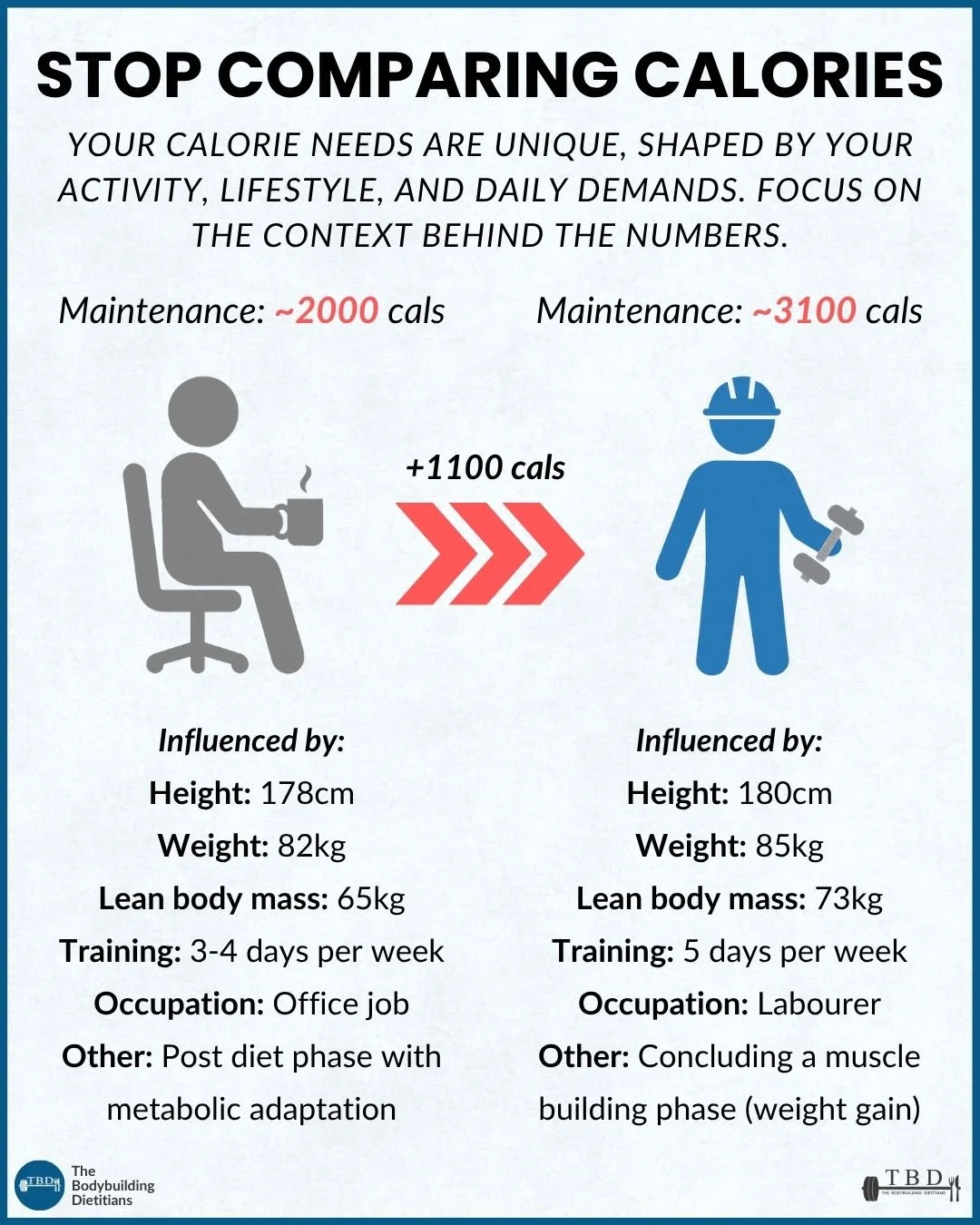
Two people of nearly identical height and weight can have maintenance calorie needs that differ by over 1,000 calories per day. The specific context (occupation, training frequency, lean body mass, and dieting or gaining history) shapes the actual requirement far more than the basic stats used in calorie calculators.
"How many calories do you eat?" is a fine question to ask out of curiosity, but it rarely holds up as a comparison. Two lifters standing next to each other, matching in height, weight, age, and gender, can have maintenance calorie requirements that differ by hundreds or even over a thousand calories per day. This happens routinely, and it is one of the more common sources of confusion among lifters trying to calibrate their intake using calculators, general recommendations, or comparisons with training partners.
The variability isn't the calculator being wrong in a fixable way, and it isn't a sign that something is unusual about the individual whose numbers don't line up with the estimate. It is the natural consequence of daily energy needs being shaped by many variables that basic estimates simply don't capture. Understanding which variables actually drive the differences helps explain why comparisons miss the point and points toward a more useful approach: collecting personal data to identify individual maintenance rather than relying on external estimates.
This article walks through the specific variables that shape individual calorie requirements, why calorie calculators tend to leave people disheartened when the estimate doesn't match reality, and how to identify your own maintenance more accurately than any equation can.
Why Do Two People Who Look the Same Have Different Calorie Needs?
Height, weight, age, and gender are the four inputs most calorie calculators use to estimate maintenance. They are useful inputs because they correlate with resting metabolic rate and general size, and they produce a reasonable starting estimate for a broad population.
The problem is that "reasonable starting estimate for a broad population" is a very different thing from "accurate individual maintenance." Once basic size and demographics are held constant, the variables that produce the observed differences between individuals include the following.
Non-exercise activity thermogenesis (NEAT). This is the energy expended through all daily movement outside of structured exercise, and it's often the single largest source of variation between individuals with matched stats. A lifter with a physical labour occupation, standing desk, and a habit of walking after meals can expend 800 to 1,500 more calories per day through NEAT than a lifter with an office job, sedentary commute, and evenings on the couch. Neither is doing anything wrong; NEAT scales with lifestyle patterns and can vary substantially between two otherwise similar individuals.
Training frequency, intensity, and volume. Structured exercise adds to daily energy expenditure, and the specific contribution depends on the type and volume of training. A lifter running 5 to 6 hard resistance sessions per week with meaningful cardio expends more energy through training than a lifter doing 3 to 4 moderate resistance sessions with no cardio. The training contribution can vary by 200 to 500 calories per day between two lifters of similar size.
Recent dieting history and metabolic adaptation. Extended calorie deficits produce a downward adjustment in metabolic rate that persists beyond the end of the deficit. A lifter emerging from a 20-week contest prep may have a maintenance calorie requirement 200 to 400 calories lower than their pre-diet baseline, and returning to full pre-diet maintenance can take months of gradual reverse dieting. Conversely, a lifter concluding a muscle-building phase with sustained calorie surplus tends to sit at an elevated maintenance driven by increased NEAT, higher lean mass, and adaptive metabolic signalling.
For a more detailed look at how deep and how long a calorie deficit should be to avoid excessive metabolic adaptation, our article on how aggressive your calorie deficit should be covers the energy availability thresholds and their long-term consequences.
Level of muscularity relative to total body weight. Two lifters with the same weight but different lean body mass have different resting metabolic rates. Muscle tissue burns more calories at rest than fat tissue, so a leaner lifter of the same weight generally has a slightly higher maintenance calorie requirement than a lifter of the same weight with higher body fat. This effect is smaller than NEAT differences but real and consistent.
Sleep quality. Chronic sleep restriction affects energy expenditure, hunger regulation, and NEAT indirectly through fatigue-driven reductions in spontaneous movement. Sleep-deprived lifters tend to move less during the day, feel more hungry, and expend less energy overall. Two lifters with matched stats but different sleep patterns can differ meaningfully in maintenance calories.
Thermic effect of food (TEF). Different macronutrients produce different metabolic costs during digestion. Protein has the highest TEF at approximately 20 to 30 percent of calories consumed, carbohydrate sits at 5 to 10 percent, and fat sits at 0 to 3 percent. A lifter eating 200g of protein per day has a substantially higher TEF contribution than a lifter eating 100g of protein at the same total calorie intake, which effectively means the higher-protein lifter's maintenance sits slightly higher for the same food intake.
Any one of these variables can shift maintenance by 100 to 500 calories per day, and most lifters are influenced by several simultaneously. When two lifters differ by 1,000 or more calories per day at similar body weights, the difference is usually the compounding effect of multiple variables (say, higher NEAT, higher training volume, greater lean mass, and no recent metabolic adaptation) rather than any single dramatic difference.
Why Do Calorie Calculators Leave People Disheartened?
Calorie calculators using height, weight, age, gender, and a broad activity multiplier produce estimates that often miss the mark for specific individuals. This is not because the calculators are broken; it is because the inputs available to them can't capture the variables that actually drive individual differences.
Most calculators use one of several standard equations (Mifflin-St Jeor, Harris-Benedict, Katch-McArdle) to estimate resting metabolic rate, then multiply by a broad activity factor to estimate total daily energy expenditure. These equations are based on population averages, which means they produce good estimates for typical individuals but systematically miss for those whose individual context sits outside the averaged assumptions.
The most common patterns of mismatch include several situations that come up often.
Lifters recovering from extended dieting phases. Calculator estimates typically project maintenance from body weight and demographics without accounting for the metabolic adaptation that recent dieting has produced. A lifter who has spent 20 weeks in a deficit may have an actual maintenance sitting 200 to 400 calories below the calculator's estimate, which leads to the surprising and disheartening experience of gaining weight at what should theoretically be maintenance calories.
Lifters with physical occupations or high NEAT. Calculator activity multipliers typically categorise activity into broad tiers (sedentary, lightly active, moderately active, very active), and the differences between tiers are often 15 to 20 percent of RMR. Actual NEAT varies more than this framework captures, particularly for physical labourers, tradespeople, and lifters with active lifestyle habits outside of structured exercise. The calculator can underestimate actual maintenance by hundreds of calories per day for these individuals.
Lifters with meaningfully more or less muscle mass than typical. The standard equations use total body weight as the primary size input rather than lean body mass. Two lifters at 85kg with different body compositions (say, 15 percent body fat versus 30 percent body fat) have different resting metabolic rates, but standard calculators don't distinguish between them. Adjusted equations that use lean body mass (like Katch-McArdle) partially address this, but require the lifter to have an accurate estimate of their body composition.
Lifters coming out of extended surplus phases. Just as recent dieting reduces measured maintenance, recent gaining phases tend to elevate it, both through increased lean mass and through adaptive metabolic signalling. Calculators don't distinguish between a lifter at 85kg who has been eating at maintenance for years and a lifter at 85kg who has been in a 500-calorie surplus for the past six months.
The disheartening experience of the estimate not matching reality is usually a sign that the estimate is missing individual context, not a sign that something is unusual about the person. The calculator did its best with the information available, and the specific context that makes the individual's requirement different from the average wasn't part of the input.
How Do You Identify Your Own Maintenance More Accurately?
The most reliable way to identify individual maintenance is to collect personal data over a period of consistent intake and observe what body weight actually does at that intake level. This produces a more accurate answer than any equation because it reflects the individual's actual physiology and lifestyle rather than a population average estimate.
The basic protocol involves tracking a stable intake for 2 to 4 weeks at a level you believe is close to maintenance, weighing yourself daily under consistent conditions (same time, same clothing, ideally first thing in the morning after bathroom and before food), and averaging weekly weight to smooth out the daily fluctuations. If weekly average weight is stable across the tracking period, that intake is your maintenance. If it is trending up or down, adjust intake by 100 to 200 calories in the appropriate direction and continue tracking.
Several variables improve the accuracy of this protocol.
Track consistently. The intake needs to be genuinely consistent across the tracking period, which requires weighing food, using accurate database entries, and tracking every calorie that goes in. Casual estimation produces answers that reflect measurement error more than actual physiology.
Wait long enough for weight to reflect intake. Body weight fluctuates day-to-day through water balance, digestive contents, sodium intake, and other variables that have nothing to do with actual energy balance. Weekly averages smooth these fluctuations, but even weekly averages need 2 to 4 weeks to reliably reflect the underlying trend.
Match the tracking period to a stable life context. The maintenance identified during a stable training block, consistent sleep, and normal work demands reflects the requirements for that context. A tracking period spanning a holiday, an unusually stressful work project, or a significant training change will produce data that doesn't generalise well.
Repeat the process periodically. Maintenance shifts over time as training changes, body composition changes, lifestyle shifts, and dieting or gaining phases run their course. A maintenance identified accurately today may not be accurate 12 months from now if life or training has changed meaningfully. Re-checking periodically keeps the number accurate.
Collecting this data (intake, NEAT, training, sleep, and how you feel) over time tends to reveal actual requirements far more accurately than any equation or comparison. It also produces a substantial secondary benefit: the process of collecting the data develops a much better intuitive sense of individual context, which makes future adjustments faster and more accurate.
Not Sure How to Interpret Your Own Numbers?
Identifying maintenance accurately is one part of the picture. Interpreting the data, adjusting intake for specific goals (fat loss, muscle gain, contest prep, or a return from a diet), and adapting the plan as the individual context changes is the harder part. Our team works with clients on the specific interpretation of their tracking data, the adjustments that fit their goals, and the ongoing calibration that keeps the plan matched to their actual physiology and life.
What Is a Useful Question Instead of "How Much Should I Eat?"
Given that calorie needs are individual and comparisons rarely produce useful information, a more useful question than "how many calories should I eat" is whether current intake supports several markers that are worth checking regardless of the specific calorie number.
Energy availability sits in a good position for health, performance, and recovery. Energy availability is the amount of energy remaining for physiological function after training expenditure is subtracted from intake. Very low energy availability (below approximately 30 kcal per kg of lean body mass per day for sustained periods) can produce hormonal, metabolic, and health consequences documented as Relative Energy Deficiency in Sport (RED-S). If current intake sits well below this threshold across weeks or months, that is a more useful signal than any calculator estimate.
Your diet carries enough diversity to meet nutrient requirements. Total calories is one variable; the composition of those calories is another. A diet built around a very narrow food rotation, or one that consistently underdelivers on specific micronutrients (iron, calcium, vitamin D, omega-3 fatty acids, iodine), can leave a lifter meeting calorie targets but sitting nutritionally short on the variables that shape long-term health.
Food occupies a relatively small share of your mental space. If food, meal timing, or macros dominate daily attention to the point of interfering with work, relationships, or sleep, that is a signal worth addressing. The goal of a well-calibrated intake is that food supports life rather than dominates it, and persistent food preoccupation is often a signal that the calorie intake is too low, the diet is too restrictive, or the psychological approach needs adjustment.
You are in tune with hunger and fullness. A well-calibrated intake tends to produce appetite signals that broadly match energy needs. Persistent extreme hunger throughout the day usually indicates the intake is meaningfully below actual requirements. Persistent lack of appetite despite active training can indicate excess, though it can also reflect stress or sleep issues. Attending to what appetite is telling you is often more useful than adhering to an intake target that ignores those signals.
Your appetite isn't interfering with sleep or quality of life. Waking up hungry, going to bed hungry, or having persistent food-focused thoughts that intrude on sleep are all signals worth taking seriously. These indicate the intake, deficit, or timing is affecting quality of life in ways that are worth adjusting even if the calorie number technically "fits" some external estimate.
These markers apply regardless of whether the specific calorie number is 2,000 or 3,500 per day. They provide a more useful frame for evaluating whether current intake is working than any comparison to another individual's requirements.
Practical Takeaways
Two people with the same height, weight, age, and gender can have calorie requirements that differ by hundreds or over a thousand calories per day. The observed differences reflect multiple context variables that basic calculators don't capture.
The variables that most influence individual maintenance include non-exercise activity thermogenesis (NEAT), training frequency and intensity, recent dieting history and metabolic adaptation, level of muscularity relative to total weight, sleep quality, and the thermic effect of specific foods.
Calorie calculators produce reasonable estimates for typical individuals but systematically miss for those whose context sits outside averaged assumptions. The mismatch is not a sign that anything is wrong with the individual; it reflects the limitations of the inputs available to the calculator.
The most reliable way to identify individual maintenance is to track consistent intake for 2 to 4 weeks and observe what weekly average body weight does at that intake level. Adjust intake in 100 to 200 calorie increments based on the observed trend and repeat periodically as context changes.
More useful questions than "how many calories should I eat" include whether current intake supports adequate energy availability, dietary diversity for nutrient requirements, a relatively small share of mental space occupied by food, hunger and fullness signals broadly matched to intake, and no interference with sleep or quality of life.
Comparisons to other lifters' calorie intakes rarely produce useful information because the underlying context variables that shape maintenance differ between individuals even when basic stats match.
Frequently Asked Questions
Why do I eat less than other lifters my size?
Because calorie requirements are shaped by variables that basic size and demographics don't capture, including occupation and non-exercise activity, training volume, recent dieting history and metabolic adaptation, lean body mass relative to total weight, sleep quality, and the thermic effect of the specific foods eaten. Any one of these can shift maintenance by 100 to 500 calories per day, and most lifters are influenced by several at once. The comparison rarely produces useful information about your own requirements.
Why doesn't the calorie calculator match my actual intake?
Calculators use height, weight, age, gender, and a broad activity multiplier to produce an estimate that fits the average population but systematically misses for individuals whose context sits outside the averaged assumptions. This is particularly common for lifters coming out of extended dieting phases (where the calculator overestimates because it doesn't account for metabolic adaptation), lifters with high non-exercise activity from physical occupations or lifestyle habits (where the calculator underestimates), and lifters with meaningfully different lean body mass than the population average at their weight.
How do I find my actual maintenance calories?
Track consistent intake for 2 to 4 weeks at a level you believe is close to maintenance, weigh yourself daily under consistent conditions, and average weekly weight to smooth daily fluctuations. If weekly average weight is stable, that intake is your maintenance. If it is trending up or down, adjust intake by 100 to 200 calories in the appropriate direction and continue tracking. Repeat the process periodically as training and lifestyle change.
How much can calorie needs vary between two people the same size?
Substantially. Two lifters of nearly identical height and weight can have maintenance calorie needs that differ by over 1,000 calories per day when the underlying context variables compound (different NEAT, different training volume, different lean body mass, different dieting or gaining history, different sleep patterns). Differences of 200 to 500 calories per day are extremely common even between lifters who look identical on paper.
What is a healthy amount of calories to eat?
There isn't a universal answer because healthy intake is specific to the individual and their goals. More useful markers than a specific calorie number include whether current intake maintains adequate energy availability (at least 30 kcal per kg of lean body mass per day for lifters, and more during muscle building phases), supports dietary diversity for nutrient requirements, produces hunger and fullness signals matched to daily activity, and doesn't interfere with sleep or quality of life.
How does metabolic adaptation change my maintenance calories?
Extended calorie deficits produce a downward adjustment in metabolic rate that persists beyond the end of the deficit. A lifter emerging from a 20-week contest prep may have a maintenance calorie requirement 200 to 400 calories lower than their pre-diet baseline. Recovering to pre-diet maintenance typically takes months of gradual reverse dieting, and this is one of the main reasons calculator estimates often overshoot actual maintenance for lifters recently out of a deficit.
If you want help identifying your own maintenance, calibrating intake to your specific goals, and interpreting the tracking data as your context shifts across training blocks and phases, our team can build a plan matched to your individual physiology and life. You can enquire about coaching or book a consultation with our team.