Creatine has the deepest evidence base of any performance supplement, and the research is continuing to expand into cognitive function and general health applications. This guide covers what creatine does, how to dose it correctly, the newer work on brain function at higher doses, and the practical details often glossed over in shorter summaries.
Creatine monohydrate is the most researched performance supplement available, with consistent evidence for improvements in strength, power, and lean mass gains alongside emerging research into cognitive function, mood, and mental fatigue resistance. A daily dose of 3 to 5 grams saturates muscle creatine stores within approximately four weeks and is sufficient for the physical performance benefits. Higher doses of approximately 5 to 10 grams daily are increasingly supported for cognitive benefits, particularly under conditions of sleep deprivation or high cognitive load, because brain creatine stores respond more slowly to supplementation and require a larger substrate supply. A loading phase of 20 grams per day for 5 to 7 days accelerates initial saturation but does not change the endpoint, and it is optional rather than required. The most common misinterpretations of creatine are attributing the 1 to 2 kilograms of intramuscular water retention to fat gain and dismissing alternative forms (creatine hydrochloride, ethyl ester, buffered creatine) as having research support similar to monohydrate, which they do not.
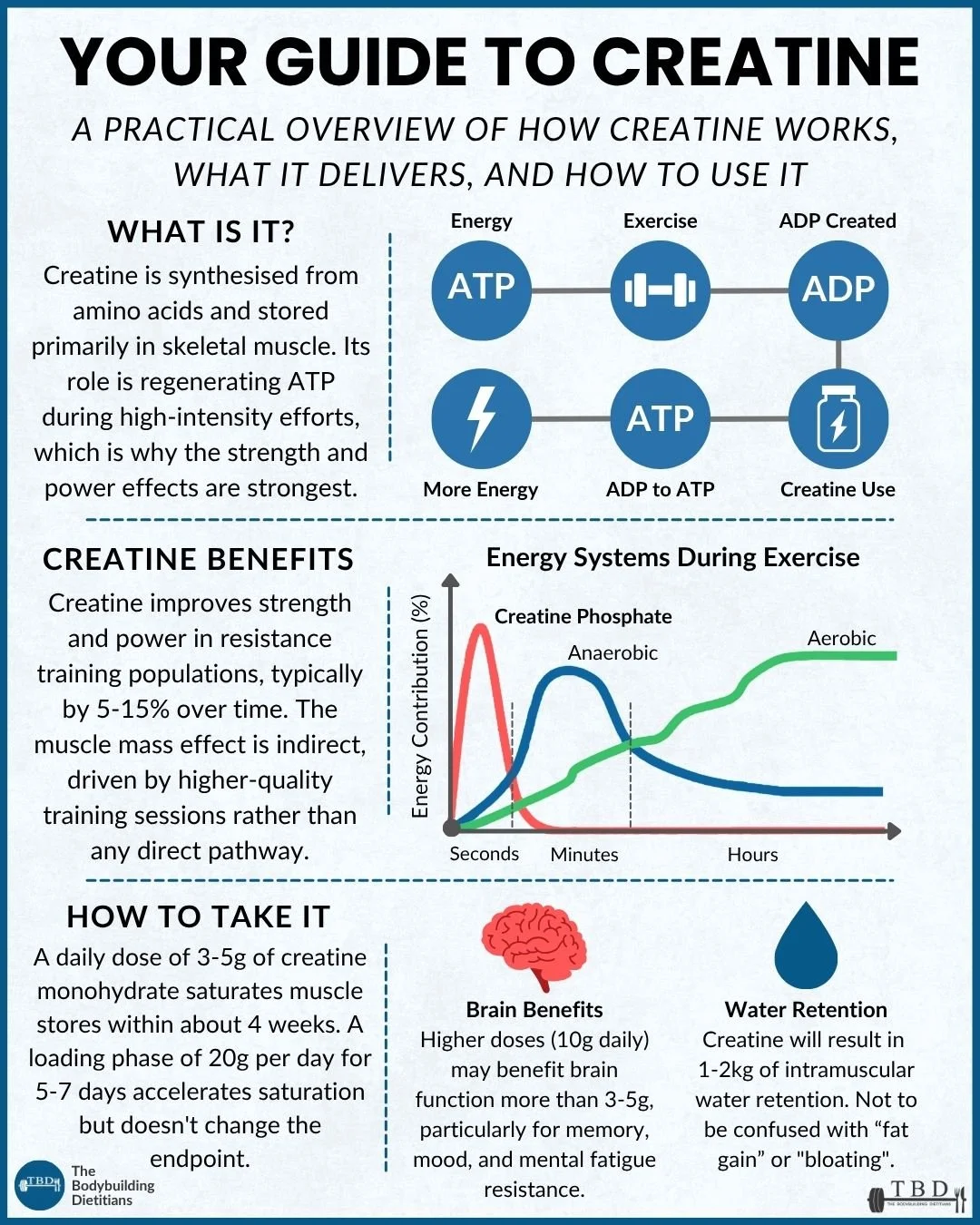
Creatine monohydrate at a glance: the ATP regeneration mechanism, the strength and power benefits from higher-quality training sessions, standard dosing at 3 to 5 grams daily, the newer cognitive research at 10 grams daily, and what the 1 to 2 kilograms of intramuscular water retention actually represents.
Creatine monohydrate has been studied for over three decades across a broader range of populations and applications than any other supplement in sports nutrition. The evidence base for its effects on strength, power, and lean mass gains has been consistent enough that the International Society of Sports Nutrition describes creatine as the most effective ergogenic nutritional supplement currently available for increasing high-intensity exercise capacity and lean body mass during training. That framing has held up across hundreds of studies since it was first published.
What has changed more recently is the expansion of creatine research into cognitive function, mood, and general health outcomes. The physical performance evidence remains the foundation of the recommendation, but the emerging cognitive research is genuinely interesting, and the practical dosing recommendations shift slightly when those newer benefits are prioritised. This article covers both territories, alongside the practical details (loading protocols, water retention, form selection, timing) that shape how creatine is actually used in day-to-day training and life.
What Is Creatine and How Does It Work?
Creatine is a compound synthesised naturally in the body from three amino acids (glycine, arginine, and methionine) and stored primarily in skeletal muscle as phosphocreatine. Approximately 95 percent of the body's total creatine is stored in muscle tissue, with smaller amounts held in the brain, heart, and other high-energy-demand tissues.
The physiological role of creatine is straightforward. During high-intensity muscular efforts, muscle cells use adenosine triphosphate (ATP) as their immediate energy currency, converting ATP to adenosine diphosphate (ADP) as energy is released. ATP is depleted quickly during heavy work, and the muscle relies on the phosphocreatine system to rapidly regenerate ATP by donating a phosphate group from phosphocreatine back to ADP, converting it into fresh ATP.
Higher intramuscular creatine stores mean more phosphocreatine available for this ATP regeneration process. The practical result is a modest but consistent increase in the number of quality repetitions a lifter can complete in a heavy set, faster recovery between sets, and small improvements in strength and power output on working sets. Over months and years of consistent training, these small acute improvements accumulate into meaningfully higher training volumes, which translates into more muscle and strength gain than the same training would produce without supplementation.
Food sources of creatine (primarily red meat, poultry, and fish) contain roughly 1 to 2 grams of creatine per pound of tissue. Obtaining a supplemental dose from food alone requires eating over a kilogram of beef daily, which is why supplementation with creatine monohydrate accomplishes the same result more practically and at substantially lower cost per gram.
Creatine is a compound synthesised in the body from amino acids and stored primarily in skeletal muscle as phosphocreatine, where it supports rapid ATP regeneration during high-intensity efforts and contributes to strength, power, and lean mass adaptations over time.
What Are the Performance and Body Composition Benefits?
The physical performance benefits of creatine are the most established application, with consistent effects across resistance-trained and untrained populations, males and females, and across a broad age range.
Strength and power improvements of approximately 5 to 15 percent over time are typical in resistance training populations, with the magnitude varying based on training experience, individual responsiveness, and the specific outcome measured. The effect is most pronounced on activities that draw heavily on the phosphocreatine system (short-duration, high-intensity efforts of a few seconds to under a minute), which includes most heavy resistance training sets. Endurance activities show smaller or no direct performance benefit from creatine, though repeated sprint activities within an endurance sport can benefit.
Lean mass gains with creatine supplementation are consistent in the literature, with pooled meta-analyses showing meaningful improvements in muscle mass alongside strength when creatine is combined with progressive resistance training. Importantly, the mechanism is indirect. Creatine does not act directly on the muscle protein synthesis pathway or trigger anabolic signalling in the way that dietary protein and resistance training do. It works by allowing the lifter to accumulate more productive training volume, which drives the muscle gain through standard training adaptations.
A meta-analysis of over 700 participants across resistance training studies confirmed that creatine monohydrate supplementation consistently increases lean body mass, strength, and high-intensity exercise performance across a wide range of populations, ages, and training statuses. The effects were most pronounced when combined with a structured resistance training program, supporting the indirect mechanism through improved training quality. Source: Forbes et al., 2022, Nutrients, 14(6):1255.
The indirect mechanism has practical implications. Creatine works best when combined with a training program that actually places demand on the phosphocreatine energy system, which for most physique-focused lifters means resistance training at working intensities that produce meaningful acute fatigue. Taking creatine without training progressively produces smaller and less consistent effects, because the substrate is available but the demand that would translate it into training quality improvements is absent.
For lifters interested in how creatine fits within the broader picture of evidence-based supplementation, our article on which supplements are worth your money covers the priority order of supplement decisions.
What Does the Newer Research on Cognitive Benefits Show?
The most interesting recent development in creatine research is the expansion of the evidence base into cognitive function, mood, and mental fatigue resistance. This work is more recent and less mature than the physical performance literature, but the mechanism is well-supported and the applications are promising.
The brain uses substantial amounts of ATP to support neuronal signalling, memory formation, and cognitive processing. Brain creatine stores are meaningfully lower than muscle creatine stores at baseline, and they respond more slowly to supplementation. This is why the cognitive benefits of creatine appear to require higher daily doses than the standard 3 to 5 grams used for muscle saturation, and why they take longer to develop.
The strongest cognitive effects of creatine appear under conditions of increased brain energy demand: sleep deprivation, high cognitive load, mental fatigue, and possibly certain mood-related states. Under normal, well-rested conditions in healthy adults, the cognitive effects are more subtle and less consistently observed, which suggests that creatine's cognitive role is more about supporting brain function under stress than boosting baseline performance.
A systematic review of creatine and cognitive function found that creatine supplementation improved measures of memory, particularly in older adults and under conditions of sleep deprivation or mental fatigue. The magnitude of effect was smaller and less consistent under normal conditions in healthy young adults, and higher doses (typically 5 to 10 grams daily, sometimes with initial loading protocols) were associated with more pronounced cognitive effects than the standard 3 to 5 gram muscle saturation dose. Source: Prokopidis et al., 2023, Nutrition Reviews, 81(4):416-427.
The practical implication is that lifters who want to prioritise the cognitive benefits of creatine may benefit from doses closer to 5 to 10 grams daily rather than the 3 to 5 gram standard. The muscle saturation and physical performance benefits are still achieved at these higher doses (they are simply already at or above the muscle saturation ceiling), and the additional creatine supplies the brain and other tissues where saturation is slower and less complete.
For lifters primarily interested in the physical benefits, 3 to 5 grams daily remains sufficient. The higher-dose recommendation is specifically relevant for lifters who want the cognitive and mental fatigue benefits alongside the muscular effects.
How Should You Dose Creatine?
The practical dosing framework for creatine is straightforward, with a small amount of variation based on the goals being prioritised.
Standard dose for muscle saturation and physical performance: 3 to 5 grams of creatine monohydrate daily, taken consistently. This dose saturates intramuscular creatine stores within approximately 4 weeks and is sufficient for the strength, power, and lean mass benefits.
Higher dose for cognitive and mental fatigue benefits: 5 to 10 grams of creatine monohydrate daily. This dose maintains muscle saturation while providing additional substrate for slower-responding tissues including the brain. Larger lifters (over 90 kilograms) may benefit from the upper end of this range, and lifters interested in the cognitive applications may benefit from consistent dosing at 10 grams daily.
Loading protocol (optional): 20 grams per day for 5 to 7 days, followed by the standard 3 to 5 gram maintenance dose. Loading accelerates initial saturation, reaching full muscle saturation within approximately one week rather than four. The endpoint is identical to the non-loading approach, and loading is not required for the supplement to work.
Timing: Not important. The evidence does not strongly support taking creatine at any specific time of day, and the practical recommendation is to take it at whatever time makes daily consistency easiest. Adding it to a habitual meal, protein shake, or morning coffee works well. The key variable is not skipping days.
Consistency: Missing a single day has minimal impact on muscle creatine stores. Missing several consecutive weeks would begin to see stores decline back toward baseline, but stores can be re-saturated within a few weeks of resuming consistent daily use. The compound has a long half-life in muscle tissue, which is what makes daily dosing effective without requiring precise timing.
The 3 to 5 grams versus 5 to 10 grams decision comes down to whether the lifter wants the cognitive benefits alongside the physical ones. For most physique-focused lifters, the physical benefits are the primary goal, and 3 to 5 grams is sufficient. For lifters with high cognitive demands (particularly those balancing training with intellectually demanding work or study, or those regularly experiencing sleep deprivation), the higher dose is worth considering.
Why Does Creatine Monohydrate Remain the Recommended Form?
The supplement industry has produced numerous alternative forms of creatine over the past two decades, including creatine hydrochloride, creatine ethyl ester, buffered creatine (Kre-Alkalyn), creatine nitrate, creatine magnesium chelate, and micronised creatine. None of these has demonstrated superiority over creatine monohydrate in head-to-head comparisons, despite the marketing claims that often accompany them.
Creatine monohydrate has the deepest research base by a wide margin. The strength, power, lean mass, cognitive, and safety findings that support creatine supplementation almost all come from studies using monohydrate specifically. Extrapolating those findings to alternative forms assumes bioequivalence that has not been consistently demonstrated in the literature.
Alternative forms tend to be priced substantially higher per gram of active creatine than monohydrate, which means the practical result is paying more for a less-researched product with no demonstrated advantage. The typical marketing arguments (better absorption, less water retention, no gastrointestinal side effects) have either not been supported in comparative studies or reflect effects small enough to be practically irrelevant.
Micronised creatine monohydrate is worth a specific note. This is not a different form of creatine but the same monohydrate compound processed into a finer particle size, which improves dissolution in water and can reduce the mild gastrointestinal discomfort some lifters experience with standard-particle monohydrate. It is a reasonable option for lifters who experience mild digestive symptoms on standard monohydrate, at a slight cost premium.
The practical recommendation is straightforward: use creatine monohydrate, prefer micronised versions if digestive comfort is an issue, and treat alternative form marketing with scepticism until the research base actually supports the claims being made.
What Does the Water Retention Actually Mean?
Creatine supplementation typically produces an initial 1 to 2 kilogram increase in body weight over the first few weeks of consistent use, which represents intramuscular water retention rather than fat gain or generalised bloating.
The mechanism is straightforward. Creatine draws water into muscle cells as it accumulates in the intramuscular space, which increases muscle cell volume slightly and produces a modest but measurable increase in body weight. This is intracellular water within muscle tissue, not extracellular water sitting under the skin or in the digestive tract. The visible effect is either neutral or subtly positive (slightly fuller-looking muscles), rather than the puffy, watery appearance that lifters associate with bloating.
This is one of the more commonly misinterpreted effects of creatine. Lifters who see the scale rise 1 to 2 kilograms in the first few weeks of supplementation sometimes attribute the gain to fat, which leads to premature discontinuation of a supplement that would otherwise support their goals. The water retention is real and expected, and it is not something to try to avoid or minimise. It represents the supplement doing what it is supposed to do: increasing intramuscular creatine content and the associated intracellular water that accompanies it.
For lifters actively tracking body composition, the practical adjustment is to expect a 1 to 2 kilogram weight increase in the first few weeks of creatine supplementation and to attribute that specifically to the supplementation rather than to any dietary change. After the initial saturation period, body weight will resume tracking the underlying nutritional and training variables, and subsequent changes reflect actual body composition shifts rather than continued creatine effects.
Contest prep is one of the few contexts where lifters sometimes discontinue creatine to avoid the water retention, in the belief that it will improve conditioning. The evidence does not clearly support this approach. The intramuscular water associated with creatine does not affect subcutaneous water balance or visible conditioning, and discontinuing creatine near the end of prep tends to sacrifice muscle fullness and training performance without producing the leaner visible appearance the discontinuation was intended to create. Most experienced coaches now recommend maintaining creatine through prep for these reasons.
What About the Common Concerns Around Creatine?
Several concerns about creatine circulate persistently in lifting communities despite lacking evidence support. Working through them here allows the article to serve as a reference for the actual state of the research.
Kidney damage. Creatine has been studied extensively in healthy populations, and the evidence consistently supports its safety when used at recommended doses. The 2017 ISSN position stand reviewed hundreds of studies and concluded that creatine supplementation is safe when used at recommended doses, with no evidence of adverse effects on renal function in healthy individuals across short-term or long-term use. The concern about kidney damage originates from misinterpretation of creatine's role in producing creatinine, a metabolic byproduct that is used clinically to assess kidney function. Higher circulating creatinine in supplement users is expected and reflects the higher creatine turnover rather than kidney impairment, but standard clinical reference ranges can occasionally flag this as an incorrect signal. Existing kidney disease is a different situation requiring medical guidance, but the concern about creatine damaging healthy kidneys is not supported by the current evidence.
Hair loss. The concern about creatine causing hair loss originates from a single 2009 study in rugby players that showed an increase in dihydrotestosterone (DHT) levels with creatine supplementation. That study has not been replicated, and no direct evidence links creatine supplementation to hair loss in humans. The DHT connection remains a theoretical mechanism rather than a demonstrated effect, and individuals with a family history of male pattern baldness would develop the condition based on their genetic predisposition regardless of creatine use.
Muscle cramping and dehydration. Older claims that creatine causes muscle cramping and dehydration have not been supported in controlled research. If anything, some evidence suggests creatine may be modestly protective against cramping and heat-related issues in athletes, likely through the intramuscular water retention that increases cellular hydration status. Adequate general hydration remains important during creatine supplementation, but this is the same recommendation that applies to lifting generally.
Gastrointestinal side effects. The one side effect that does occur in a subset of users is mild gastrointestinal discomfort, particularly in the first few days or weeks of supplementation. This typically presents as bloating, mild stomach upset, or occasional loose stools, and is thought to relate to the osmotic effect of undissolved creatine drawing water into the digestive tract. Practical strategies include taking creatine with a meal (which slows absorption), splitting the daily dose across two servings rather than a single larger dose, ensuring adequate fluid intake, and using micronised monohydrate rather than standard particle size. These adjustments resolve GI symptoms within a week or two for most affected users.
Where Does Creatine Sit Within a Broader Supplement Approach?
Creatine is one of two supplements (alongside caffeine) with the strongest evidence base for improving training performance, and it earns its place as a foundational inclusion in a supplement stack for most lifters.
Building a broader supplement approach around creatine means thinking about what other gaps are worth filling based on individual context. Whey protein isolate or another complete protein supplement fits the convenience gap for lifters who struggle to hit their daily protein target from food alone. Caffeine works acutely to reduce perceived effort and improve power output during training. Vitamin D supplementation may be worthwhile for lifters with documented deficiency. Omega-3 fatty acids from fish oil may be worth adding for lifters who consume little fatty fish.
Beyond these core additions, the marginal benefit of adding more supplements declines quickly, and the supplement budget is generally better allocated to whole food quality, training equipment, or coaching guidance.
Not Sure Whether You Are Getting the Most From Your Current Approach?
If you have been supplementing creatine for years without seeing the effect you expected, if you have discontinued it based on a misinterpretation of the water retention, or if you are trying to decide whether the higher-dose cognitive approach is worth the additional spend for your situation, the answers depend on individual response and context. Our team helps clients audit their supplement approach, structure timing and dosing to match their goals, and interpret their individual responses over months of consistent use.
Practical Takeaways
Creatine monohydrate is the most researched performance supplement available, with consistent evidence for strength, power, and lean mass gains alongside emerging research into cognitive function, mood, and mental fatigue resistance.
A daily dose of 3 to 5 grams of creatine monohydrate is sufficient for the muscle saturation and physical performance benefits, reaching full saturation within approximately four weeks. Consistency matters more than timing.
Higher doses of 5 to 10 grams daily may be worthwhile for lifters who want the cognitive and mental fatigue benefits alongside the muscular ones, particularly under conditions of sleep deprivation, high cognitive load, or intellectually demanding work alongside training.
A loading protocol of 20 grams per day for 5 to 7 days accelerates initial saturation but does not change the endpoint. Loading is optional rather than required.
The 1 to 2 kilogram increase in body weight during the first few weeks of creatine supplementation represents intramuscular water retention, not fat gain or bloating. This is expected and useful, and it should not be a reason to discontinue the supplement.
Creatine monohydrate has the deepest research base by a wide margin. Alternative forms (hydrochloride, ethyl ester, buffered) have not demonstrated superiority in head-to-head comparisons and typically cost more per gram of active creatine.
Concerns about kidney damage, hair loss, dehydration, and muscle cramping are not supported by the current evidence base in healthy populations at recommended doses.
Frequently Asked Questions
How much creatine should I take per day?
Three to five grams of creatine monohydrate per day is sufficient for muscle saturation and the strength, power, and lean mass benefits. Larger lifters (over 90 kilograms) may benefit from the upper end of this range or slightly above. Lifters interested in the cognitive and mental fatigue benefits may benefit from higher doses of 5 to 10 grams daily, because brain creatine stores respond more slowly to supplementation and require a larger substrate supply.
Do I need a creatine loading phase?
No, a loading phase is optional. The historical protocol of 20 grams per day for 5 to 7 days followed by 3 to 5 grams per day reaches muscle saturation faster (within about a week) but produces the same steady-state result as taking 3 to 5 grams per day from the start. The standard daily approach reaches full saturation within three to four weeks and avoids the higher initial doses that some lifters find harder to tolerate.
Is the water retention from creatine a bad thing?
No. Creatine draws water into muscle cells as it accumulates in the intramuscular space, producing a 1 to 2 kilogram initial increase in body weight that represents intracellular water within muscle tissue rather than subcutaneous or generalised bloating. This is expected, useful, and part of the mechanism through which creatine supports muscle cell volume and training performance. It should not be confused with fat gain, and it does not affect the visible leanness or conditioning of the physique.
When should I take creatine, before or after my workout?
Timing does not appear to meaningfully affect creatine's effectiveness. The evidence supports taking it at whatever time makes daily consistency easiest, whether that is with a meal, alongside coffee in the morning, or in a post-workout shake. Missing a single day has minimal impact on muscle stores due to the compound's long half-life in muscle tissue. Daily consistency across weeks matters far more than the specific time of day.
Is creatine safe long-term?
Yes. The 2017 ISSN position stand reviewed hundreds of studies and concluded that creatine supplementation is safe at recommended doses, with no evidence of adverse effects on renal function in healthy individuals across short-term or long-term use of up to five years. Concerns about hair loss, muscle cramping, and dehydration are not supported by the current evidence. Existing kidney disease is a separate situation requiring medical guidance.
Does creatine improve brain function?
Emerging research supports cognitive benefits of creatine supplementation, particularly under conditions of increased brain energy demand including sleep deprivation and high cognitive load. The effects are more pronounced at higher doses (5 to 10 grams daily) than at the standard 3 to 5 gram muscle saturation dose, because brain creatine stores respond more slowly to supplementation. The benefits are more subtle in healthy, well-rested adults under normal conditions than under stress, which suggests creatine's cognitive role is more about supporting brain function under demand than boosting baseline performance.
Are alternative forms of creatine better than monohydrate?
No, on the current evidence. Creatine monohydrate has by far the deepest research base, and alternative forms (creatine hydrochloride, ethyl ester, buffered creatine, creatine nitrate) have not demonstrated superiority in head-to-head comparisons. Alternative forms typically cost more per gram of active creatine than monohydrate. Micronised creatine monohydrate is the same compound processed into a finer particle size, which can improve dissolution and reduce mild gastrointestinal discomfort in a subset of users.
If you want help auditing your supplement approach, structuring creatine and other supplements to fit your training and goals, and interpreting your individual response over months of consistent use, you can enquire about coaching or book a consultation with our team.