Creatine and caffeine sit above other supplements on the evidence, but only if they are dosed, timed, and structured correctly around training and sleep. This guide covers what each does, how to use them, and where they fit in a broader supplement approach.
Creatine monohydrate and caffeine are the two supplements with the most consistent evidence for improving training performance, and for most lifters they are the two most cost-effective inclusions in a supplement stack. Creatine increases phosphocreatine availability in muscle, supporting repeated high-intensity efforts and enabling slightly higher training volumes over time; the effect on lean mass is indirect and works through improved training quality rather than a direct anabolic pathway. A daily dose of 3 to 5 grams saturates muscle stores within a few weeks, with daily consistency mattering more than timing, and a loading phase is optional. Caffeine reduces perceived effort, improves power output, and supports muscular endurance and aerobic performance, with a typical dose of 3 to 6 milligrams per kilogram of bodyweight consumed 30 to 90 minutes before training. The most important practical consideration is sleep, because training performance gains from caffeine do not survive chronic sleep disruption. Both supplements have decades of research behind them and continue to have their evidence bases expand into cognitive and general health territory.
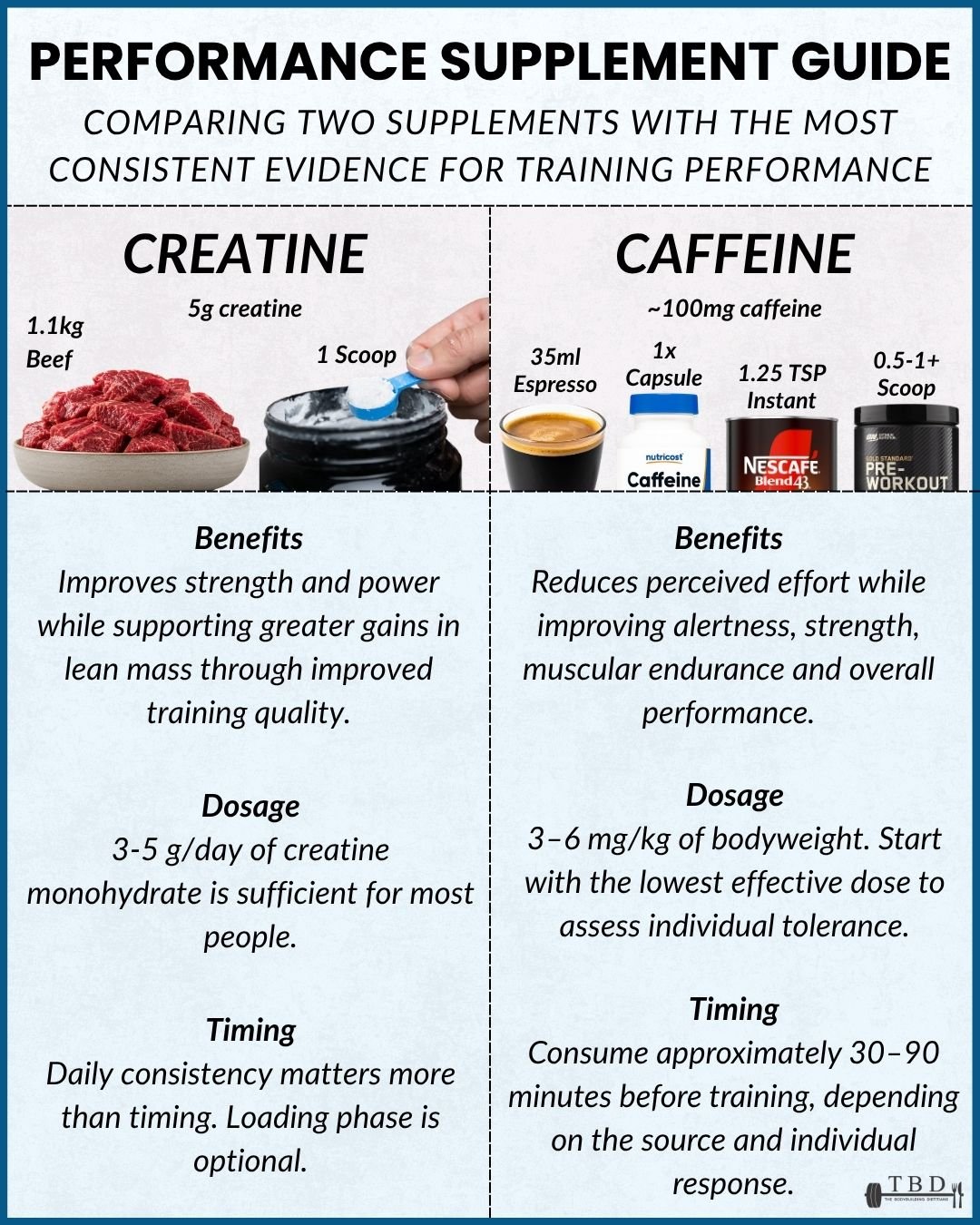
Creatine and caffeine are the two supplements with the most consistent evidence for improving training performance. Creatine works by saturating muscle phosphocreatine stores over weeks of daily use, while caffeine works acutely by reducing perceived effort and improving power output within 30 to 90 minutes of a pre-training dose.
The supplement industry produces enough new products each year to fill any lifter's stack several times over, but the number of supplements with genuinely strong evidence for improving training performance remains small. Two sit clearly at the top: creatine monohydrate and caffeine. Both have decades of research behind them, both work through well-understood mechanisms, and both continue to have their evidence bases expand into cognitive and general health territory beyond the original performance context.
For most lifters, understanding what these two supplements actually do, how to dose them correctly, and how they fit into the broader picture of training and recovery removes most of the decision fatigue around supplement stacks. The other categories (BCAAs, testosterone boosters, most pre-workout formulations beyond the caffeine content, most fat burners) either work through weaker mechanisms, produce smaller effects, or duplicate something already provided by an adequate diet. Structuring an approach around creatine and caffeine, then adding others only when a specific gap warrants it, tends to be a more effective use of supplement budget than trying to optimise a longer list.
Why Do Creatine and Caffeine Sit Above Other Supplements?
Creatine and caffeine occupy the top of the evidence-based supplement hierarchy because both meet three criteria that few other supplements satisfy simultaneously: they produce measurable effects on training performance at practical doses, the mechanism is well understood at the physiological level, and the effects are consistent across a large and mature body of research.
Creatine has been studied for over three decades, and the position stand from the International Society of Sports Nutrition describes it as the most effective ergogenic nutritional supplement currently available for increasing high-intensity exercise capacity and lean body mass during training. The evidence base extends across trained and untrained populations, males and females, and (more recently) into cognitive function and general health applications.
The International Society of Sports Nutrition position stand on creatine, which reviewed hundreds of studies, concluded that creatine monohydrate is the most effective ergogenic nutritional supplement currently available for increasing high-intensity exercise capacity and lean body mass during training. It also concluded that creatine supplementation is safe when used at recommended doses, with no evidence of adverse effects on renal function in healthy individuals across short-term or long-term use. Source: Kreider et al., 2017, Journal of the International Society of Sports Nutrition, 14(1):18.
Caffeine has a similarly deep evidence base, particularly for aerobic endurance and various measures of anaerobic performance including power output, muscular endurance, and reduced perception of effort. The ISSN position stand on caffeine consolidates decades of research into a set of practical recommendations that align closely with what the dosing infographic shows.
The International Society of Sports Nutrition position stand on caffeine concluded that supplementation with caffeine acutely enhances various aspects of exercise performance, with small to moderate benefits for muscular endurance, movement velocity, muscular strength, sprinting, jumping, and throwing performance, and moderate to large benefits for aerobic endurance. Dosing between 3 and 6 milligrams per kilogram of bodyweight consumed approximately 60 minutes pre-exercise was identified as the most consistently effective range. Source: Guest et al., 2021, Journal of the International Society of Sports Nutrition, 18(1):1.
Beyond these two, other supplements can be justified in specific contexts (whey protein for convenience, beta-alanine for repeated high-intensity efforts lasting 60 seconds or more, vitamin D or omega-3s for correcting a documented deficiency), but the evidence base is narrower and the practical effect size smaller than for creatine and caffeine used correctly.
What Does Creatine Actually Do for Training?
Creatine works by increasing the amount of phosphocreatine stored in muscle tissue, which supports the body's ability to rapidly regenerate adenosine triphosphate (ATP) during high-intensity efforts.
The relevant physiology is straightforward. During resistance training and other high-intensity efforts, muscles use ATP as their immediate energy currency, but ATP is depleted quickly during heavy work. Phosphocreatine, stored in muscle, donates a phosphate group to convert used ATP (in the form of ADP) back into fresh ATP, extending the muscle's ability to sustain high-intensity efforts before energy production has to shift to slower metabolic pathways.
Higher muscle creatine stores mean more phosphocreatine available for this recycling process. The practical result is a modest increase in the number of quality repetitions a lifter can perform in a heavy set, faster recovery between sets, and a slight improvement in strength and power output on the working sets themselves. Over months and years, these small acute improvements accumulate into meaningfully higher training volumes, which translates into more muscle gain than the same training would produce without creatine.
The effect on lean mass is real and consistent, but it is indirect. Creatine does not act on the muscle protein synthesis pathway directly. It works by allowing the lifter to train harder, recover between sets faster, and accumulate more productive training volume, which then produces the muscle gain through standard training adaptations. This distinction matters because it clarifies why creatine works even for lifters who are not particularly deficient in dietary creatine: the saturation of muscle stores lifts the ceiling on training performance in a way that food-level creatine intake cannot easily replicate.
Food sources of creatine (primarily red meat and fish) contain approximately 1 to 2 grams per pound of tissue, which means obtaining a saturating dose from food alone requires eating over a kilogram of beef daily. Supplementation with 3 to 5 grams of creatine monohydrate accomplishes the same result more practically and at substantially lower cost per gram.
How Should You Dose and Time Creatine?
A daily dose of 3 to 5 grams of creatine monohydrate is sufficient to saturate muscle stores within a few weeks of consistent use, and this is the approach most lifters should follow.
The historical loading protocol (20 grams per day for five to seven days, followed by a maintenance dose of 3 to 5 grams) reaches saturation faster (within about a week) but produces the same steady-state result as the standard approach. Loading is optional and is most relevant for lifters who want to feel the effects sooner (before a training block or competition preparation) rather than as a requirement for the supplement to work. For most lifters, the simpler 3 to 5 grams daily from day one accomplishes the same end result within three to four weeks without the initial larger doses.
Timing matters less than consistency. The evidence does not strongly support taking creatine at any specific time of day (pre-workout, post-workout, with meals, or independently), and the practical recommendation is to take it at whatever time makes daily consistency easiest. For most lifters, this means adding it to a habitual meal, protein shake, or morning coffee. The key variable is not skipping days.
For lifters who have been supplementing consistently, missing a single day has minimal impact on muscle creatine stores. Missing several consecutive weeks would begin to see stores decline back toward baseline, but stores can be re-saturated within a few weeks of resuming consistent daily use.
Creatine monohydrate is the form with by far the most research support, and no other form (creatine hydrochloride, creatine ethyl ester, buffered creatine) has demonstrated superiority in the literature despite marketing claims to the contrary. Monohydrate remains the default recommendation on both effectiveness and cost per gram.
How Do You Handle Creatine Side Effects and Gastrointestinal Issues?
Creatine is one of the most extensively studied supplements in sports nutrition, and the evidence consistently supports its safety in healthy individuals. Concerns about kidney function, hair loss, or muscle cramping are not supported by the current evidence base, though they remain persistent as marketing counter-claims from products positioned against creatine monohydrate.
The most common actual side effect is mild gastrointestinal discomfort, typically in the first few days or weeks of supplementation. This tends to include a feeling of bloating, occasional stomach upset, or mild loose stools. The mechanism is thought to relate to the osmotic effect of undissolved creatine drawing water into the digestive tract, particularly at higher doses or with inadequate fluid intake.
Practical strategies for managing gastrointestinal issues include taking creatine with a meal (which slows absorption and reduces the osmotic effect), splitting the daily dose across two servings rather than a single larger dose, ensuring adequate fluid intake throughout the day, and using micronised creatine monohydrate (finer particle size, better dissolution) rather than standard particle size. For most lifters, these adjustments resolve gastrointestinal symptoms within a week or two.
Some lifters experience a mild increase in body weight of one to two kilograms in the first few weeks of supplementation, which reflects increased intracellular water in muscle tissue rather than fat gain. This is a normal and expected response and does not indicate that the supplement is causing bloating or fluid retention in a problematic sense.
For a broader look at how digestive comfort and tolerance interact with dietary choices, our article on gut health covers the eight variables that shape digestive function and microbial composition.
What Does Caffeine Actually Do for Training Performance?
Caffeine works acutely (within an hour of consumption) by antagonising adenosine receptors in the brain, which reduces the perception of fatigue and effort during exercise. The downstream effects include improved alertness, higher power output, better sustained work, and improved performance across a range of training modalities.
The strongest effects show up in aerobic endurance performance, where the reduced perception of effort translates into substantially longer time-to-exhaustion and improved performance in time trials and endurance events. For resistance-trained lifters, caffeine produces small to moderate improvements in maximum strength, power output, muscular endurance, and sprint or jump performance. The effect on maximum strength is real but generally smaller than the effect on power and endurance work, so the perceived benefit varies with training style.
Caffeine also improves cognitive metrics (reaction time, attention, working memory) that are relevant to training. For lifters training after a full workday or in a fatigued state, this cognitive component can be as valuable as the direct performance effects. The subjective experience of feeling more alert and focused before training is a real physiological effect, not a placebo response, and it contributes to the willingness to push through harder sets that ultimately drives adaptation.
The effects diminish with habitual high intake as tolerance develops. Lifters consuming large amounts of caffeine throughout the day tend to derive less acute benefit from a pre-training dose than lifters using caffeine more strategically, which is one of the reasons the ISSN position stand recommends starting from the lowest effective dose and adjusting based on individual response.
How Should You Dose and Time Caffeine?
A dose of 3 to 6 milligrams per kilogram of bodyweight consumed 30 to 90 minutes before training aligns with peak plasma concentrations of caffeine and is the range where the ergogenic effects are most consistently observed.
For an 80-kilogram lifter, this translates to 240 to 480 milligrams of caffeine per training session, which is equivalent to approximately three to five espresso shots, two to three cups of drip coffee, or one to two servings of most pre-workout products. The lower end of this range (3 mg/kg) is a sensible starting point for lifters with limited caffeine exposure, and the dose can be adjusted upward based on individual response and tolerance.
Timing depends on the source. Caffeine from coffee and pre-workout powders is absorbed relatively quickly, with peak plasma concentrations reached within 30 to 60 minutes. Caffeine tablets and capsules are absorbed more slowly, with peaks closer to 60 to 90 minutes post-consumption. Caffeine in chewing gum form is absorbed particularly quickly and peaks within 10 to 15 minutes. The practical implication is that a lifter consuming coffee or pre-workout should aim to time the dose so that peak concentrations coincide with the working sets of training, while a lifter using capsules should dose earlier.
Starting with the lowest effective dose is worthwhile for two reasons. First, individual sensitivity to caffeine varies substantially due to genetic differences in caffeine metabolism (specifically variations in the CYP1A2 enzyme). Some lifters experience jitters, elevated heart rate, and reduced training performance at doses that others tolerate comfortably. Second, lower doses preserve responsiveness by limiting tolerance development.
For lifters who experience jitters or unpleasant elevation in heart rate at effective performance doses, combining caffeine with L-theanine at a 1:2 caffeine-to-theanine ratio can smooth the response while preserving the performance benefit. L-theanine is an amino acid found in tea that produces a mild calming effect and has been shown to attenuate some of the acute cardiovascular effects of caffeine without reducing the ergogenic properties.
How Does Chronic Caffeine Use Interact With Sleep?
The most important practical consideration for lifters using caffeine strategically is the interaction between chronic caffeine intake and sleep quality. Training performance gains from caffeine do not survive chronic sleep disruption, and habitual high caffeine intake is one of the more common contributors to fragmented sleep in the physique-focused population.
Caffeine has a half-life of approximately five hours in most adults, meaning a dose consumed at midday still has half of its caffeine present in circulation by early evening. A 300 milligram dose at 1 pm leaves approximately 150 milligrams still in the system at 6 pm and roughly 75 milligrams at 11 pm. This residual caffeine is enough to increase sleep onset latency, reduce deep sleep, and reduce overall sleep quality even in habitual users who report subjectively feeling like caffeine "does not affect their sleep."
The pattern most common in coaching is a lifter who has gradually escalated their daily caffeine intake to sustain training intensity across increasingly demanding training weeks or a fat loss phase, while their sleep quality has progressively declined. The two are not independent: the deteriorating sleep is being partly driven by the escalating caffeine, and the escalating caffeine is being partly driven by the deteriorating sleep. This loop can persist for months or years before it becomes obvious.
Practical strategies for balancing caffeine and sleep include stopping caffeine intake by early afternoon (approximately 8 hours before intended sleep time), keeping the pre-training dose as the primary daily source rather than adding caffeine across the rest of the day, and periodically reducing caffeine intake for one to two weeks to reset tolerance and restore sleep quality. For lifters whose sleep is meaningfully disrupted, reducing total daily caffeine to a single pre-training dose (or eliminating caffeine on non-training days) often produces improvements in sleep within one to two weeks.
Are Your Supplements Actually Fitting Into the Bigger Picture?
If you have been steadily increasing caffeine intake to sustain training intensity while noticing that your sleep quality, mood, or recovery has been drifting in the wrong direction, the two are almost certainly connected. This is one of the more common patterns we see with lifters coming to us for structured guidance, particularly during demanding training blocks or fat loss phases where the temptation to lean harder on caffeine is highest. Our team helps lifters structure supplement timing, training load, and recovery in a way that fits their individual physiology and life demands rather than working from a generic protocol.
How Should You Fit Creatine and Caffeine Into a Broader Supplement Approach?
Creatine and caffeine are foundational rather than complete. Building a broader supplement approach around them means thinking about what other gaps are worth filling based on individual context.
Whey protein isolate or another complete protein supplement fits the convenience gap for lifters who struggle to hit their daily protein target from food alone, or who want a portable protein source around training. It is not strictly necessary if daily protein targets are being met through whole food sources, but it is one of the highest-value additions when a gap exists.
Vitamin D supplementation may be worthwhile for lifters with documented deficiency, particularly in populations with limited sun exposure or during winter months. Blood testing is a sensible way to determine whether supplementation is needed rather than defaulting to it as a routine addition.
Omega-3 fatty acids (particularly EPA and DHA from fish oil) may be worth adding for lifters who consume little fatty fish, both for general cardiovascular and inflammatory support and for possible recovery benefits. The evidence base is weaker than for creatine and caffeine but reasonable for filling a dietary gap.
Beta-alanine produces small performance benefits for repeated high-intensity efforts lasting approximately 60 to 240 seconds, which makes it more relevant for endurance and interval training than for standard resistance training. For most lifters focused on physique goals, it is a low-priority inclusion.
Multivitamins, testosterone boosters, fat burners, and most "muscle building" products occupy the lower tiers of the supplement evidence hierarchy. Most either duplicate something already delivered by an adequate diet, produce effects too small to detect reliably, or work through mechanisms that do not translate into meaningful performance or physique outcomes.
The practical framework is that a supplement stack for most lifters can be built around creatine and caffeine, with a complete protein supplement added for convenience, and other additions only when a specific documented gap justifies them. Beyond that, the marginal benefit of adding more products declines quickly, and the supplement budget is generally better allocated to whole food quality, training equipment, or coaching guidance.
For a fuller look at how supplement decisions fit within the broader nutrition priority order, our fuelling hierarchy article covers where supplementation sits relative to energy availability, protein intake, macronutrient distribution, and meal timing.
Practical Takeaways
Creatine monohydrate and caffeine are the two supplements with the strongest evidence for improving training performance, and both work through well-understood mechanisms with decades of research support.
Creatine works by saturating muscle phosphocreatine stores, which supports repeated high-intensity efforts and enables higher training volumes over time. A daily dose of 3 to 5 grams saturates muscle stores within a few weeks, with consistency mattering more than timing. A loading phase is optional.
Caffeine works acutely by reducing perceived effort and improving power output, with a typical dose of 3 to 6 milligrams per kilogram of bodyweight consumed 30 to 90 minutes before training. Starting with the lowest effective dose helps assess individual tolerance and preserves responsiveness.
Chronic caffeine intake interacts meaningfully with sleep quality due to caffeine's approximately five-hour half-life. Training performance gains from caffeine do not survive chronic sleep disruption, and stopping caffeine intake by early afternoon is one of the most impactful practical adjustments for most lifters.
Creatine monohydrate remains the form with the strongest evidence base and best cost per gram. Alternative forms (hydrochloride, ethyl ester, buffered) have not demonstrated superiority despite marketing claims.
A supplement stack built around creatine and caffeine, plus whey protein for convenience where needed, covers the majority of the useful supplementation for most lifters. Other additions are worthwhile only when a specific documented gap justifies them.
Frequently Asked Questions
Do I need a creatine loading phase?
No, a loading phase is optional. The historical protocol of 20 grams per day for five to seven days followed by 3 to 5 grams per day reaches muscle creatine saturation faster (within about a week) but produces the same steady-state result as taking 3 to 5 grams per day from the start. The standard daily approach reaches full saturation within three to four weeks and avoids the higher initial doses that some lifters find harder to tolerate.
How much creatine should I take per day?
Three to five grams of creatine monohydrate per day is sufficient for most people to maintain saturated muscle stores. Larger lifters or those with higher fat-free mass may benefit from the upper end of this range or slightly above (up to approximately 5 to 10 grams daily), but the marginal benefit above 5 grams is small for most lifters. Consistency across days matters more than the specific dose within this range.
Is creatine safe long-term?
Yes. The 2017 ISSN position stand reviewed hundreds of studies and concluded that creatine supplementation is safe when used at recommended doses, with no evidence of adverse effects on renal function in healthy individuals across short-term or long-term use of up to five years. Concerns about hair loss, muscle cramping, and dehydration are not supported by the current evidence base.
How much caffeine should I take before training?
Three to six milligrams per kilogram of bodyweight consumed 30 to 90 minutes before training is the range where the ergogenic effects are most consistently observed. For an 80-kilogram lifter, this translates to 240 to 480 milligrams per session. Starting at the lower end of this range and adjusting based on individual response and tolerance is the most sensible approach, particularly for lifters with limited caffeine exposure.
Does caffeine tolerance reduce its performance benefit?
Yes, at least partially. Lifters consuming large amounts of caffeine daily tend to derive less acute benefit from a pre-training dose than lifters using caffeine more strategically. Periodically reducing total caffeine intake for one to two weeks can restore responsiveness, and keeping the pre-training dose as the primary daily caffeine source (rather than adding caffeine throughout the day) helps preserve the acute performance effect.
Can caffeine affect my sleep even if I feel fine?
Yes. Caffeine has a half-life of approximately five hours in most adults, meaning meaningful amounts remain in circulation for several hours after consumption. Habitual caffeine users often report subjectively feeling like caffeine does not affect their sleep, but objective measures typically show increased sleep onset latency, reduced deep sleep, and reduced overall sleep quality with late-day caffeine intake. Stopping caffeine consumption by early afternoon is one of the most consistently useful adjustments for improving sleep in lifters.
If you want help structuring your supplement approach around what actually works, matching timing to training and sleep, and building the broader nutrition plan that supplements are meant to support, you can enquire about coaching or book a consultation with our team below.