Recovery routines attract a great deal of attention, but the variables that consistently drive training progress and repair are well-established and relatively unglamorous. Understanding the hierarchy of what matters most makes it considerably easier to direct time and resources toward what will produce the most return.
The foundations that reliably drive recovery are consistently adequate sleep of 7 to 9 hours with a regular schedule, sufficient total energy intake for the current training phase, sensible training structure with appropriate deload periods and volume management, adequate daily fluid and electrolyte intake, and genuine stress management through downtime. Practices such as mouth taping, alkaline water, cold facial immersions, and detailed wearable tracking carry much smaller effects relative to the attention and resources they often receive. Both categories can coexist, but the order of priority matters: the foundational variables need to be consistently in place before the marginal additions offer meaningful additional benefit.
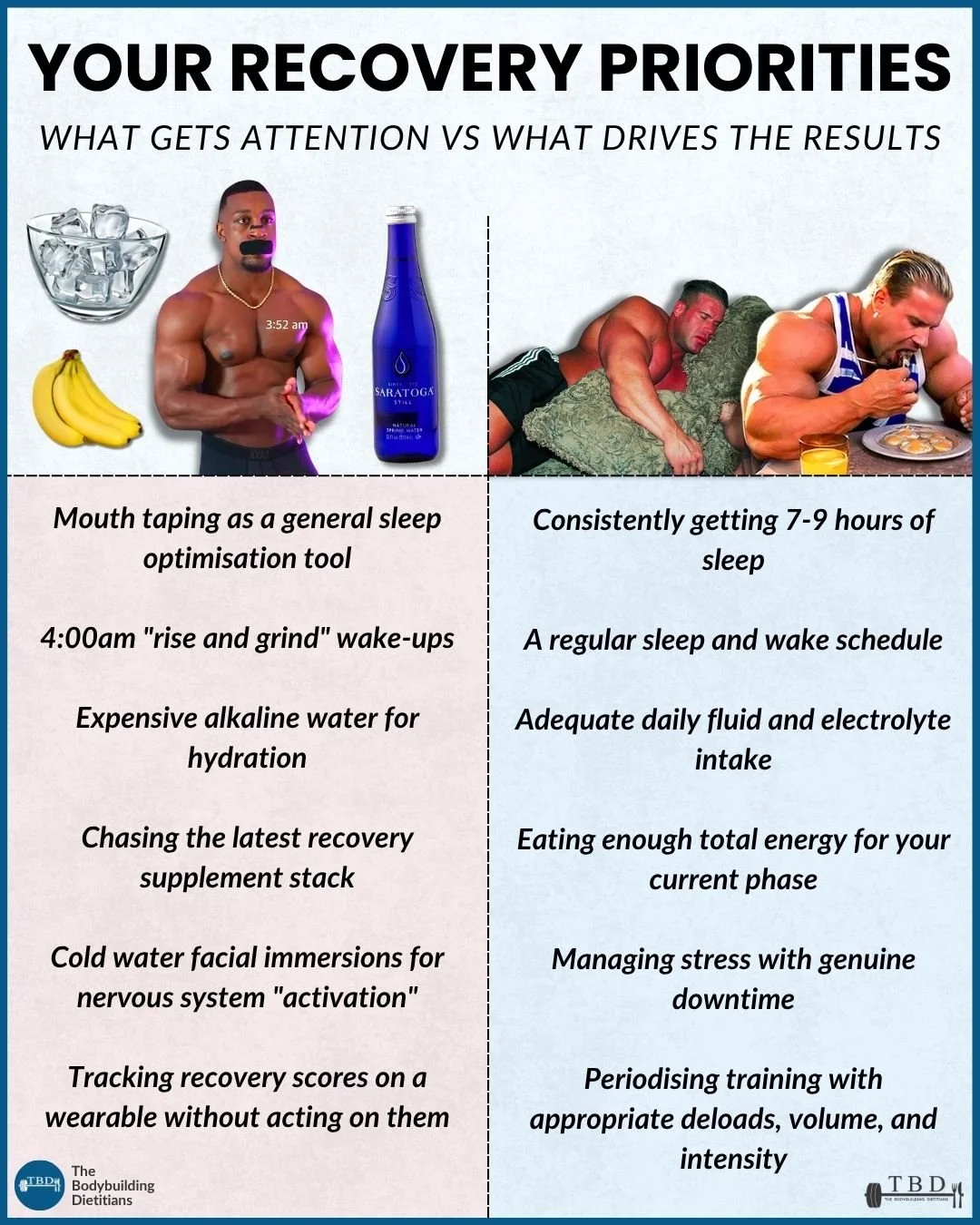
The recovery practices that receive the most attention compared to the foundational variables that consistently drive training adaptation, repair, and long-term progress.
Recovery has become an elaborate topic in recent years, and the range of practices that get discussed as part of a serious athlete's routine has expanded considerably. Some of these practices are genuinely useful in the right context. Most of them carry effects that are real but small, operating at the margin rather than as primary drivers of the outcome.
The issue is proportionality. A person who sleeps five hours a night, trains without adequate deloads, and eats below their energy requirements will recover poorly regardless of how many recovery tools they add on top of those conditions. The absence of a fundamental is not filled by the presence of something marginal, and the attention that elaborate recovery practices attract is frequently out of proportion to the results they contribute when the foundations are not yet consistently in place.
The framework here distinguishes the foundational recovery variables, the ones that account for the large majority of recovery outcome, from the supplementary practices that can add marginal benefit once those foundations are genuinely established.
Why Sleep Is the Single Most Important Recovery Variable
Sleep is where the majority of physiological recovery occurs. Growth hormone is released in pulses during slow-wave sleep, supporting muscle tissue repair and protein synthesis. Cortisol is cleared, allowing the hormonal environment to normalise after training-related elevation. Nervous system recovery from the accumulated fatigue of resistance training occurs primarily during sleep, and cognitive restoration that supports training motivation, decision-making, and dietary adherence follows the same pattern.
Consistently achieving 7 to 9 hours of sleep per night is the single most impactful recovery intervention available to most lifters, and it is also the one most frequently substituted for lesser alternatives. A regular sleep and wake schedule, rather than highly variable sleep timing across the week, provides additional benefit by stabilising circadian rhythms that regulate hormonal release, immune function, and cellular repair processes. The combination of adequate duration and regular timing produces meaningfully better recovery outcomes than the same total hours accumulated inconsistently.
A study by Walker and colleagues found that sleep restriction to six hours per night across two weeks produced deficits in cognitive performance equivalent to two full nights of total sleep deprivation, with participants largely unaware of the cumulative decline, suggesting that chronic mild sleep insufficiency is both common and underappreciated in its effects.
Source: Van Dongen et al., 2003, Sleep.
Early morning wake-ups that compress sleep duration below 7 hours to create additional training or productivity time represent a direct trade of recovery for a marginal gain in schedule, and the compounding effect of that trade across weeks tends to be negative from a performance and body composition perspective.
Why Energy Intake Is a Recovery Variable, Not Just a Body Composition Variable
Eating enough total energy to support the current training phase is a recovery prerequisite that is often treated primarily as a body composition variable. In the context of recovery, energy availability determines whether the body has sufficient substrate to complete the repair processes that training has initiated.
When energy intake is insufficient relative to training demand, a state called low energy availability, protein synthesis is downregulated, glycogen replenishment is compromised, hormonal function is disrupted including reductions in testosterone and thyroid hormone, and immune function is impaired. Recovery under these conditions is slower and less complete than under adequate energy conditions, and the training load that can be sustained while adapting productively is lower.
Energy availability refers to the dietary energy remaining for physiological processes after the energy cost of training has been subtracted. Low energy availability is a feature of aggressive calorie deficits, and it is one of the reasons that very aggressive fat loss phases tend to produce poor recovery, declining performance, and muscle loss despite adequate protein intake. The calorie deficit that drives fat loss simultaneously creates conditions that impair recovery if it becomes too deep.
In practical terms, eating enough for the current phase means calibrating intake to what the current training demand and body composition goal require, rather than cutting calories beyond what the phase warrants. For individuals in a fat loss phase, maintaining performance as a monitoring signal for whether energy availability is sufficient is a practical approach to managing this balance.
How Training Structure Affects Recovery Capacity
Recovery does not occur only between sessions. It is also shaped by how the training program is structured across weeks and months. Appropriate periodisation, meaning the deliberate variation of training volume, intensity, and load across a training block, provides the structure within which recovery and adaptation occur rather than simply fatigue accumulation.
A deload is a structured reduction in training volume while intensity is maintained, typically occurring every four to eight weeks depending on the training load and individual recovery capacity. Its function is to allow accumulated fatigue to dissipate while preserving the fitness gains that have been developing beneath it. Athletes who train consistently without deloads tend to accumulate fatigue to a point where expressed performance declines even as underlying fitness continues to develop, which is the accumulated fatigue pattern described in the RPE article. A well-timed deload resolves this by clearing the fatigue and allowing the fitness to be expressed.
Volume management across the mesocycle matters for the same reason. Starting a training block at a volume that is challenging but manageable, progressing volume across the block, and then reducing at the deload point, is a structure that allows progressive overload to occur within a recovery-compatible framework. Training at maximum volume across all sessions with no structure for fatigue management tends to produce diminishing performance and poor recovery before long-term adaptation can accumulate.
What Hydration and Stress Management Contribute to Recovery
Adequate daily fluid and electrolyte intake supports recovery through several distinct mechanisms: nutrient transport and waste removal, maintenance of cardiovascular output during training, enzyme function and cellular processes involved in repair, and normal hormonal signalling. Dehydration at even modest levels impairs training performance and recovery, and the effect compounds across days of insufficient fluid intake.
The practical standard for hydration is maintaining pale yellow urine across the day rather than targeting a specific daily volume, since individual requirements vary considerably with bodyweight, sweat rate, training intensity, and environmental conditions. Electrolytes including sodium, potassium, and magnesium support fluid retention and neuromuscular function, and their relevance increases for individuals training at high volumes or in warm conditions. Standard food and fluid intake meets electrolyte needs for most people; the specific situations where electrolyte supplementation provides additional benefit are narrower than the marketing around recovery electrolyte products suggests.
Expensive alkaline water provides no recovery advantage over standard tap water in terms of its pH-modifying effect on the body, as the body tightly regulates blood pH through respiratory and renal mechanisms regardless of the pH of fluid consumed.
Stress management through genuine downtime, meaning time genuinely spent outside of productive, achievement-oriented activity, contributes to recovery by reducing the cumulative cortisol load that training, dietary restriction, and professional and personal stress collectively create. Chronically elevated cortisol impairs protein synthesis, reduces testosterone and thyroid hormone, promotes central fat storage, and disrupts sleep quality, all of which compound negatively over a training block. The recovery practices that best manage this load are individual, but the common factor is genuine psychological disengagement from performance demands rather than passive screen time or low-stimulation activities that maintain cognitive activation.
How to Think About Supplementary Recovery Practices
Once the foundational recovery variables are consistently in place, supplementary practices can be evaluated on their own terms and incorporated where they provide genuine personal benefit.
Cold water immersion has a legitimate evidence base for reducing acute muscle soreness and perception of fatigue following high-volume training, though the research on its effects on long-term adaptation is more nuanced, with some evidence suggesting that regular post-training cold immersion may attenuate the training adaptation itself rather than just the soreness. Its appropriate use is context-dependent rather than universally beneficial.
Wearable recovery tracking provides data that can be acted on, and monitoring recovery scores in conjunction with training load, sleep, and dietary data can inform periodisation decisions in a useful way. The limitation is that tracking without acting on the data adds no benefit, and the practical value of a recovery score is determined by how it informs the decisions that follow from it.
Practices such as mouth taping as a general sleep optimisation tool have limited evidence for most individuals outside of those with specific breathing disorders, and the investment in elaborate sleep optimisation devices is better directed toward the bedtime consistency and duration variables that account for the large majority of sleep quality outcomes.
The sequencing principle is worth applying: the marginal additions are worth experimenting with once the fundamentals are genuinely in place and consistently maintained. Layering supplementary practices onto an inconsistent foundation produces a poor return. Layering them onto a consistently well-managed foundation produces a smaller but real marginal benefit for the right individual. Knowing where someone is actually losing recovery, and deciding what to address first, is part of how we approach training and nutrition structure with coaching clients.
Practical Takeaways
Consistently adequate sleep of 7 to 9 hours per night with a regular schedule is the single most impactful recovery variable available to most lifters, and the one most frequently substituted for lesser alternatives.
Total energy intake is a recovery variable as much as a body composition one. Eating below the requirements of the current training phase impairs protein synthesis, glycogen replenishment, and hormonal function, all of which reduce recovery quality.
Appropriate training periodisation, including structured deload periods and volume management across training blocks, provides the conditions for recovery and adaptation to occur rather than simply fatigue accumulation.
Adequate daily hydration through regular fluid and electrolyte intake supports nutrient transport, cellular repair, and neuromuscular function. Standard food and fluid intake meets electrolyte needs for most individuals.
Genuine stress management through downtime reduces the cumulative cortisol load that training, dietary restriction, and professional stress collectively create, and supports the hormonal conditions in which recovery occurs.
Supplementary recovery practices carry smaller effects than the foundational variables and are best evaluated once those foundations are consistently in place. The sequencing matters: foundations first, marginal additions after.
Frequently Asked Questions
What is the most important factor for recovery after training?
Sleep is the most consistently impactful recovery variable for most lifters. Growth hormone release, cortisol clearance, nervous system recovery, and tissue repair all occur primarily during sleep, and chronic sleep insufficiency below 7 hours per night produces meaningful deficits in performance, adaptation, and body composition outcomes over time. A regular sleep schedule that provides 7 to 9 hours consistently across the week will produce more recovery benefit than any supplementary practice added on top of insufficient or inconsistent sleep.
Does alkaline water improve recovery?
No evidence supports alkaline water as providing recovery benefits beyond those of standard water. The body tightly regulates blood pH through respiratory and renal buffer systems, meaning the pH of consumed fluid has negligible effect on physiological pH. Standard tap water and adequate total daily fluid intake are appropriate for hydration during training, and the additional cost of alkaline water products does not correspond to a measurable performance or recovery advantage.
How often should I deload for optimal recovery?
Deload frequency depends on training volume, intensity, experience level, and individual recovery capacity. A structured deload every four to eight weeks is a practical starting range for most resistance-trained individuals. Higher-volume training blocks and deeper calorie deficits may warrant more frequent deloads, as both increase the rate of fatigue accumulation. The most reliable signal that a deload is needed is sustained decline in training performance that does not resolve with a day or two of rest, particularly in the context of the accumulated fatigue pattern described in the RPE framework.
Does cold exposure improve recovery?
Cold water immersion has evidence for reducing acute muscle soreness and perception of fatigue following high-volume or high-intensity training. Its effect on long-term training adaptation is more nuanced, with some research suggesting that regular post-training cold immersion may attenuate muscle hypertrophy by blunting some of the inflammatory signalling involved in adaptation. Its appropriate use is most clearly supported in competitive contexts where minimising soreness and sustaining performance across consecutive training days is the priority, rather than as a universal post-workout practice for all training goals.
How does stress affect training recovery?
Chronic psychological stress elevates cortisol, which impairs protein synthesis, reduces testosterone and thyroid hormone, disrupts sleep quality, and promotes central fat storage. These effects compound negatively with the training-induced cortisol and fatigue of a demanding training block. Managing psychological stress through genuine downtime and appropriate recovery activities reduces the total hormonal burden on the body and supports the conditions in which training adaptation and tissue repair occur. High-stress life periods produce poorer training adaptation and body composition outcomes for this reason, independent of nutritional and training variables.
Is it worth tracking recovery with a wearable device?
Recovery tracking tools including heart rate variability and recovery score wearables provide data that can inform periodisation and training load decisions when acted on appropriately. Their value is determined by how that data is used: monitoring recovery scores across a training block and adjusting volume or intensity based on trends provides genuine benefit, while monitoring without acting on the data adds cognitive overhead without improving outcomes. They are most useful as one input within a broader performance monitoring framework rather than as a primary recovery intervention on their own.
Knowing which recovery variable is most relevant for a specific person at a specific point in their training and diet is where most of the practical work sits. If you want that level of individual analysis applied to your training and recovery approach, you can enquire about coaching or book a consultation to get started.