A self-reinforcing pattern where fear of fat gain repeatedly cuts the gaining phase short before muscle actually builds, producing years of effort with minimal progression. This is what the pattern looks like, why it keeps recurring, and what a productive gaining phase actually requires.
The most common reason lifters spend years in the gym without building meaningful muscle is a self-reinforcing cycle where every gaining phase gets cut short before it produces anything. The pattern is: enter a calorie surplus with the intention of building muscle, experience some fat gain (which is normal and unavoidable in a productive gaining phase), interpret the fat gain as a signal that something is going wrong, prematurely initiate a fat loss phase to reverse it, and return to the starting body composition within weeks. Muscle tissue doesn't accrue on the timeline that this cycle allows for. Building meaningful muscle mass requires sustaining a controlled calorie surplus for months at a time, tracking progress on a monthly rather than weekly basis, and accepting that some fat gain is a normal part of a productive gaining phase. A practical target is 0.5 to 1 percent of bodyweight gained per month, sustained for 12 to 20 weeks or longer, in a surplus of approximately 100 to 200 calories above maintenance. The lifters who make sustained muscle gain progress are typically the ones who have learned to trust a slow process that looks like it isn't working until it suddenly is.
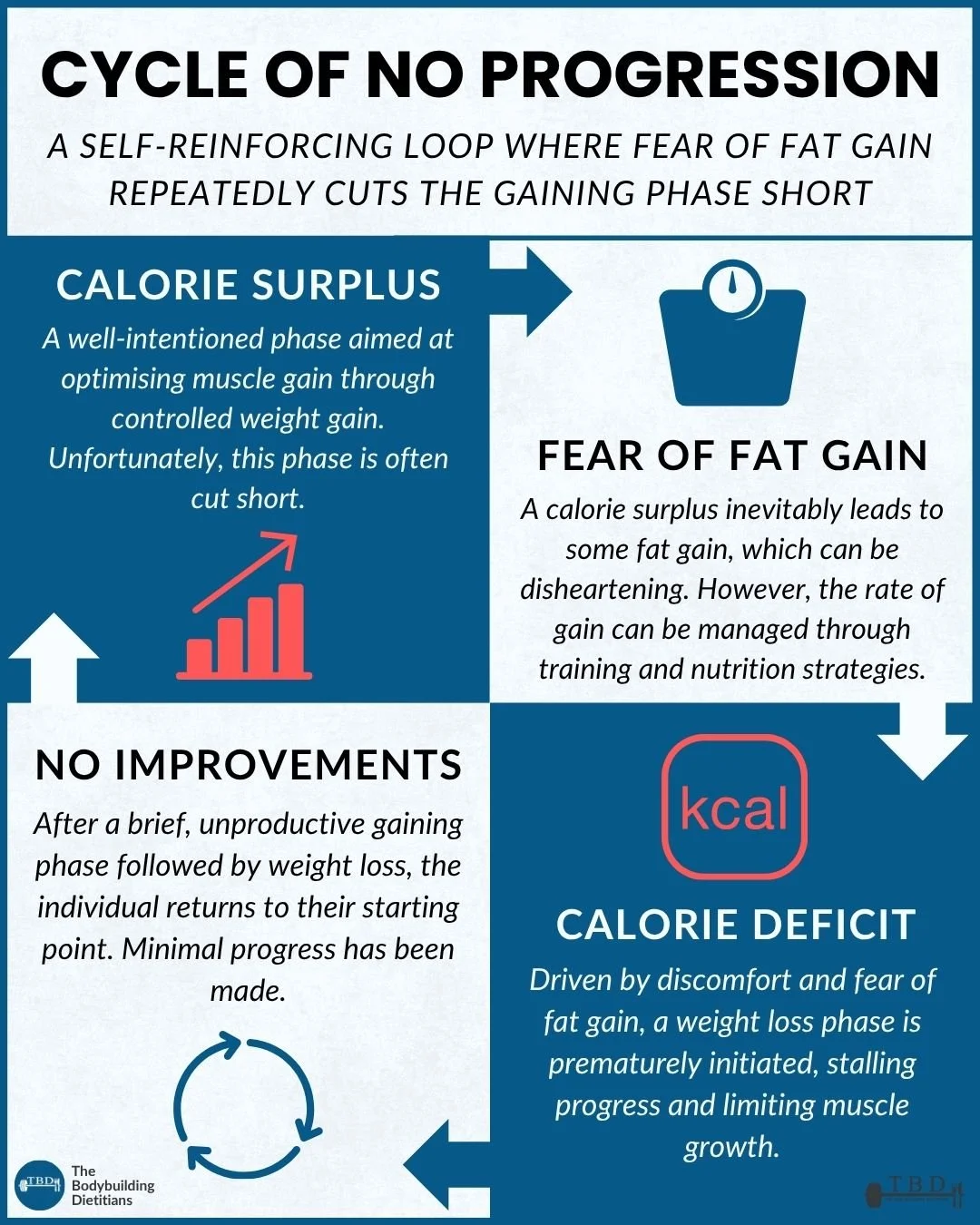
The cycle of no progression that keeps many lifters spinning their wheels for years. The pattern is self-reinforcing because each premature end to a gaining phase returns the lifter to the starting body composition, which then prompts another attempt that cuts short at the same point.
Building skeletal muscle is slow and energy-intensive. It is possible to minimise fat gain during a gaining phase, but some fat gain is unavoidable if the goal is to maximise muscle growth over time. The specific pattern that keeps many lifters spinning their wheels year after year is treating that inevitable fat gain as a signal to stop, when it is actually a normal part of a productive gaining phase.
The cycle looks like this: enter a calorie surplus with the intention of building muscle, experience some fat gain within the first several weeks, interpret the fat gain as evidence that something has gone wrong, prematurely initiate a fat loss phase to reverse the gain, complete the fat loss phase back to the starting body composition, and repeat. Each individual phase feels like it was managed responsibly (no runaway fat gain, no excessive deficit), but the total outcome across months and years is minimal progress in either direction.
This article walks through the specific pattern, why it keeps recurring for the same lifters, and what a productive gaining phase actually requires in terms of surplus size, duration, and psychological orientation toward the process.
What Is the Cycle of No Progression?
The cycle of no progression is a self-reinforcing loop with four repeating stages, each of which feels internally justified in the moment but which collectively produce no meaningful body composition change across months or years of effort.
Stage one: entering a controlled calorie surplus. The lifter decides to run a gaining phase, sets a modest surplus (say, 200 to 400 calories above estimated maintenance), and begins tracking. Training may be structured or unstructured depending on the lifter's experience. Intentions are appropriate and the initial framing is productive.
Stage two: experiencing fat gain within the first few weeks. Body weight climbs (some of which is water and glycogen, some of which is genuine fat gain), waistline measurements creep up slightly, and the lifter starts to notice softening in the mirror. The fat gain at this stage is not excessive; it is the normal and expected consequence of a calorie surplus, and it typically accounts for 30 to 50 percent of the weight gained during a well-executed gaining phase.
Stage three: interpreting fat gain as a signal to stop and initiate a fat loss phase. This is the specific stage where the cycle becomes self-defeating. The lifter interprets the modest fat gain (which is normal) as evidence that the gaining phase is going wrong. Discomfort in the mirror, tighter fitting clothes, or a scale number that exceeds the expected range prompts an early transition to a fat loss phase. The transition often happens within 4 to 8 weeks of starting the surplus, well before muscle tissue has had time to accrue in any meaningful amount.
Stage four: completing fat loss back to starting body composition with minimal muscle gain to show for the cycle. The fat loss phase runs its course, body weight returns to (or near) the pre-gaining phase level, and body composition ends up substantially similar to where the cycle started. Some lifters may have gained a small amount of muscle across the full cycle, but the amount is far below what a properly sustained gaining phase would have produced.
The loop then repeats. Six to twelve months later, the lifter decides to try another gaining phase, running through the same four stages with the same outcome. Two, three, or five years pass with the lifter having spent most of that time in one phase or another, but with limited progress to show for the accumulated effort.
The pattern is particularly frustrating because each individual decision feels justified in the moment. The initial surplus was appropriate. The fat gain was noticed and addressed. The fat loss phase was executed. Nothing dramatically wrong happened at any single point. The failure is at the level of the phase's duration and the lifter's response to normal early-phase feedback, not at the level of any single tactical decision.
Why Does the Cycle Keep Recurring?
Understanding why the same pattern keeps producing the same outcome requires looking at what actually drives the premature phase transitions. Three factors tend to combine.
Fat gain during a gaining phase is inevitable. In any calorie surplus large enough to support meaningful muscle growth, some proportion of the gained weight will be fat rather than muscle. This is a physiological reality rather than a sign of poor execution. Trained lifters can expect roughly 30 to 50 percent of gained weight to be fat during a well-structured gaining phase, and untrained lifters may see a slightly better ratio in their earliest months of training. Attempting to reduce the fat gain proportion further usually requires a smaller surplus, which slows the muscle gain proportionally. The trade-off is fundamental to the process.
The psychological weight of noticing fat gain often exceeds the actual physiological cost. A lifter watching the scale climb 2 to 3 kilograms across the first six weeks of a gaining phase may feel like the phase has gone badly wrong, when the physiological reality is that the phase is going exactly as expected. The discomfort in the mirror, the tighter fit of clothes, and the scale number itself all feel worse than the underlying situation actually is. Lifters who have spent years primarily in fat loss or maintenance phases tend to be particularly sensitive to this, because their baseline expectation is a lean physique that gradually shifts unfavourably during any period of gaining.
Muscle gain is slow enough that it feels imperceptible during the phase itself. Muscle accrues at a rate of approximately 0.5 to 1 percent of bodyweight per month for trained lifters, which for an 80 kilogram lifter is 400 to 800 grams per month. This is small enough that day-to-day and even week-to-week changes are essentially invisible in the mirror. The lifter sees the fat gain clearly (because fat sits in specific visible locations) while the muscle gain remains invisible until it has accumulated for months. This asymmetry in visible feedback (fat immediately visible, muscle invisible until much later) is one of the specific reasons the phase feels unrewarding in real time and gets cut short.
The three factors combine to produce a pattern where the lifter feels justified in ending the phase early, because the visible feedback (fat gain, tighter clothes, higher scale) all point toward the phase going wrong, while the actually productive part of the phase (muscle accrual) hasn't had time to become visible. Ending the phase in that state feels responsive to the data, when in fact it ends the phase just as the productive part is about to begin showing up.
For a more detailed look at how gaining phases fit into a longer-arc bodybuilding career, our article on bodybuilding phases covers the structural framework.
What Does a Productive Gaining Phase Actually Look Like?
A productive gaining phase has four defining characteristics that separate it from the cycle-of-no-progression pattern.
A surplus small enough to keep fat gain slow. The specific target is typically 100 to 200 calories above maintenance, which is a smaller surplus than most lifters instinctively run. At this surplus size, weight gain proceeds at approximately 0.5 to 1 percent of bodyweight per month, with the fat gain proportion staying at the lower end of the possible range. Larger surpluses produce faster weight gain but a worse ratio of muscle to fat, which is one of the reasons more aggressive bulks tend to produce more fat gain than the muscle gain justifies.
Duration measured in months rather than weeks. A productive gaining phase runs for a minimum of 12 to 16 weeks and often extends to 20 to 40 weeks or longer, depending on training experience and goals. This is the timeline over which meaningful muscle accrual actually happens. Phases shorter than 12 weeks rarely produce the accumulated muscle gain that justifies the fat gain incurred.
Progress tracked at the monthly rather than weekly level. Weekly average body weight fluctuates enough due to training volume, hydration, glycogen, and gut contents that the underlying trend is often hidden by short-term noise. Assessing progress at the monthly level (comparing this month's average weight to last month's, or this month's photos to those from 4 to 8 weeks ago) reveals the underlying trend more accurately than weekly assessments. Lifters who track and interpret at the weekly level tend to react to noise rather than signal, which contributes to the premature phase transitions.
Explicit acceptance that some fat gain is normal and expected. Lifters who enter a gaining phase with the framing that "any visible fat gain means something is going wrong" are essentially guaranteed to end the phase prematurely. Lifters who enter with the framing that "some fat gain is expected and the phase runs until it has produced meaningful muscle" tend to sustain the phase long enough for the productive part to happen. The psychological orientation toward the process is a genuine variable rather than a soft consideration.
The rate of muscle accrual in trained lifters is well-established at approximately 0.5 to 1 percent of bodyweight per month during a well-structured gaining phase with resistance training and adequate protein. For an 80 kilogram lifter, this translates to 400 to 800 grams of muscle gained per month. This slow accrual rate is one of the specific reasons short gaining phases (4 to 8 weeks) rarely produce meaningful progress. Source: Slater et al., 2019, Nutrients, 11(6):1301; Schoenfeld et al., 2018, Journal of Sports Sciences, 36(15):1720-1728.
For a more detailed look at how per-meal protein distribution supports muscle gain during a surplus, our article on where excess protein goes covers the metabolic side of the question.
Wondering Whether Your Current Gaining Approach Is Set Up to Actually Work?
If you have run several gaining phases over the past few years and are back to (or near) the body composition you started at, the pattern in this article probably applies. The specific fix depends on which stage of the cycle keeps ending the phase (surplus size, phase duration, response to early fat gain, or something else) and requires an honest audit of the pattern as it has played out for you specifically. Our team works with clients on identifying where the cycle keeps breaking down, structuring a gaining phase that survives long enough to produce meaningful results, and building the tracking and interpretation systems that keep the phase from getting cut short prematurely.
How Do You Actually Sustain a Gaining Phase?
Knowing that a gaining phase needs to run for 12 to 20 weeks or longer is different from actually sustaining one over that timeframe. Several practical strategies help lifters hold the phase long enough for it to produce results.
Set the surplus small enough that fat gain is genuinely slow. A surplus of 100 to 200 calories above maintenance produces weight gain at approximately 0.5 to 1 percent of bodyweight per month. At this rate, the fat gain visible in the mirror develops slowly enough that it doesn't produce the acute discomfort that drives premature transitions. Larger surpluses produce faster weight gain and faster fat gain, both of which increase the psychological pressure to end the phase early.
Track weekly averages rather than daily weights. Daily body weight fluctuates enough that the day-to-day noise obscures the underlying trend. Weekly averages smooth this out and reveal the actual gaining rate. For lifters particularly sensitive to scale numbers, tracking waist measurements weekly and photos monthly can be more useful references than the scale itself.
Plan the phase length before starting. Deciding at the start that the phase will run for 20 weeks removes the daily decision of "should I keep going" and replaces it with the pre-committed decision made in a rational state. Lifters who leave the phase length open-ended tend to end it earlier than lifters who committed to a specific timeline at the start.
Build in check-in points rather than continuous evaluation. Rather than assessing progress every week or every day, set specific check-in points (say, at week 8, week 16, and week 20) where progress will be assessed formally and the phase length or intensity might be adjusted. Between check-ins, the plan runs without daily reassessment. This structure reduces the ongoing psychological pressure that drives premature exits.
Adjust the phase based on actual progress data rather than in-the-moment discomfort. If the phase is producing appropriate weight gain (0.5 to 1 percent per month) and the ratio of muscle to fat gain is reasonable (assessed via waist measurements, photos, and training performance), the phase should continue. If the phase is producing excessive weight gain or the ratio has skewed toward fat, adjust the surplus down. The specific data trigger should be the driver of decisions rather than in-the-moment discomfort.
Recognise that muscle gain will become visible later than fat gain. Fat gain shows up in the mirror within weeks. Muscle gain takes months to become visible. This asymmetry means that during the first 8 to 12 weeks of a gaining phase, the visible feedback will almost always look worse than the underlying progress justifies. Anticipating this asymmetry in advance helps prevent the response to it from cutting the phase short.
For a more detailed look at how tracking scale weight versus body composition affects decision-making in a gaining phase, our article on why calorie needs vary between individuals covers the individual data collection approach.
Practical Takeaways
The most common reason lifters spend years in the gym without building meaningful muscle is a self-reinforcing cycle where every gaining phase gets cut short before muscle has time to actually build.
The cycle has four stages: calorie surplus, fat gain within the first several weeks, premature transition to a fat loss phase driven by discomfort with the fat gain, and return to the starting body composition. Each individual stage feels justified in the moment, but the overall pattern produces no meaningful progress.
Fat gain during a gaining phase is inevitable and normal. Trained lifters can expect roughly 30 to 50 percent of gained weight to be fat during a well-structured phase, and attempting to reduce this proportion further usually requires a smaller surplus that slows muscle gain proportionally.
A productive gaining phase requires a surplus of approximately 100 to 200 calories above maintenance, weight gain of 0.5 to 1 percent of bodyweight per month, duration measured in months rather than weeks (typically 12 to 20 weeks minimum), and explicit acceptance that some fat gain is expected.
Muscle gain in trained lifters proceeds at approximately 0.5 to 1 percent of bodyweight per month, which is slow enough to be invisible day-to-day and week-to-week. Fat gain becomes visible before muscle gain does, which is one of the specific asymmetries that drives premature phase termination.
Sustaining a gaining phase over its productive duration requires setting the surplus small enough to keep fat gain slow, tracking weekly averages rather than daily weights, planning the phase length before starting, building in structured check-in points rather than continuous evaluation, and anticipating in advance that early visible feedback will look worse than the underlying progress justifies.
Frequently Asked Questions
Why do I keep gaining and losing the same weight without building muscle?
The most common reason is that each gaining phase gets cut short before muscle has time to actually build. Muscle accrues at approximately 0.5 to 1 percent of bodyweight per month, which requires sustained calorie surplus for 12 to 20 weeks or longer. If the gaining phase ends within 4 to 8 weeks (typically driven by discomfort with the normal fat gain that occurs during any surplus), it doesn't produce the muscle gain that justifies the fat gain incurred, and the subsequent fat loss phase returns the lifter to the starting point.
How much fat gain is normal during a gaining phase?
Roughly 30 to 50 percent of gained weight is typically fat during a well-structured gaining phase in trained lifters, with the remainder as muscle, water, and glycogen. This ratio is largely determined by the surplus size, training quality, and training experience rather than by any specific error the lifter has made. Larger surpluses produce a worse ratio, while smaller surpluses produce a better ratio at the cost of slower total weight gain. Attempting to eliminate fat gain entirely tends to require a surplus so small that muscle gain slows to a rate not much better than maintenance.
How long should a gaining phase last?
A productive gaining phase typically runs for a minimum of 12 to 16 weeks and often extends to 20 to 40 weeks or longer, depending on training experience and goals. Phases shorter than 12 weeks rarely produce meaningful muscle accrual because muscle tissue simply doesn't build fast enough for a shorter timeline to produce visible results. Lifters running repeated 4 to 8 week bulks and following each with a fat loss phase typically make far less progress than lifters sustaining a single 20 to 40 week gaining phase.
How much weight should I gain per month during a bulk?
Approximately 0.5 to 1 percent of bodyweight per month is a reasonable target, which for an 80 kilogram lifter is 400 to 800 grams per month. This rate is slow enough that fat gain accumulates gradually rather than dramatically, while still allowing meaningful muscle gain over the full phase. Faster rates (say, 1.5 to 2 percent per month) produce more fat gain per unit of muscle gain, which tends to make the phase harder to sustain and produces a worse body composition outcome by the end.
How do I stop cutting my bulks short?
Several strategies help. Set the surplus small enough that fat gain is slow and manageable (100 to 200 calories above maintenance rather than 500 or more). Track weekly averages rather than daily weights so that daily fluctuations don't drive decisions. Plan the phase length before starting (say, 20 weeks) rather than leaving it open-ended. Build in specific check-in points where progress is formally assessed, rather than continuously evaluating throughout the phase. Anticipate in advance that early visible feedback will look worse than the underlying progress justifies.
Is it better to bulk and cut, or to recomp?
It depends on the training stage and body composition context. Lifters with less than one to two years of consistent training, or lifters starting at higher body fat percentages, can often make meaningful recomposition progress (simultaneous muscle gain and fat loss) at maintenance calories. Trained lifters at leaner body compositions typically need a dedicated gaining phase to make meaningful muscle gain progress, because recomposition rates slow substantially at more advanced training stages. For a more detailed look at when recomposition works and when a dedicated gaining phase is necessary, our article on whether you can build muscle and lose fat at the same time covers the specific decision framework.
If you want help identifying where your own gaining phases keep breaking down, structuring a phase that survives long enough to produce meaningful results, and building the tracking and interpretation systems that keep the phase from getting cut short, our team can build a plan matched to your specific situation. You can enquire about coaching or book a consultation with our team.