A practical breakdown of evidence-based protein, carbohydrate, fat, and fibre targets, and how to apply them across different phases of training and body composition.
Daily macro targets for most resistance-trained individuals sit around 1.6 to 2.4 grams of protein per kilogram of bodyweight, 0.5 to 1.5 grams of fat per kilogram, with carbohydrates filling the remaining calories. During a fat loss phase, keeping fat toward the lower end of its range preserves more calories for carbohydrate, which helps sustain training output. Fibre targets of at least 30 grams per day for males and 25 grams per day for females are well-supported by research and often underappreciated in their broader health impact.
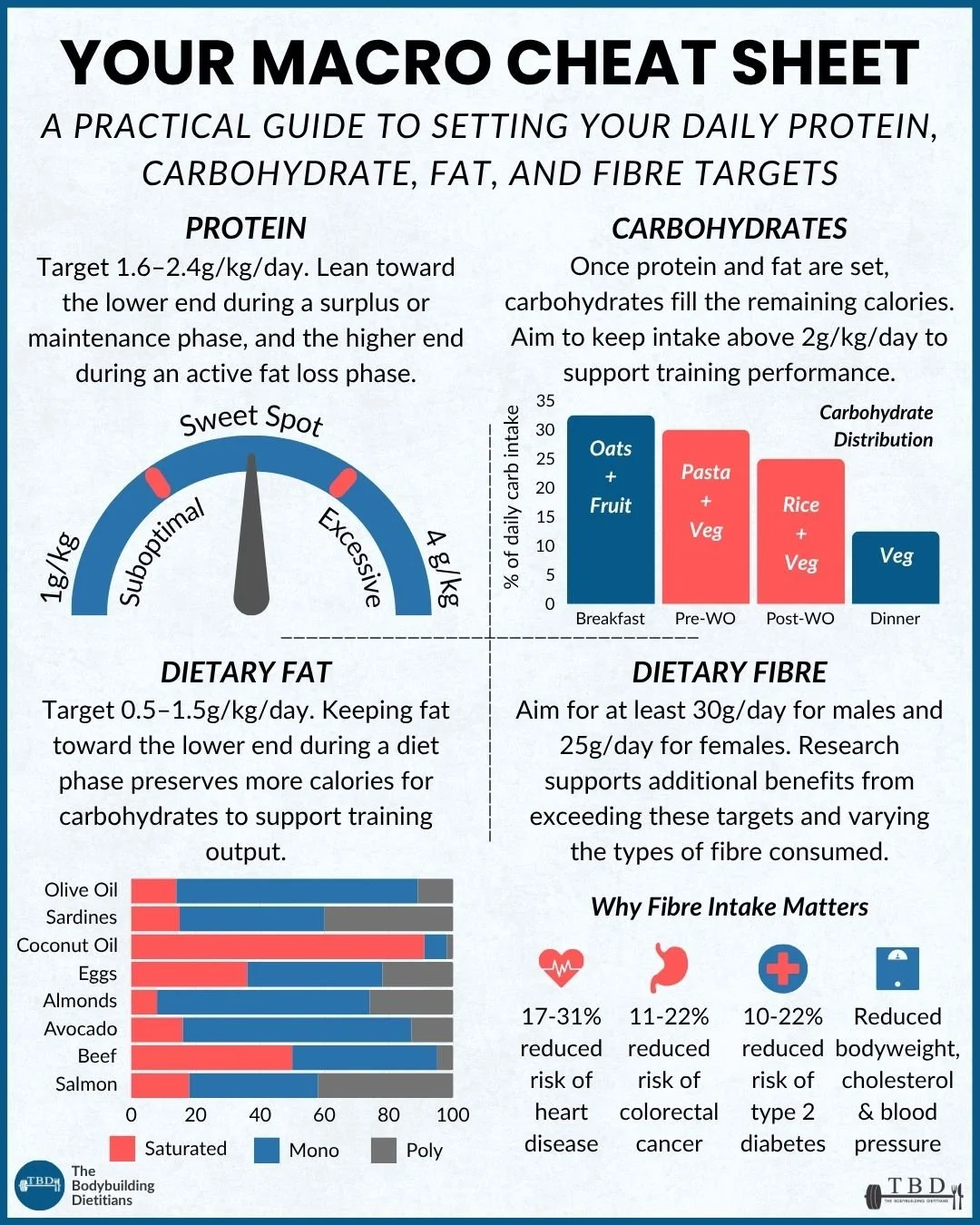
Daily macro targets for protein, carbohydrates, fat, and fibre, with guidance on adjusting each across training phases.
What Is the Right Daily Protein Target?
For most resistance-trained individuals, a daily protein intake of 1.6 to 2.4 grams per kilogram of bodyweight covers the full range of practical need. Within that range, positioning tends to be driven by the goal of the current phase rather than by any universal rule.
During a surplus or maintenance phase, muscle protein synthesis is supported by a positive or neutral energy environment, which means the lower end of the protein range is generally sufficient for retaining and building lean mass. Sitting around 1.6 to 1.8 grams per kilogram is reasonable under these conditions, and it leaves more dietary space for the carbohydrate and fat intake that supports training and recovery.
During an active fat loss phase, the picture changes. Reduced calorie intake, higher training stress relative to energy availability, and the physiological tendency to break down lean tissue under a deficit all make adequate protein more important. Targeting the higher end of the range, around 2.0 to 2.4 grams per kilogram, provides a meaningful buffer against muscle loss and helps manage hunger as intake decreases.
Protein is a macronutrient composed of amino acids that supports tissue repair, skeletal muscle growth, enzyme function, and numerous metabolic processes. Muscle protein synthesis is the biological process through which dietary protein stimulates the repair and construction of muscle fibres following resistance training.
A meta-analysis of 49 randomised controlled trials found that protein supplementation significantly increased muscle mass and strength gains in response to resistance exercise in healthy adults, with benefits plateauing at around 1.62 grams per kilogram of bodyweight per day on average across the study population.
Source: Morton et al., 2018, British Journal of Sports Medicine.
In coaching practice, protein tends to be the macro that is easiest to set with confidence. The research is consistent, the practical range is clear, and the primary skill is choosing protein sources that fit someone's preferences, budget, and total food structure. If you want to understand how we approach protein intake for our coaching clients, that is covered in the intake process from the start.
How Should Carbohydrate Intake Be Set?
Carbohydrate is most usefully understood as the flexible macro. Once protein is established and fat is set at a level that covers physiological need, carbohydrates fill the remaining calorie budget. That sounds straightforward, but it carries an important implication: the decisions made about fat intake directly shape how much carbohydrate is available.
For individuals who train hard and consistently, keeping carbohydrate above approximately 2 grams per kilogram of bodyweight per day tends to support training performance meaningfully. Below that level, especially across longer training blocks or during higher-volume phases, the effects on session quality and recovery can become noticeable.
Glycogen is the stored form of carbohydrate found primarily in muscle and liver tissue, and it serves as the primary fuel source for high-intensity resistance and cardiovascular training. Insufficient carbohydrate intake reduces glycogen availability, which can affect the capacity to sustain effort across a training session.
Beyond total intake, carbohydrate distribution across the day is worth considering. A practical approach for most training days involves placing a meaningful portion of carbohydrate at breakfast, concentrating the largest portion around the pre-workout meal when glycogen availability is most relevant, and keeping dinner lighter in carbohydrate relative to earlier meals. Vegetables contribute across all meals as a low-calorie, high-fibre carbohydrate source that supports satiety and gut health without significantly affecting calorie targets.
This kind of distribution is not rigidly mandatory, and the differences between timing strategies are relatively modest compared to the importance of total daily intake. For most people, structuring carbohydrate logically around training is useful, but it should not create unnecessary complexity or override food preferences and practical lifestyle factors.
How Much Dietary Fat Do You Need?
Dietary fat targets in the range of 0.5 to 1.5 grams per kilogram of bodyweight per day are broadly practical for most physique-focused individuals. That range is wide enough to accommodate both diet and building phases while ensuring fat intake never drops to a level that compromises hormonal function, fat-soluble nutrient absorption, or general health.
The key decision point is where within that range to sit based on the current goal. During a calorie deficit, keeping fat toward the lower end, around 0.5 to 0.8 grams per kilogram, preserves more calorie space for carbohydrate. This matters because carbohydrate is more directly linked to training output than fat is, and protecting performance during a diet phase supports muscle retention and adherence. Fat intake can be allowed to sit higher during a surplus or maintenance phase, where the priority on calorie efficiency is lower.
Not all dietary fat sources behave identically in terms of health impact. The fatty acid composition of a food reflects its relative proportions of saturated, monounsaturated, and polyunsaturated fat, and these differ considerably across common foods. Oils, animal products, nuts, avocado, and fatty fish each carry a distinct fatty acid profile, and a diet that draws from a variety of these sources tends to support both cardiovascular health and practical food diversity better than one that concentrates fat intake in a narrow range of foods.
Omega-3 fatty acids, particularly the long-chain forms found in fatty fish such as salmon and sardines, have well-established anti-inflammatory and cardiovascular benefits and are worth including regularly. Most dietary fat targets can be met fairly easily across a balanced food pattern, provided fat intake is not being cut so aggressively that it falls below the physiological floor.
Why Does Dietary Fibre Matter and How Much Do You Need?
Dietary fibre is the variable most often underallocated relative to what the research consistently supports. Targets of at least 30 grams per day for males and 25 grams per day for females are well established, and the evidence base for meeting and exceeding these targets is substantial.
Dietary fibre refers to the indigestible carbohydrate components of plant foods that pass through the small intestine largely intact and are fermented or partially fermented in the large intestine. This broad category includes both soluble fibre, which forms a gel in the digestive tract and is associated with cholesterol reduction and glycaemic management, and insoluble fibre, which adds bulk to stool and supports bowel regularity.
A landmark meta-analysis by Reynolds et al. published in The Lancet in 2019, drawing on data from 185 prospective studies and 58 clinical trials, found that higher dietary fibre intakes were associated with a 17 to 31 percent reduction in cardiovascular disease risk, an 11 to 22 percent reduction in colorectal cancer risk, and a 10 to 22 percent reduction in type 2 diabetes risk compared to lower intakes. Benefits were observed across the range of fibre intakes, with dose-response relationships suggesting that exceeding minimum targets continues to offer value.
Source: Reynolds et al., 2019, The Lancet.
For physique athletes and serious lifters, adequate fibre intake also supports satiety, gut motility, and microbiome diversity, all of which become relevant during extended diet phases when food volume is reduced and the practical experience of hunger is more pronounced. Getting to 30 grams per day is achievable across a well-constructed food pattern that includes oats, legumes, vegetables, fruit, and whole grains, though it does require intentional attention for people eating in a significant calorie deficit.
Varying the sources of fibre consumed is worth emphasising. Different plant foods provide different types of fibre, and a diet that draws across oats, legumes, vegetables, fruit, and seeds covers the functional spectrum more effectively than one that relies on a single high-fibre food.
How Do These Macros Work Together Across Different Phases?
The value of a macro framework is not in memorising a fixed set of numbers but in understanding how protein, carbohydrate, fat, and fibre interact, and how adjusting each one purposefully produces a different outcome depending on the phase.
During a calorie surplus aimed at muscle gain, total intake is higher, protein sits at the lower end of its range, fat can sit comfortably within the middle of its range, and carbohydrate takes up the remaining calorie space. The focus is on training output, recovery, and progressive overload.
During a calorie deficit aimed at fat loss, total intake falls, protein moves toward the higher end of its range to protect lean mass, fat is kept conservative to preserve carbohydrate allocation, and carbohydrate is managed to maintain training quality for as long as possible across the diet. Fibre intake becomes especially important during this phase because food volume decreases and managing hunger without significantly increasing calories becomes a meaningful practical challenge.
During maintenance, or between phases, the framework becomes more flexible. Protein targets remain consistent, carbohydrate and fat adjust to fit total energy need and food preferences, and the priority shifts toward building habits and dietary patterns that are sustainable over the longer term.
Understanding how to apply these adjustments in your own context is where individual calibration matters. The numbers are useful, but the skill is in knowing when to move them, and by how much. That calibration is central to how we structure nutrition across a full coaching engagement.
Know the numbers but not sure how to apply them to your phase?
The ranges here are the easy part. The harder part is knowing where to sit within them for your training volume, your food preferences, whether you are building or dieting right now, and when to adjust as things change. That calibration is what our team works through with every client, rather than handing over a fixed set of numbers.
PRACTICAL TAKEAWAYS
Protein targets of 1.6 to 2.4 grams per kilogram of bodyweight cover most practical needs. Use the lower end during a surplus or maintenance phase and the higher end during a calorie deficit.
Carbohydrates fill the calorie space remaining after protein and fat are set. Keeping intake above 2 grams per kilogram of bodyweight per day tends to support training performance and recovery.
Dietary fat in the range of 0.5 to 1.5 grams per kilogram is practical for most goals. Keeping fat toward the lower end during a diet phase preserves more calories for carbohydrate.
Fibre targets of at least 30 grams per day for males and 25 grams per day for females are well-supported by research and frequently underallocated. Meeting these targets requires deliberate inclusion of plant foods across the day.
Carbohydrate distribution across meals is worth considering, with a practical approach concentrating carbohydrate around training and keeping dinner lighter. Total daily intake matters more than precise timing.
These ranges are starting points, not fixed prescriptions. Applying them well depends on training volume, food preferences, and where you are in a building or dieting phase.
FREQUENTLY ASKED QUESTIONS
Do macro targets need to change between a building phase and a diet? Yes, and meaningfully so. During a surplus, protein can sit toward the lower end of its range and fat can be more flexible, while carbohydrate fills a larger proportion of the diet. During a deficit, protein moves higher to protect lean mass, fat is kept conservative, and carbohydrate is managed carefully to maintain training quality. The fundamental framework stays the same; the position within each range shifts depending on the goal.
Why does carbohydrate take priority over fat during a fat loss phase? Carbohydrate is more directly linked to training performance than fat, primarily through its role in replenishing muscle glycogen. When calories are reduced, keeping carbohydrate intake adequate for as long as possible helps sustain session quality and protect lean mass. Fat intake can be reduced more freely to create the calorie deficit without the same impact on training output, provided it does not fall below the level needed for hormonal and physiological function.
Is 1.6 grams of protein per kilogram enough for muscle gain? For most resistance-trained individuals in a calorie surplus, intakes around 1.6 to 1.8 grams per kilogram per day appear sufficient to support muscle protein synthesis and lean mass gains. The higher end of the protein range becomes more relevant during a calorie deficit, where protein's protective role against muscle loss is more significant. Consistently meeting total daily protein targets matters more than the precise value within the range.
How do you practically reach 30 grams of fibre per day? Reaching 30 grams per day is achievable without dramatic dietary changes, but it does require attention to food selection. Oats, legumes, lentils, vegetables, fruit with skin intact, and whole grains all contribute meaningfully. A practical approach involves anchoring fibre-rich foods at each main meal rather than attempting to load fibre into one part of the day. For people eating in a calorie deficit, this requires more deliberate planning as overall food volume decreases.
Should dietary fat sources vary, or does the type matter much? The type of fat consumed does matter for long-term health outcomes, though within a well-constructed diet the differences are modest compared to the impact of total intake. Including a variety of fat sources, particularly those with a higher proportion of monounsaturated and polyunsaturated fats such as olive oil, avocado, nuts, and fatty fish, supports cardiovascular health and provides a broader nutrient profile than concentrating fat intake in a narrow range of sources.
Are these macro targets appropriate for both men and women? The gram-per-kilogram targets for protein, carbohydrate, and fat apply to both males and females, as they are based on bodyweight rather than absolute amounts. The fibre targets differ by sex, with 30 grams per day for males and 25 grams per day for females reflecting reference values from major dietary guidelines. Individual variation in body composition, training volume, and food tolerance will influence where within each range a person lands in practice.
If you would like support applying these targets to your own training phase, food preferences, and body composition goals, our team works through exactly this kind of individual calibration with every client.