Pre-workout nutrition is context-dependent. The session type, duration, intensity, and how much time is available before training determine what to eat, how much carbohydrate to target, and which food sources are most appropriate.
For moderate to high-intensity training sessions lasting over 45 to 60 minutes, pre-workout nutrition meaningfully supports performance, muscle retention, and energy availability. Carbohydrate is the primary fuel for high-intensity work, with a target of 0.5 to 1 gram per kilogram of bodyweight providing a practical starting range. Meal composition and food selection shift with proximity to the session: a balanced meal with carbohydrate, protein, fat, and fibre suits a window of more than 2 hours; a carbohydrate-focused meal with lower fat and fibre suits 1 to 2 hours out; easy-to-digest carbohydrates with minimal fat, fibre, and protein suit 30 to 60 minutes out; and fast-acting, low-volume, carbohydrate-dense foods suit the final 30 minutes. Individual digestive tolerance varies and the specific application looks different across people, training times, and goals.
Generic pre-workout nutrition advice tends to miss a central variable: the session itself. What and when someone should eat before training depends considerably on how long and how intense the session is, what they are trying to achieve from it, and how much time there is between eating and training. A high-intensity resistance session lasting 75 minutes where performance and muscle retention are priorities is a different physiological situation from a 30-minute moderate walk after a recent meal, and the pre-workout approach that suits one does not necessarily suit the other.
The framework below works through the relevant decisions in sequence: whether to eat at all, how much carbohydrate to target, how meal composition should change as proximity to the session narrows, and how to choose between whole food and refined carbohydrate sources based on the timing available.
Should You Eat Before Training?
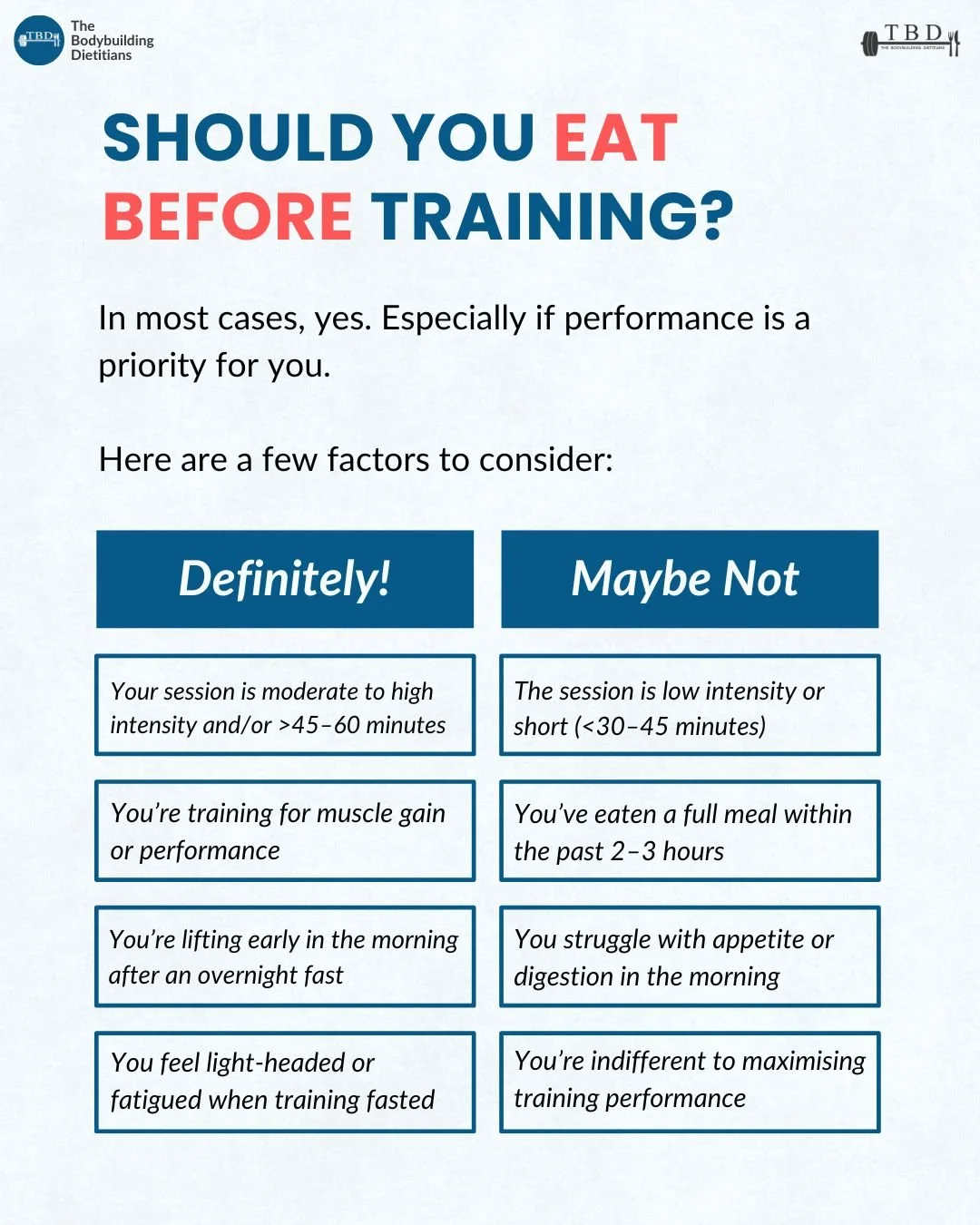
For most people training at moderate to high intensity for 45 minutes or longer, some form of pre-workout nutrition supports performance, muscle retention, and energy availability during the session. The case for eating beforehand becomes more relevant as session intensity, duration, and the performance stakes increase.
The situations where pre-workout nutrition is most clearly beneficial include training sessions that are moderate to high intensity and last more than 45 to 60 minutes, training aimed at muscle gain or performance outcomes where session quality matters to the result, early morning training after an overnight fast where glycogen availability may be reduced, and individuals who regularly experience light-headedness or early fatigue during fasted sessions.
The situations where eating immediately before training is less critical include short or low-intensity sessions lasting under 30 to 45 minutes where glycogen demand is minimal, training that follows a full meal eaten within the past 2 to 3 hours, and individuals who have genuine appetite or gastrointestinal difficulties in the morning that make eating close to training uncomfortable. For someone not specifically prioritising training performance as an outcome, the practical urgency of pre-workout nutrition is lower.
The decision is ultimately a practical one based on how the training session responds to different preparation approaches. Individual variation in how well fasted versus fed training feels is real and worth calibrating over time rather than assumed to follow a universal pattern.
How Much Carbohydrate Should You Eat Before Training?
Carbohydrate is the primary fuel source for high-intensity resistance and cardiovascular training. Glycogen, the stored form of carbohydrate in muscle and liver tissue, is the main substrate that allows high-intensity effort to be sustained across a training session. Pre-workout carbohydrate contributes to glycogen availability before the session begins and provides circulating glucose to support effort during it.
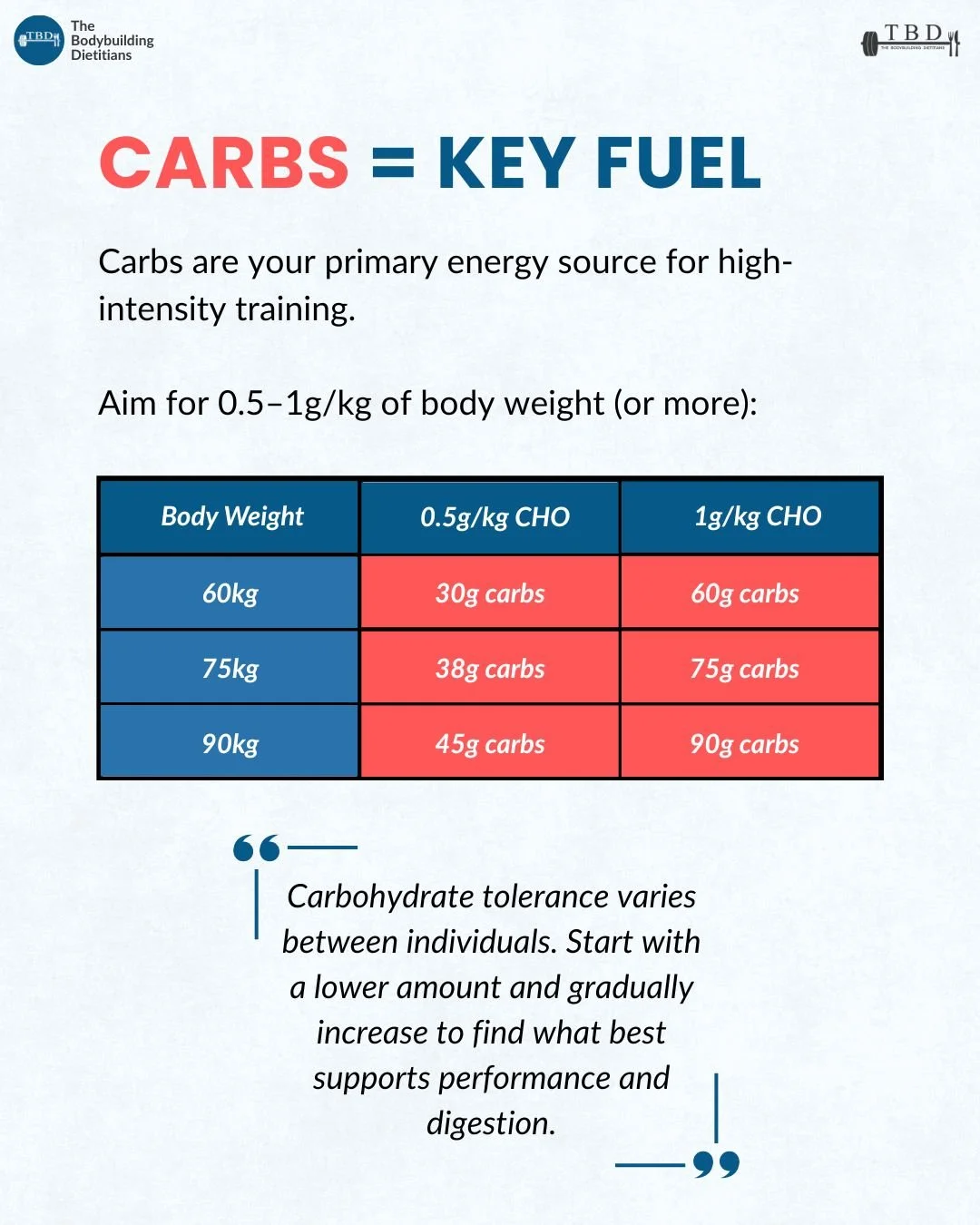
A practical target of 0.5 to 1 gram of carbohydrate per kilogram of bodyweight provides a reasonable starting range for most individuals in the pre-training window. For a 60-kilogram person, this translates to approximately 30 to 60 grams of carbohydrate. For a 75-kilogram person, approximately 38 to 75 grams. For a 90-kilogram person, approximately 45 to 90 grams. Higher amounts may be appropriate for longer or more demanding sessions, and the specific amount that works well will also depend on how much time is available before training and individual digestive tolerance.
Carbohydrate tolerance varies between individuals, and the upper end of these targets may cause gastrointestinal discomfort for some people, particularly when eating close to training. Starting toward the lower end of the range and gradually adjusting based on how performance and digestion respond is a sensible approach to calibrating the amount that works best for a given training context.
How Should Meal Composition Change With Proximity to Training?
The composition of a pre-training meal shifts based on how much time is available before the session begins. The closer to training, the more the meal needs to prioritise rapid digestion and minimal gastrointestinal burden, and the more it should concentrate carbohydrate while reducing fat, fibre, and protein.
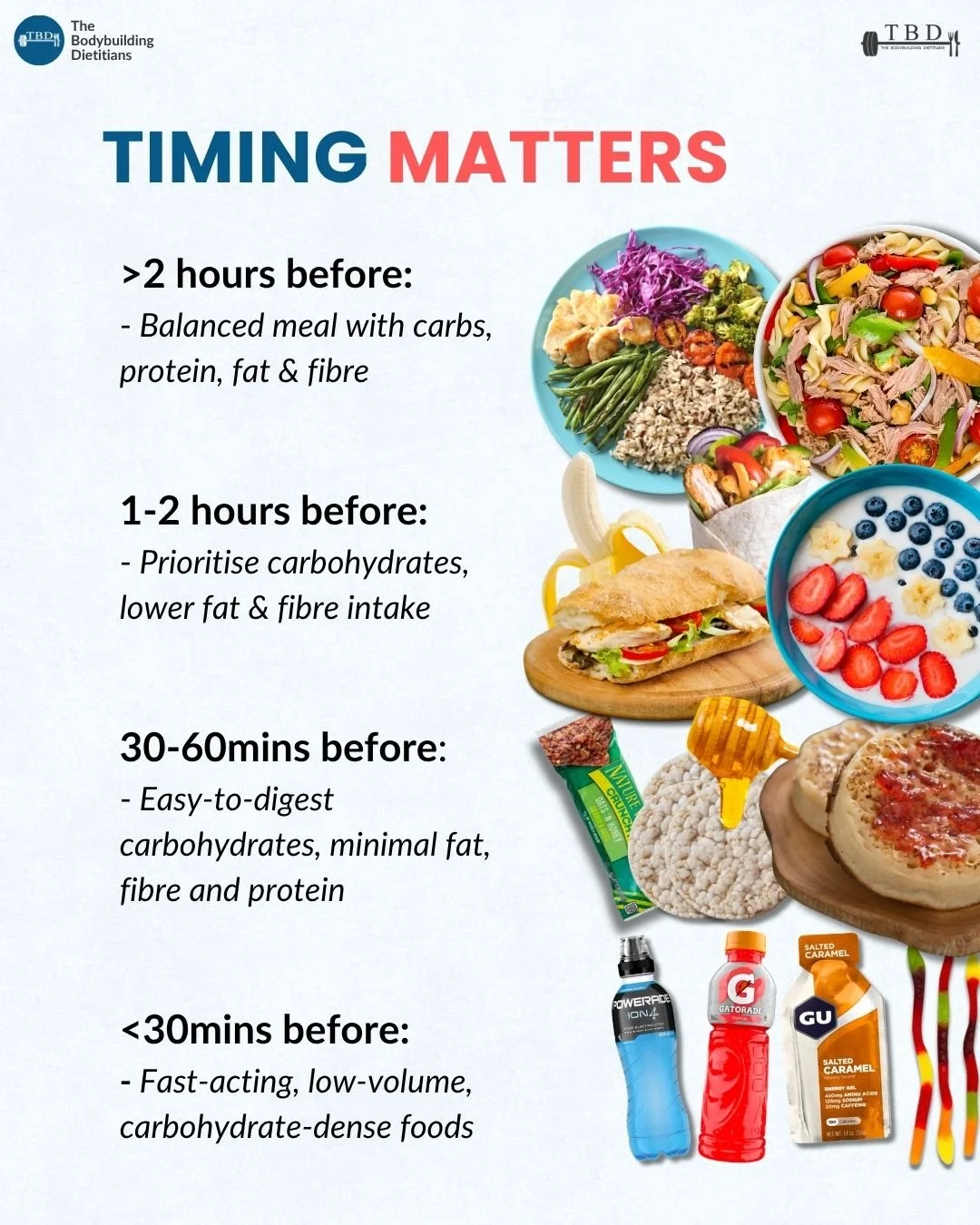
More than 2 hours before training: With more than 2 hours available, a balanced meal containing carbohydrates, protein, fat, and fibre is appropriate and practical. Digestion has sufficient time to process the full range of macronutrients without residual digestive activity coinciding with training. This window accommodates larger meals and allows whole food sources that take longer to digest, making it the easiest window in which to meet pre-training carbohydrate targets without compromise.
1 to 2 hours before training: As the window narrows to 1 to 2 hours, the composition shifts toward carbohydrate priority with reduced fat and fibre. Fat slows gastric emptying and extends the time food remains in the digestive tract, and fibre adds bulk that can contribute to gastrointestinal discomfort during training in some individuals. Keeping both lower in this window makes the meal faster to digest and better tolerated during the session. Protein can still be included but in moderate rather than large amounts.
30 to 60 minutes before training: In the 30 to 60 minute window, the meal should consist primarily of easy-to-digest carbohydrate sources with minimal fat, fibre, and protein. The goal is to provide available fuel with minimal digestive burden during the session. Practical options in this window include rice cakes, crumpets, a banana, white bread, or a small serve of cereal with low-fat milk.
Under 30 minutes before training: In the final 30 minutes before training, fast-acting, low-volume, carbohydrate-dense sources are the most practical choice. Sports drinks, energy gels, lollies, and small amounts of fast-digesting carbohydrate serve the purpose here. The priority is rapid absorption with essentially no digestive load, and food volume should be minimal to avoid any gastric discomfort at the start of the session.
When Are Whole Foods the Better Choice and When Do Refined Carbs Work Better?
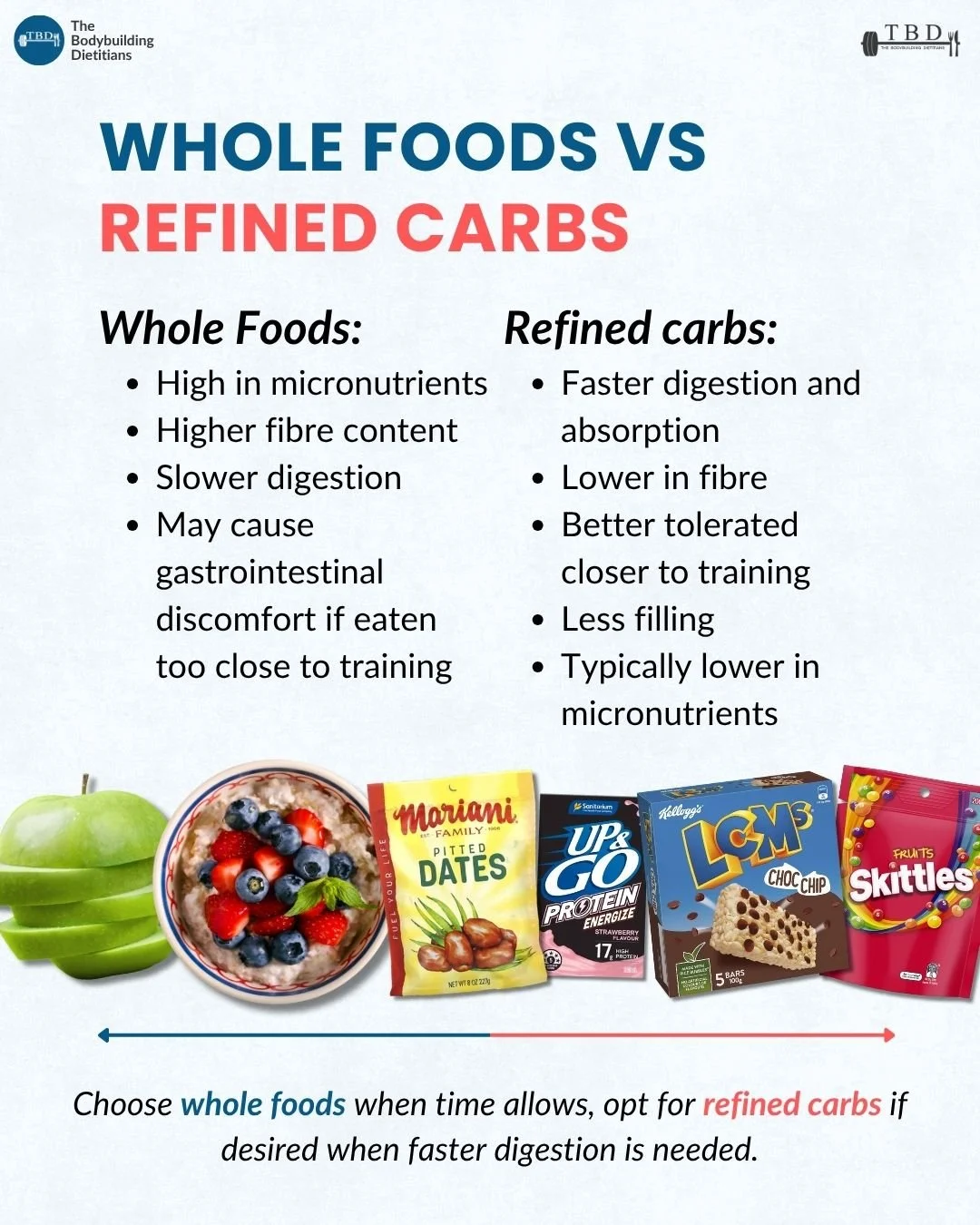
The choice between whole food carbohydrate sources and refined carbohydrate sources in the pre-workout context is largely a matter of timing and digestive tolerance rather than one being categorically preferable to the other.
Whole foods, including oats, fruit, wholegrain bread, and legumes, are higher in micronutrients, higher in fibre, and digest more slowly than refined alternatives. These properties make them ideal for the earlier pre-training windows, where digestion time is available, the slower glucose release supports sustained energy, and the broader nutritional contribution of whole foods is fully captured. The one practical consideration for whole food sources is that their higher fibre content can cause gastrointestinal discomfort in some individuals when eaten too close to training, which shifts the preference toward refined options as the session approaches.
Refined carbohydrate sources, including sports drinks, white bread, rice cakes, low-fibre cereals, and confectionery, digest more quickly and are better tolerated close to training for most individuals. Their lower fibre content and faster absorption make them particularly practical in the 30 to 60 minute and under 30 minute windows, where rapid glucose delivery is the priority and digestive burden needs to be minimised. Using refined carbohydrates strategically in the pre-workout context is appropriate and evidence-supported, and their use in this setting is different from their use across the rest of the day where whole food variety and fibre contribution matter more.
The practical guidance is to choose whole food carbohydrate sources when the timing window allows, and to use refined carbohydrates when the proximity to training makes faster digestion and better tolerance the more relevant consideration.
What Do Common Carbohydrate Targets Look Like in Practice?
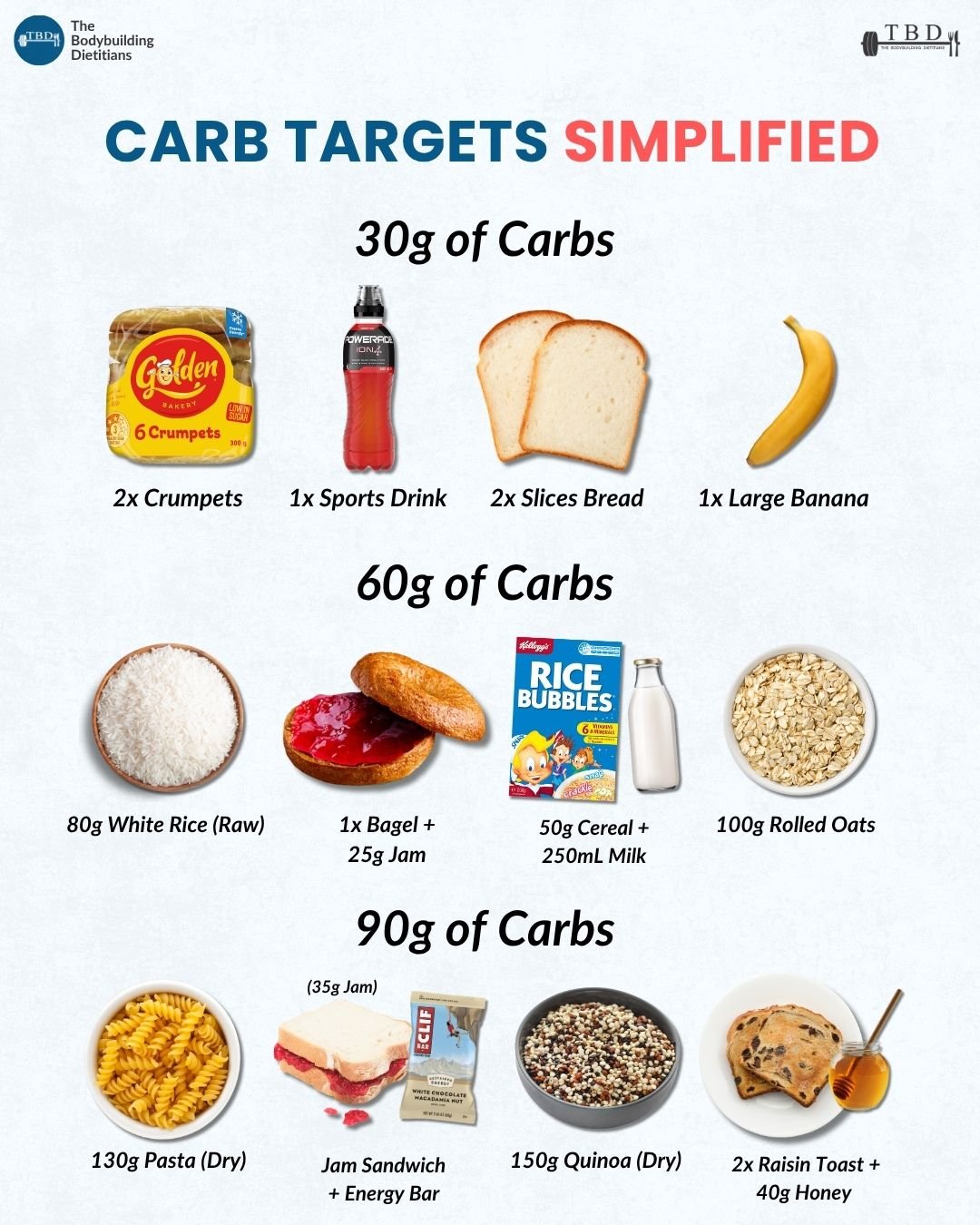
Understanding what 30, 60, and 90 grams of carbohydrate looks like in real food terms makes the target easier to apply without detailed calculation at each meal.
Approximately 30 grams of carbohydrate is provided by 2 crumpets, a 600-millilitre sports drink, 2 slices of white bread, or 1 large banana. This sits at the lower end of the target range and suits smaller individuals, the closer timing windows, or sessions where carbohydrate loading is not a priority.
Approximately 60 grams of carbohydrate is provided by 80 grams of raw white rice, a bagel with 25 grams of jam, 50 grams of cereal with 250 millilitres of milk, or 100 grams of rolled oats. This sits in the mid-range and suits most individuals targeting the 0.5 to 1 gram per kilogram target in the 1 to 2 hour window.
Approximately 90 grams of carbohydrate is provided by 130 grams of dry pasta, a jam sandwich combined with an energy bar, 150 grams of dry quinoa, or 2 slices of raisin toast with 40 grams of honey. This sits at the upper end of the target range and suits larger individuals, longer or more demanding sessions, or situations where a substantial pre-training meal in the 2-plus hour window is appropriate.
These are illustrative examples using common foods rather than fixed prescriptions, and the specific foods that work best will reflect individual tolerance, food preferences, and the rest of the day's intake. How pre-workout carbohydrate is structured within total daily macro targets, and how it shifts across training days and rest days, is part of how we structure nutrition for coaching clients around their training schedule.
Practical Takeaways
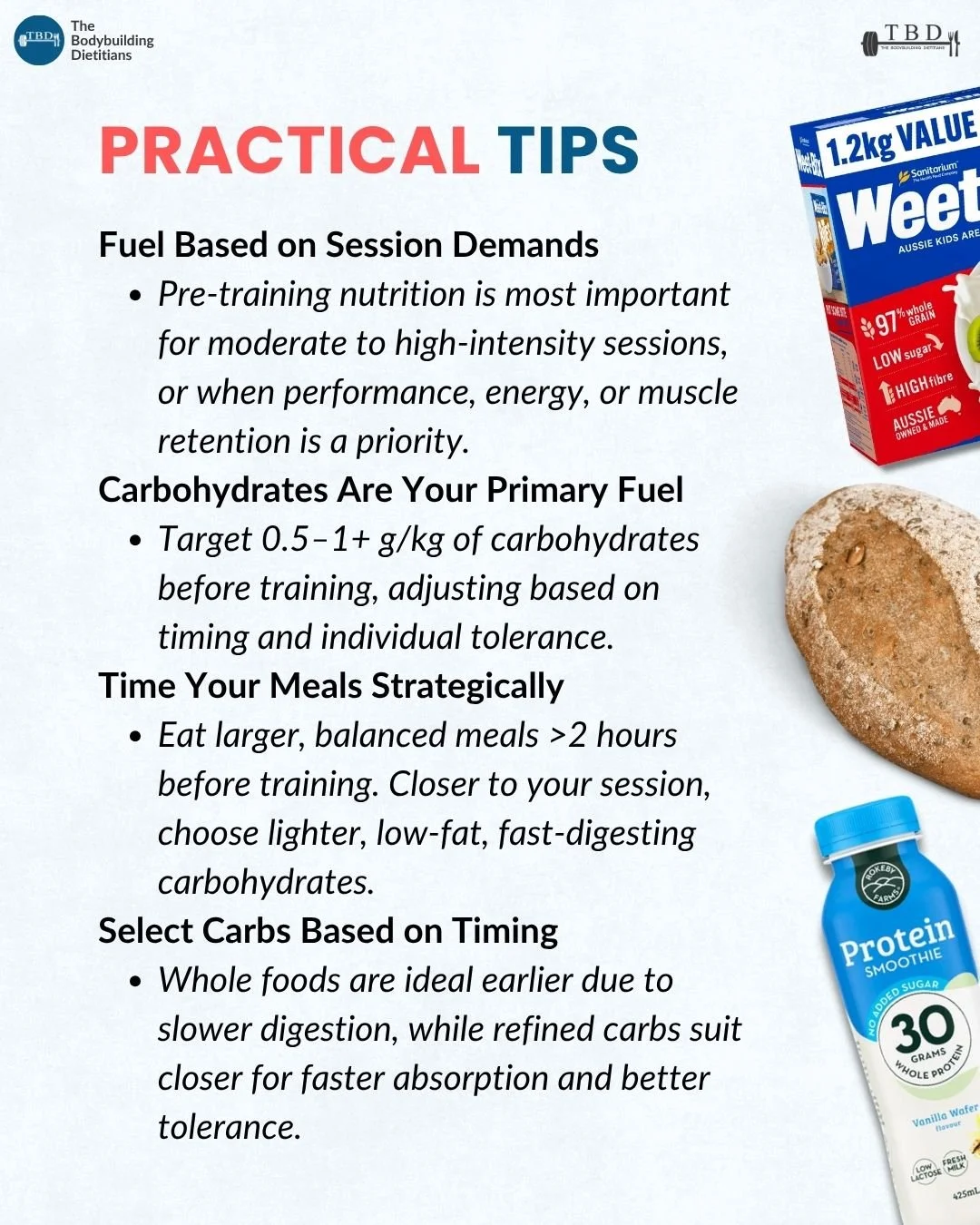
Pre-workout nutrition is most important for moderate to high-intensity sessions lasting 45 minutes or longer, and for training aimed at performance or muscle retention outcomes. Lower intensity or shorter sessions following a recent meal have a lower requirement for deliberate pre-workout nutrition.
Carbohydrate is the primary fuel for high-intensity training. A target of 0.5 to 1 gram per kilogram of bodyweight provides a practical starting range, with the specific amount adjusting for session demands, timing, and individual digestive tolerance.
Meal composition shifts with proximity to training. More than 2 hours out, a balanced meal with carbohydrate, protein, fat, and fibre is appropriate. Closer to the session, fat and fibre are progressively reduced to support faster digestion and better tolerance during training.
In the final 30 minutes before training, fast-acting, low-volume, carbohydrate-dense sources, including sports drinks, energy gels, or small amounts of refined carbohydrate, are the most practical choice.
Whole food carbohydrate sources are ideal earlier due to their nutritional density and slower digestion. Refined carbohydrates suit the closer timing windows where faster absorption and lower gastrointestinal burden are the priority.
Individual digestive tolerance varies considerably. Starting toward the lower end of carbohydrate targets and adjusting gradually based on how performance and digestion respond is a sensible calibration approach.
Frequently Asked Questions
Should you eat before a morning workout?
For moderate to high-intensity morning sessions, eating something before training tends to support performance, energy availability, and muscle retention compared to fully fasted training. The amount and type depends on how much time is available and individual tolerance. In the early morning, easy-to-digest, lower-fibre carbohydrate sources are often more practical than a large balanced meal. For shorter, lower-intensity morning sessions, or for individuals who have no appetite or digestive difficulties first thing, training without eating may be equally effective.
How many carbohydrates should you eat before training?
A target of 0.5 to 1 gram of carbohydrate per kilogram of bodyweight is a practical starting range, which translates to approximately 30 to 60 grams for a 60-kilogram person and 45 to 90 grams for a 90-kilogram person. Larger amounts suit longer or more demanding sessions and the earlier timing windows, while smaller amounts suit the closer windows or situations where digestive tolerance limits intake near training. Individual carbohydrate tolerance varies, and the amount that works best is worth calibrating through practical experience.
How long before training should you eat?
The timing of the pre-workout meal determines its composition as much as the amount. More than 2 hours before training allows a balanced meal with all macronutrients. One to two hours out suits a carbohydrate-focused meal with reduced fat and fibre. Thirty to sixty minutes out suits easy-to-digest carbohydrate sources with minimal fat, fibre, and protein. Within the final 30 minutes, fast-acting, low-volume carbohydrate sources are most practical. The specific timing that works best for a given individual will also be influenced by personal digestive patterns.
Are refined carbohydrates acceptable before training?
Refined carbohydrates including sports drinks, white bread, rice cakes, and fast-digesting snacks are appropriate and evidence-supported choices in the pre-workout context, particularly in the 30 to 60 minute and under 30 minute timing windows. Their faster digestion and lower fibre content make them better tolerated close to training for most individuals. Their strategic use in the pre-workout window is different from their general dietary context, and there is a good practical case for including them when timing and digestive tolerance make them the more appropriate choice.
Is it better to train fasted or fed?
For performance, muscle retention, and session quality, fed training generally produces better outcomes than fasted training for moderate to high-intensity sessions. The research comparing fasted and fed resistance training tends to show modest performance advantages for fed conditions, particularly for longer sessions where glycogen availability becomes a limiting factor. For lower-intensity or shorter sessions, the difference is smaller and individual preference and digestive comfort are more relevant. Individuals who perform well fasted and are not primarily focused on maximising performance may have less to gain from eating before training.
What should you eat before an early morning workout with no appetite?
When appetite is genuinely limited first thing in the morning, prioritising small, easy-to-digest, carbohydrate-dense options tends to be more practical than a full meal. A banana, a small serve of cereal, a slice of toast with honey, a sports drink, or even a small amount of fruit juice provides accessible carbohydrate with minimal digestive demand and is more likely to be tolerated than a larger, more complete meal in the absence of morning appetite. The specific amount that can be consumed comfortably close to training is something to calibrate individually over time.
How pre-workout nutrition is structured around an individual's training times, session intensity, and daily food intake is a key part of what we work through with coaching clients. If you want a nutrition approach built around your specific training schedule and goals, you can enquire about coaching or book a consultation to get started.