Almost every food we consume undergoes some form of processing. A four-tier classification separates minimally processed whole foods from ultra-processed industrial formulations in a way that is considerably more useful than treating processing as a binary concept.
Food processing exists on a spectrum, and the four-tier classification used in most nutrition research separates it more usefully than a simple processed versus unprocessed distinction. Minimally processed foods include fresh produce, raw meat, eggs, milk, nuts, and whole grains, where processing is limited to picking, washing, freezing, or vacuum packing. Processed culinary ingredients include oils, butter, sugar, salt, and flour, derived from minimally processed foods through pressing, milling, or refining. Processed foods are minimally processed foods with salt, sugar, oil, or similar additions for flavour, preservation, or shelf life. Ultra-processed foods are industrial formulations made largely from refined extracts and additives, with little resemblance to original whole food ingredients. The practical concern is the proportion of total diet sitting in the ultra-processed tier, rather than whether any processing has occurred.
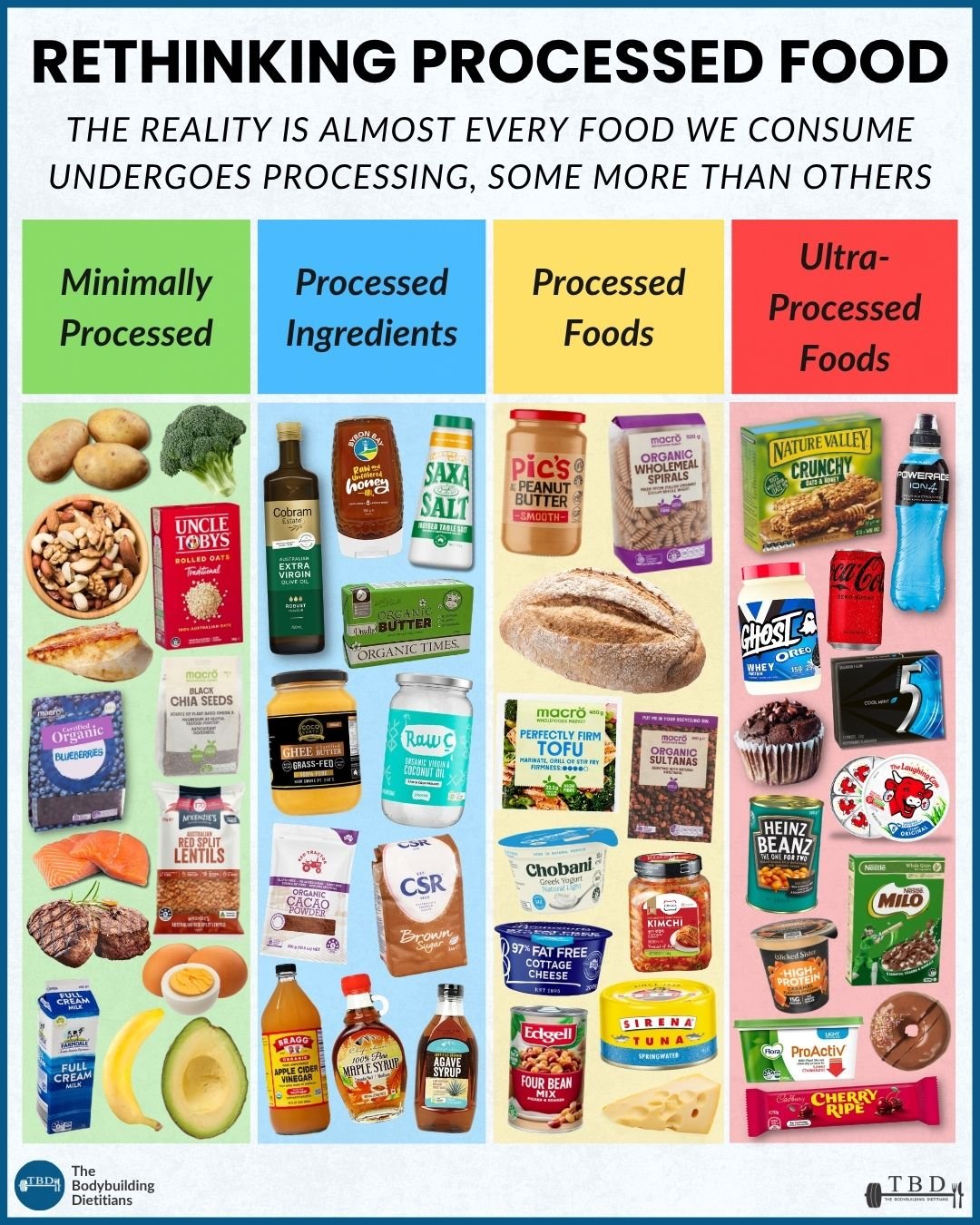
The four-tier food processing classification, from minimally processed whole foods on the left to ultra-processed industrial formulations on the right, with Australian supermarket examples for each category.
The word processed is used loosely in nutrition discussions in a way that lumps together products with very different properties and health implications. Bagged broccoli, rolled oats, strained yoghurt, and a chocolate bar are all processed in some sense, but they sit at entirely different points on the processing spectrum and produce very different dietary outcomes when consumed regularly. The distinction matters practically, and the four-tier classification used in most nutrition epidemiology research is a considerably more useful tool for thinking about food quality than the processed versus unprocessed binary that most food communication relies on.
This framework does not make any food categorically forbidden or categorically ideal. It provides a vocabulary for understanding where a food sits on the processing spectrum and what that placement tends to mean for its nutritional properties, its satiety effects, and its role in the overall diet.
What Is Minimally Processed Food?
Minimally processed foods are whole foods that have undergone only the processing required to make them safe, shelf-stable, or convenient to access, without meaningfully altering their nutritional composition.
The processing at this tier is limited to actions such as picking, washing, peeling, cutting, freezing, pasteurising, vacuum packing, or refrigerating. These processes extend shelf life or reduce contamination risk but do not add ingredients or significantly change the nutritional profile of the original food. Fresh vegetables, raw and frozen fruit, raw meat and fish, eggs, plain milk, whole grains, nuts, seeds, and legumes all sit in this category.
Nutritionally, minimally processed foods retain the intact fibre, micronutrients, and phytonutrients of the original food in their most complete form. The evidence base for dietary patterns built predominantly around minimally processed whole foods is among the most consistent in nutrition research, with strong associations with reduced risk of cardiovascular disease, type 2 diabetes, colorectal cancer, and all-cause mortality across large prospective studies.
Frozen vegetables and fruit occupy this category, which is worth noting because they are often perceived as inferior to fresh. Freezing preserves most micronutrient content effectively, and the frozen option frequently has a longer practical shelf life and lower cost than its fresh equivalent without meaningful nutritional disadvantage.
What Are Processed Culinary Ingredients?
Processed culinary ingredients are substances derived from minimally processed foods through processes including pressing, milling, refining, grinding, or drying. They are rarely consumed on their own and function primarily as components of cooking and food preparation rather than as standalone food items.
Extra virgin olive oil, butter, ghee, coconut oil, table salt, honey, sugar, flour, cacao powder, vinegar, and similar items sit in this category. Each is derived from a minimally processed food through extraction or refining that concentrates specific components: pressing oil from olives or seeds, churning cream to produce butter, milling grain to produce flour, crystallising plant sap to produce sugar.
The health implications of processed culinary ingredients are highly context-dependent. Olive oil used in cooking or dressing provides monounsaturated fats and polyphenols with well-established cardiovascular benefit. The same calorie contribution from highly refined seed oils used in ultra-processed food manufacturing represents a different dietary situation. Salt used in home cooking in moderate amounts is a normal feature of a well-prepared diet. Sodium at the concentrations found in ultra-processed foods, where it functions as a flavour enhancer and preservative at much higher levels, is a different consideration.
The tier is useful for understanding why these ingredients, despite having been processed, are not equivalent to ultra-processed foods: they are single-component extracts from known whole food sources, used in cooking rather than as the primary matrix of industrial food formulations.
What Are Processed Foods?
Processed foods are minimally processed foods with one or more culinary ingredients added for purposes including flavour, preservation, texture, or shelf life extension. They are meaningfully different from ultra-processed foods in that the original food is still recognisable and constitutes the primary ingredient.
Canned beans with salt added, canned tuna in spring water or oil, yoghurt, cheese, kimchi, sourdough bread, wholemeal pasta, peanut butter, tofu, and cured meats sit in this category. Each begins with a whole food ingredient and has undergone processing beyond minimal, but the product remains closely related to its original food source.
The example of peanut butter is illustrative of how the same product name can span tiers. A natural peanut butter with two ingredients, peanuts and salt, sits in the processed food tier. A commercial peanut butter with added refined oils, sugar, and emulsifiers sits closer to the ultra-processed tier despite appearing similar on the shelf. Reading the ingredient list is the practical tool for distinguishing between them, and a shorter ingredient list composed of recognisable food components generally indicates a lower processing level within the same product category.
Fermented foods including yoghurt, kimchi, and kefir occupy this tier and provide gut microbiome benefit through their probiotic content in addition to their nutritional value as dairy or vegetable products. The fermentation process is a traditional form of food preservation that also modifies the food's nutritional properties in ways that are generally beneficial.
Processed foods in this tier are a normal and practical component of a well-structured diet. The processing they have undergone serves genuine functions around food safety, shelf stability, and culinary accessibility without the nutritional concerns associated with ultra-processed formulations.
What Are Ultra-Processed Foods and Why Does the Proportion Matter?
Ultra-processed foods are industrial formulations made largely from substances extracted from foods, including refined oils, starches, proteins, sugars, and fats, combined with additives including emulsifiers, artificial flavours, colour stabilisers, preservatives, and flavour enhancers. The original whole food ingredient is often unrecognisable in the final product, and many ultra-processed foods could not be produced from standard home kitchen ingredients.
Packaged biscuits, soft drinks, sports drinks, flavoured protein supplements, commercial breakfast cereals, mass-produced bread, confectionery, packaged snack foods, commercial sauces, canned baked beans with added sugar and thickeners, and most fast food products sit in this category. The characteristic features are a long ingredient list containing many unfamiliar components, a high palatability engineered for continued consumption, high calorie density, and low fibre and micronutrient content relative to calories.
The health evidence around ultra-processed food consumption is substantial. A large body of epidemiological research links higher ultra-processed food intake with elevated risk of obesity, type 2 diabetes, cardiovascular disease, depression, and all-cause mortality, though the mechanistic pathways are complex and likely involve multiple factors including caloric density, low fibre, high sodium, and the specific additives used. The NOVA classification used in this framework was developed to separate ultra-processed foods as a category specifically because their health associations differ meaningfully from other processed foods, even when calorie and macronutrient content is comparable.
A large prospective cohort study by Monteiro et al. found that each 10 percent increment in the proportion of ultra-processed foods in the diet was associated with a 12 percent increased risk of all-cause cancer, with consistent associations across multiple cancer subtypes.
Source: Fiolet et al., 2018, British Medical Journal.
The practical concern is proportion rather than presence. Ultra-processed foods are present in virtually every dietary environment and their complete elimination is neither realistic nor necessary for most people. The relevant question is what proportion of total energy intake they contribute, and whether that proportion is displacing whole food sources of protein, fibre, micronutrients, and phytonutrients that the diet would otherwise provide. A dietary pattern that draws primarily from the minimally processed and processed food tiers, with ultra-processed foods as occasional rather than dominant components, reflects the balance that population-level research consistently associates with better health outcomes.
How to Use This Framework Practically
The four-tier classification is most useful as a lens for assessing the overall character of the diet rather than as a tool for scrutinising individual food choices. A single ultra-processed food item in the context of a predominantly whole food diet has different implications than the same item in a diet where ultra-processed foods provide the majority of daily energy.
A practical starting point is to assess where the bulk of daily energy is coming from across the four tiers. A diet whose protein sources are primarily minimally processed meats, fish, eggs, legumes, and dairy, whose carbohydrate sources are primarily whole grains, vegetables, and fruit, and whose fats come from minimally processed or processed culinary ingredient sources, will have a nutritional character very different from a diet where the same macronutrient totals are provided primarily through protein bars, processed cereals, commercial sauces, and packaged snack foods.
This is not an argument against all processed or ultra-processed foods. Many people use sports drinks, protein supplements, canned goods, and packaged convenience foods as practical tools within a predominantly whole food dietary pattern, and these uses are reasonable and appropriate. The distinction between using ultra-processed products as occasional conveniences and relying on them as the primary source of energy and nutrients is what determines their dietary significance.
Food processing level is one of several variables that shapes dietary quality alongside macronutrient content, micronutrient density, fibre, food variety, and total energy intake. How the balance of processing level is adjusted relative to a specific person's goals, training demands, and lifestyle constraints is part of how we approach dietary planning with coaching clients.
Practical Takeaways
Almost every food undergoes some form of processing. The relevant distinction is where on the processing spectrum a food sits, not whether it has been processed at all.
The four tiers of food processing are minimally processed foods, processed culinary ingredients, processed foods, and ultra-processed foods. Each tier has distinct nutritional properties and health implications.
Minimally processed foods retain the nutritional composition of the original whole food most completely. Dietary patterns built predominantly around this tier have the strongest evidence base for long-term health outcomes.
Processed foods, including yoghurt, canned tuna, sourdough bread, and peanut butter, are a practical and normal component of a well-structured diet. The original food is still recognisable and constitutes the primary ingredient.
Ultra-processed foods are industrial formulations made from refined extracts and additives with little resemblance to the original food. The practical concern is the proportion of total energy intake they contribute, not their occasional presence in the diet.
The same product name can span tiers depending on the ingredient list. Natural peanut butter with two ingredients sits in the processed food tier; commercial peanut butter with added oils, sugar, and emulsifiers sits closer to the ultra-processed tier.
The framework is most useful for assessing the overall character of the diet across a week rather than for scrutinising individual food choices.
Frequently Asked Questions
What is the NOVA classification of food processing?
The NOVA classification is a four-group system developed by researchers at the University of São Paulo that categorises foods by the nature, extent, and purpose of processing rather than by their nutrient content. The four groups are minimally processed foods, processed culinary ingredients, processed foods, and ultra-processed foods. NOVA is widely used in nutrition epidemiology research because it captures aspects of dietary quality that nutrient-based classifications miss, particularly the distinction between ultra-processed formulations and whole food products with comparable macronutrient profiles.
Are all processed foods unhealthy?
No. The word processed covers a wide spectrum of foods with very different nutritional properties. Yoghurt, canned beans, sourdough bread, and canned tuna are processed foods, and each contributes nutritional value to the diet. The health concerns in the evidence base are concentrated in the ultra-processed tier, characterised by refined extracts, high calorie density, low fibre, and multiple industrial additives. Treating all processing as equivalent obscures this distinction and produces unnecessarily restrictive dietary guidance.
How do I identify ultra-processed foods?
Ultra-processed foods typically have long ingredient lists containing unfamiliar substances that would not be found in a home kitchen, including emulsifiers, artificial flavours, colour stabilisers, humectants, and preservatives. They are often calorie-dense with low fibre and micronutrient content relative to their energy value, and they are designed for high palatability and extended shelf life. A practical check is whether the product could be made at home from standard whole food ingredients. If the answer is no, it is likely ultra-processed.
Is frozen food processed?
Frozen fruit and vegetables are classified as minimally processed foods. Freezing is a preservation method that maintains most of the nutritional content of the original food and does not alter its fundamental composition. Frozen vegetables with added sauces or seasoning blends move toward the processed food tier depending on the additions. Frozen ready meals and commercial frozen products with multiple added ingredients typically sit in the processed or ultra-processed tier depending on their specific composition.
Does the proportion of ultra-processed food in the diet really matter?
Yes, substantially. Large prospective cohort studies consistently associate higher ultra-processed food intake with elevated risk of obesity, cardiovascular disease, type 2 diabetes, depression, and all-cause mortality. The associations hold even after adjusting for total calorie intake and macronutrient composition, suggesting that aspects of ultra-processed foods beyond their energy and macronutrient content are contributing to health risk. Reducing the proportion of ultra-processed foods in the diet is one of the more consistently supported dietary changes in nutrition epidemiology, independent of specific macronutrient targets.
Can protein supplements and sports drinks be ultra-processed?
Yes. Many commercial protein supplements and sports products are formulated with extracted protein concentrates or isolates, artificial flavours, sweeteners, emulsifiers, and other additives that place them in the ultra-processed tier under the NOVA classification. This does not necessarily make them harmful when used appropriately as conveniences within a predominantly whole food diet. The relevant consideration is whether they are supplementing an otherwise nutrient-dense dietary pattern or substituting for whole food protein sources across most of the day's intake.
Working out where a specific person's current diet sits across these tiers, and adjusting the balance based on their goals, training demands, and lifestyle constraints, is part of what we work through with every client. You can enquire about coaching or book a consultation to get started.