Hunger is inevitable during a contest prep, and the competitors who manage it well tend to accept it as a condition of the sport rather than an emergency. This guide covers the practical strategies for working with prep hunger across a twelve to twenty week deficit, the specific patterns that make it worse than it needs to be, and the distinction between hunger and food focus that shapes how sustainable the prep feels.
Hunger during a contest prep is a physiological baseline rather than a signal that anything has gone wrong. Managing it well requires accepting it as a condition of sustained energy deficit and applying practical strategies that reduce its intensity without expecting it to disappear entirely. The most effective approaches include prioritising protein intake toward the upper end of the 1.6 to 3.0 gram per kilogram range, structuring meals around fibrous high-volume foods that maximise satiety per calorie, keeping meal times consistent, front-loading calories earlier in the day, and using mixed macronutrient meals that slow digestion. A parallel skill is managing food focus, the preoccupation with food that intensifies during prep, by limiting exposure to food-focused social media, avoiding hyper-palatable diet foods that can worsen appetite, and reducing meal-plan changes that increase decision fatigue. The distinction between hunger (a physiological sensation) and food focus (a cognitive preoccupation) shapes how sustainable a twelve to twenty week prep actually feels, and the two are managed differently.
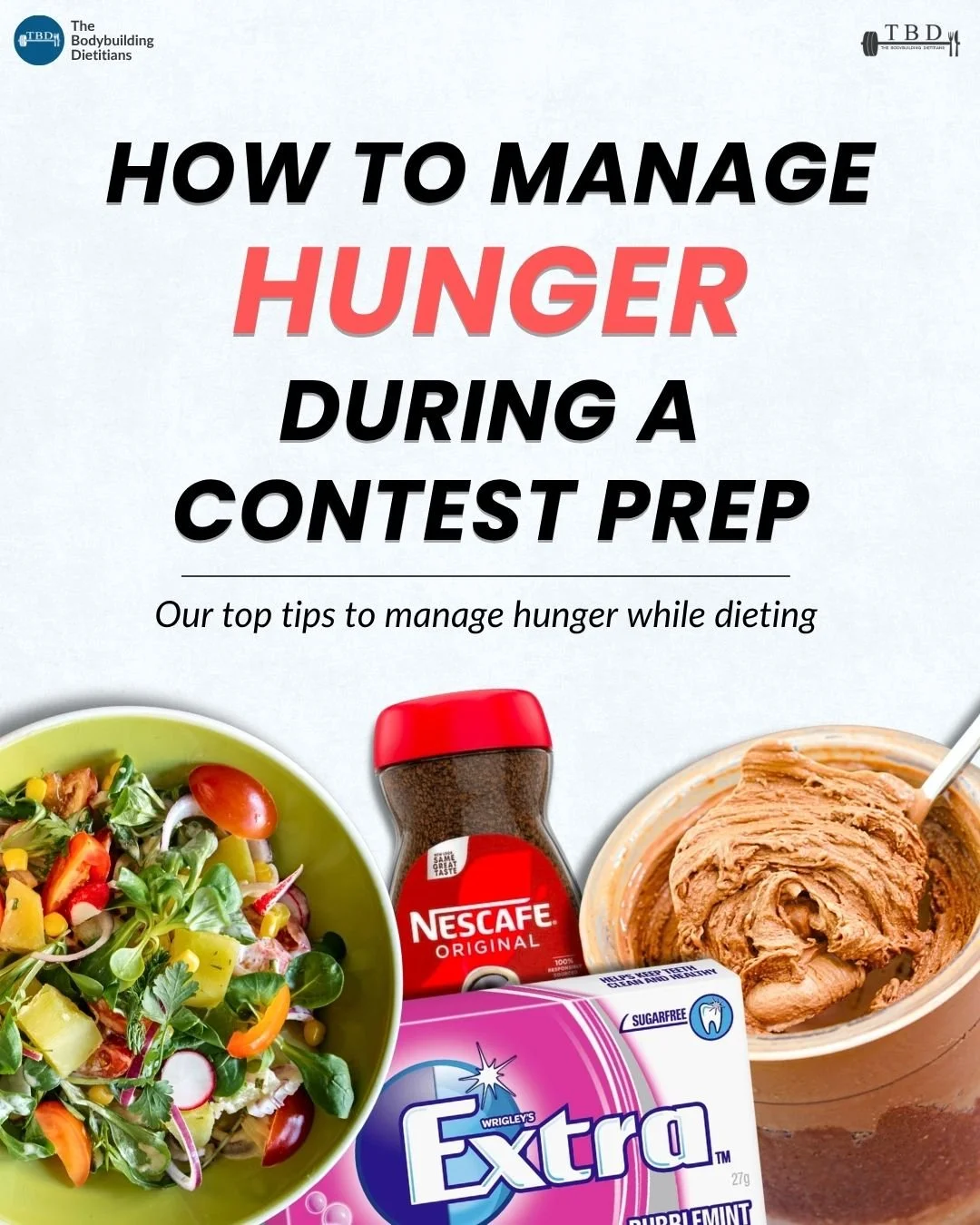
Managing hunger during a contest prep is a skill that develops with experience and deliberate practice. Everyone experiences it eventually, whether it is a first-time competitor learning what a genuine deficit feels like or a pro athlete on their fifteenth prep. The extent varies based on prep length, deficit depth, individual physiology, and food choices, but the presence of some hunger during a sustained deficit is a physiological baseline rather than a failure of preparation, willpower, or dietary strategy.
The competitors who navigate prep hunger well tend to do a few things consistently. They accept it as a condition of the sport rather than an emergency to solve. They structure meals around foods with high satiety-to-calorie ratios. They keep protein and fibre distributed across the day. They protect sleep and manage stress where the training and life context allows. And they stay focused on the outcome they are working toward rather than the sensation they are managing.
None of this makes hunger disappear completely. What it does is reframe hunger as something to work with rather than defeat, which is a more sustainable relationship to have with it across a twelve to twenty week prep. This guide covers the practical strategies that make that relationship possible.
For the broader framework on hunger management that applies across any dieting phase (not specifically contest prep), our practical hunger management article covers the foundational hormonal and behavioural mechanisms in more depth. This article focuses specifically on the prep context where the deficit is deeper, the timeline is longer, and the psychological demands are higher than in a standard fat loss phase.
Why Is Hunger During Contest Prep Different From Regular Dieting?
Contest prep is not a standard fat loss phase, and the hunger characteristics reflect this. Competitors are dieting to a level of body fat below where their physiology would prefer to sit, sustaining that deficit for meaningfully longer than a general fat loss phase, and doing so with performance demands and psychological pressures that do not apply to non-competitive dieting.
Three factors distinguish prep hunger from standard dieting hunger.
Duration. A general fat loss phase might run four to twelve weeks. A contest prep typically runs twelve to twenty weeks, sometimes longer, at progressively lower calorie levels. The cumulative physiological adaptation to sustained restriction is meaningfully greater than in a shorter phase, and the hunger signals intensify rather than plateau as the prep progresses.
Depth. By the final weeks of prep, body fat percentages sit below the range the body would defend at maintenance. Leptin, the hormone that signals fullness and energy status, drops substantially as fat mass declines. Ghrelin, the hormone that signals hunger, rises. The hunger signals in the final month of prep are physiologically distinct from those in early prep because the underlying hormonal state has shifted meaningfully.
Psychological pressure. Standard dieting hunger sits within a life context that has flexibility around adherence. Prep hunger sits within a competitive context where a stage date is fixed, the outcome depends on execution, and the psychological consequences of a lapse in adherence are meaningfully larger than in a non-competitive setting. The same physical sensation carries different weight depending on the context surrounding it.
These three factors compound. The physical hunger is genuinely more intense than in general dieting, and the psychological demands make it feel more consequential. The strategies for managing it need to reflect both, which is why the approaches that work for a four-week cut are often insufficient for a twenty-week prep.
What Is the Difference Between Hunger and Food Focus?
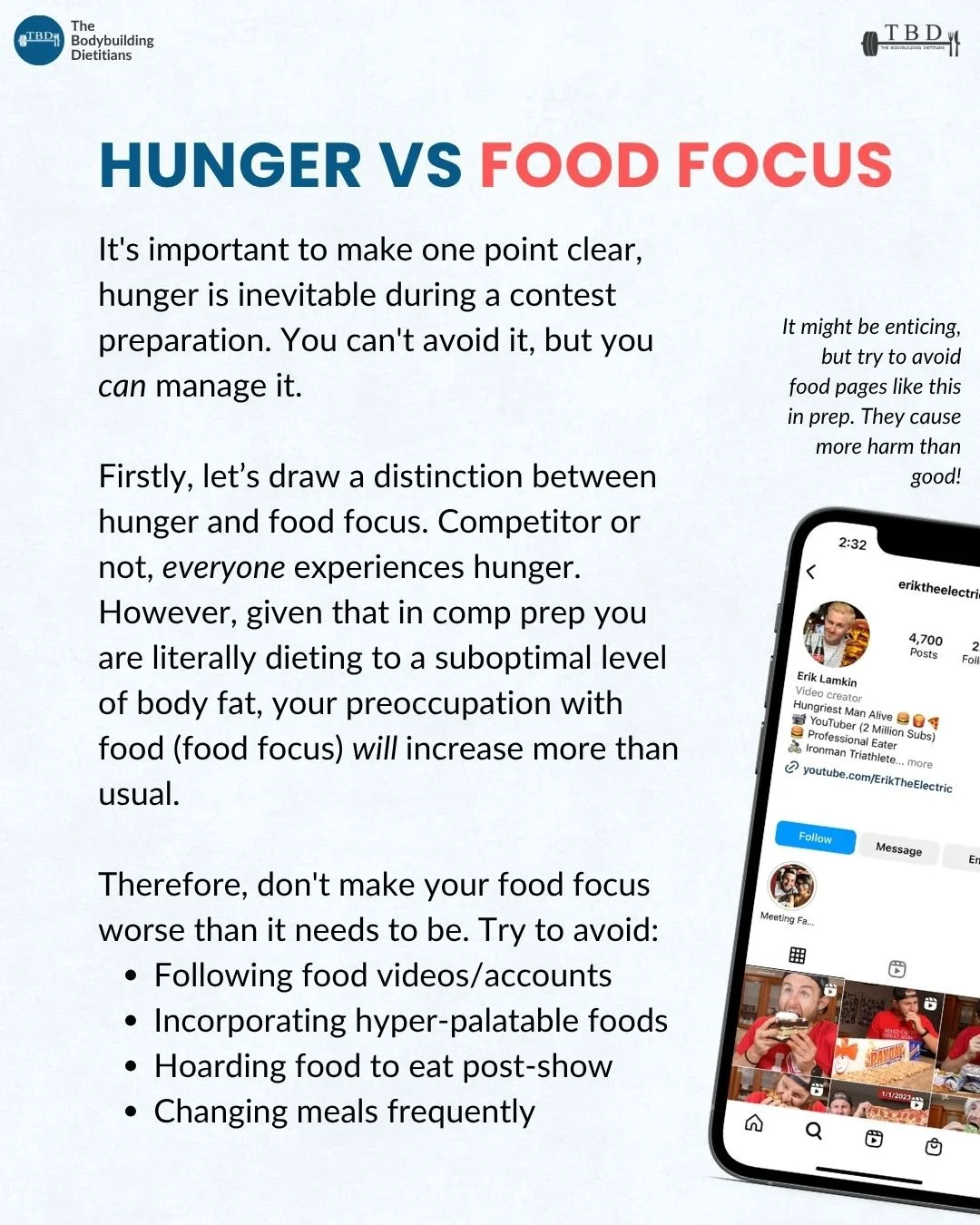
One of the more useful distinctions in prep nutrition is between hunger (the physiological sensation of needing food) and food focus (the cognitive preoccupation with food that intensifies as body fat drops). Both increase during prep, but they are managed differently, and mixing them up tends to make both harder to work with.
Hunger is the physical sensation driven by hormonal signals (ghrelin, leptin, PYY, GLP-1) and by the mechanical state of the stomach and small intestine. It responds to food intake, macronutrient composition, meal timing, and total energy availability. Hunger is genuinely physiological, and while it can be managed and softened through the strategies covered later in this article, it cannot be eliminated during a sustained energy deficit.
Food focus is the cognitive state in which food becomes disproportionately present in the competitor's attention. It manifests as thinking about upcoming meals, planning post-show meals in extensive detail, scrolling food content on social media, watching cooking or eating videos, and structuring the day around meal times more than usual. Food focus is partially physiological (hunger and reduced food intake both drive attention toward food at the neurological level) and partially environmental (what the competitor is exposed to, what habits they build around food during prep).
The distinction matters because food focus is meaningfully more controllable than hunger itself. A competitor cannot decide to stop being hungry, but they can decide to stop following food-focused social media accounts. They can decide not to watch cooking videos in the final month of prep. They can decide not to hoard food to eat post-show. Each of these reduces food focus without pretending to reduce hunger, which produces a more sustainable psychological state through prep even though the physical sensation of hunger remains.
Four specific patterns tend to worsen food focus during prep and are worth avoiding:
Following food videos and food-focused social media accounts. Cooking channels, restaurant reviews, competitive eating content, and general food-focused Instagram or TikTok accounts all drive food attention. During prep, the same content that felt entertaining at maintenance becomes an active source of increased food focus, and the reduction in exposure produces a noticeable psychological benefit within days.
Incorporating hyper-palatable foods. Foods engineered for maximum reward (typical fast food, sugary desserts, ultra-processed snacks) tend to increase rather than decrease food focus, even when they fit macronutrient targets. The reward signal drives continued attention to food rather than satisfying it. Building the diet around less hyper-palatable whole foods reduces this pattern.
Hoarding food to eat post-show. Some competitors keep a running list of foods they plan to eat once prep ends, or physically save specific products for post-show. The intention is to sustain motivation through the deficit, but the practical effect is to keep food consistently present in attention throughout prep. The post-show meal will happen regardless of whether the list is maintained, and the list itself increases food focus during the phases where reducing it would be more useful.
Changing meals frequently. Novelty in meals draws attention. A competitor who cycles through many different meal templates each week tends to have higher food focus than one who eats a repetitive rotation of the same three or four meals. The cognitive load of choosing what to eat, sourcing new ingredients, and evaluating new options all contribute to food attention. Repetition is boring, and boring is exactly what competitor psychology often benefits from at the tail end of prep.
How Do Protein and Fibre Support Hunger Management During Prep?
Protein and fibre are the two dietary variables with the strongest evidence for reducing hunger per calorie, and both become more relevant during prep than in a standard fat loss phase.
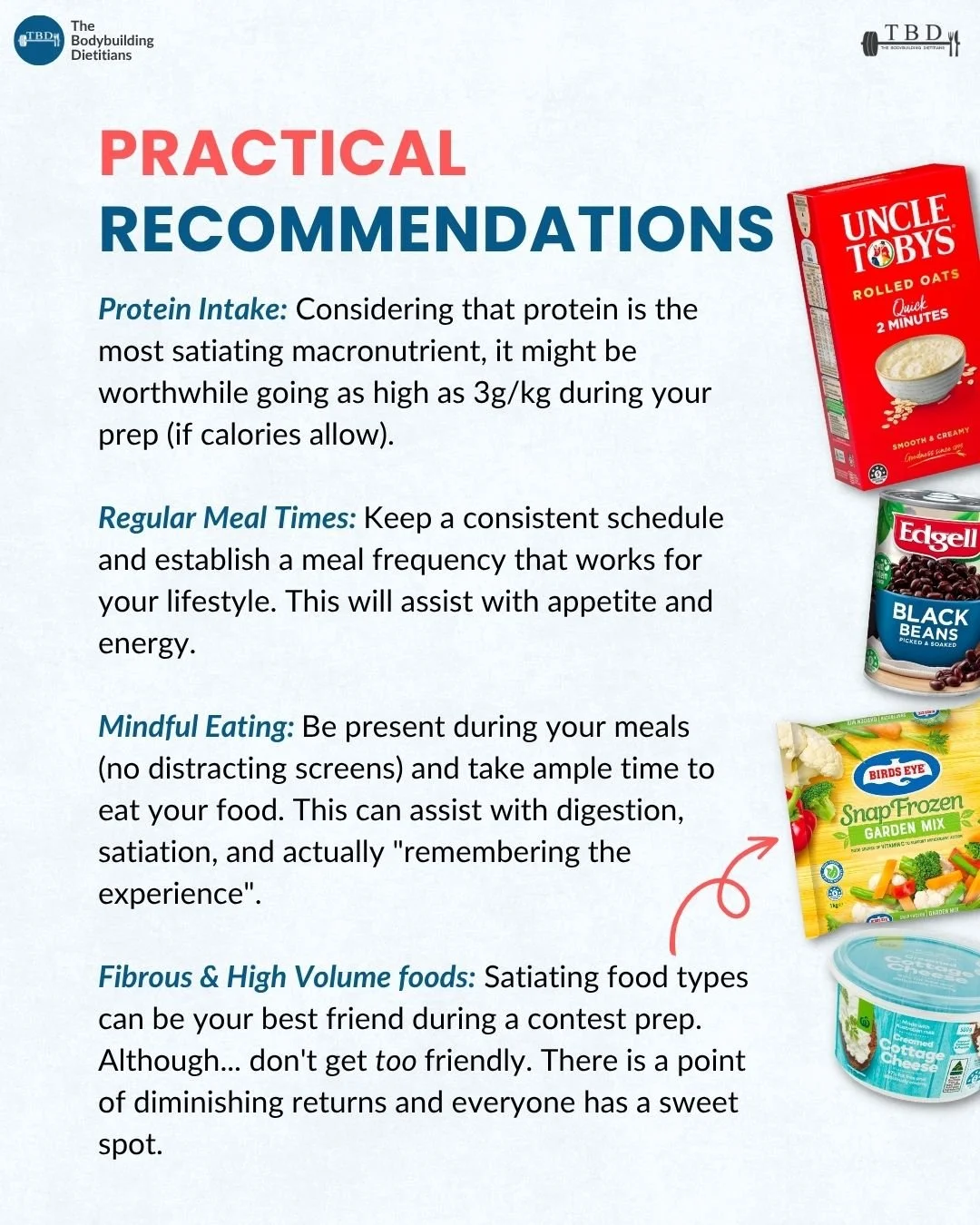
Protein intake. Protein is consistently the most satiating macronutrient in the literature, producing the strongest reduction in hunger and the strongest increase in fullness signals per calorie consumed. During prep, targeting protein toward the upper end of the recommended range (approximately 2.2 to 3.0 grams per kilogram of bodyweight per day) provides both satiety benefits and lean mass preservation, which becomes progressively more important as the deficit deepens.
The 3 grams per kilogram figure is at the upper end of what most research supports, and it is only worth pursuing if calorie targets allow. In the final weeks of prep when calories are tight, hitting 3 grams per kilogram may leave insufficient budget for carbohydrate, which supports training performance and glycogen replenishment. The practical approach is to prioritise protein toward the upper end of the range while preserving enough carbohydrate to sustain training quality, which typically means protein sits at 2.4 to 2.8 grams per kilogram for most competitors.
Fibre intake. Fibrous, high-volume foods are one of the most useful satiety tools during prep. Vegetables (particularly leafy greens, cruciferous vegetables, and stalky vegetables like celery and asparagus), berries, konjac-based products, and other low-calorie high-volume foods provide substantial meal volume and satiety per calorie. Legumes (lentils, chickpeas, beans) contribute both protein and fibre, which makes them particularly useful in prep meals.
There is a point of diminishing returns with high-volume foods, and everyone has a sweet spot. Some competitors experience gastrointestinal discomfort when vegetable and fibre volumes get very high, particularly in the final weeks of prep when digestion tends to become more sensitive. The practical approach is to build meals around fibrous high-volume foods without pushing them past the point of digestive tolerance, which requires some individual experimentation to identify.
Combining protein and fibre in each main meal is more effective for satiety than either variable alone. A meal built around a lean protein source, a fibrous carbohydrate, a serving of vegetables, and a small amount of healthy fat delivers substantially more satiety per calorie than the same macronutrient totals from more processed or lower-fibre sources.
How Should Meal Structure and Timing Support Prep Hunger?
Beyond the macronutrient composition of individual meals, several structural variables around when and how meals are eaten influence hunger through prep.
Regular meal times. Keeping a consistent daily schedule (three to five main meals at similar times each day) supports appetite regulation and energy management. The body adapts to consistent meal timing, which tends to concentrate hunger around expected meal times rather than distributing it throughout the day. Erratic meal timing tends to produce more diffuse and less predictable hunger patterns, which are harder to manage psychologically.
Meal frequency that fits lifestyle. Three larger meals, four moderate meals, or five smaller meals all work in prep, and the choice comes down to what fits the competitor's schedule, training timing, and personal preference. Some competitors do well with fewer larger meals because the larger portion size feels more satisfying. Others do better with more frequent smaller meals because the shorter gaps between meals feel more manageable. Neither is intrinsically better, and the correct choice is the one that supports adherence and quality of life through prep.
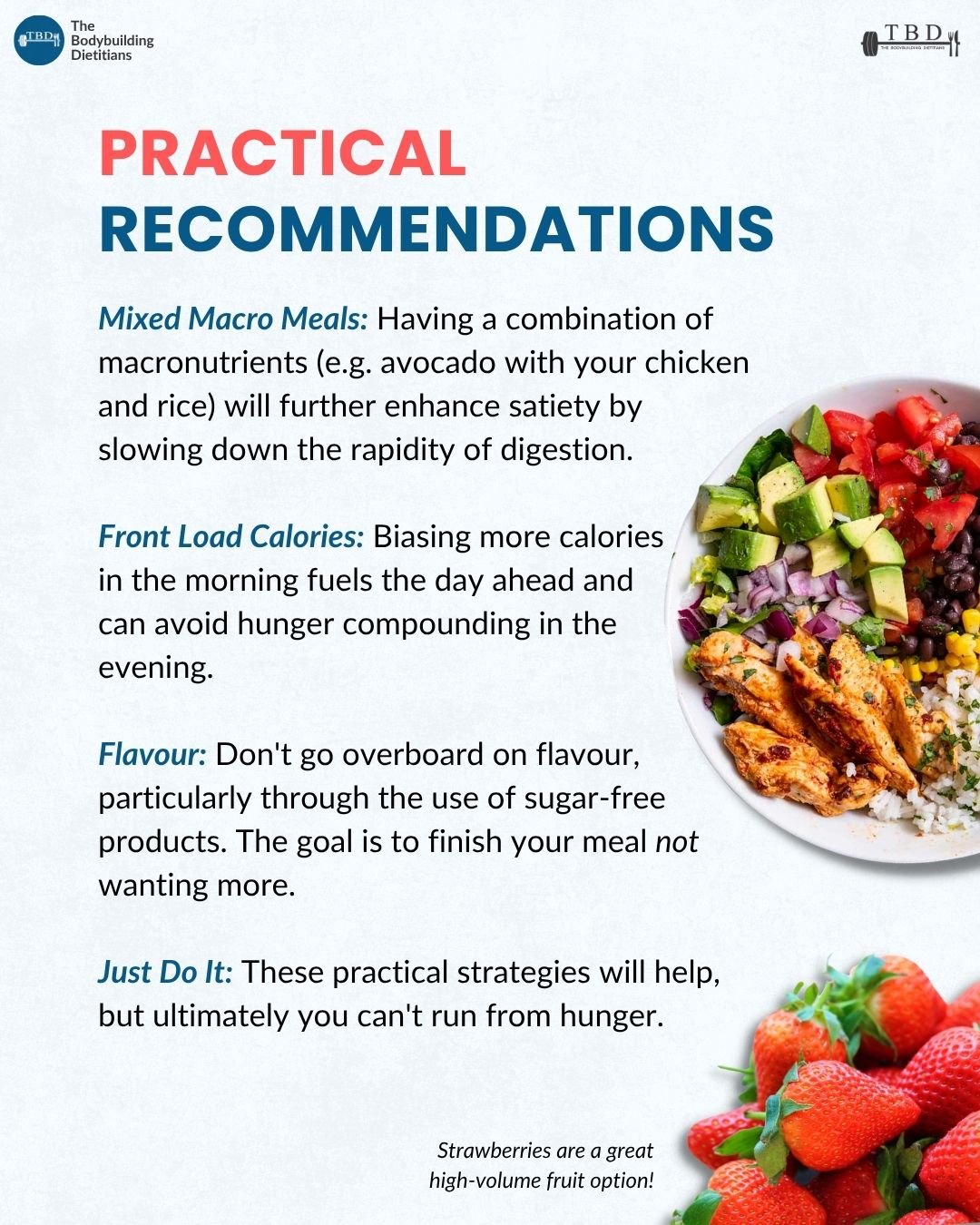
Front-loading calories toward the earlier part of the day. Biasing more of the daily calorie intake toward breakfast and lunch, rather than dinner and evening snacks, fuels the day ahead and reduces hunger compounding in the evening. Many competitors find that if the majority of calories are consumed earlier, evening hunger becomes more manageable than if calories are distributed evenly or weighted toward evening. This is not a universal rule (some competitors prefer larger evening meals for social or lifestyle reasons), but it is worth experimenting with if evening hunger is a specific challenge.
Mindful eating without screen distraction. Being present during meals (without phones, screens, or multitasking) supports digestion, satiation signalling, and the psychological experience of the meal actually happening. Distracted eating tends to produce less satisfying meal experiences because the cognitive and sensory processing of the food is compromised. In the prep context where meals become psychologically important, the practice of eating without distraction tends to make each meal feel more substantial than it would if consumed while scrolling social media or watching content.
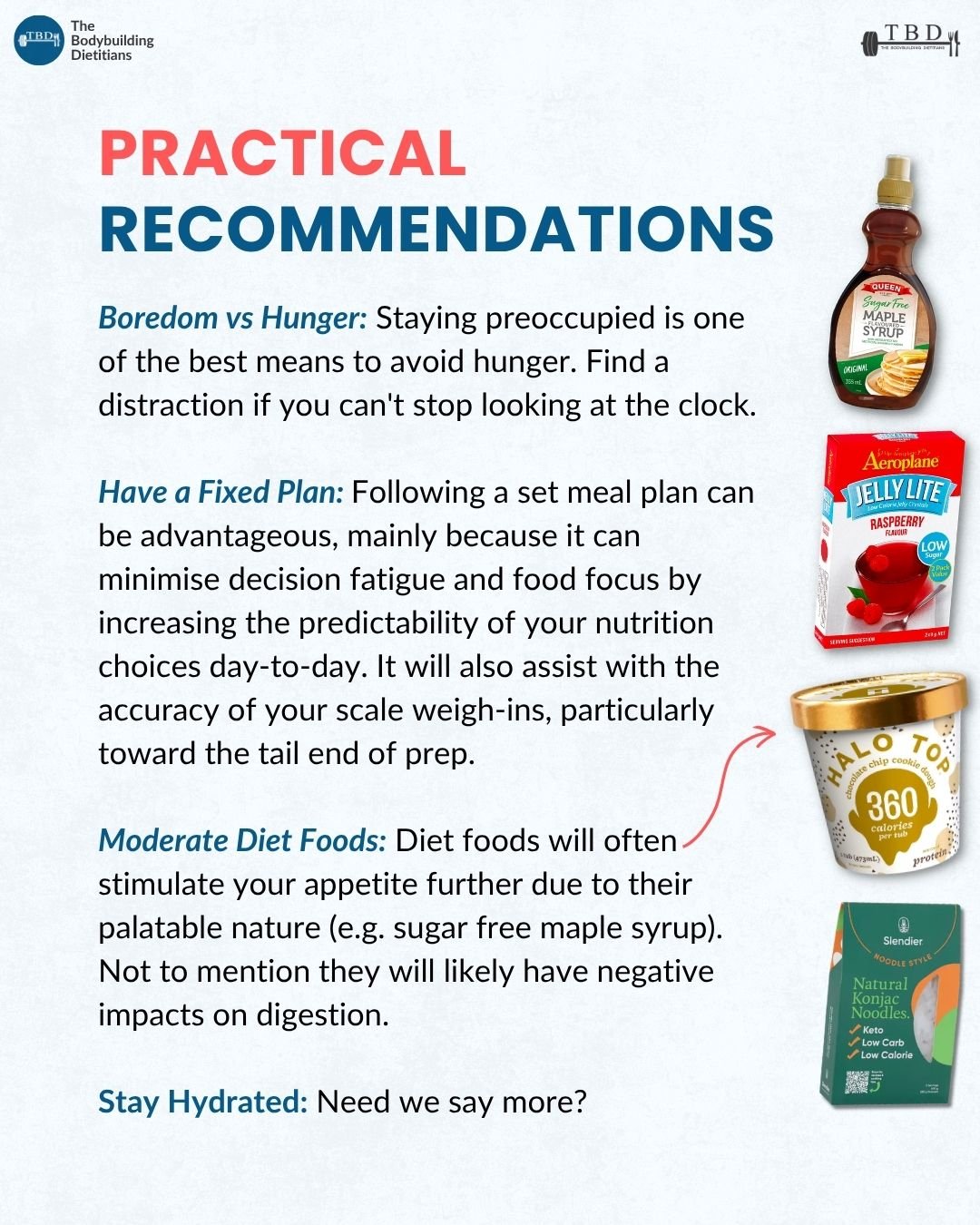
Fixed meal plans over flexible tracking. For most competitors, the trade-off between fixed meal plans and flexible macronutrient tracking shifts in favour of fixed plans during the second half of prep. Fixed plans reduce decision fatigue (one fewer thing to think about every day), reduce food focus (less time spent choosing and planning meals), and improve the accuracy of scale weigh-ins by minimising day-to-day variation in food composition and sodium intake. The final weeks of prep, in particular, benefit from a fixed plan that removes as many variables as possible from the daily routine.
Wondering How to Structure Your Own Prep for the Hunger Ahead?
If you are approaching your first prep, or if previous preps have been harder on hunger and psychological wellbeing than they needed to be, structuring the prep with hunger management built in from the start tends to produce meaningfully better outcomes than trying to manage escalating hunger reactively as it develops. Our team works with competitors on the meal structure, macronutrient distribution, food selection, and phase transitions that make a twelve to twenty week prep as sustainable as it can be, matched to individual context rather than a template.
What Role Do Mixed Macronutrients and Meal Composition Play?
The macronutrient composition of individual meals affects both satiety and the rate at which hunger returns after the meal ends. Two patterns are worth building into prep meal design.
Mixed macronutrient meals slow digestion. Meals that combine protein, carbohydrate, fat, and fibre digest more slowly than meals dominated by a single macronutrient. The slower digestion produces more sustained blood glucose and amino acid levels, which extends the period of satiety after the meal ends. A meal of chicken and rice alone digests more quickly than the same chicken and rice with added vegetables, avocado, and a small serving of legumes.
This does not mean every meal needs to be maximally mixed. Very training-adjacent meals often benefit from faster digestion (higher carbohydrate, lower fibre and fat) to support training performance without gastrointestinal discomfort. The meals further from training benefit more from the mixed macronutrient approach that supports sustained satiety.
Restrained flavour additions. Flavour is important for adherence and enjoyment, but there is a point where flavour enhancement starts to work against satiety by driving continued appetite for more. Ultra-palatable additions (sugar-free syrups, heavily flavoured protein products, engineered diet foods) tend to end meals with the competitor still wanting more rather than feeling satisfied. This is one of the more counterintuitive aspects of prep nutrition, because these products are marketed specifically for prep use, but their palatability profile can work against the goal they are ostensibly serving.
The practical approach is to use flavour additions strategically (herbs, spices, moderate use of low-calorie sauces, appropriate seasoning) without leaning heavily on the most engineered diet products. Meals should be enjoyable, but ending a meal without a strong pull toward more food is a useful marker that the flavour profile is supporting rather than working against satiety.
How Should Diet Foods and Sugar-Free Products Be Used in Prep?
Diet foods and sugar-free products are common in prep diets, and their role is nuanced. They can support adherence by providing variety and perceived indulgence within tight calorie constraints, but they can also worsen hunger and food focus in ways that are worth thinking through.
The specific concerns with heavy diet food use during prep include several patterns worth understanding.
Hyper-palatable diet foods can stimulate rather than satisfy appetite. Sugar-free maple syrup, engineered diet ice creams, artificially sweetened protein bars, and similar products deliver strong reward signals without proportional nutritional density. The reward signal drives continued attention to food rather than satisfying it, which can produce a rebound hunger effect after consumption. This effect is not universal (some competitors tolerate these products well) and depends on individual response.
Gastrointestinal side effects. Many diet foods contain sugar alcohols (erythritol, xylitol, sorbitol, maltitol) or other ingredients that can produce bloating, gastrointestinal discomfort, or altered bowel habits, particularly at higher intakes. During prep when digestion tends to become more sensitive, these effects can be meaningful. Konjac-based products (like konjac noodles) can also cause GI discomfort at higher intakes despite their low calorie profile.
Palatability drift. Regular consumption of ultra-palatable diet products can shift baseline palatability expectations, making unflavoured or minimally flavoured whole foods feel less satisfying by comparison. This can compound food focus and increase psychological difficulty as prep progresses.
The practical framework is to use diet foods in moderation as adherence tools where they genuinely help, rather than as staples that dominate the diet. A serving of sugar-free jelly with dinner or a low-calorie protein ice cream in the evening can support adherence without producing the counterproductive effects that heavier reliance tends to create. The specific tolerance varies by individual, and competitors who notice worsened hunger or food focus after diet food consumption should experiment with reducing the frequency and volume.
For a more detailed look at how different sweeteners and diet food ingredients compare on satiety and digestive effects, our sweeteners comparison article covers the specific categories in depth.
What Other Practical Strategies Support Prep Hunger Management?
Several additional strategies do not fit cleanly under the macronutrient or meal structure headings but are worth including in the overall approach.
Distinguishing boredom from hunger. Prep involves periods of reduced novelty in food, restricted social eating, and general reduction in the pleasure economy of daily life. Boredom can present as hunger even when the physical sensation is genuinely mild. Staying preoccupied through work, training, hobbies, or social activities reduces the frequency with which boredom presents as apparent hunger. Finding a distraction when clock-watching for the next meal is often more effective than trying to work through the hunger through willpower alone.
Staying hydrated. Adequate water intake supports both satiety (through stomach volume and general physiological signalling) and general prep wellbeing. Hunger and thirst signals can be confused, particularly in the middle of prep when both may be present simultaneously. A glass of water before recognising an intense hunger signal often reduces the intensity meaningfully. The specific target varies by body size and training volume, but most competitors do well aiming for 3 to 5 litres per day depending on climate and training demands.
Non-caloric beverages that support meal satisfaction. Coffee, tea, sparkling water, and other zero-calorie beverages can extend the perceived length of a meal or provide something to sip between meals. This is not a substitute for actual food, but it can help bridge the gaps between meals and support the psychological experience of eating occasions.
Sugar-free gum. A small note that sugar-free gum can help with oral fixation during periods of high food focus. The mechanism is partly the mechanical act of chewing and partly the low-level reward signal from the flavour without meaningful calorie content. Individual response varies, and some competitors find that gum increases food focus while others find it reduces it. Worth experimenting with for competitors who have not tried it.
Accepting that hunger will happen anyway. The final strategy is the least tactical but arguably the most important. Even with every strategy in this article applied optimally, hunger will still be present during prep. The competitors who manage it well tend to have accepted this at the start of prep, so the presence of hunger does not create additional psychological stress on top of the sensation itself. Hunger that is understood and expected is meaningfully more sustainable than the same intensity of hunger accompanied by anxiety, frustration, or the sense that something has gone wrong.
For a broader perspective on the psychology of contest prep and the habits that separate well-managed preps from reactive ones, our contest prep habits article covers the behavioural side in depth.
Practical Takeaways
Hunger during contest prep is inevitable and represents a physiological baseline rather than a failure of preparation. Accepting it as a condition of the sport tends to make the prep meaningfully more sustainable than treating it as an emergency to solve.
Distinguish between hunger (the physical sensation) and food focus (the cognitive preoccupation with food). Hunger cannot be eliminated but can be managed. Food focus is more controllable, and reducing exposure to food-focused social media, hyper-palatable foods, and post-show food planning meaningfully reduces prep difficulty.
Prioritise protein intake toward the upper end of the range (2.4 to 2.8 grams per kilogram, up to 3 grams per kilogram if calories allow) for satiety and lean mass preservation. Combine with high-volume fibrous foods for maximum satiety per calorie, within the limits of individual digestive tolerance.
Structure meals with consistent timing, front-loaded calorie distribution earlier in the day, mixed macronutrients that slow digestion, and mindful eating without screen distraction. Fixed meal plans become more valuable than flexible tracking in the second half of prep for decision fatigue and weigh-in accuracy.
Use diet foods and sugar-free products in moderation as adherence tools. Heavy reliance can worsen hunger through ultra-palatable reward signals and produce gastrointestinal side effects that are more meaningful during prep than at maintenance.
Adequate hydration, distinguishing boredom from hunger, non-caloric beverages, sugar-free gum, and staying preoccupied through work and hobbies all support hunger management alongside the dietary strategies.
Frequently Asked Questions
Is hunger during contest prep avoidable?
No. Hunger is a physiological baseline during any sustained energy deficit, and contest prep involves a deeper and longer deficit than standard dieting. The strategies in this article reduce the intensity of hunger and improve how sustainable prep feels, but they do not eliminate it. Accepting hunger as a condition of the sport tends to make it meaningfully easier to manage than treating it as a signal that something has gone wrong.
What is the difference between hunger and food focus?
Hunger is the physical sensation of needing food, driven by hormones (ghrelin, leptin, PYY, GLP-1) and by the state of the digestive tract. Food focus is the cognitive preoccupation with food that intensifies as body fat drops during prep, manifesting as increased thinking about food, planning around meals, and attention to food content. Both increase during prep, but food focus is more controllable through the reduction of food-focused social media, hyper-palatable foods, and post-show food planning.
How much protein should I eat during contest prep?
Research supports intakes of 2.4 to 3.0 grams of protein per kilogram of bodyweight per day during contest prep, with the upper end of this range appropriate when calories allow and lean mass preservation is a priority. Protein is the most satiating macronutrient, so higher intakes support both muscle retention and hunger management. In the final weeks of prep when calories are tight, protein may sit slightly lower to preserve enough carbohydrate for training performance, typically around 2.4 to 2.6 grams per kilogram.
Should I use a fixed meal plan during contest prep?
Fixed meal plans tend to become more valuable in the second half of prep than at the start. They reduce decision fatigue, minimise food focus by removing daily meal choices from consideration, and improve the accuracy of scale weigh-ins by reducing day-to-day variation in food composition and sodium intake. The trade-off is reduced flexibility, so the transition from flexible tracking to a fixed plan often happens partway through prep rather than at the start.
Do diet foods and sugar-free products help with prep hunger?
Diet foods can help with adherence when used in moderation as psychological tools within tight calorie constraints. Heavy reliance on ultra-palatable diet products can worsen hunger by delivering strong reward signals without proportional satiety, and can produce gastrointestinal discomfort through sugar alcohols and other ingredients. The practical approach is to use them strategically as small additions rather than as staples that dominate the diet.
What foods are most useful for managing prep hunger?
Foods with the highest satiety per calorie tend to be highest in protein, high in fibre and volume, and lower in energy density. Practical options include lean protein sources (chicken breast, lean fish, egg whites, low-fat Greek yoghurt, cottage cheese), high-volume vegetables (leafy greens, cruciferous vegetables, stalky vegetables), berries and other high-volume fruit, legumes (lentils, chickpeas, beans), and mixed macronutrient meal templates that combine these categories. Konjac-based products can also help with volume within calorie constraints, though tolerance varies.
If you are preparing for a competition and want structured guidance on managing hunger, food focus, and the psychological demands of a twelve to twenty week prep, our team can build a plan that fits your training, timeline, and individual context. You can enquire about bodybuilding coaching or book a consultation with our team.