A dietitian compares BCAAs, essential amino acids, and whey protein isolate on amino acid composition, muscle protein synthesis response, and practical value, with a framework for deciding which supplement (if any) is worth the spend.
Branched-chain amino acids (BCAAs) stimulate muscle protein synthesis, but the response sits below what a complete essential amino acid source produces and further below what whey protein produces at typical serving sizes. Research shows a 5.6-gram BCAA dose increases muscle protein synthesis by approximately 22 percent post-exercise, while a 20-gram whey protein dose produces roughly a 37 percent increase, and the same author noted BCAA responses were approximately 50 percent lower than whey doses containing similar BCAA amounts. For lifters already consuming adequate daily protein (1.6 to 2.2 grams per kilogram of bodyweight from whole food sources), BCAA supplementation adds very little because the amino acids they provide are already being delivered by dietary protein throughout the day. Essential amino acid (EAA) supplements provide the complete amino acid profile needed for a full muscle protein synthesis response, and whey protein isolate delivers the same complete profile with more total protein per serving and lower cost. The situations where BCAAs remain a reasonable choice are narrow, and in most cases another option performs the same job more effectively.
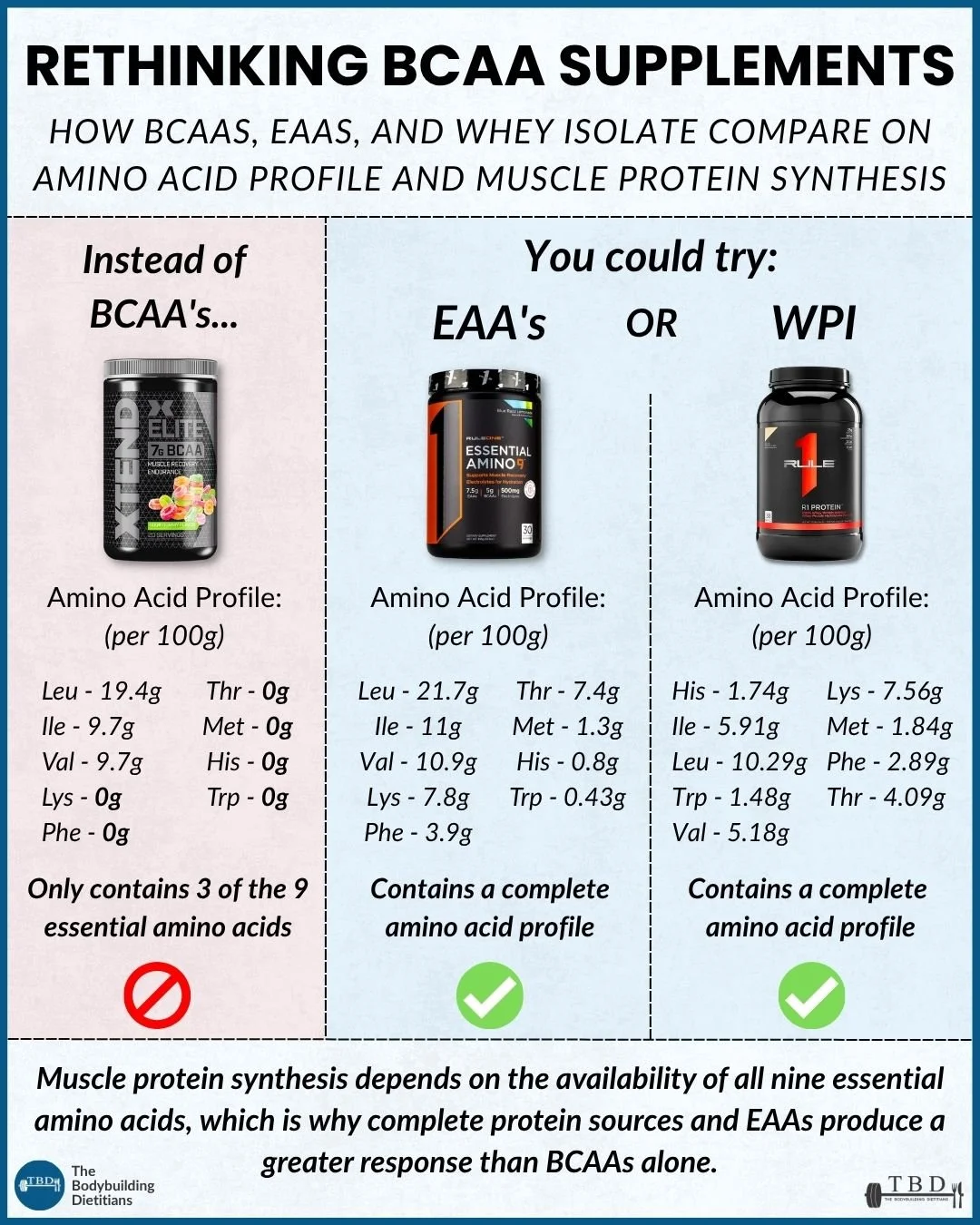
A comparison of amino acid profiles across BCAAs, EAAs, and whey protein isolate per 100 grams. Complete protein sources and EAAs contain all nine essential amino acids required to support the full muscle protein synthesis response, while BCAAs contain only three.
Branched-chain amino acid supplements have occupied a durable position in the lifting supplement industry for several decades, with most gym-goers having taken them at some point either on their own or bundled into a pre-workout or intra-workout product. The core marketing claim, that BCAAs support muscle recovery and muscle protein synthesis, is directionally accurate. The more useful question is not whether BCAAs work at all, but whether they add anything worthwhile when placed alongside two closely related alternatives: essential amino acid (EAA) supplements and whey protein isolate.
Understanding how these three options compare on amino acid composition, the muscle protein synthesis response they produce, and their practical value per dollar allows a clearer decision about which (if any) belongs in a lifter's supplement stack. For most people already consuming adequate daily protein, the answer changes what a sensible supplement approach looks like.
What Are BCAAs, EAAs, and Whey Protein Isolate?
The three products discussed in this article target the same broad goal, supporting muscle recovery and growth, but they differ substantially in what they actually contain.
Branched-chain amino acids (BCAAs) are a group of three specific amino acids: leucine, isoleucine, and valine. These three share a similar branched molecular structure and are grouped together because they are metabolised differently to other amino acids, with a substantial proportion oxidised in skeletal muscle rather than in the liver. Leucine in particular has been the subject of extensive research due to its role in triggering muscle protein synthesis through the mTORC1 signalling pathway.
Essential amino acids (EAAs) are the nine amino acids that the body cannot synthesise from other amino acids and must therefore obtain from dietary protein. They include the three BCAAs (leucine, isoleucine, valine) plus lysine, threonine, methionine, phenylalanine, histidine, and tryptophan. An EAA supplement provides all nine, typically in ratios matched to the requirements for maximising the muscle anabolic response.
Whey protein isolate is a complete protein derived from milk, containing all nine essential amino acids alongside non-essential amino acids in a naturally occurring balance. Whey isolate is the most refined form of whey (typically 90 percent or higher protein by weight), with lactose and fat largely removed during processing. It has a high leucine content, rapid absorption profile, and consistent bioavailability, which has made it the most researched protein supplement in the sports nutrition literature.
Muscle protein synthesis is the biological process through which dietary protein and resistance training stimulate the repair and growth of skeletal muscle, and it is the primary mechanism through which any of these three supplements is intended to work.
How Do BCAAs, EAAs, and Whey Compare on Amino Acid Profile?
The most important difference between the three options is completeness. Muscle protein synthesis requires all nine essential amino acids to be available for the body to build new muscle tissue, and this requirement is what determines how effectively each supplement can support the anabolic response.
A typical BCAA supplement provides approximately 19 grams of leucine, 10 grams of isoleucine, and 10 grams of valine per 100 grams of product, with zero grams of the other six essential amino acids. This means BCAAs alone can only supply three of the nine amino acids the body needs to fully drive muscle protein synthesis, with the remaining six needing to come from other dietary sources or from the amino acid pool released through protein breakdown.
A typical EAA supplement provides all nine essential amino acids in a balanced ratio, with leucine still at the highest proportion (approximately 22 grams per 100 grams) but with meaningful amounts of the other six as well. This complete profile provides the substrate needed for muscle protein synthesis to run at its full rate without requiring the body to draw on other sources for the missing amino acids.
Whey protein isolate provides a naturally occurring complete profile including all nine essential amino acids plus non-essential amino acids. The leucine content is lower per gram of product than in a BCAA or EAA supplement (approximately 10 grams per 100 grams of whey isolate), but the total protein content per serving is substantially higher because each gram of whey delivers a complete profile rather than a concentrated subset.
The practical implication is that BCAAs, EAAs, and whey all deliver leucine (the primary trigger for muscle protein synthesis), but only EAAs and whey deliver the complete set of building blocks needed for the body to complete the synthesis process at maximum rate.
What Does the Research Show About BCAAs and Muscle Protein Synthesis?
BCAAs do stimulate muscle protein synthesis. The response is measurable, consistent across studies, and mechanistically explained by leucine's role in activating the mTORC1 pathway. The more important question is how large that response is compared to complete protein sources.
A study in resistance-trained men found that ingesting 5.6 grams of BCAAs immediately after resistance exercise increased myofibrillar muscle protein synthesis by approximately 22 percent compared to placebo. The authors noted that this response was approximately 50 percent lower than the muscle protein synthesis response previously reported for whey protein doses containing similar amounts of BCAAs. Source: Jackman et al., 2017, Frontiers in Physiology, 8:390.
The 22 percent figure sits meaningfully below the response produced by complete protein sources at typical serving sizes. Research on whey protein has shown that a 20-gram serving post-exercise produces a myofibrillar muscle protein synthesis response of approximately 37 percent above placebo, roughly 50 percent greater than the BCAA response despite delivering a comparable amount of BCAAs alongside the other essential amino acids.
Post-exercise ingestion of 20 grams of whey protein isolate produced a 37 percent greater myofibrillar muscle protein synthesis response compared to placebo in resistance-trained men. The response scaled with protein dose up to approximately 20 grams, at which point the response reached a plateau in the acute post-exercise window. Source: Witard et al., 2014, American Journal of Clinical Nutrition, 99(1):86-95.
EAA supplements sit between these two positions. Because they contain the complete essential amino acid profile, they produce a stronger muscle protein synthesis response than BCAAs alone. The response tends to be similar to or slightly below that of a complete protein like whey at matched EAA content, though the specific comparison depends on dose and study design.
The clear picture across the literature is that BCAAs alone produce a submaximal response, EAAs produce a stronger response due to the complete profile, and whey protein delivers a similar or slightly stronger response than EAAs at matched EAA content. The gap between BCAAs and complete sources is not marginal; it is meaningful enough to change the practical recommendation.
Why Do Complete Essential Amino Acids Produce a Stronger Response Than BCAAs Alone?
The mechanistic explanation for the response gap is straightforward. Muscle protein synthesis is a construction process that requires all nine essential amino acids to be present in adequate amounts. Leucine acts as the primary signalling trigger through the mTORC1 pathway, but once the pathway is activated, the body needs the full set of building blocks to actually assemble new muscle tissue.
When BCAAs are consumed in isolation, the leucine signal is delivered strongly, and muscle protein synthesis is activated. The response is limited, though, because the body must source the other six essential amino acids from somewhere. Some come from the amino acid pool in the blood (which is continuously supplied by breakdown of existing body proteins), and some come from any recent meals still being digested. The result is that muscle protein synthesis can proceed, but at a submaximal rate because the substrate availability is incomplete.
When a complete EAA supplement or whey protein is consumed, leucine still triggers the response, but the other essential amino acids arrive alongside it in adequate amounts. Muscle protein synthesis proceeds at its full rate for the duration of the elevated amino acid availability.
This is why the difference between BCAAs and complete sources is not primarily about the signalling side (leucine content is similar or often higher per gram in BCAA supplements) but about the substrate side (the availability of the other essential amino acids to complete the construction process).
For a more detailed look at how amino acids flow through the body's shared amino acid pool and are allocated across multiple protein synthesis demands, our article on protein metabolism covers the underlying pathway in depth.
Do BCAAs Add Anything When Daily Protein Intake Is Adequate?
For anyone already eating adequate daily protein from whole food sources, BCAA supplementation adds very little to the muscle protein synthesis response across the day.
The reasoning is that the amino acids BCAAs provide are already being delivered by the whole protein foods being consumed. A lifter eating 1.6 to 2.2 grams of protein per kilogram of bodyweight per day from meat, fish, eggs, dairy, or well-combined plant sources is consuming plentiful leucine, isoleucine, and valine throughout the day, alongside the other essential amino acids required for the full muscle protein synthesis response. Adding a BCAA supplement provides more of just three of the essential amino acids, which does not raise the ceiling on the muscle protein synthesis response because the ceiling is set by the completeness of the amino acid profile, not by the absolute amount of BCAAs specifically.
The commonly cited rationale for BCAA use in the fasted or intra-workout window (that BCAAs prevent muscle breakdown during training) is also less compelling than it once appeared. Research on training in the fasted state suggests that any acute increase in muscle protein breakdown during a workout is small relative to the total daily protein turnover, and it is more than compensated for by post-workout intake of a complete protein source. For lifters training after a recent meal (within 4 to 6 hours), the amino acids from that meal remain in circulation and continue supplying the muscle throughout the training session and into recovery, making intra-workout supplementation of BCAAs largely redundant.
The practical result is that a lifter taking BCAAs while already meeting their daily protein target is spending money on a product that duplicates something they are already getting from food. The muscle protein synthesis response for the day is not meaningfully improved, and the calorie contribution from the BCAA drink (typically minimal) is not fulfilling any nutritional gap. The BCAA supplement occupies budget that could be redirected toward whole food protein, a complete supplement, or supplements with clearer evidence of benefit like creatine.
Are You Getting Value From Your Current Supplement Stack?
If you have been taking BCAAs (or a broader supplement stack) for years without a clear framework for why each product is in it, you are in the position most lifters find themselves in at some point: spending steady money on supplements chosen through habit or industry defaults rather than evidence. The question of which supplements are actually earning their place in the stack is one of the more common conversations we have with new coaching clients, particularly those who have accumulated a rotation of products over several training cycles.
Our team works with lifters to audit and rebuild their supplement approach based on their individual goals, phase of training, and where their diet actually sits, rather than a generic recommended list. This individualised approach tends to reduce the total supplement spend while improving the effectiveness of what remains.
When Might BCAAs Still Make Sense?
The context where BCAAs remain a defensible supplement choice is narrow, and in most cases another option performs the same job more effectively.
Intra-workout amino acid delivery: Some lifters prefer the taste and mouthfeel of BCAA products during training over whey shakes, and the light, sweet formulations can be more palatable across a long session than a protein shake. For this use case, EAAs cover the same intra-workout niche with a complete amino acid profile, making them a better choice than BCAAs on almost every measure except cost per serving (BCAAs are typically slightly cheaper per serving than EAAs, though both are more expensive per gram of protein than whey isolate). The intra-workout window itself is also better served by carbohydrate than by additional protein when total daily protein intake is adequate.
Prolonged fasted training: Lifters training in a genuine fasted state (over 6 hours since the last protein-containing meal, which is uncommon for most lifters) may benefit from some form of intra-workout amino acid delivery. Here again, EAAs or a small serving of whey outperform BCAAs on completeness of profile.
Situations where cost per serving is a hard constraint and complete alternatives are unavailable: BCAAs are cheaper per serving than EAAs, and in situations where the choice is genuinely BCAAs or nothing during a training session, some amino acid delivery is better than none. This is a narrow scenario in practice, because whey protein is typically the cheapest option per gram of protein and covers the same use case better.
The framing that BCAAs are "traditional but redundant" is directionally accurate for most lifters. The product category is a legacy of an earlier stage of the supplement industry, when BCAAs were more novel and the alternatives were less accessible. As EAA products have become widely available and whey protein has become the default supplement for most lifters, the specific role BCAAs used to fill has been more effectively covered by other options.
How Should You Evaluate Whether a Supplement Is Worth the Spend?
A useful framework for evaluating any supplement is to ask three questions: what specific gap in the diet or training programme is this supplement addressing, what is the strength of the evidence for the claimed benefit, and what is the cost per unit of the actual active ingredient compared to alternatives.
Gap identification: A supplement is most valuable when it fills a genuine nutritional or physiological gap. Creatine monohydrate, for example, provides an intramuscular substrate that is difficult to obtain in adequate amounts from food alone and has strong evidence for supporting muscle mass and strength. Whey protein fills a convenience gap when protein needs to be consumed quickly and portably. BCAAs, for a lifter already eating adequate daily protein, do not fill a gap that is not already covered by the diet.
Evidence strength: Supplements with consistent research support at practical doses (creatine, whey protein, caffeine for performance, in specific contexts vitamin D or omega-3s) are meaningfully different from supplements with weak or inconsistent evidence. BCAAs sit in a middle position: the muscle protein synthesis response is real, but the marginal benefit over dietary protein is small for most lifters.
Cost per active ingredient: On a per-gram-of-protein basis, whey protein isolate is the cheapest option and delivers a complete profile. EAA supplements are more expensive per gram of essential amino acids, but they concentrate the useful portion of the amino acid profile. BCAAs are the most expensive per essential amino acid delivered, because two-thirds of the amino acids present (the non-essential ones and the other six essential amino acids) are missing from the product entirely.
Applied to BCAAs specifically, the framework yields a consistent answer: the gap is minimal for anyone eating adequate protein, the evidence supports the mechanism but at a lower response than complete alternatives, and the cost per useful outcome is high compared to whey or EAAs. This is why the practical recommendation for most lifters shifts toward whey protein as the default protein supplement and away from BCAAs specifically. For a more detailed look at where supplementation fits within the broader nutrition priorities, our approach to coaching covers the full framework we use with clients.
Practical Takeaways
BCAAs stimulate muscle protein synthesis, but the response sits approximately 50 percent lower than complete protein sources like whey containing similar amounts of BCAAs. The gap is mechanistic: all nine essential amino acids need to be present for muscle protein synthesis to run at its full rate.
Essential amino acid (EAA) supplements provide the complete profile and produce a stronger muscle protein synthesis response than BCAAs alone. They occupy the intra-workout or convenience niche more effectively than BCAAs when a full protein source is not preferred.
Whey protein isolate delivers a complete amino acid profile, produces the strongest muscle protein synthesis response per typical serving, and is the cheapest option per gram of protein. It is the default protein supplement for most lifters.
For anyone consuming adequate daily protein (1.6 to 2.2 grams per kilogram of bodyweight from whole food sources), BCAA supplementation adds very little because the amino acids are already being delivered by the diet across the day.
The narrow situations where BCAAs remain reasonable (intra-workout palatability, prolonged fasted training, cost-constrained scenarios) are almost always covered better by EAAs or a small serving of whey.
Supplement decisions are best made by asking what specific gap the product addresses, how strong the evidence is at practical doses, and what the cost is per unit of active ingredient. Applied to BCAAs, the framework consistently suggests reallocating that budget to whey, creatine, or other supplements with clearer evidence and better value.
Frequently Asked Questions
Do BCAA supplements work?
BCAAs do stimulate muscle protein synthesis. Research shows that a 5.6-gram BCAA dose post-exercise increases muscle protein synthesis by approximately 22 percent compared to placebo. The response is real but sits approximately 50 percent below what complete protein sources like whey produce when they contain similar amounts of BCAAs, because muscle protein synthesis requires all nine essential amino acids to run at its full rate.
Are EAAs better than BCAAs?
Yes, for the purpose of stimulating muscle protein synthesis. EAAs provide all nine essential amino acids in a complete profile, which allows the muscle protein synthesis response to proceed at its full rate rather than being limited by the missing amino acids. BCAAs contain only three of the nine essential amino acids (leucine, isoleucine, and valine), which caps the response even when leucine content is high.
Should I take BCAAs if I already eat enough protein?
For most lifters consuming 1.6 to 2.2 grams of protein per kilogram of bodyweight per day from whole food sources, BCAA supplementation adds very little to the muscle protein synthesis response across the day. The amino acids BCAAs provide are already being delivered by dietary protein, and adding more of just three of them does not raise the ceiling on muscle protein synthesis. Reallocating the BCAA budget to whey protein, creatine, or other supplements with clearer evidence typically provides better value.
Is whey protein better than BCAAs for muscle growth?
Yes, on virtually every measure. Whey protein isolate delivers a complete essential amino acid profile, produces a stronger muscle protein synthesis response per serving, is cheaper per gram of protein, and works effectively both around training and as a general daily protein source. BCAAs occupy a narrow niche that whey protein covers more effectively at lower cost.
Do BCAAs prevent muscle breakdown during training?
The claim that BCAAs prevent muscle breakdown during fasted or intra-workout training is less compelling than it once appeared. Any acute increase in muscle protein breakdown during a workout is small relative to total daily protein turnover, and it is more than compensated for by post-workout intake of a complete protein source. For lifters training after a recent meal, amino acids from that meal remain in circulation and continue supplying the muscle throughout the session.
Are BCAAs worth taking during a fat loss phase?
Not typically. During a fat loss phase, maintaining adequate protein intake (1.6 to 2.4 grams per kilogram of bodyweight, with the upper end appropriate for lifters in a deficit) is far more important than any specific timing or supplement approach. Whey protein serves the same role as BCAAs for around-workout intake at lower cost and with a complete amino acid profile, and directing the supplement budget toward whey, creatine, or other evidence-supported options typically produces better outcomes than adding BCAAs.
If you want help auditing your current supplement stack, choosing which products actually earn their place, and matching supplementation to your training phase and goals, you can enquire about coaching or book a consultation with our team below.