Small tracking errors are predictable, consistent, and almost always underestimate intake rather than overestimate it. A dietitian explains the six most common errors, how they compound across the day, and when accuracy matters most for your goals.
Macro tracking errors tend to underestimate calorie intake by 100 to 300 calories per day in serious trackers, and substantially more in less experienced ones. The six most common errors are using cooked weights instead of raw, measuring grains and other foods by cups rather than grams, selecting generic database entries that match the wrong food, eyeballing high-density foods like oils, sauces, nut butters, and avocado, mis-specifying meat cuts (skin on versus off, breast versus thigh), and undercounting sauces and condiments. Each error typically adds 30 to 80 calories, and stacked across a day they compound into the difference between progress and a stall. Tracking accuracy matters most during plateaus, late stages of fat loss, and contest prep, where the margin for error narrows and tracking becomes the variable that determines whether the next change is actually needed. During maintenance, a looser approach is generally fine. The aim of macro tracking is to be accurate enough for the data to be useful and reliable enough to act on, not to be perfect.
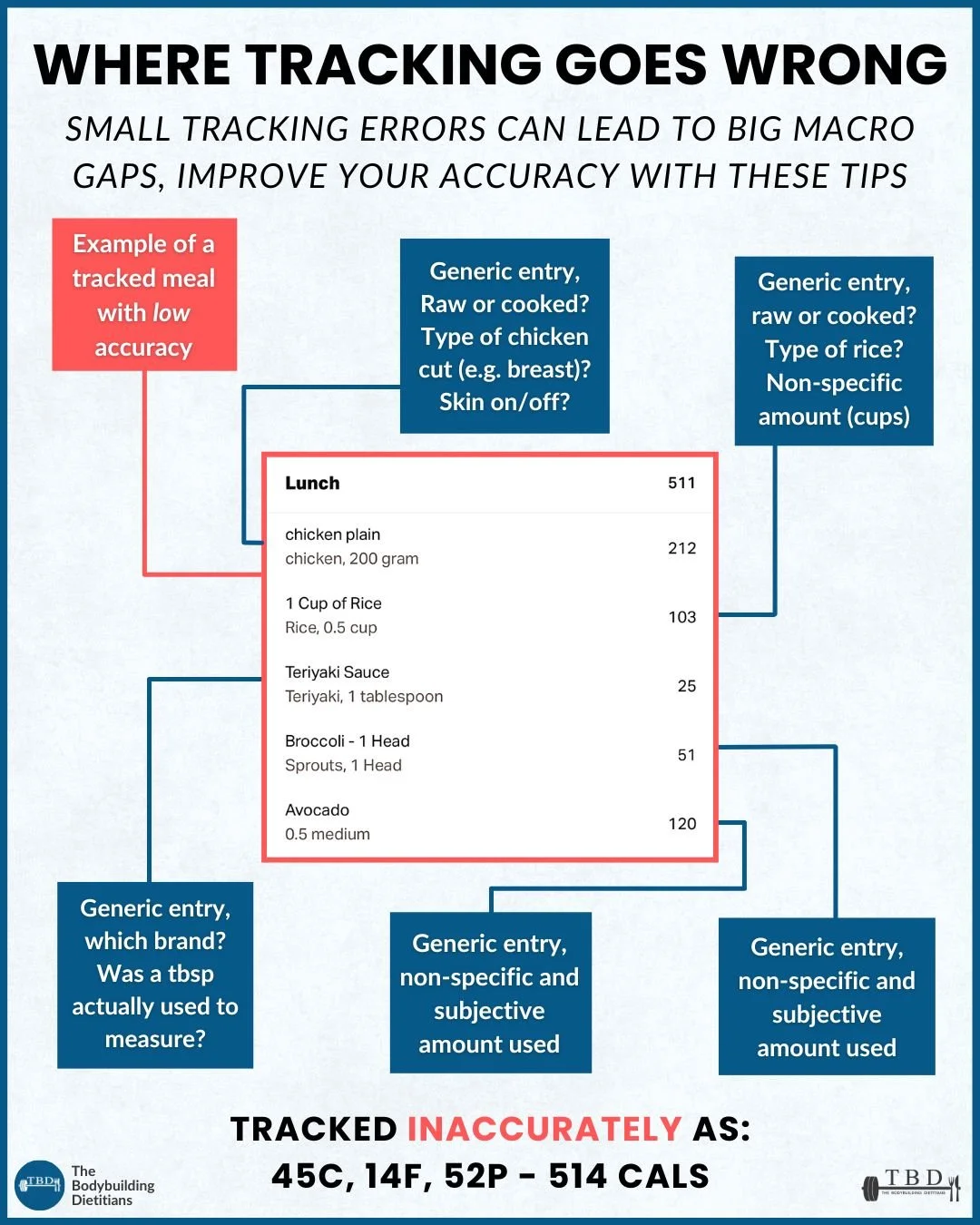
An example of a tracked meal with low accuracy. Generic database entries, volume measurements instead of grams, and unspecified amounts create cumulative errors that significantly understate the meal's true calorie content.
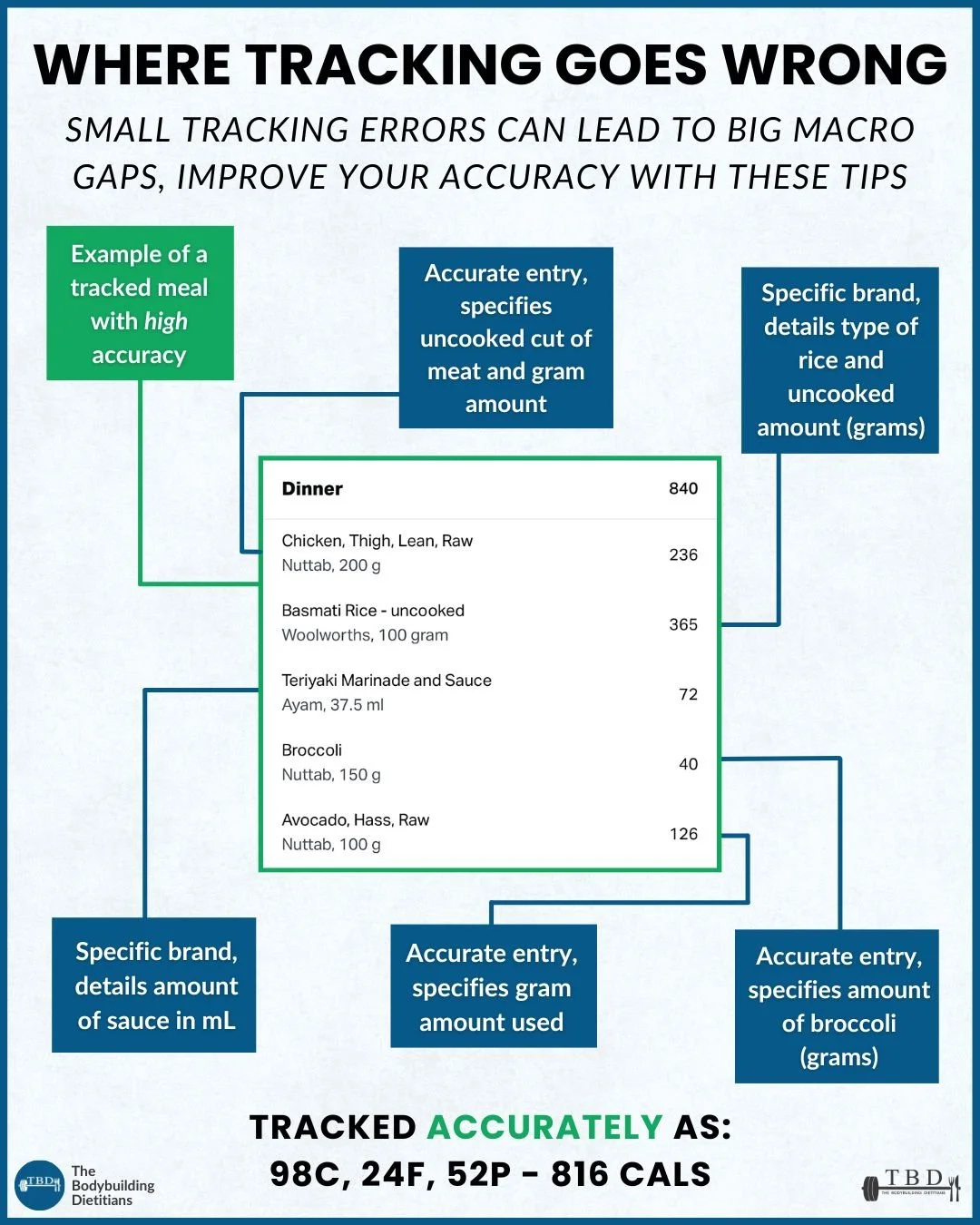
The same meal tracked with high accuracy. Specifying raw weights, brand-specific database entries, gram amounts instead of volume measures, and the precise type of each food produces a calorie total of 816 instead of 514, a 302 calorie gap on a single meal.
Macro tracking is one of the more useful tools in nutrition for understanding what your intake actually looks like, identifying patterns over time, and making informed adjustments when progress stalls. Like any tool, it produces useful output only when the input is accurate enough to act on. The most common pattern in coaching is not a failure of the tool itself but a small set of predictable input errors that consistently underestimate intake by amounts large enough to matter.
The two example meals in the carousel illustrate this well. The same meal of chicken, rice, sauce, broccoli, and avocado tracks as 514 calories when entered with low accuracy and 816 calories when entered with high accuracy. A 302 calorie gap on a single meal is at the upper end of what tracking errors typically produce, but the underlying pattern (selecting generic database entries, measuring by volume instead of weight, using cooked weights, eyeballing higher-density foods) recurs reliably and can quietly add several hundred calories to a daily total without the tracker realising.
Why Do Tracking Errors Matter for Progress?
Tracking errors matter because they directly determine whether the calorie targets a lifter is working from reflect their actual intake. When tracked intake is consistently lower than real intake, the apparent deficit a person believes they are running is smaller than the real one. Progress stalls, the natural response is to reduce the calorie target further, and the underlying tracking gap remains in place.
The most common scenario in coaching is someone adjusting calories down because progress has stalled, when the existing target was being mis-tracked by 100 to 300 calories in the first place. This creates unnecessary deficit depth and avoidable frustration, and it happens because tracking errors almost always run in one direction.
Research using doubly labelled water to measure free-living energy expenditure has consistently shown that self-reported food intake underestimates actual intake. In a classic study of diet-resistant obese subjects, self-reports of food intake underestimated actual intake by an average of 47 percent, while reported physical activity overestimated actual activity by 51 percent. The pattern of underreporting in self-reported food intake has been replicated across multiple populations and methodologies. Source: Lichtman et al., 1992, New England Journal of Medicine, 327:1893-1898.
The 47 percent underestimation in Lichtman's diet-resistant subjects is the upper end of what is observed in the literature. Among more experienced trackers who weigh food and use detailed entries, the gap is much smaller, typically in the range of 5 to 15 percent of total intake. For a lifter eating 2,500 calories per day, a 10 percent underestimation translates to 250 calories, which over a week is the difference between a meaningful deficit and near-maintenance.
Why Do Tracking Errors Almost Always Underestimate Intake?
Tracking errors consistently underestimate intake rather than overestimate it for a combination of psychological and structural reasons. Understanding why helps clarify which errors are most worth addressing first.
The structural reasons are the more practical ones. Generic database entries tend to default to leaner or simpler versions of foods because those entries are the most commonly searched and tend to populate the top of search results. "Chicken" returns lean chicken breast more often than fattier cuts, "rice" returns cooked rice more often than uncooked, and so on. Volume measurements like cups translate to more food by weight than the entry assumes, particularly for denser foods. Eyeballed amounts for high-calorie items like oils, nut butters, and sauces tend to err toward smaller estimates because the volume of these foods in spoons or splashes looks unintuitively small relative to the calories they contain.
The psychological reasons are more subtle but equally consistent. Snack-type foods, drinks containing calories, oils used in cooking, and small additions like dressings or condiments are forgotten or omitted more often than main meal components. The brain treats these as peripheral rather than as part of the meal, and they drop off the tracking log accordingly.
The result is a one-directional bias. Tracking errors that overestimate intake do occur, but they are rare enough that the typical aggregate effect of imperfect tracking is to understate real intake.
What Are the Six Most Common Macro Tracking Errors?
Across the lifters and physique athletes we work with, six error patterns recur consistently and account for the majority of the underestimation gap. Each individually can add 30 to 80 calories to the true intake, and stacked across a day they compound into the difference between progress and a stall.
Error 1: Cooked Versus Raw Weights for Meat
Meat loses water during cooking, which means a 200 gram raw piece of chicken breast typically weighs around 140 to 150 grams after cooking. Tracking 200 grams of meat in a database that lists raw weight, after the meat has been cooked, understates the actual quantity consumed by roughly 25 to 30 percent. For chicken breast, that translates to an underestimation of approximately 50 to 60 calories per 200 gram portion. For fattier cuts like chicken thigh or beef mince, the gap is larger.
The simplest fix is to weigh meat raw and track it against a raw entry, or to weigh it cooked and track it against a cooked entry. Both approaches work as long as the entry and the weight match. The most common error is weighing cooked meat and tracking it against a raw entry, which understates intake.
Error 2: Cup and Volume Measurements Instead of Grams
Cup measurements for grains, oats, pasta, and similar foods are inherently imprecise and reliably understate intake. A "one cup" entry in a tracking database assumes a specific weight that often does not match what the user actually has in front of them. The variability is larger for foods that compress (like cooked rice or oats) than for foods that don't, but the direction of the error is consistent: cup measurements typically translate to more food by weight than the database assumes.
The same applies to half-cup, quarter-cup, and tablespoon entries. Switching to gram weights using a kitchen scale removes the variability and is the single highest-yield change for most trackers.
Error 3: Generic Database Entries
Tracking apps contain thousands of user-submitted entries for the same food, with widely varying calorie and macro values. A generic search for "chicken" or "rice" returns entries that may not match what the lifter is actually eating, and the top results are usually leaner or lower-calorie versions because those are the most commonly logged.
The fix is to use verified entries from established food composition databases (such as Nuttab, USDA, or branded entries from the actual product) rather than generic user-submitted ones. For brand-specific items like sauces, marinades, and packaged foods, scanning the barcode or finding the manufacturer-verified entry is more reliable than searching by name.
Error 4: Eyeballed High-Density Foods
Oils, nut butters, sauces, dressings, avocado, cheese, and other calorie-dense foods are reliably underestimated when eyeballed rather than weighed. The reason is structural: small volumes of these foods contain large numbers of calories, so the visual estimate of "a splash of oil" or "a spoonful of peanut butter" almost always sits below the actual amount used.
A tablespoon of olive oil is around 120 calories. A "splash" used in cooking may be closer to two tablespoons in practice. A "spoonful" of peanut butter eyeballed off the jar may be 25 to 35 grams (around 150 to 210 calories) rather than the 15 grams (around 95 calories) the user assumes. These underestimations add up quickly, particularly for trackers who use multiple high-density foods across the day.
Weighing high-density foods on a kitchen scale, even if other foods are estimated, removes the largest single source of tracking error for most lifters.
Error 5: Mis-Specified Meat Cuts
Selecting "chicken" rather than "chicken thigh, lean, raw" or "rump steak, raw" introduces variability that depends on how the database resolves the generic entry. Skin on versus off, lean versus untrimmed, breast versus thigh, and similar distinctions can change the calorie content of a 200 gram portion by 50 to 150 calories.
This error compounds with the cooked-versus-raw issue: a tracker who weighs 200 grams of cooked chicken thigh and tracks it as "200 grams of chicken" (defaulting to raw lean chicken breast) can understate the actual intake of that meal by 100 to 150 calories on its own.
The fix is the same as for generic database entries: select the specific cut, raw or cooked, and skin on or off in the entry, ideally from a verified database.
Error 6: Undercounting Sauces, Condiments, and Cooking Oils
Sauces, marinades, dressings, and cooking oils are the most commonly forgotten items in tracking logs. They feel like accessories to the meal rather than ingredients, and the calorie contribution is easy to ignore.
A teriyaki marinade may contribute 60 to 80 calories to a meal that the tracker logged as containing only the chicken and rice. A salad dressing may add 100 to 150 calories. A tablespoon of olive oil used for cooking adds approximately 120 calories. Across a day, the cumulative contribution of these items can be 200 to 400 calories that never appear in the tracking log.
The fix is to track these items by weight or volume and to develop a habit of logging cooking oil at the point of cooking rather than estimating after the meal.
How Do These Errors Compound Across a Day?
Individual errors of 30 to 80 calories sound small, but they compound across a typical day in ways that produce meaningfully misleading totals. A practical example: a lifter eating four meals per day, with one or two errors per meal averaging 50 calories each, accumulates 200 to 400 calories per day in tracking gap. Across a week, that compounds to 1,400 to 2,800 calories, which is the difference between losing weight and maintaining it for most people.
The meal example in the carousel illustrates the compounding pattern within a single meal. Five tracked items, each with one or two of the common errors, produce a 302 calorie gap between the low-accuracy and high-accuracy versions of the same meal. That single meal alone accounts for what most lifters would expect their daily error budget to look like, which suggests how easily tracking gaps can grow when the same patterns repeat across multiple meals per day.
The underlying mathematics is straightforward. If tracking errors run consistently in one direction (underestimation), and if the typical magnitude per item is 30 to 80 calories, then any lifter eating four to six meals per day with one or two tracked items per meal containing an error will accumulate 100 to 400 calories of underestimation per day.
For a more detailed look at how energy availability and total daily intake fit into the broader nutrition framework, the fuelling hierarchy article covers how these targets are set in the first place.
When Does Tracking Accuracy Matter Most?
Tracking accuracy carries different weight depending on the phase, the goal, and the margin for error in the current target.
During maintenance, the margin for error is wide. The body adjusts to small variations in intake through changes in non-exercise activity thermogenesis, spontaneous activity, and minor shifts in metabolic rate. A 100 to 200 calorie tracking gap at maintenance produces little observable difference in body composition or weight over weeks. A looser tracking approach, where higher-density foods are weighed and other items are estimated, is generally fine for this context.
During fat loss phases, accuracy starts to matter more, particularly as the diet progresses. Early in a fat loss phase, when the deficit is fresh and the metabolic adaptations are minimal, small tracking errors are absorbed by the size of the deficit itself. As the diet extends and the body adapts, the practical deficit narrows, and tracking errors that previously had no observable effect start to determine whether progress continues or stalls.
During plateaus, tracking accuracy is often the variable that determines whether the next adjustment is needed. The most common pattern in coaching is a lifter wanting to drop calories because the scale has not moved in two weeks, when a tightening of tracking accuracy would close the actual deficit without further calorie reduction. Reducing calories before checking tracking accuracy is a predictable way to compound restriction unnecessarily.
During contest prep and the late stages of fat loss, accuracy is non-negotiable. The deficit is narrow, the metabolic environment is sensitive, and the cost of misjudging intake is meaningful (lean mass loss, performance decline, prolonged restriction). Every input variable that can be controlled with precision should be, and tracking is one of the most controllable.
During muscle gain phases, the question shifts. Tracking accuracy still matters, but the direction of useful precision is different: a lifter trying to ensure adequate calorie intake to support muscle gain may benefit more from making sure the surplus is large enough rather than from precisely controlling small variations. Underestimation of intake during a gaining phase typically presents as slower-than-expected progress, and the fix is the same (tightening accuracy) but the consequences of error are less time-sensitive.
For a more applied perspective on how diet phase changes the priority of different variables, our approach to nutrition coaching involves matching tracking expectations to where the client is in their phase.
How Should You Actually Approach Macro Tracking?
The goal of tracking is calibration, not control. The data exists to inform decisions about adjustment, identify patterns over time, and provide a reliable basis for the next change. The aim is for the tracking to be accurate enough to be useful and reliable enough to act on, not to be perfect.
A practical framework that works for most lifters involves three priorities, in order:
Weigh high-density foods, including oils, nut butters, cheese, sauces, dressings, and avocado. These contribute the largest single error per gram of food and produce the highest return on the time invested in weighing.
Use specific database entries for protein sources and grains. Verified entries (Nuttab, USDA, branded items) for the actual cut and cooking state of the food eliminate the largest source of misallocation. This is more important than the absolute precision of the weighing.
Estimate lower-density foods loosely when needed. Vegetables, salads, and most fruits contribute relatively little to the total calorie count and can be estimated without meaningfully affecting accuracy. Time and attention are better invested at the high-density end.
Beyond these three priorities, the goal is consistency. Tracking the same way across days produces useful trend data even if the absolute numbers contain some error, because the error pattern is consistent and the comparison across days remains valid. Trend data over weeks reveals what the body is actually doing in response to the inputs, which is the information that informs the next adjustment.
For more on managing hunger and adherence alongside tracking through different diet phases, the practical hunger management article covers the supporting strategies that make tighter tracking sustainable.
Practical Takeaways
Macro tracking errors almost always underestimate intake rather than overestimate it, with the typical gap among experienced trackers sitting at 100 to 300 calories per day and considerably more among less experienced ones.
The six most common tracking errors are cooked versus raw weights for meat, cup measurements instead of grams, generic database entries, eyeballed high-density foods, mis-specified meat cuts, and undercounted sauces and cooking oils. Each individually adds 30 to 80 calories, and they compound across the day.
High-density foods including oils, nut butters, sauces, dressings, cheese, and avocado are the highest-yield items to weigh accurately. Weighing only these and estimating the rest captures most of the available accuracy gain.
Verified database entries from sources like Nuttab, USDA, or branded product entries are substantially more reliable than generic user-submitted ones. Selecting the specific cut, cooking state, and brand of each item eliminates the largest source of misallocation.
Tracking accuracy matters most during plateaus, late stages of fat loss, and contest prep, where the margin for error is narrowest. During maintenance and the early stages of fat loss, a looser approach is generally workable.
The goal of tracking is calibration, not perfection. The aim is for the data to be accurate enough to be useful and reliable enough to act on, with consistency across days producing useful trend data even when absolute accuracy has some imperfection.
Frequently Asked Questions
Why is my weight not going down despite tracking my macros?
The most common cause is tracking error rather than metabolic resistance. Self-reported food intake consistently underestimates actual intake, with the typical gap among experienced trackers sitting at 100 to 300 calories per day. Before reducing calories further, the highest-yield first step is to tighten tracking accuracy, particularly on high-density foods like oils, sauces, nut butters, and avocado, and to verify that database entries match the actual food and cooking state of what was eaten.
Should you weigh food raw or cooked?
Either approach works as long as the database entry matches the weighing method. Raw weights paired with raw entries, or cooked weights paired with cooked entries, both produce accurate tracking. The common error is weighing food cooked and tracking it against a raw entry, which understates intake by approximately 25 to 30 percent for most meats due to water loss during cooking.
How accurate does macro tracking need to be?
Accuracy requirements depend on the phase. During maintenance, a looser approach with high-density foods weighed and other items estimated is generally fine. During fat loss plateaus and contest prep, accuracy becomes the variable that determines whether the next change is needed, and tighter tracking is warranted. The aim is for the data to be reliable enough to inform adjustments, not to achieve perfect precision.
Do I need to weigh vegetables and salads?
For most lifters, no. Vegetables and salad components contribute relatively little to total calorie intake, and the time invested in weighing them produces a small accuracy gain compared to weighing high-density foods. Estimating vegetables loosely while weighing oils, sauces, dressings, meat, and grains captures most of the available accuracy improvement.
Are tracking apps accurate?
The accuracy of a tracking app depends almost entirely on the entries selected. Apps that allow access to verified food composition databases (like Nuttab or USDA) and branded product entries produce accurate tracking when the user selects those entries. Apps that rely primarily on generic user-submitted entries introduce variability that depends on which entry was chosen. The tool is not the limiting factor in most cases; the inputs are.
How long should I track macros before adjusting?
A useful guideline is 10 to 14 days of consistent tracking at a given target before assessing whether an adjustment is needed. Single-week fluctuations in scale weight and other markers are influenced by hydration, glycogen, gut contents, training stress, and sleep, none of which reflect changes in body composition. Trend data over two weeks at consistent tracking accuracy provides a more reliable basis for adjustment decisions.
If you want help tightening your tracking accuracy, identifying which entry errors are most relevant to your situation, and adjusting your calorie targets based on what the data actually reflects, you can enquire about coaching or book a consultation with our team.