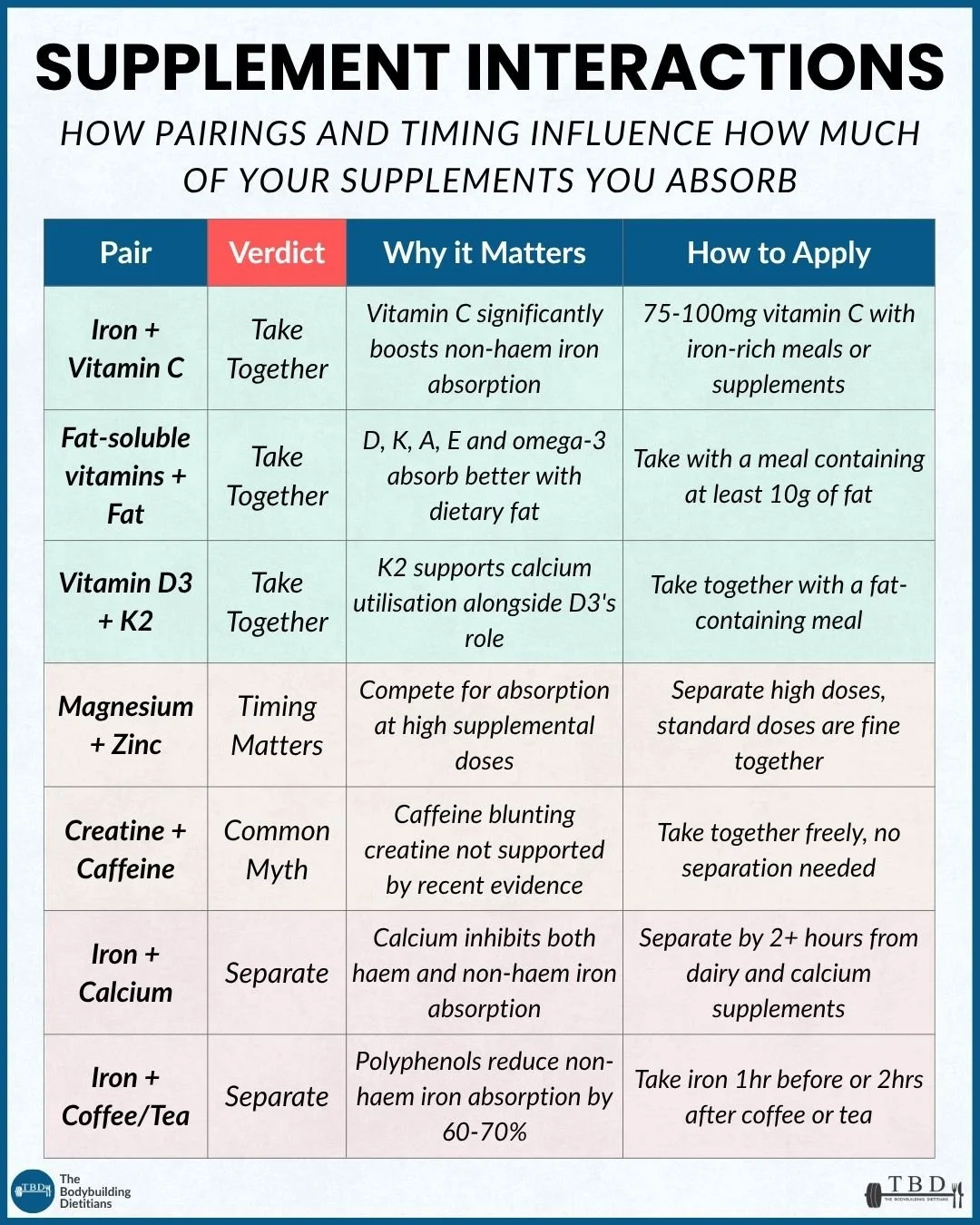
Seven supplement pairings that influence how much of each compound the body actually absorbs. On a single day, the effect is small. Across months of consistent supplementation, the cumulative impact on nutrient status is meaningful.
Taking a supplement and absorbing one are two different things. Some nutrients enhance each other's absorption, some compete for the same transporters, and some are partially blocked by coffee, tea, or calcium in the wrong window. This is a guide to the pairings that matter, the ones that don't, and the practical timing decisions worth attending to.
Supplement absorption depends on the interactions between the compounds taken together, and several specific pairings warrant attention. Iron and vitamin C should be taken together (vitamin C enhances non-haem iron absorption 3 to 4-fold at the meal level, though the long-term effect on iron status is more modest than commonly stated). Fat-soluble vitamins (A, D, E, K) and omega-3s should be taken with a meal containing approximately 10 to 15 grams of dietary fat. Vitamin D3 and K2 work well together, particularly for calcium utilisation. Iron and calcium should be separated by at least 2 hours because calcium inhibits both haem and non-haem iron absorption at supplemental doses. Iron should also be separated from coffee and tea by 1 to 2 hours because polyphenols reduce non-haem iron absorption by 50 to 70 percent. Magnesium and zinc compete for absorption at high supplemental doses (typically above 250 mg magnesium and above 40 mg zinc) but are fine together at standard doses. Creatine and caffeine can be taken together freely; the "caffeine blunts creatine" claim is not supported by current evidence. On any single day, none of this changes much. Across months of consistent supplementation, the interactions account for meaningful differences in what the body actually receives.
A lot of education around supplements starts and ends at the name and the dose. Between swallowing a supplement and it actually doing anything, several interactions shape how much of it the body receives. Some nutrients rely on each other to be absorbed. Others share the same transporter pathways and compete when taken together. A few are partially blocked by coffee, tea, or calcium in the wrong window.
On any single day, none of this changes much. Across months of daily supplementation, the interactions account for a meaningful portion of why two people on identical supplement routines can end up with different absorption results and different nutrient status over time. Getting the pairings and timing right is one of the higher-value refinements available in a supplement protocol without changing the products or the doses themselves.
This article walks through the specific supplement pairings that warrant attention, the ones that don't, and the practical timing decisions worth attending to. For a related look at which supplements are actually worth taking in the first place, our article on which supplements are worth your money covers the priority order before the timing question becomes relevant.
Which Supplements Should You Take Together?
Three specific pairings enhance each other's absorption and are worth taking together deliberately rather than separately.
Iron and vitamin C. Vitamin C (ascorbic acid) enhances non-haem iron absorption at the meal level by converting ferric iron (Fe³⁺) to the more absorbable ferrous form (Fe²⁺) and by forming a soluble chelate that protects iron from inhibitors like phytates and tannins. In single-meal isotope studies, 50 mg of vitamin C increases non-haem iron absorption approximately 3-fold, and 100 mg increases it approximately 4-fold.
A systematic review and meta-analysis of vitamin C and non-haem iron absorption found a highly significant increase in iron absorption when ascorbic acid was added to test meals. However, the long-term effect on iron status is more modest than the single-meal data suggests. Complete-diet studies and large randomised trials (including a 2020 RCT in 400 adults with iron deficiency anaemia) have not found meaningful improvements in haemoglobin or ferritin from routine vitamin C co-administration when iron is already well-dosed. Source: Heffernan et al., 2017, Proceedings of the Nutrition Society, 76(OCE4); Li et al., 2020, JAMA Network Open, 3(11):e2023644.
The practical framing is that vitamin C reliably enhances short-term iron chemistry and can be worth including when iron intake is limited (vegetarian and vegan diets, plant-heavy meals, iron deficiency anaemia), but routine high-dose vitamin C alongside well-dosed iron supplements produces smaller clinical effects than commonly stated. For lifters wanting to include vitamin C with iron-containing meals, 75 to 100 mg is a reasonable practical dose (a medium orange, half a cup of orange juice, or a small serve of capsicum all deliver this).
Fat-soluble vitamins and dietary fat. Vitamins A, D, E, and K, along with omega-3 fatty acids, require dietary fat for optimal absorption because they are incorporated into micelles and chylomicrons for transport across the intestinal wall. Taking these supplements with a fat-free meal or in a fasted state substantially reduces the amount actually absorbed.
The optimal amount of fat is approximately 10 to 15 grams per meal, based on studies specifically examining vitamin D and other fat-soluble vitamin absorption. Very low fat (under 5 grams) reduces absorption meaningfully, while very high fat (35+ grams) produces slightly lower absorption than the moderate range, likely because the vitamin gets sequestered in a larger fat mass and doesn't reach the intestinal wall as efficiently.
Practical fat sources that hit the 10 to 15 gram range include a tablespoon of olive oil, a quarter of an avocado, a small handful of nuts, a tablespoon of nut butter, or a serving of oily fish. Any meal containing meaningful protein and fat (a plate of salmon, chicken with olive oil, or eggs) reliably delivers the fat needed. The main practical adjustment is to avoid taking fat-soluble vitamin supplements in the morning with black coffee, before breakfast, or with other fat-free foods and beverages.
Vitamin D3 and vitamin K2. These two fat-soluble vitamins work together to support calcium regulation. Vitamin D3 increases calcium absorption from the gut, and vitamin K2 activates the proteins (osteocalcin and matrix Gla protein) that direct calcium into bone tissue rather than into soft tissue and arterial walls. Taking them together with a fat-containing meal supports both the absorption of each vitamin and the coordinated calcium regulation the two vitamins produce.
Many quality vitamin D3 supplements now include K2 as a combined product, which simplifies the practical decision. For lifters taking them separately, taking both with the same fat-containing meal is the practical recommendation. For more detailed guidance on vitamin D specifically, our vitamin D guide covers dosing, deficiency, and testing.
Which Supplements Should You Separate?
Three specific pairings compete for absorption or interfere with each other and are worth separating by at least 1 to 2 hours.
Iron and calcium. Calcium inhibits both haem and non-haem iron absorption at supplemental doses above approximately 300 mg. The mechanism involves calcium competing for the same intestinal transporters used by iron. Taking iron with a calcium supplement, a large glass of milk, or a calcium-fortified food substantially reduces the amount of iron actually absorbed from that dose.
The practical adjustment is to separate iron supplements from dairy products, calcium supplements, and calcium-fortified plant milks by at least 2 hours. For lifters taking both iron and calcium supplements, taking one in the morning and the other in the evening usually resolves the timing conflict. For lifters taking iron with meals, avoiding the meal that contains the most dairy or fortified plant milk is a reasonable practical rule.
Iron supplementation is most relevant for vegetarian and vegan lifters, women with heavy menstrual bleeding, and lifters with documented iron deficiency. For most lifters eating a mixed diet with adequate red meat, supplemental iron isn't necessary and this specific interaction isn't relevant.
Iron and coffee or tea. Polyphenols in coffee and tea (particularly tannins in tea and chlorogenic acid in coffee) reduce non-haem iron absorption by approximately 50 to 70 percent when consumed alongside iron-containing meals or supplements. This is a substantial reduction and one of the more impactful interactions in the supplement space.
A landmark study on food iron absorption found that a cup of coffee consumed with an iron-rich meal reduced iron absorption by approximately 39 percent, and a cup of tea reduced it by approximately 64 percent. Later dose-response studies confirmed that the inhibitory effect scales with the polyphenol content of the beverage and is most pronounced with strong tea and dark coffee. Source: Morck et al., 1983, American Journal of Clinical Nutrition, 37(3):416-420; Hurrell et al., 1999, British Journal of Nutrition, 81(4):289-295.
The practical adjustment is to take iron supplements at least 1 hour before or 2 hours after coffee or tea. For lifters who drink coffee with breakfast, taking iron supplements in the mid-morning (rather than with the breakfast coffee) or in the evening usually works well. For lifters who drink tea throughout the day, the timing gap needs more deliberate planning.
Magnesium and zinc at high doses. These two minerals compete for absorption at supplemental doses because they use similar transporter pathways. At standard supplemental doses (typically under 250 mg magnesium and under 40 mg zinc), the competition is small enough that taking them together produces minimal interference. At higher doses (above these thresholds), the interference becomes meaningful enough to justify separating the doses by several hours.
For most lifters taking standard-dose magnesium and zinc as part of a general supplement stack, this interaction isn't practically relevant. For lifters taking larger doses of one or both for specific purposes (magnesium at 400+ mg for sleep, zinc at 40+ mg for immune support during travel or illness), separating them into different times of the day is worthwhile.
What About the Common Myths?
Two commonly cited supplement interactions warrant explicit correction because they persist in fitness communities despite lacking evidence support.
Creatine and caffeine. The claim that caffeine "blunts" the effect of creatine originated from a small 1996 study in Belgium and has been widely repeated ever since. Subsequent research has not supported the interaction, and multiple studies have shown that combined caffeine and creatine supplementation produces performance benefits comparable to (or slightly greater than) either alone. There is no evidence-based reason to separate the two supplements in a daily protocol.
For a more detailed look at how creatine works, how to dose it, and where the alternative-form marketing stories don't hold up, our complete guide to creatine covers the full picture including the ATP regeneration mechanism and the newer cognitive research.
Whey protein and creatine. The claim that whey protein and creatine should be taken separately is similarly unsupported. Both compounds are absorbed through separate mechanisms and don't interfere with each other's uptake. Taking them together in a post-workout shake is fine, and there is no evidence-based reason to space them apart.
Not Sure Whether Your Current Stack Is Optimally Timed?
For lifters taking multiple supplements daily who are unsure whether the current timing structure is producing the absorption the products can support, an audit of the interactions and pairings is one of the smaller-effort adjustments that can meaningfully improve what the body actually receives from the same products. Our team works with clients on supplement audits alongside the broader nutrition and training plan, matched to individual context rather than a generic protocol.
When Does Timing Actually Matter?
Two considerations shape whether the interactions in this article are worth acting on for any specific lifter.
The dose determines whether the interaction is meaningful. At low doses of the interacting compounds, the effect on absorption is small enough that the practical impact is minimal. Someone drinking half a cup of decaf coffee alongside their iron supplement is losing a small percentage of the dose, not the 60 to 70 percent that a large mug of strong tea would cost them. Someone taking 10 mg of zinc alongside 100 mg of magnesium is well below the doses at which the competition becomes meaningful. The interactions matter most at supplemental doses of the individual compounds, and less at food-level doses.
The cumulative time frame determines whether the effect on status is meaningful. On a single day, missing one iron dose to a coffee interaction or one vitamin D dose to a fat-free breakfast doesn't change nutrient status meaningfully. Across months of daily supplementation with the same suboptimal timing, the cumulative effect can be substantial enough to explain differences in iron, vitamin D, calcium, or other nutrient status between individuals on nominally identical supplement routines. Timing adjustments matter most for supplements taken consistently over months and years, and less for one-off or intermittent supplementation.
For most lifters, the specific timing adjustments worth prioritising are: taking iron supplements away from coffee, tea, and dairy; taking fat-soluble vitamins and omega-3s with a fat-containing meal; and combining vitamin D3 with K2 in the same fat-containing meal. These three adjustments cover most of the practically meaningful interactions and don't require complex protocol management. The other interactions in this article (magnesium and zinc at high doses, the creatine and caffeine myth) are relevant in specific contexts rather than as universal recommendations.
For a broader look at how supplement decisions fit within the wider nutrition priority order, our fuelling hierarchy article covers where timing sits relative to energy availability, protein intake, and meal composition.
Practical Takeaways
Taking a supplement and absorbing one are two different things. Some nutrients enhance each other's absorption, some compete for the same transporters, and some are partially blocked by coffee, tea, or calcium in the wrong window.
Iron and vitamin C should be taken together. Vitamin C at 75 to 100 mg enhances non-haem iron absorption 3 to 4-fold at the meal level, though the long-term effect on iron status is more modest than commonly stated.
Fat-soluble vitamins (A, D, E, K) and omega-3 fatty acids should be taken with a meal containing approximately 10 to 15 grams of dietary fat. Very low fat and very high fat both reduce absorption compared to the moderate range.
Vitamin D3 and K2 work well together for coordinated calcium regulation and can be taken with the same fat-containing meal. Combined D3 plus K2 products simplify the practical decision.
Iron and calcium should be separated by at least 2 hours because calcium inhibits both haem and non-haem iron absorption at supplemental doses. Iron should also be separated from coffee and tea by 1 to 2 hours because polyphenols reduce non-haem iron absorption by 50 to 70 percent.
Magnesium and zinc compete for absorption at high supplemental doses (above approximately 250 mg magnesium and 40 mg zinc) but are fine together at standard doses. Creatine and caffeine can be taken together freely; the interaction is not supported by current evidence.
On any single day, timing matters little. Across months of consistent supplementation, the cumulative effect on nutrient status is meaningful.
Frequently Asked Questions
Should I take iron with vitamin C?
Yes for short-term absorption at the meal level. Vitamin C at 50 to 100 mg increases non-haem iron absorption approximately 3 to 4-fold when consumed at the same meal. However, the long-term effect on iron status from routine vitamin C co-administration is more modest than commonly stated. Recent large randomised trials in adults with iron deficiency anaemia have not found meaningful improvements in haemoglobin or ferritin from adding vitamin C to well-dosed iron supplements. Vitamin C co-administration is most useful for vegetarian and vegan lifters, those on plant-heavy diets, and those with documented iron deficiency.
How much fat do I need with fat-soluble vitamins?
Approximately 10 to 15 grams of fat in the meal delivers optimal absorption for vitamins A, D, E, K, and omega-3s. Very low fat (under 5 grams) reduces absorption substantially, while very high fat (35+ grams) produces slightly lower absorption than the moderate range. Practical fat sources at 10 to 15 grams include a tablespoon of olive oil, a quarter avocado, a small handful of nuts, or any typical protein-containing meal.
Should I separate calcium and iron?
Yes, by at least 2 hours. Calcium inhibits both haem and non-haem iron absorption at supplemental doses above approximately 300 mg. For lifters taking both iron and calcium supplements, separating them by taking one in the morning and one in the evening usually resolves the interaction. Dairy products and calcium-fortified plant milks should also be separated from iron supplements by 2 hours.
Does coffee really affect iron absorption?
Yes, substantially. Polyphenols in coffee (particularly chlorogenic acid) and tea (tannins) reduce non-haem iron absorption by 50 to 70 percent when consumed alongside iron-containing meals or supplements. The effect is dose-dependent and most pronounced with strong tea and dark coffee. Taking iron supplements at least 1 hour before or 2 hours after coffee or tea meaningfully improves absorption.
Can I take creatine and caffeine together?
Yes. The claim that caffeine "blunts" creatine originated from a small 1996 study and has not been supported by subsequent research. Multiple studies have shown that combined caffeine and creatine supplementation produces performance benefits comparable to or slightly greater than either alone. There is no evidence-based reason to separate the two supplements in a daily protocol.
Do I need to separate magnesium and zinc?
Only at high supplemental doses. At standard doses (typically under 250 mg magnesium and under 40 mg zinc), the interaction is small enough that taking them together produces minimal interference. At higher doses (400+ mg magnesium for sleep, 40+ mg zinc for specific purposes), separating them by several hours is worthwhile. For most lifters on standard-dose supplement stacks, this interaction isn't practically relevant.
If you want help auditing your current supplement stack, structuring timing and pairings to improve what the body actually absorbs, and matching supplement decisions to your specific goals and context, our team can build a plan that fits your specific situation. You can enquire about coaching or book a consultation with our team.