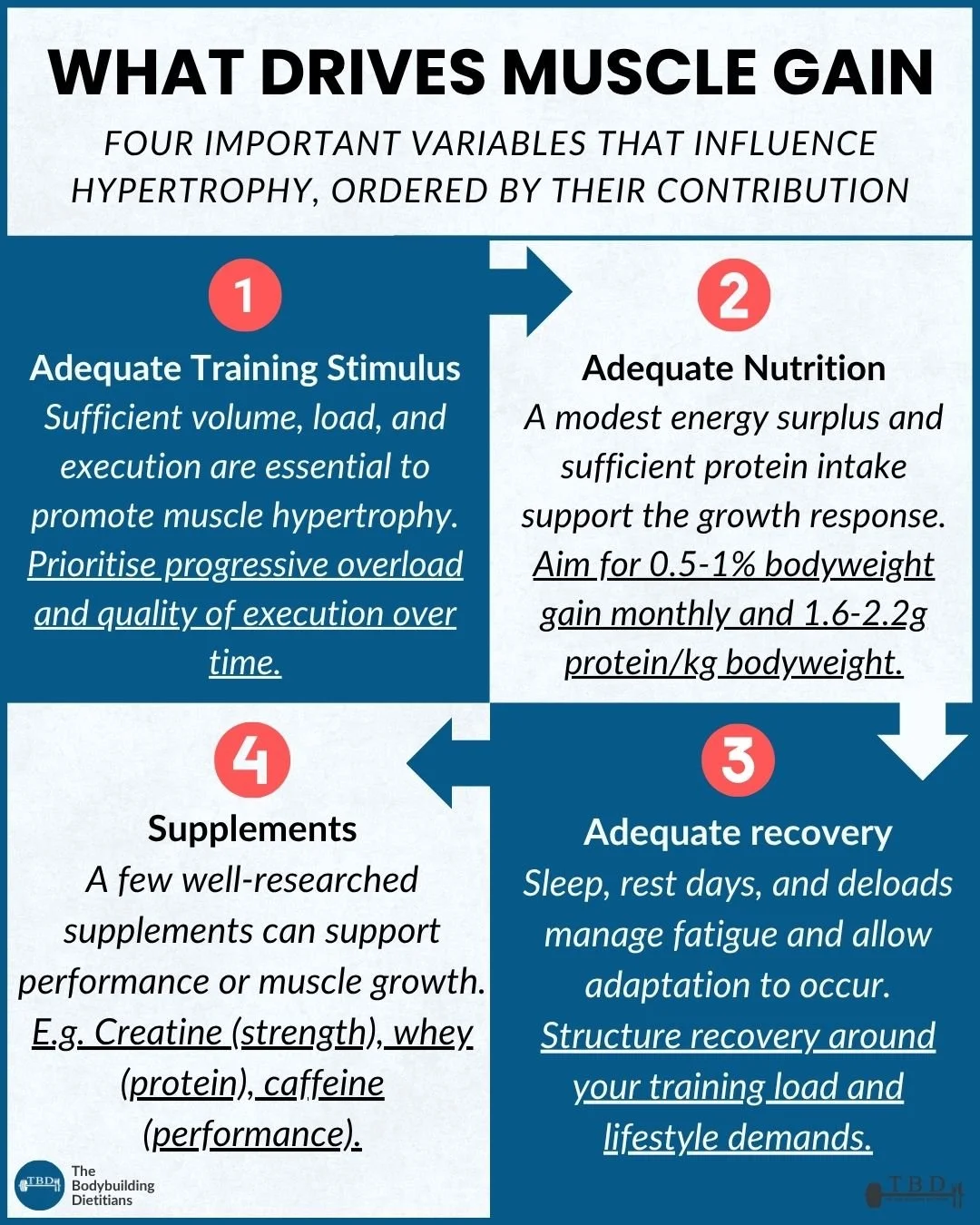
The four variables that drive muscle gain in lifters, ranked by impact. Training provides the stimulus, nutrition supports the response, recovery allows adaptation to happen, and supplements sit well behind those three.
Muscle growth is simple in theory but often mis-prioritised in practice. Training provides the stimulus, nutrition supports the response, recovery lets adaptation happen, and supplements sit well behind those three. This is the four-level hierarchy in order of impact, with specific targets for each level and links to the deeper content for each variable.
Four variables drive muscle gain, in the following order of impact. First, adequate training stimulus (sufficient volume, load, and progressive overload with quality execution). Second, adequate nutrition (a modest calorie surplus of approximately 100 to 200 calories above maintenance, combined with protein intake of 1.6 to 2.2 grams per kilogram of bodyweight per day). Third, adequate recovery (sufficient sleep, structured rest days, and periodic deloads to manage fatigue and allow adaptation to happen). Fourth, well-researched supplements (creatine monohydrate for strength and power, whey protein for convenient protein contribution, caffeine for training performance). The order matters more than any single variable in isolation. Refining supplement choices while sleeping five hours per night, or optimising nutrition around training that lacks intensity or progression, is unlikely to move things forward meaningfully. The most common pattern in coaching is lifters who have been training seriously for years feeling that progress doesn't reflect the effort they're putting in, and the root cause is usually a mismatch between where their attention is going and where the actual limiting variable sits.
Muscle growth is simple in theory and much harder to execute well. Training provides the stimulus, nutrition supports the response, and recovery influences how well that training can actually translate into adaptation. Supplements sit well behind those three, despite occupying a disproportionate share of the conversation in most physique-focused content.
The bigger issue for most lifters isn't understanding these variables individually. It's how they get prioritised. Refining supplement choices while sleeping five hours per night, or optimising nutrition around training that lacks quality and intensity, is unlikely to move things forward meaningfully. This is often one of the first areas we look at with lifters who have been training seriously for years and feel their progress doesn't reflect the amount of effort they're putting in.
This article covers the four-level hierarchy in order of impact, with specific targets for each level. Each section is deliberately brief and links out to the deeper content in the library for readers who want more depth on any specific variable.
Why Does the Order Matter?
The four variables don't contribute equally to muscle gain, and refining a lower-priority variable while a higher-priority one sits unaddressed produces disappointing returns. This is the specific insight the hierarchy is designed to enforce.
Consider a lifter spending significant effort on supplement timing and specific brand selection while their training program has no progressive overload structure, or a lifter tracking macros to the gram while consistently sleeping five hours per night. Both are optimising a variable that sits below the actual limiting factor in their progress. The supplement or nutrition refinements can be technically correct without producing meaningful outcomes because the higher-priority variable is capping how much the lower-priority variable can contribute.
The hierarchy is most useful applied as a diagnostic tool rather than as a strict rule. When progress stalls, the first question is which variable currently sits as the limiting factor. Usually it's one or two levels up from where the lifter has been focusing their attention.
Priority 1: Adequate Training Stimulus
Training is the variable that actually causes muscle growth. Nutrition, recovery, and supplements all support the response to training, but without an adequate training stimulus none of the others produces meaningful hypertrophy.
Adequate training stimulus means sufficient volume (typically 10 to 20 working sets per muscle group per week for most lifters), sufficient load (working close enough to failure to genuinely stress the muscle), and quality execution (technique that actually loads the target muscle rather than transferring tension elsewhere). Progressive overload across weeks and months is the specific mechanism through which sustained training produces sustained adaptation.
The most common training-side issue in lifters who feel their progress doesn't reflect their effort is either insufficient intensity (working sets not taken close enough to failure), insufficient progression (weight or reps not increasing across weeks), or insufficient volume management (running the same program without accounting for accumulating fatigue).
For a more detailed look at how training progression fits within the multi-phasic structure of a bodybuilding career, our article on bodybuilding phases covers the improvement season and prep progression that most lifters cycle through. For a look at how session intensity is calibrated using RPE and reps-in-reserve, our RPE and reps in reserve article covers the practical framework.
Priority 2: Adequate Nutrition
Nutrition supports the muscle-building response that training initiates. Two variables account for most of the nutrition contribution to muscle gain: energy balance (a modest calorie surplus) and protein intake (sufficient total protein distributed across the day).
Energy balance. A modest calorie surplus of approximately 100 to 200 calories above maintenance produces weight gain at a rate of approximately 0.5 to 1 percent of bodyweight per month, which is the range where most of the gained weight goes to muscle rather than fat. Larger surpluses produce faster weight gain but a worse ratio of muscle to fat gain, which is one of the more common mistakes in traditional bulking approaches.
Protein intake. Targeting 1.6 to 2.2 grams of protein per kilogram of bodyweight per day, distributed across 3 to 5 meals of adequate protein content per meal, supports the acute muscle protein synthesis response and the daily muscle protein balance that drives long-term hypertrophy.
For a more detailed look at the specific rate of gain that fits different training experience levels, our article on how fast you should bulk covers the training-age-adjusted targets. For the specific behavioural pattern that causes many gaining phases to fail before muscle actually builds, our article on the cycle of no progression covers the psychological failure mode. For the broader nutrition priority order, our fuelling hierarchy article provides the framework, and our complete guide to protein covers the specific protein targets and distribution in depth.
Priority 3: Adequate Recovery
Recovery is where the actual adaptation to training happens. Training produces the stimulus, nutrition provides the raw materials, and recovery is when the body assembles the response. Insufficient recovery caps how much of the training stimulus can actually translate into muscle gain, regardless of how well the training and nutrition are structured.
Sleep. Sleep is the single largest recovery variable for most lifters, and it's also the one most commonly under-optimised. Chronic sleep restriction (under 6 hours per night sustained) impairs muscle protein synthesis, reduces training performance, increases perceived exertion, and disrupts the hormonal environment that supports muscle growth. Aiming for 7 to 9 hours per night is the practical target for most trained lifters.
Rest days and deloads. Rest days and periodic deloads (weeks of reduced volume or intensity, typically every 4 to 8 weeks depending on training experience) allow accumulated fatigue to dissipate and the adaptation from previous training blocks to become apparent. Lifters who train hard without deloading tend to see progress stall as fatigue accumulates faster than adaptation.
General stress management. Sustained high stress, whether from work, life circumstances, or under-recovery, competes with the recovery capacity required for adaptation. Lifters going through demanding life phases often benefit from reduced training volume to match the reduced recovery capacity.
For a more detailed look at how sleep interacts with body composition specifically, our article on sleep and body composition covers the mechanisms in depth.
Priority 4: Supplements
Supplements sit at the bottom of the hierarchy for a specific reason: they produce meaningful benefits only when the higher-priority variables are already dialled in. The best supplement stack in the world can't compensate for inadequate training, insufficient nutrition, or chronic under-recovery.
Three well-researched supplements have consistent evidence for supporting muscle gain or training performance:
Creatine monohydrate. The most researched performance supplement available, supporting strength and power output through phosphocreatine saturation. A daily dose of 3 to 5 grams is sufficient, with cognitive benefits emerging at higher doses (5 to 10 grams).
Whey protein. A convenient, high-quality protein source that supports the daily protein target. Useful for lifters who struggle to hit protein targets from food alone or who want a portable protein source around training.
Caffeine. Improves training performance through reduced perceived effort and improved power output. Typical dose is 3 to 6 milligrams per kilogram of bodyweight, taken 30 to 60 minutes pre-training.
Other supplements (BCAAs, testosterone boosters, most pre-workout ingredients beyond caffeine, most fat burners) either work through weaker mechanisms, produce smaller effects, or duplicate what an adequate diet already provides.
Not Sure Where Your Progress Is Actually Bottlenecked?
If you have been training seriously for years and feel that progress doesn't reflect the effort you're putting in, the issue is usually a mismatch between where your attention is going and where the actual limiting variable sits. Identifying which level of the hierarchy currently caps your progress requires an honest audit of your training quality, nutrition consistency, sleep and recovery, and supplement use as they actually operate day to day. Our team works with clients on this specifically, matched to individual context rather than assuming the same variable is limiting for everyone.
What Is the Most Common Prioritisation Mistake?
The single most common pattern in coaching is lifters focusing on the lower-priority variables (supplements, macronutrient precision, meal timing) while a higher-priority variable (training progression, sleep, adequate calorie intake) sits unaddressed. The visible attention this pattern generates feels productive, because the decisions being made are small, specific, and easy to control. What it doesn't produce is meaningful additional muscle gain, because the actual limiting variable isn't being touched.
Three specific patterns account for most of the observed mis-prioritisation:
Refining supplements while training lacks progression. A lifter can spend years optimising creatine timing, protein powder brand, and pre-workout stacks while their training program hasn't increased load meaningfully in 12 months. The supplements are doing what they're supposed to do, but the training stimulus isn't producing the underlying adaptation the supplements are supposed to support.
Optimising macros while sleep is chronically short. A lifter can track macros to the gram, hit protein perfectly, and time carbohydrates around training while consistently sleeping 5 to 6 hours per night. The nutrition is technically excellent, but the recovery capacity to actually use it for muscle gain is compromised.
Cutting phases short while under-eating in the gaining phases. A lifter can cycle through short gaining phases followed by fat loss phases, spending most of the year in maintenance or deficit and only briefly in the surplus that actually drives muscle gain. The specific technical execution of each phase can be fine, but the total time spent in the state that produces muscle gain is too short for meaningful adaptation to occur.
The diagnostic question isn't "am I doing the low-priority things well?" It's "am I doing the high-priority things well enough that the low-priority things could actually matter?" If training progression, sleep, and calorie intake are compromised, no amount of supplement optimisation or macronutrient precision will move progress meaningfully.
Practical Takeaways
Four variables drive muscle gain in order of impact: adequate training stimulus, adequate nutrition, adequate recovery, and well-researched supplements. The order matters more than any single variable in isolation.
Adequate training means sufficient volume (10 to 20 working sets per muscle group per week), sufficient intensity (working close to failure), quality execution, and progressive overload across weeks and months.
Adequate nutrition means a modest calorie surplus of 100 to 200 calories above maintenance (0.5 to 1 percent bodyweight gain per month) and 1.6 to 2.2 grams of protein per kilogram of bodyweight per day.
Adequate recovery means 7 to 9 hours of sleep per night, structured rest days, and periodic deloads to manage accumulated fatigue.
Supplements sit at the bottom of the hierarchy. Three well-researched options are creatine (3 to 5 grams daily for strength and power), whey protein (as a convenient protein source), and caffeine (3 to 6 milligrams per kilogram of bodyweight pre-training).
The most common prioritisation mistake is refining lower-priority variables while a higher-priority one sits unaddressed. Identifying which level of the hierarchy currently caps progress is more useful than continuing to refine variables that aren't the actual limiting factor.
Frequently Asked Questions
What matters most for building muscle?
Adequate training stimulus is the single most important variable for building muscle. Nutrition, recovery, and supplements all support the response to training, but without sufficient volume, load, and progressive overload, none of the other variables produces meaningful hypertrophy. Adequate training means 10 to 20 working sets per muscle group per week, working close enough to failure to genuinely stress the muscle, quality execution, and progression across weeks and months.
How important is nutrition compared to training for muscle gain?
Nutrition sits second in the hierarchy after training. It supports the muscle-building response that training initiates, but nutrition alone doesn't build muscle. A lifter eating adequately without training progressively will not gain meaningful muscle mass, while a lifter training well but under-eating on calories or protein will gain less than they could. The two work together, with training as the primary driver and nutrition as the necessary support.
Do I need supplements to build muscle?
No, supplements are optional. Muscle gain happens through adequate training, nutrition, and recovery. Well-researched supplements (creatine, whey protein, caffeine) can support the process modestly, but they sit at the bottom of the hierarchy and don't compensate for gaps in the higher-priority variables. Most of the muscle gain most lifters will ever achieve comes from training and nutrition rather than from any specific supplement.
Why has my muscle gain stalled despite consistent training?
The most common cause is a mismatch between where attention is going and where the actual limiting variable sits. Refining supplements while training lacks progression, optimising macros while sleep is chronically short, or cycling through short gaining phases without spending enough time in an actual surplus all produce the appearance of effort without the underlying variable that would drive muscle gain. The diagnostic question is which level of the hierarchy is currently capping progress, which usually isn't the level where most of the current attention is going.
If you want help identifying which level of the muscle gain hierarchy is currently limiting your progress, and building a plan that addresses the actual bottleneck rather than continuing to refine variables that aren't the limiting factor, our team can build a plan matched to your specific situation. You can enquire about coaching or book a consultation with our team.