Calorie intake and energy availability are two different measurements. A dietitian explains the difference, the thresholds that distinguish a productive deficit from a counterproductive one, and how to apply the framework practically across fat loss, contest prep, and improvement seasons.
Energy availability (EA) is the energy remaining for basic physiological function after training expenditure is subtracted from total calorie intake, expressed per kilogram of fat-free mass per day. Optimal EA of 45 kcal/kg FFM/day or above supports growth, recovery, and hormonal function. Reduced EA between 30 and 44 kcal/kg FFM/day is generally acceptable for finite fat loss periods with monitoring, though it carries some cost to recovery and adaptation. Low EA below 30 kcal/kg FFM/day is where injury risk, bone density decline, and endocrine dysfunction begin to compound, and sustained exposure carries meaningful health consequences. The 30 and 45 thresholds were established primarily in female athletes and should be treated as useful reference points rather than fixed cutoffs, particularly for male athletes where the evidence base is smaller. Two people eating the same total calories can have very different energy availability depending on training expenditure, which is why calorie intake alone is an incomplete picture of how aggressive a deficit actually is.
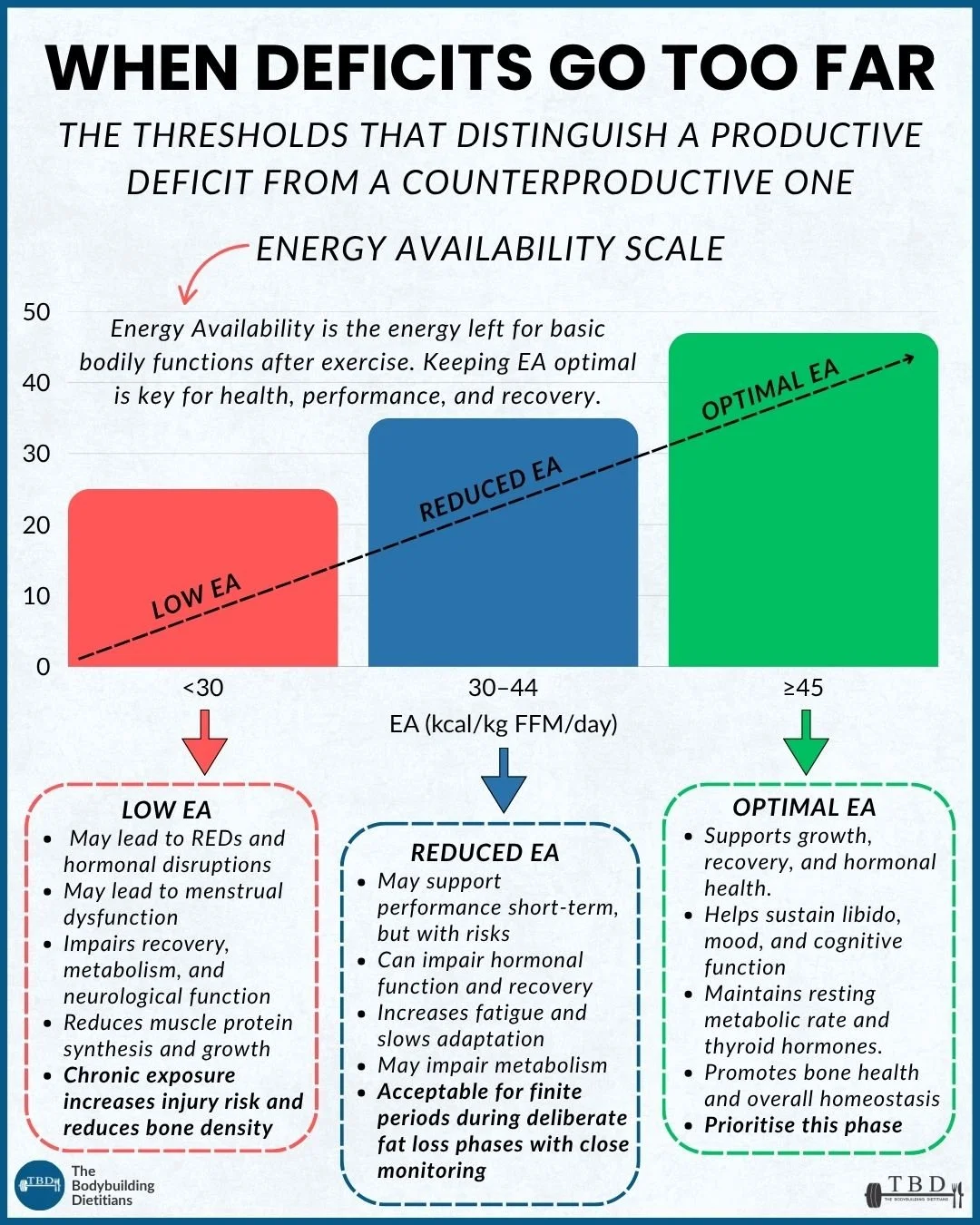
The energy availability scale showing three zones and their physiological implications. The 30 and 45 kcal/kg FFM/day thresholds were established primarily in female athletes and should be treated as useful reference points rather than rigid cutoffs, particularly for males where the evidence base is smaller.
The question of how aggressive a calorie deficit should be is one that comes up repeatedly for anyone serious about fat loss or contest prep. The framing usually starts with total calorie intake, or with a percentage below maintenance, but neither number tells the full story. The variable that determines whether a deficit is productive or counterproductive is not the calorie total in isolation. It is the amount of energy remaining for physiological function after training expenditure is accounted for, a concept known as energy availability.
Energy availability provides a more accurate lens for thinking about deficit depth, particularly for athletes with high training volumes. Two lifters can eat identical calorie totals and be in very different physiological states depending on how much of that energy is being consumed by training. Understanding this distinction, and the thresholds that separate a sustainable deficit from one that begins to compromise health and performance, is central to making informed decisions about diet phase structure.
What Is Energy Availability, and How Does It Differ From Calorie Intake?
Energy availability (EA) is the energy remaining for basic physiological function after training expenditure is subtracted from total calorie intake, expressed per kilogram of fat-free mass per day. Calorie intake is total energy in. Energy availability is what is left over for everything the body has to do outside of training.
The distinction matters because training expenditure is variable and often substantial. A physique athlete training six hours per week has a very different energy landscape from one training twelve hours per week, even at the same total calorie intake. In the first case, more of the consumed energy is available for muscle protein synthesis, hormonal function, immune activity, and recovery. In the second, a larger proportion is being used to fuel training itself, leaving less for the physiological processes that happen in the background across the rest of the day.
Someone eating 2,500 calories while training six hours per week has substantially higher energy availability than someone eating 2,500 calories while training twelve. The first lifter is running a mild deficit with room for the body to recover and adapt. The second may be sitting close to or below the reduced energy availability threshold, with meaningful implications for recovery, hormonal function, and long-term progress. Neither number would look problematic in isolation, but the physiological experience of the two lifters would be quite different.
This framing also helps explain a pattern that shows up frequently in coaching. Two lifters using the same calorie target and macro split can respond very differently to a fat loss phase, with one making steady progress and the other stalling, losing training performance, or accumulating fatigue faster than expected. The difference is often not the calorie prescription itself but the training expenditure sitting alongside it. Adjusting calorie targets in isolation, without accounting for how much of that energy is being consumed by training, misses the most important variable.
How Is Energy Availability Calculated?
The formula for energy availability is straightforward: total daily calorie intake minus estimated training expenditure, divided by fat-free mass in kilograms.
Energy Availability = (Calorie Intake - Training Expenditure) / Fat-Free Mass (kg)
A worked example clarifies the calculation. Consider a lifter with 65 kg of fat-free mass, eating 2,600 calories per day, and expending approximately 350 calories per session across five training sessions per week (an average of 250 calories per day). Their energy availability is (2,600 - 250) / 65, which equals 36 kcal/kg FFM/day. This sits in the reduced EA zone, which is acceptable for a finite fat loss period with close monitoring but is not where sustained training and recovery should be maintained.
The calculation is arithmetically simple, but it depends on reasonable estimates of two variables that carry uncertainty. Training expenditure is difficult to measure precisely outside a laboratory setting, and fitness trackers and heart rate monitors provide estimates that can be off by 20 to 30 percent in either direction, particularly for resistance training. Fat-free mass estimates from bioimpedance scales and even DEXA scans have measurement error that varies with hydration status, recent meals, and equipment calibration.
The practical implication is that any calculated EA figure should be treated as a guide rather than a precise readout. A calculated value of 34 kcal/kg FFM/day may reflect a true EA anywhere between 28 and 40 depending on the accuracy of the underlying estimates. This is one of the reasons the framework is best applied through pattern recognition across weeks rather than through single-point calculations, and why monitoring downstream indicators (training performance, sleep, mood, hunger, menstrual regularity, morning body temperature) provides more actionable feedback than the number itself.
For a more detailed look at how tracking accuracy affects the numbers going into these calculations, our article on the six most common macro tracking errors covers how small input errors compound into meaningful differences in calorie totals.
What Are the Three Energy Availability Zones?
Research and clinical frameworks divide energy availability into three broad zones, each with distinct physiological implications.
Optimal EA (≥45 kcal/kg FFM/day) is the zone where the body has sufficient energy for growth, recovery, and hormonal function. Resting metabolic rate and thyroid hormones remain stable, sex hormones are supported, bone health is maintained, and libido, mood, and cognitive function operate normally. This is the zone that should be prioritised across improvement seasons, muscle gain phases, and maintenance periods. It is also the zone that most sustainably supports long-term progress in the sport, because the physiological environment allows training adaptations to accrue rather than being blunted by compromised recovery.
Reduced EA (30 to 44 kcal/kg FFM/day) is the zone where the body is drawing on reserves to sustain function, and where physique athletes typically spend significant time during cutting phases. Short-term exposure is generally manageable and often unavoidable during deliberate fat loss. Muscle protein synthesis, recovery capacity, and hormonal function all begin to show some compromise, but the effects are usually reversible with a return to higher EA. Performance can be maintained short-term, though fatigue tends to accumulate faster than in the optimal zone, and adaptation to training slows.
Low EA (below 30 kcal/kg FFM/day) is where the risk profile shifts from a manageable trade-off to consequences that compound. The 30 kcal/kg FFM/day threshold was originally identified as the point at which luteinising hormone pulsatility begins to disrupt in females, with downstream effects on menstrual function and reproductive hormones. Beyond this specific mechanism, sustained low EA is associated with impaired recovery, reduced muscle protein synthesis, endocrine dysfunction, and (with chronic exposure) increased injury risk and reduced bone density.
Research using controlled short-term manipulation of energy availability in regularly menstruating women found that LH pulsatility was undisturbed at energy availability of 30 kcal/kg fat-free mass per day, but below this threshold, LH pulse frequency decreased significantly, indicating disruption of reproductive hormonal function. Source: Loucks and Thuma, 2003, Journal of Clinical Endocrinology and Metabolism, 88(1):297-311.
The three-zone model is a useful clinical shorthand, but the underlying physiology is more of a continuum than three distinct categories. The 2023 IOC consensus statement on Relative Energy Deficiency in Sport (REDs) explicitly describes low energy availability as existing on a spectrum from adaptable to problematic, with individual factors including exposure duration, severity, and biological sex influencing how any given EA value translates into health and performance outcomes.
The 2023 IOC consensus statement on Relative Energy Deficiency in Sport describes low energy availability as existing on a continuum from adaptable to problematic. Adaptable LEA is mild and transient, while problematic LEA (sufficient exposure duration and severity) is associated with adverse outcomes including impaired reproductive function, musculoskeletal health, metabolism, immunity, glycogen availability, and mental health. Source: Mountjoy et al., 2023, British Journal of Sports Medicine, 57(17):1073-1097.
Why Do the 30 and 45 Thresholds Exist?
The 30 kcal/kg FFM/day threshold was derived from controlled research in regularly menstruating women, where five days of energy availability at or above 30 preserved luteinising hormone pulsatility, while values below 30 produced disruption in pulse frequency. This threshold was subsequently linked to a broader constellation of physiological changes, including reductions in thyroid function, insulin-like growth factor 1, bone turnover markers, and (with sustained exposure) menstrual cycle disturbances.
The 45 kcal/kg FFM/day figure represents the approximate energy availability required to fully support metabolic and hormonal function in a healthy adult, essentially the value at which the body's homeostatic systems function without needing to draw down reserves or downregulate energetic processes. This threshold has held up across the literature as the practical target for phases where full physiological function should be prioritised.
Both numbers should be understood as reference points from specific research contexts, not as absolute biological cutoffs. The evidence base was built primarily on short-term laboratory studies in female participants with normal menstrual function, and applying the thresholds to different populations (male athletes, physique athletes cutting to competition levels, long-term dieters) involves some extrapolation.
The practical value of the thresholds is that they provide a common language and a rough calibration for how aggressive a deficit is. Someone consistently at 40 kcal/kg FFM/day is running a moderate deficit that most physiological systems can sustain for a finite period. Someone consistently at 25 kcal/kg FFM/day is running a deficit that has moved past the point where the body can maintain full function, and the trade-offs become significant.
Do the Same Thresholds Apply to Male and Female Athletes?
The 30 and 45 kcal/kg FFM/day thresholds were established primarily in research conducted on female endurance athletes, and applying them directly to male athletes involves some caveats.
Emerging research in male athletes suggests that low energy availability produces similar categories of dysfunction (impaired testosterone, thyroid function, bone health, recovery capacity, and performance) but potentially at somewhat lower thresholds than the female research established. Some studies suggest male athletes may tolerate EA values in the low 20s for finite periods with less pronounced hormonal disruption than would be expected in females at the same values, though the evidence base is smaller and more variable than the female literature.
The 2023 IOC REDs consensus explicitly acknowledges that REDs affects both male and female athletes but that the presentation and thresholds may differ. For males, the most reliable early indicators of problematic low EA are typically reduced libido, morning erections, and gradual declines in training performance and recovery, alongside biochemical markers where available.
For female athletes, menstrual function is one of the most sensitive and clinically informative indicators. Cycle irregularity, oligomenorrhea (infrequent menstruation), or amenorrhea (absence of menstruation) in the context of training and dieting are strong signals that energy availability has moved into problematic territory, and they warrant assessment and adjustment regardless of what the calculated EA figure suggests. This is one of the areas where symptom-based monitoring is more informative than the numerical framework alone, because the calculation depends on estimates that carry meaningful uncertainty.
The broader principle that low EA compromises physiological function applies across both sexes. The numerical thresholds should be treated as useful reference points rather than fixed cutoffs, and the framework is most useful when combined with monitoring of downstream indicators (performance, recovery, mood, hunger, menstrual regularity in females, libido and morning erections in males).
For female athletes experiencing menstrual irregularity or amenorrhea, or for any athlete with symptoms suggesting significant hormonal or musculoskeletal dysfunction, working with a sports dietitian and, where appropriate, a sports physician is the sensible path forward. Booking a consultation with our team is one way to get individualised guidance on how to structure the next phase safely.
When Is Reduced Energy Availability Acceptable During Fat Loss?
The reduced EA zone (30 to 44 kcal/kg FFM/day) is where most physique athletes spend significant time during cutting phases, and short-term exposure is generally acceptable when the phase is deliberate, finite, and monitored.
The physiological trade-offs in this zone are real but manageable. Muscle protein synthesis is somewhat reduced compared to optimal EA, recovery from training is slower, hormonal markers may show some downward shift, and fatigue tends to accumulate more quickly. These effects are typically reversible with a return to higher EA, and the benefits of running the deficit (fat loss, competition readiness, body composition changes) can be worth the trade-off within a defined phase.
Several factors determine how well reduced EA is tolerated in practice:
Duration is the most important. A four-to-twelve-week fat loss phase in the reduced EA zone is meaningfully different from a nine-month contest prep sustained in the same zone. Physiological compromise scales with exposure time, and short-term dips are absorbed more easily than sustained periods.
Starting body composition influences how the body responds. Leaner athletes tend to experience more pronounced physiological changes at the same EA values than athletes carrying more body fat, because they have less energetic reserve. This is one reason contest prep in the final weeks of leaning out tends to produce more noticeable hormonal and recovery changes than the earlier stages of the same prep.
Training load shapes the balance between demand and supply. Very high training volumes combined with reduced EA compound the physiological stress, while moderate training volumes at the same EA value tend to be better tolerated. During deep deficits, some reduction in training volume or intensity may be more sustainable than trying to maintain full training load with fewer calories to fuel it.
Monitoring is what turns an acceptable trade-off into a controlled one. Tracking training performance, sleep quality, morning heart rate, hunger levels, mood, and (for females) menstrual regularity provides feedback on how well the body is tolerating the phase. When those indicators start to shift meaningfully, the response should be either a temporary return to higher EA or a re-evaluation of the phase structure.
The practical framing is that reduced EA is a tool that can support finite fat loss objectives when applied with structure and monitoring, not a sustainable long-term state. The optimal EA zone is where the body should sit outside of deliberate fat loss phases, and returning to it periodically (even briefly) during longer diet phases helps buffer the accumulated physiological stress.
What Happens With Sustained Low Energy Availability?
Sustained low energy availability (below 30 kcal/kg FFM/day for weeks to months) is where the physiological consequences shift from acceptable trade-offs to compounding dysfunction.
The endocrine changes are among the most clinically significant. Reproductive hormone function declines, with reduced testosterone in males and menstrual dysfunction in females. Thyroid hormones drop, reducing metabolic rate. Cortisol tends to rise, particularly under continued training stress. Insulin-like growth factor 1 falls, contributing to reduced tissue repair and adaptation.
Bone health is a longer-term concern. Bone turnover markers shift toward net resorption within weeks of sustained low EA, and prolonged exposure is associated with reduced bone mineral density and increased fracture risk. This is particularly relevant for female athletes with amenorrhea, where the combined effect of low estrogen and low EA on bone health is well-documented.
Muscle mass retention becomes progressively harder. Muscle protein synthesis is suppressed, protein turnover shifts in an unfavourable direction, and the physiological environment for maintaining lean tissue during a deficit deteriorates. This is one of the reasons very aggressive prep in the final weeks often costs more lean mass than the calorie mathematics alone would predict.
Recovery capacity declines across systems. Sleep quality often reduces, subjective energy drops, mood tends to worsen, and cognitive function may show some impairment. Training performance declines, though the pattern is variable and can be masked initially by increased psychological effort.
Injury risk rises, particularly stress-related injuries including stress fractures and soft tissue overuse. The compromised recovery and reduced bone density both contribute, and the combination becomes more dangerous with continued training load.
For physique athletes, the practical implication is that competition-level leanness is inherently associated with periods of reduced or low EA, but the duration, depth, and management of those periods substantially affect the health and performance costs. Deliberate periodisation, with post-competition recovery phases returning the body to optimal EA, is not just useful for long-term progress but is meaningfully protective against the compounding costs of extended time in low EA. This is one of the reasons our approach to bodybuilding coaching prioritises structured improvement seasons and recovery phases as central features of long-term development, not as time away from the sport.
How Should Energy Availability Guide Fat Loss and Contest Prep Decisions?
Energy availability is most useful as a framework for thinking about deficit depth and diet phase structure, rather than as a number to chase or optimise in isolation.
The framework informs several practical decisions:
Setting the initial deficit depth. Rather than choosing a calorie target based on a percentage below maintenance, the EA framework asks how the deficit relates to training expenditure. A lifter with high training volume needs a smaller nominal calorie deficit to reach the same EA zone than a lifter with lower training volume. This is one reason blanket recommendations like "500 calories below maintenance" produce very different physiological outcomes across athletes.
Structuring diet phase length. The relationship between EA zone and sustainable duration is roughly inverse: the deeper the deficit, the shorter the phase should be. Reduced EA can be sustained for months with careful monitoring. Low EA is a short-term tool for the final stages of contest prep, not a phase to spend extended time in.
Deciding when to introduce diet breaks or refeeds. When training performance, recovery, and other indicators begin to shift meaningfully during a phase in reduced EA, a temporary return to optimal EA (a diet break of one to two weeks at maintenance) can buffer the accumulated physiological stress and allow the phase to continue more sustainably afterward.
Planning improvement seasons. After extended time at reduced or low EA, the improvement season is not simply about eating more to gain mass. It is also about restoring the physiological environment (hormonal function, bone health, recovery capacity) that supports future training adaptations. This is one reason short, aggressive gaining phases tend to underperform longer, more moderate improvement seasons that spend meaningful time at optimal EA.
Matching training volume to available energy. During deep deficits, reducing training volume (rather than intensity, in most cases) can support better tolerance of the deficit and preserve training performance. A phase with reduced EA and moderate training volume is often more productive than the same EA with high training volume.
The framework does not replace individual monitoring and pattern recognition, but it provides a structured way to think about how aggressive a deficit is, how long it can be sustained, and when the trade-offs stop being worth it. Setting calorie targets, monitoring training load, and adjusting both as energy demands shift across phases is one of the areas where structured coaching can help physique athletes navigate complex phase transitions with more clarity.
For more on how energy availability fits into the broader hierarchy of nutrition decisions (energy availability, then protein, then carbohydrate and fat distribution, then meal timing), the fuelling hierarchy article covers the priority order in detail.
Practical Takeaways
Energy availability is total calorie intake minus training expenditure, divided by fat-free mass in kilograms. It is a more accurate lens for thinking about deficit depth than calorie intake alone, particularly for athletes with high training volumes.
Optimal EA is at or above 45 kcal/kg FFM/day and supports full physiological function including growth, recovery, hormones, bone health, and mood. Reduced EA (30 to 44) is generally acceptable for finite fat loss periods with monitoring. Low EA (below 30) is where health and performance costs begin to compound.
The 30 and 45 kcal/kg FFM/day thresholds were established primarily in female athletes and should be treated as useful reference points rather than fixed cutoffs. Male thresholds may be somewhat lower and the evidence base is smaller.
The calculation depends on estimates of training expenditure and fat-free mass that carry meaningful uncertainty. Any calculated EA figure should be treated as a guide, with monitoring of downstream indicators (performance, sleep, mood, hunger, menstrual regularity or libido) providing more actionable feedback.
Sustained low EA is associated with hormonal dysfunction, bone density loss, impaired muscle mass retention, reduced recovery capacity, and increased injury risk. Duration is one of the most important factors in whether reduced EA is tolerated well or accumulates significant physiological cost.
The framework is most useful for structuring diet phases: setting initial deficit depth, deciding phase length, planning diet breaks, and matching training volume to available energy. It also emphasises the importance of periodically returning to optimal EA, particularly between fat loss phases.
Frequently Asked Questions
What is energy availability?
Energy availability is the amount of energy remaining for basic physiological function after training expenditure is subtracted from total calorie intake, expressed per kilogram of fat-free mass per day. It provides a more accurate picture of how aggressive a deficit is than calorie intake alone, because two athletes eating the same total calories can have very different energy availability depending on how much of that energy is being used to fuel training.
How do you calculate energy availability?
The formula is (total calorie intake minus training expenditure) divided by fat-free mass in kilograms. For example, a lifter with 65 kg of fat-free mass eating 2,600 calories per day and expending 250 calories per day on training has an energy availability of (2,600 - 250) / 65, or 36 kcal/kg FFM/day. Both training expenditure and fat-free mass estimates carry uncertainty, so the calculated figure should be treated as a guide rather than a precise readout.
What is the difference between calorie intake and energy availability?
Calorie intake is total energy in. Energy availability is what remains for physiological function after training expenditure is subtracted. Someone eating 2,500 calories while training six hours per week has substantially higher energy availability than someone eating 2,500 calories while training twelve hours per week, even though the calorie totals are identical. This distinction matters because the second lifter is running a much deeper effective deficit despite eating the same amount.
Is low energy availability the same as REDs?
Low energy availability is one of the primary drivers of Relative Energy Deficiency in Sport (REDs), a syndrome that includes impairments in reproductive function, musculoskeletal health, metabolism, immunity, and mental health. REDs describes the constellation of downstream effects that can result from sustained low energy availability. The 2023 IOC consensus statement describes low energy availability as existing on a continuum from adaptable to problematic, with the transition point depending on exposure duration, severity, and individual factors.
Do the same energy availability thresholds apply to men and women?
The 30 and 45 kcal/kg FFM/day thresholds were established primarily in research on female endurance athletes. Male athletes may tolerate somewhat lower EA values for finite periods with less pronounced hormonal disruption, though the evidence base is smaller and more variable. The broader principle that low EA compromises physiological function applies across both sexes, but the specific thresholds and clinical indicators differ. Menstrual function is a key indicator for females, while libido, morning erections, and biochemical markers are more informative for males.
How long can you sustain reduced energy availability?
The reduced EA zone (30 to 44 kcal/kg FFM/day) can be sustained for finite periods of weeks to months with monitoring, and it is the typical zone for deliberate fat loss phases in physique athletes. The sustainable duration depends on starting body composition, training load, individual response, and the presence of monitoring to detect when accumulated physiological stress warrants a return to higher EA. Very long periods (six months or more) in reduced EA tend to accumulate meaningful physiological cost even when the calculated figure looks acceptable.
If you want help structuring your fat loss, contest prep, or improvement season around the energy availability framework, our team can build a plan that fits your training demands and goals. You can enquire about coaching or book a consultation with our team below.