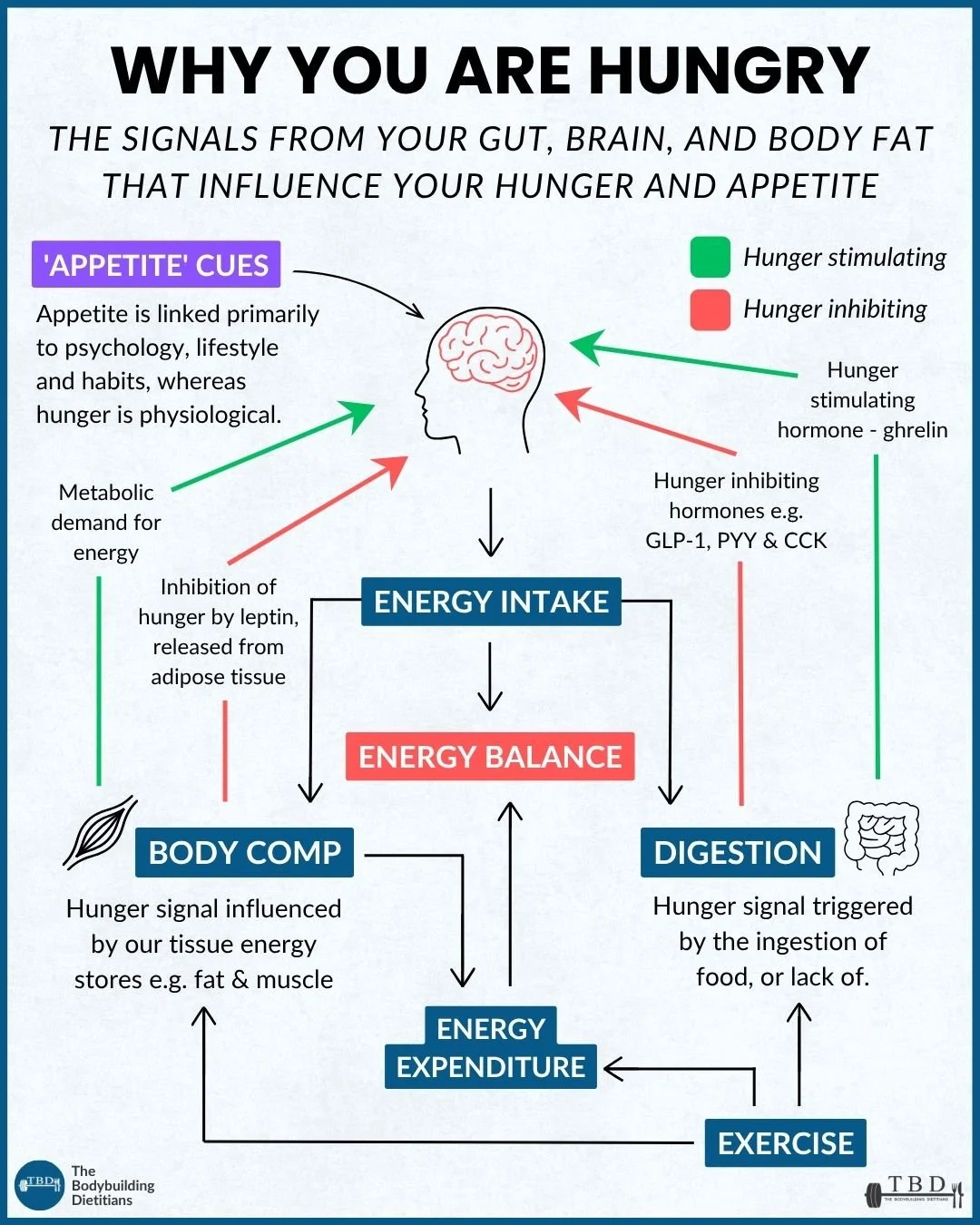
The multi-system regulation of hunger involves hormonal signals from the gut and adipose tissue, metabolic demand for energy, and the mechanical state of digestion, all feeding into brain-level hunger perception. Appetite operates alongside this system but responds to psychological and environmental inputs that hunger physiology doesn't directly track.
Hunger and appetite are not the same thing. Hunger is a physiological signal reflecting the body's energy status. Appetite is the psychological pull toward food shaped by habits, environment, and everything you've learned to associate with eating. This is a walk through the specific hormones and signals that drive each, and why understanding the distinction changes how you interpret cravings during a fat loss phase, hunger during a lean bulk, and the decisions you make around meals every day.
Hunger is a physiological signal driven by hormonal and metabolic feedback from the gut, adipose tissue, and other tissues that require energy. Appetite is a psychological pull toward food shaped by habits, environment, taste, sleep, stress, and everything you've learned to associate with eating. The two systems overlap but operate through different pathways and respond to different inputs. Hunger is driven by four main systems: metabolic demand for energy, gut hormones (ghrelin stimulates hunger while GLP-1, PYY, and CCK inhibit it), leptin signalling from adipose tissue (higher body fat produces more leptin and reduced hunger, while lower body fat reduces leptin and increases hunger), and digestion (the mechanical state of the stomach and small intestine). Appetite responds to environmental cues, meal timing habits, emotional states, sleep quality, and the availability of particular foods. Much of what people describe as hunger in day-to-day life is actually appetite. Genuine hunger is slower to build and non-specific (any food will do), while appetite is quick to arrive and typically attaches to specific foods. Learning to distinguish the two is one of the more useful skills for building a sustainable relationship with food, particularly during fat loss phases where appetite tends to increase alongside genuine hunger.
Hunger is a physiological signal that reflects the body's energy status. It is driven by hormones released from the gut and adipose tissue, by metabolic demand for energy from the body's active tissues, and by the mechanical state of digestion. Appetite is something different. It is the psychological pull toward food, shaped by habits, environment, taste, sleep, stress, and everything you have learned to associate with eating over the course of your life.
A lot of what people call hunger in day-to-day life is actually appetite. Genuine hunger tends to be slower to build and non-specific in its character (any food will do). Appetite arrives quickly, attaches itself to particular foods, and responds to cues that have nothing to do with energy balance (the smell of coffee, the sight of a bakery, the time on the clock, the sound of a wrapper opening). Both are real, both drive eating behaviour, and both need attention when structuring a diet that fits training and body composition goals. But they operate through different mechanisms and respond to different inputs, and understanding which one is driving a specific eating decision is genuinely useful.
This article walks through the four main physiological systems that drive hunger (metabolic demand, gut hormones, leptin signalling, and digestion), the psychological and environmental drivers of appetite, and the practical implications of the distinction for lifters navigating fat loss phases, muscle gain phases, and general body composition management.
For a related look at the coaching applications of the hunger and food focus distinction specifically during contest prep, our article on how to manage hunger during contest prep covers the applied side of the same concept.
What Are the Four Physiological Systems That Drive Hunger?
Hunger is regulated by multiple systems operating in parallel rather than by any single mechanism. Four main systems account for most of the observed variation in hunger between individuals and across different phases of eating.
Metabolic demand for energy. The body's active tissues (muscle, brain, organs) require a constant supply of energy to sustain function. When the energy available in circulation or in short-term stores runs low, hunger signalling increases through pathways involving glucose sensing in the hypothalamus and other central nervous system regions. This is one of the reasons hunger tends to increase during prolonged fasting, high training volume, or extended calorie deficits. The metabolic demand hasn't changed, but the energy available to meet it has diminished, and hunger signalling responds to the gap.
Gut hormones. The gastrointestinal tract releases several hormones that either stimulate or inhibit hunger in response to the state of the digestive system. Ghrelin is the primary hunger-stimulating hormone, released from the stomach when it is empty and typically peaking in the hours before an expected meal. Ghrelin levels drop after eating and gradually rise again as digestion completes and the stomach empties. GLP-1, PYY, and CCK are the primary hunger-inhibiting hormones, released from various sections of the small intestine in response to nutrients arriving during and after a meal. These hormones produce the sense of fullness that develops during and after eating, and their levels track the amount and composition of what has been consumed.
Leptin and adipose tissue signalling. Adipose tissue (body fat) is not metabolically inert. It releases leptin, a hormone that signals the brain about the body's longer-term energy status. Higher body fat produces more leptin and reduced hunger signalling, while lower body fat reduces leptin production and increases hunger signalling. This is one of the mechanisms behind the sustained hunger that competitors experience in the later stages of contest prep. As body fat drops below the level the body would naturally defend, leptin signalling drops and hunger increases persistently as a consequence.
Digestion and the mechanical state of the stomach. The physical fullness of the stomach influences hunger perception through mechanoreceptors in the stomach wall that signal stretch and volume. A stomach filled with a high-volume, low-calorie meal (large salad with lean protein) produces stronger mechanical satiety signals than the same calorie intake delivered in a smaller, more energy-dense form (protein bar). This is one of the reasons high-fibre and high-volume foods are useful for hunger management during fat loss phases.
Research on the hormonal regulation of hunger consistently shows that ghrelin, leptin, GLP-1, PYY, and CCK operate as a coordinated system rather than as independent signals. Individual variation in the sensitivity and secretion of these hormones accounts for meaningful differences in hunger perception between people at the same body composition and energy intake. Source: Andermann and Lowell, 2017, Neuron, 95(4):757-778; Woods and D'Alessio, 2008, Journal of Clinical Endocrinology and Metabolism, 93(11 Suppl 1):S37-S50.
The four systems combine to produce the moment-to-moment and day-to-day variation in hunger that most lifters experience. Understanding which system is driving hunger in a specific context (metabolic demand during heavy training, ghrelin rising before an expected meal, leptin dropping during prolonged fat loss, mechanical emptiness after a low-volume meal) helps identify which practical adjustments are most likely to help.
What Drives Appetite Instead of Hunger?
Appetite operates through pathways that overlap with hunger but respond to different inputs. Where hunger tracks the body's energy status through hormonal and metabolic feedback, appetite tracks environmental, psychological, and habitual cues that have limited direct connection to energy balance.
Environmental cues. The sight, smell, and sound of food (bakery aromas, a menu, a wrapper opening) can trigger appetite regardless of the body's actual energy status. This is one of the reasons walking past a food court can produce a strong pull toward eating even shortly after a meal that objectively met the body's energy needs.
Habits and expected meal timing. The body develops routines around eating, and appetite tends to align with expected meal times. Eating lunch at noon most days creates a learned pattern where appetite arrives around noon regardless of the actual physiological hunger state. This is one of the reasons the same meal skipped an hour before its usual time can feel much harder than the same meal skipped when the routine has already been broken.
Emotional states. Stress, boredom, low mood, and anxiety can all drive appetite without meaningful changes in physiological hunger. Emotional eating operates through pathways that involve reward and comfort seeking rather than energy balance signalling, and it can produce strong pulls toward specific foods (often calorie-dense and highly palatable ones) that don't reflect the body's actual energy needs.
Sleep and stress physiology. Poor sleep and chronic stress alter the balance of hunger-related hormones (ghrelin tends to rise, leptin tends to fall) but also affect appetite pathways independently. Sleep-deprived lifters often report increased appetite and stronger food focus even when calorie intake at their usual level would produce comparable physiological outcomes.
Palatability and food reward. Highly palatable foods (calorie-dense, sweet, salty, or engineered for maximum reward) can drive appetite well past physiological hunger. This is one of the reasons ultra-processed foods can be easy to overconsume compared to less palatable whole foods at the same calorie content.
Learned associations. Everything you have learned to associate with eating over the course of your life (specific foods with specific occasions, particular emotions with particular meals, the context in which you first developed food preferences) shapes appetite in ways that aren't traceable to physiology. A specific comfort food craving that appears during stress is largely learned rather than physiologically driven.
The practical difference between hunger and appetite is that hunger reflects the body's actual energy status while appetite reflects the psychological, environmental, and habitual cues that are wrapped around eating in each person's life. Both are real, both drive eating decisions, and both need attention. But they respond to different interventions, and treating an appetite issue with a hunger response (or vice versa) tends not to work.
How Do You Tell Whether It's Hunger or Appetite?
Several practical signs help distinguish hunger from appetite in the moment, though the distinction isn't always sharp and both often coexist.
Speed of onset. Genuine hunger builds slowly across hours, tracking the state of digestion and the drop in circulating energy. Appetite can arrive within minutes of exposure to a cue (walking past a bakery, seeing a food advertisement, receiving a message that mentions a specific food).
Specificity of the food craving. Genuine hunger is non-specific. A lifter who is truly hungry will usually accept a range of foods that fit the general macro and calorie needs of the meal. Appetite is typically food-specific: the person wants a particular food (a specific type of chocolate, a specific brand of chips, a specific dish from a specific restaurant) and other foods don't feel like a real substitute.
Time since the last meal. Genuine hunger is more likely to be present several hours after a meal than shortly after eating. Appetite can arrive immediately after a meal, particularly if the meal ended without the person feeling satisfied or if a cue for further eating appeared.
Physical sensations. Genuine hunger produces physical sensations (stomach growling, some emptiness in the abdomen, sometimes a mild headache or fatigue if extended). Appetite is largely cognitive: the pull toward food dominates without necessarily involving strong physical sensations.
Response to a small intervention. Genuine hunger typically responds to eating (even a small amount of food reduces the intensity). Appetite may persist even after eating, particularly if the food consumed wasn't the specific food the person wanted. Waiting 15 to 20 minutes and drinking water often reduces appetite meaningfully while leaving genuine hunger largely unchanged.
The distinction isn't perfectly clean in most situations. Most eating decisions involve both physiological hunger and psychological appetite operating together, with one or the other dominant depending on context. But being able to identify which one is more dominant helps in choosing the appropriate response: whether to eat, whether to wait, whether to change the environment, or whether to address an underlying pattern like sleep or stress.
Not Sure How to Read Your Own Signals Across Phases?
Teaching lifters to read hunger and appetite signals accurately across different phases (fat loss, muscle gain, maintenance, contest prep) is one of the areas where structured coaching tends to produce meaningful improvements. The specific pattern that shows up in someone's hunger response varies with training phase, life circumstances, sleep quality, and dietary structure, and identifying the pattern for a specific person is the practical work of turning the physiology into applied nutrition. Our team works with clients on this alongside the broader nutrition and training plan.
Why Does the Distinction Matter for Fat Loss and Muscle Gain?
The practical value of distinguishing hunger from appetite comes from how each phase of training and dieting affects the two systems differently.
During fat loss phases, both hunger and appetite tend to increase, but they increase for different reasons and respond to different interventions. Physiological hunger increases because energy intake is below expenditure, leptin signalling drops as body fat decreases, and metabolic demand for energy isn't being fully met. Appetite increases because food takes on more psychological weight in the context of restriction, food-focused environmental cues become more salient, and the reduced satisfaction of smaller meals leaves more residual pull toward eating.
Managing the two requires different approaches. Physiological hunger is managed through meal composition (higher protein, higher fibre, higher volume foods that produce stronger satiety signals per calorie), meal timing (regular schedule that aligns with expected hunger patterns), and adequate sleep and stress management. Appetite is managed through environmental adjustments (reducing exposure to food-focused content and cues), habit structure (regular meal times that reduce the number of eating decisions per day), and cognitive strategies (distinguishing boredom from hunger, waiting through the peak of a craving).
During muscle gain phases, hunger tends to be less of a challenge because energy intake is above expenditure and the physiological drivers of hunger are largely being met. Appetite can still be a factor in the opposite direction. Some lifters struggle to hit calorie targets not because they lack hunger but because their appetite doesn't scale up to match the higher intake requirement. This is a common issue in muscle gain phases, particularly for lifters with smaller body sizes or those who have spent years in fat loss phases where appetite has been trained downward.
Managing appetite in a muscle gain context involves strategies like eating more frequent meals, prioritising higher-density foods, using liquid calories where appetite for solids has reached a ceiling, and giving appetite time to adjust to the higher intake demand over weeks rather than expecting immediate adjustment.
During contest prep specifically, the interaction between hunger and appetite becomes particularly intense as body fat drops below the range the body would naturally defend. Leptin signalling drops substantially, metabolic demand isn't being fully met, and appetite responses to food cues intensify.
During maintenance phases, hunger and appetite tend to align reasonably well with actual energy needs, and the practical challenge shifts to sustaining the eating patterns that fit the current body composition and training approach. This is often when the distinction is most useful for building long-term habits, because the pressure isn't at the acute level of fat loss or the intensity of muscle gain.
For a related look at how meal composition supports both hunger and appetite management, our five-part meal framework article covers the structural template we use to build meals that address both systems.
Practical Takeaways
Hunger and appetite are not the same thing. Hunger is a physiological signal driven by hormones from the gut and adipose tissue, metabolic demand, and the mechanical state of digestion. Appetite is a psychological pull toward food shaped by habits, environment, taste, sleep, stress, and learned associations.
The four main physiological drivers of hunger are metabolic demand for energy, gut hormones (ghrelin stimulates, GLP-1 and PYY and CCK inhibit), leptin signalling from adipose tissue, and the mechanical state of the stomach and small intestine.
Appetite responds to environmental cues, habitual meal timing, emotional states, sleep and stress physiology, food palatability, and learned associations. Most of what people call hunger in day-to-day life is actually appetite operating through these pathways.
Practical signs that distinguish hunger from appetite include speed of onset (hunger builds slowly, appetite arrives quickly), specificity of craving (hunger is non-specific, appetite is food-specific), time since the last meal, physical sensations (hunger has them, appetite is largely cognitive), and response to a small intervention (hunger responds to eating, appetite may not).
During fat loss phases, both hunger and appetite increase, but they respond to different interventions. Hunger is managed through meal composition, timing, and adequate sleep. Appetite is managed through environmental adjustments, habit structure, and cognitive strategies.
During muscle gain phases, appetite (not hunger) is often the limiting factor for hitting calorie targets, particularly for lifters with smaller body sizes or extended fat loss history. Managing this requires deliberate strategies to expand appetite rather than to suppress it.
Frequently Asked Questions
What is the difference between hunger and appetite?
Hunger is a physiological signal driven by hormones (ghrelin, leptin, GLP-1, PYY, CCK), metabolic demand for energy, and the mechanical state of digestion. It reflects the body's actual energy status. Appetite is a psychological pull toward food shaped by habits, environment, taste, sleep, stress, and everything you've learned to associate with eating. Hunger tends to build slowly and be non-specific about which food will satisfy it. Appetite arrives quickly and typically attaches to particular foods.
What hormones control hunger?
Several hormones coordinate hunger signalling. Ghrelin is the primary hunger-stimulating hormone, released from the stomach when it is empty. GLP-1 (glucagon-like peptide-1), PYY (peptide YY), and CCK (cholecystokinin) are the primary hunger-inhibiting hormones, released from the small intestine in response to food. Leptin is released from adipose tissue and signals longer-term energy status, with higher body fat producing more leptin and reduced hunger, and lower body fat reducing leptin and increasing hunger.
Why am I hungry all the time during a diet?
Multiple systems combine to increase hunger during sustained calorie deficits. Metabolic demand for energy isn't being fully met, so hunger signalling increases through central nervous system pathways. Leptin production drops as body fat decreases, which reduces the fullness signal from adipose tissue. Ghrelin levels rise more between meals. Digestion also happens faster with smaller meals, so the mechanical fullness signal fades sooner. The combined effect is that a sustained deficit produces multiple hunger signals simultaneously rather than any single easily-managed pattern.
How do I know if I'm hungry or just craving something?
Several signs help distinguish them. Hunger builds slowly over hours and is non-specific about which food will satisfy it. Cravings arrive quickly, attach to a particular food, and often respond to cues that have nothing to do with energy balance (sight of a specific food, boredom, stress). Hunger tends to produce physical sensations (stomach growling, some emptiness). Cravings are largely cognitive. Hunger reduces meaningfully with any food. Cravings may persist even after eating something else and often only resolve when the specific food is consumed or the underlying cue changes.
Does exercise increase or decrease hunger?
Both, depending on the type and intensity. Moderate exercise tends to increase hunger through increased metabolic demand for energy. High-intensity exercise can actually suppress hunger acutely (for 30 to 60 minutes post-training) through changes in ghrelin and PYY levels, though this effect fades and hunger returns as recovery progresses. Chronic high training volumes without adequate calorie intake produce sustained hunger through the same leptin and metabolic pathways that drive fat loss hunger.
Can poor sleep make me hungrier?
Yes. Sleep restriction alters the balance of hunger hormones (ghrelin rises, leptin falls) and also affects appetite pathways through changes in reward processing and impulse control. Sleep-deprived people typically report both stronger hunger and stronger appetite, and both effects can persist across days of accumulated sleep debt. Sleep quality is one of the more impactful non-dietary variables affecting hunger and appetite for lifters.
If you want help reading your own hunger and appetite signals accurately across different phases of training and dieting, and adjusting your nutrition approach based on which system is actually driving your eating decisions, our team can build a plan matched to your individual context and phase. You can enquire about coaching or book a consultation with our team.