Hunger during a fat loss phase responds to energy availability, food composition, meal timing, food environment, stress, and sleep. Most of these variables can be set up in advance rather than managed in the moment, which changes the approach from willpower to structure.
Persistent hunger during a calorie deficit is most effectively managed through six practical strategies. Fuelling appropriately means matching energy intake to activity level and monitoring deficit severity, since many hunger problems reflect a deeper deficit than necessary rather than a structural food issue. Prioritising foods high in protein and dietary fibre produces independent satiety signals that reduce total energy intake across the day. Timing meals around activity and pre-logging food the day before removes nutrition decisions from high-hunger states where they rarely align with dietary goals. Managing food focus, including reducing food-centric media consumption and the compulsive pursuit of volume foods and low-calorie substitutes, reduces appetite stimulation that is independent of actual energy need. Recognising that some hunger is expected and normal during weight loss prevents the misinterpretation of hunger as something that needs to be eliminated entirely. And managing stress while getting sufficient sleep supports the hormonal environment in which hunger can be regulated effectively.
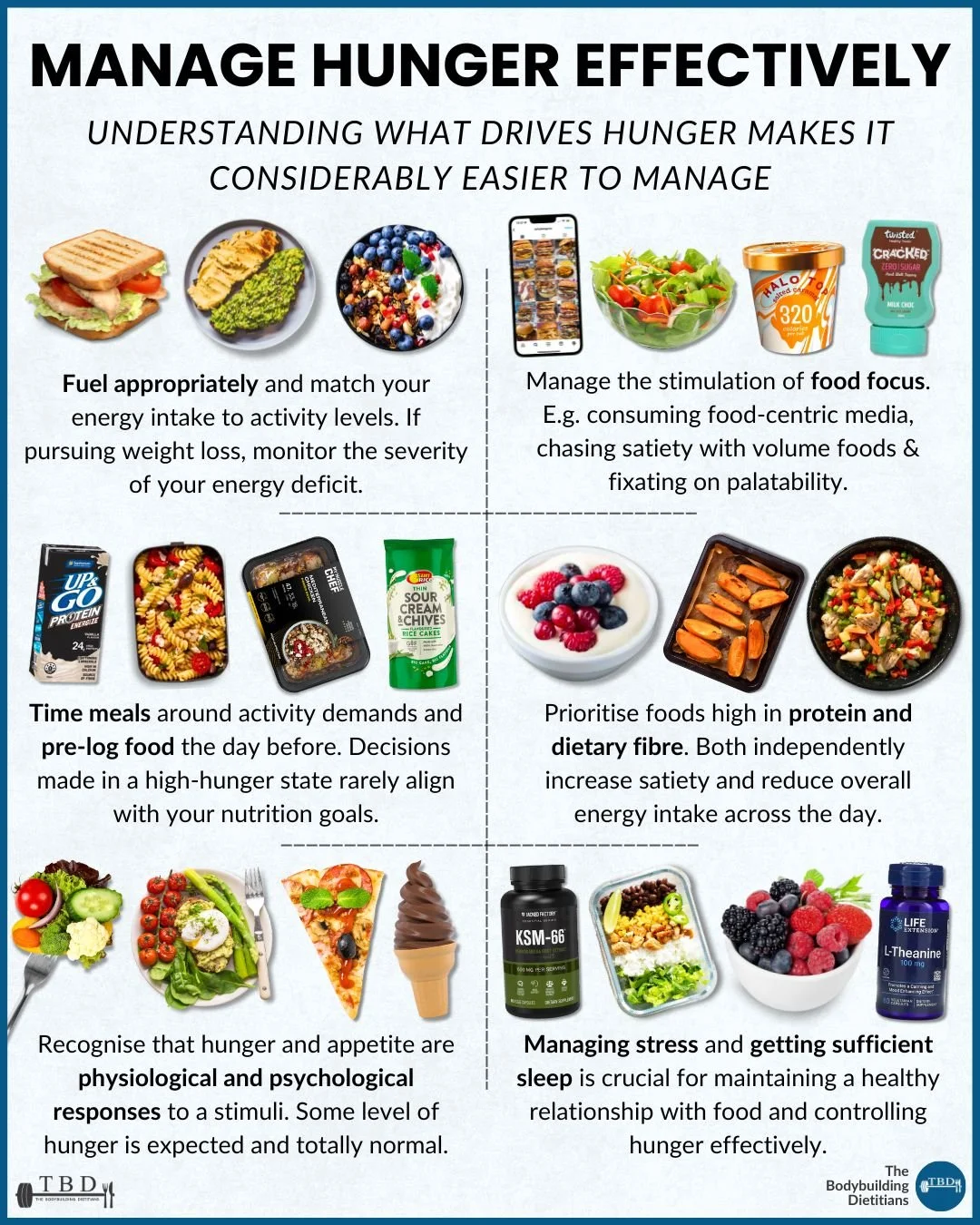
Six practical strategies for managing hunger during a fat loss phase, covering energy intake, food composition, meal timing, food environment, mindset, and lifestyle variables.
Hunger is often framed as an opponent to be fought through, and the solutions offered are frequently motivational rather than structural. But hunger responds to specific and largely modifiable inputs, and identifying which of those inputs is producing the problem in a specific person at a specific point in a diet changes what the practical response should be.
The most common pattern in people struggling with hunger during a fat loss phase is not a motivation deficit. It tends to be a combination of a deficit set deeper than necessary, meals low in protein and fibre, food decisions made late in the day under high-hunger conditions, and compulsive engagement with food-related media between meals. Each of these has a structural solution. The six strategies below cover the most consistently relevant ones.
One framing note worth establishing at the outset: some hunger is expected during a calorie deficit and is not a signal that the dietary approach has failed. The goal of hunger management is to keep hunger within a range that is compatible with consistent and deliberate decision-making, not to eliminate it entirely.
How Does Fuelling Appropriately Reduce Hunger?
Many hunger problems during a fat loss phase trace back to a deficit that is more aggressive than the goal requires. A deficit calibrated to produce 0.5 to 1 percent of bodyweight loss per week is the appropriate target for preserving lean mass and sustaining adherence across a longer phase. Deficits that produce significantly faster weight loss tend to generate a level of hunger that compounds with diet fatigue over time, making the phase increasingly difficult to sustain as weeks progress.
Matching energy intake to activity levels includes accounting for the energy expenditure that training adds. An athlete in a high-volume training block who is eating at the same calorie level as a low-volume maintenance period is in a more aggressive deficit than the calorie figure alone suggests, because the additional exercise energy expenditure is narrowing the available energy for physiological function. This is the energy availability concept covered in more depth in our article on the fuelling hierarchy: the relevant measure is not just total calories but the energy remaining after training expenditure is accounted for.
The practical audit for this variable is to check whether the current rate of weight loss is in the expected range for the deficit in place. A rate of loss significantly above 1 percent of bodyweight per week suggests the effective deficit is larger than planned, either from underestimating intake, overestimating or underestimating expenditure, or a training load that has increased without a corresponding adjustment to intake. Correcting the deficit to a more manageable level often substantially reduces hunger without requiring any other change to the dietary approach.
Why Protein and Fibre Are the Two Most Reliable Satiety Variables
Protein and dietary fibre are the two nutritional variables with the strongest and most consistent evidence for independently increasing satiety and reducing total energy intake across the day. Both operate through distinct physiological mechanisms, which means their combined effect at each meal is additive rather than redundant.
Protein suppresses ghrelin more effectively than carbohydrate or fat, and stimulates the release of satiety hormones including GLP-1 and PYY that signal fullness to the brain through pathways that produce durable post-meal satiety once activated. Total daily protein intake of 1.8 to 2.4 grams per kilogram of bodyweight during a fat loss phase covers both the lean mass protection and the appetite regulation functions simultaneously, and it is one of the most reliably actionable adjustments available when hunger is the primary problem.
Dietary fibre increases satiety through two complementary mechanisms. Insoluble fibre adds physical bulk and slows gastric emptying, extending the time before the stomach empties and the stretch response that signals fullness dissipates. Soluble fibre forms a gel in the digestive tract that further slows gastric emptying and feeds gut bacteria that produce short-chain fatty acids with additional appetite-suppressing effects through gut hormone signalling. Practical fibre targets of 25 to 30 grams or more per day from whole food sources, drawn from vegetables, legumes, fruit, wholegrains, and nuts, cover both fibre types while also providing the food volume that supports mechanical satiety.
Building meals around protein and fibre first, and then adding carbohydrate and fat to meet targets, is the practical application. A meal that begins with a lean protein source and a substantial volume of fibre-containing vegetables or legumes will produce a stronger and more durable satiety signal than one built around the same total calories from lower-protein, lower-fibre components. The specific foods that provide the best combination of fibre and low calorie density are covered in our articles on food volume versus fibre per calorie and high fibre foods ranked.
How Meal Timing and Pre-Logging Reduce Hunger-Driven Decision Making
Food decisions made in a high-hunger state consistently trend toward higher-calorie, more palatable options than the same decisions made in a well-fed and low-stress state. This is not a failure of willpower; it reflects the actual hormonal and neurological state that hunger creates, where ghrelin is elevated, the reward salience of food is heightened, and cognitive resources for deliberate decision-making are reduced.
Timing meals around activity demands takes advantage of the fact that hunger is typically lowest in the post-meal and post-exercise period, and highest in the late afternoon and evening when the cumulative effect of the day's energy deficit has built up. Placing the largest meals and the highest-protein components earlier in the day and around training, when satiety from eating and exercise is highest, produces better dietary adherence than distributing meals in a way that leaves the evening state poorly fuelled and highly hungry.
Pre-logging meals the day before, or at least planning the following day's food in advance, removes the decision from the highest-hunger point and moves it to a state where the decision is more aligned with dietary goals. A meal that has been planned and logged in advance is simply consumed rather than decided upon in real time under hunger, which eliminates the decision-making step where hunger most often undermines adherence. This is one of the most consistently effective practical tools for improving dietary adherence in coaching settings, independent of what specific foods are chosen.
How Managing Food Focus Reduces Appetite Independent of Actual Hunger
Appetite can be stimulated by external food cues independently of physiological energy need, and in an environment where food-related media, advertising, and palatability-focused content are pervasive, this cue-driven appetite stimulation can be a meaningful contributor to total food intake.
Consuming food-centric media between meals, whether recipe content, food photography, restaurant reviews, or the cooking and eating content that saturates social media, repeatedly activates appetite-relevant neural pathways in a way that increases eating independent of hunger. For someone in a calorie deficit where hunger is already elevated and the gap between appetite signals and energy need is already present, additional external appetite stimulation compounds the management challenge.
The practical response is to reduce exposure to food cues during the periods of the day when hunger is highest and the risk of cue-driven eating is greatest, while substituting other activities that engage attention without food as the subject. This is not about eliminating enjoyment of food content but about recognising when that content is functioning as an appetite stimulant rather than an enjoyable experience.
A related pattern worth noting is the compulsive use of volume foods and low-calorie substitutes as the primary hunger management tool. High-volume, low-calorie foods including diet ice cream, zero-calorie sauces, and large quantities of low-energy vegetables are genuinely useful within a broader hunger management approach, and their role in the diet is covered in the food volume vs protein article. The pattern worth examining is when these foods are doing most of the hunger management work, because that is often a signal that the upstream variables, protein intake, fibre, deficit severity, and meal timing, are not yet in place. Volume foods work best as a complement to those foundations rather than as a substitute for them.
Why Recognising Normal Hunger Matters for Long-Term Adherence
Some hunger is expected during a calorie deficit, and misinterpreting its presence as a sign that the dietary approach is failing tends to produce two counterproductive responses: attempting to eliminate hunger through increasingly aggressive volume eating that shifts the diet toward food obsession, or abandoning the approach because the experience does not match an expectation of comfortable eating throughout.
Hunger is a physiological signal that the body is in an energy-insufficient state. During a fat loss phase, that is precisely the state the diet is designed to create. The presence of hunger in that context is therefore expected rather than problematic, and the appropriate management goal is to keep it within a range that is compatible with making consistent and deliberate nutrition decisions across the day, not to prevent it entirely.
A useful reframe is to distinguish between hunger that is manageable, present but not disruptive, and hunger that is consuming cognitive attention, producing strong cravings that undermine adherence, and persisting despite the nutritional strategies above being in place. The former is a normal feature of a well-structured fat loss phase. The latter is a signal that one or more of the upstream variables needs attention. Developing the capacity to sit with manageable hunger without treating it as an emergency is a skill that improves with experience, and it is one of the practical differences between someone completing their first fat loss phase and someone who has managed several.
How Sleep and Stress Management Support Hunger Regulation
Sleep and stress sit at the hormonal level of hunger management, and their influence on appetite is direct and substantial. Sleep deprivation acutely elevates ghrelin, suppresses leptin, increases cortisol, and shifts food preferences toward higher-calorie and more palatable options, all on the following day even when dietary intake remains unchanged. The result is reliably higher hunger, stronger cravings, and reduced capacity for deliberate nutrition decisions, all on a day when the deficit is still in place.
The practical implication is that protecting sleep quality and duration is a hunger management strategy as much as a recovery strategy. An athlete who sleeps five to six hours consistently across a training and dieting week will experience meaningfully more hunger and reduced dietary adherence than one sleeping seven to nine hours, independent of their nutrition and training choices. Improving sleep quality in this context is not a secondary concern but one of the most direct available levers for improving hunger management during a deficit.
Chronic stress elevates cortisol independently of sleep, with similar effects on appetite and food preference. High training loads, psychological stress, and inadequate recovery all contribute to chronically elevated cortisol that increases appetite, particularly for energy-dense and highly palatable foods, and impairs the hormonal signals that produce satiety. Managing stress through genuine downtime and appropriate recovery is the structural response, and it influences hunger through the same hormonal pathway that sleep does. The relationship between stress, cortisol, and hunger is covered in more depth in our article on understanding hunger during a fat loss phase.
Practical Takeaways
Check deficit severity first. Many hunger problems during a fat loss phase reflect a deficit deeper than the goal requires. A rate of loss of 0.5 to 1 percent of bodyweight per week balances progress with physiological sustainability, and correcting an overly aggressive deficit often substantially reduces hunger without changing anything else.
Protein and dietary fibre are the two most reliable satiety variables and operate through distinct mechanisms that are additive at each meal. Building meals around these first produces stronger and more durable satiety than equivalent calories from lower-protein, lower-fibre components.
Pre-logging meals the day before and timing meals around training removes food decisions from the highest-hunger state and places them in a state where they are more likely to align with dietary goals.
Reducing food-centric media consumption during the highest-hunger periods of the day reduces cue-driven appetite stimulation that is independent of physiological energy need.
Some hunger is expected during a calorie deficit. The management goal is to keep hunger within a range compatible with consistent decision-making, not to eliminate it. Volume foods and low-calorie substitutes are useful within a broader strategy, but they work best alongside adequate protein, fibre, and a correctly set deficit rather than as replacements for those foundations.
Sleep and stress management influence hunger hormones directly and substantially. Protecting sleep duration and quality, and managing chronic stress through genuine recovery, is a hunger management strategy as much as a recovery one.
Frequently Asked Questions
Why am I so hungry on a diet even when I eat enough calories?
Hunger during a calorie deficit can persist even at apparently adequate calorie intakes for several reasons beyond the energy content of the diet. Low protein and fibre reduce satiety signals from the gut and accelerate gastric emptying. Poor sleep elevates ghrelin and suppresses leptin independently of food intake. High stress raises cortisol, which increases appetite for energy-dense foods. Meals timed poorly relative to hunger patterns leave the highest-hunger periods of the day underfuelled. And a deficit deeper than necessary produces hunger at a level that reflects the physiological pressure, not just the number of calories eaten. Identifying which of these is most active produces a more effective response than simply increasing total food intake.
Does eating more protein actually reduce hunger?
Yes, through several distinct and well-established mechanisms. Protein suppresses ghrelin more effectively than carbohydrate or fat, stimulates the release of satiety hormones GLP-1 and PYY that signal fullness to the brain, and requires more energy to metabolise than the other macronutrients, which extends the post-meal satiety window. Total daily protein intake is one of the strongest available dietary levers for appetite regulation during a fat loss phase, and increasing it toward 1.8 to 2.4 grams per kilogram of bodyweight is one of the most consistently effective hunger management adjustments available.
Does looking at food on social media make you hungrier?
Yes, through a well-documented mechanism. Exposure to food cues, including food photography, recipe content, and cooking media, activates appetite-relevant neural pathways in the brain's reward system that increase appetite independently of physiological energy need. For someone in a calorie deficit where hunger is already elevated, repeated exposure to food cues between meals can meaningfully compound the hunger experience and increase the likelihood of eating beyond the dietary plan. Reducing food-centric media exposure during high-hunger periods of the day is a practical environmental management tool.
Should I eat volume foods to manage hunger?
High-volume, low-calorie foods can be a useful component of hunger management during a fat loss phase, supporting the mechanical satiety that comes from gastric stretch without consuming a significant portion of the calorie budget. However, they work best alongside adequate protein and fibre intake, a correctly set deficit, and appropriate meal timing rather than as a substitute for those foundations. When volume foods and low-calorie substitutes are doing most of the hunger management work, the more useful question is whether protein targets are being met and whether the deficit is set at the right level.
How much hunger is normal on a diet?
Some hunger is a normal and expected feature of a fat loss phase. The body produces hunger signals in response to an energy-insufficient state, which is the state the diet is designed to create. Manageable hunger that is present but not disruptive to normal functioning and decision-making is a normal experience. Hunger that is consuming cognitive attention, producing strong and persistent cravings, or significantly impacting quality of life is a signal that one or more upstream variables, deficit severity, protein intake, fibre, sleep, or stress, needs attention. The goal is a hunger level compatible with consistent dietary adherence, not zero hunger.
Can poor sleep increase hunger the next day?
Yes, substantially. Sleep deprivation produces acute elevation of ghrelin, suppression of leptin, elevation of cortisol, and shifts in food preferences toward higher-calorie and more palatable options, all on the following day even when dietary intake remains exactly the same. These hormonal changes are measurable and produce reliably higher appetite and stronger cravings. Protecting sleep duration and quality is therefore a direct hunger management strategy, not just a recovery consideration.
Working through which of these variables is most relevant for a specific person, and adjusting food structure, meal timing, and habits accordingly, is a key part of what we work through with clients. If you want that level of individual analysis applied to your hunger management approach, you can enquire about coaching or book a consultation to get started.