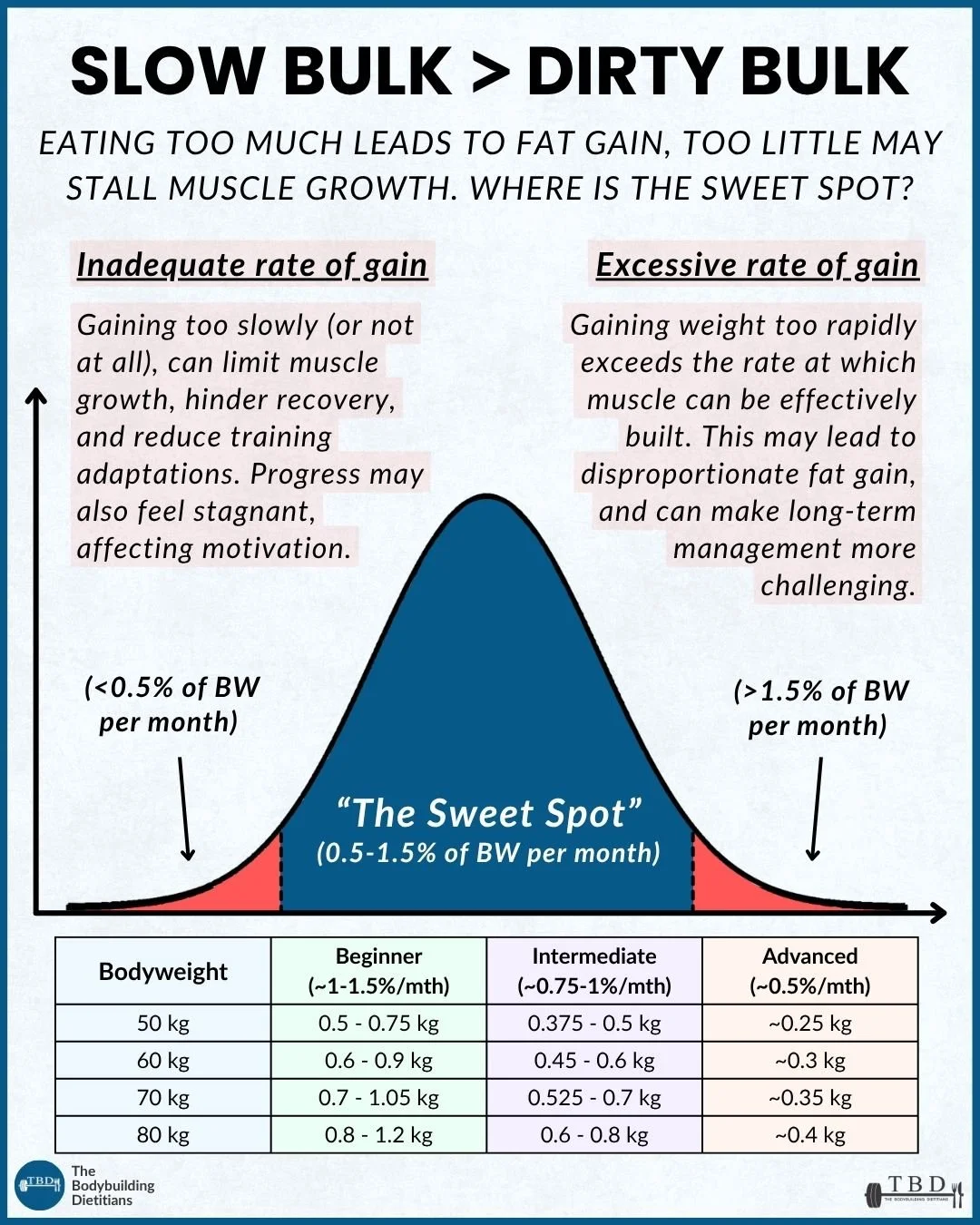
The right rate of gain sits within a range rather than at a single number, and where within the range each lifter should sit depends on training age and how much muscle potential remains. Beginners belong at the higher end, intermediates in the middle, and advanced lifters at the lower end.
Bulking pace isn't a fixed number. The right rate of gain depends on your training age, current body composition, and how close you are to your genetic ceiling. This is a guide to matching the pace to the person, with specific monthly gain targets for beginners, intermediates, and advanced lifters at common body weights.
The right rate of gain during a bulk depends on training age, current body composition, and how close the lifter is to their genetic ceiling. Beginners with substantial remaining muscle potential can gain 1 to 1.5 percent of bodyweight per month with most of the gained weight going to muscle, which justifies a meaningful calorie surplus. Intermediates with 1 to 3 years of consistent training should target 0.75 to 1 percent of bodyweight per month, with a moderate surplus that keeps fat gain in check while still supporting steady muscle accrual. Advanced lifters close to their genetic ceiling should sit at approximately 0.5 percent of bodyweight per month or lower, because the remaining muscle available to build is small enough that an aggressive surplus produces mostly fat gain rather than muscle gain. For a 70 kilogram lifter, this translates to approximately 0.7 to 1.05 kilograms per month as a beginner, 0.525 to 0.7 kilograms per month as an intermediate, and approximately 0.35 kilograms per month as an advanced lifter. The specific number matters less than matching the pace to where the lifter actually sits on the training age spectrum.
There is more nuance to bulking than a single rate of gain. The rates in this guide cover a range rather than one number because the correct pace depends on training age, current body composition, and how close a lifter is to their genetic ceiling. Applying a generic "1 percent of bodyweight per month" recommendation to a first-year lifter and a ten-year advanced lifter treats two very different situations as if they were the same, which is one of the reasons rate of gain guidance often produces disappointing outcomes at both ends of the training spectrum.
This article walks through the training-age-adjusted rate of gain framework, the specific monthly gain targets for beginners, intermediates, and advanced lifters at common body weights, and the reasoning behind why the correct pace shifts as training experience accumulates. The purpose is to replace the fixed-number thinking about bulking pace with a framework that actually matches the pace to the person.
For a related look at why so many gaining phases fail regardless of the pace, our article on the cycle of no progression covers the specific behavioural pattern where gaining phases keep getting cut short before muscle has time to actually build.
Why Doesn't a Single Rate of Gain Work for Everyone?
The reason a fixed rate of gain doesn't apply to every lifter comes down to how much muscle-building potential remains at different stages of training. Two lifters at the same body weight but very different training ages will produce very different outcomes at the same surplus size and gaining pace.
Beginners have substantial remaining muscle potential. Their bodies are highly responsive to training, and a well-structured resistance training program combined with adequate protein and a meaningful calorie surplus will produce muscle gain at rates that intermediate and advanced lifters can't match. In beginners, a larger proportion of gained body weight goes to muscle rather than fat, which justifies eating in a more aggressive surplus. The muscle response to the calories is strong enough that the tradeoff favours faster gaining.
Intermediate lifters have already captured most of the initial rapid gains from starting resistance training. Their bodies are still responsive to training but less dramatically so than in the first year or two. The proportion of gained weight going to muscle rather than fat has come down, though it remains meaningful. A moderate surplus at a moderate gaining pace produces steady muscle accrual without excessive fat gain.
Advanced lifters sit close to their genetic ceiling for muscle mass. The remaining muscle available to build across any given phase is small, and the body's responsiveness to training has substantially diminished compared to earlier stages. Attempting to eat in an aggressive surplus produces mostly fat gain because the muscle-building side of the equation has slowed. The correct approach shifts toward a small surplus that supports the modest remaining muscle gain without the substantial fat gain that a larger surplus would produce.
The training-age adjustment isn't a soft recommendation. It's a physiological reality that shapes what the same surplus size actually produces in different lifters. A 500-calorie surplus in a first-year lifter produces meaningful muscle gain with modest fat gain. The same surplus in a ten-year advanced lifter produces mostly fat gain with minimal muscle gain. Recognising this and adjusting the pace accordingly is the specific piece that fixed-number rate-of-gain guidance misses.
What Are the Specific Rate of Gain Targets by Training Age?
The training-age adjusted rate of gain sits within three broad categories, each with a specific monthly gain target that reflects the muscle-building potential remaining at that stage.
Beginners: approximately 1 to 1.5 percent of bodyweight per month.
Lifters in their first 1 to 2 years of consistent resistance training belong at the higher end of the gaining range. The rapid initial muscle response to training justifies a meaningful surplus, and the proportion of gained weight going to muscle rather than fat is at its highest during this window. Missing this window by gaining too slowly leaves substantial muscle-building potential unrealised, which is a genuine cost.
For a 50 kilogram beginner: 0.5 to 0.75 kilograms per month. For a 60 kilogram beginner: 0.6 to 0.9 kilograms per month. For a 70 kilogram beginner: 0.7 to 1.05 kilograms per month. For an 80 kilogram beginner: 0.8 to 1.2 kilograms per month.
The specific number within the range depends on training quality, protein intake, sleep and recovery, and individual response. A beginner training seriously with adequate protein and good recovery can sit at the upper end of the range comfortably. A beginner with less consistent training or recovery should sit at the lower end.
Intermediates: approximately 0.75 to 1 percent of bodyweight per month.
Lifters with 2 to 5 years of consistent training and a solid foundation of muscle mass sit in the intermediate range. The initial rapid gains have been captured, and the muscle-building rate has settled into a more moderate pace. The correct rate of gain reflects this: still meaningful gains, but at a pace that keeps fat accumulation in check.
For a 50 kilogram intermediate: 0.375 to 0.5 kilograms per month. For a 60 kilogram intermediate: 0.45 to 0.6 kilograms per month. For a 70 kilogram intermediate: 0.525 to 0.7 kilograms per month. For an 80 kilogram intermediate: 0.6 to 0.8 kilograms per month.
Intermediate lifters are typically the largest group by numbers, and this range covers the majority of physique-focused lifters between roughly 2 and 5 to 7 years into training.
Advanced lifters: approximately 0.5 percent of bodyweight per month.
Lifters with many years of consistent training who sit close to their genetic ceiling for muscle mass should target approximately 0.5 percent of bodyweight per month or lower. The remaining muscle available to build is small, and gaining faster than this pace produces disproportionate fat gain without meaningful additional muscle.
For a 50 kilogram advanced lifter: approximately 0.25 kilograms per month. For a 60 kilogram advanced lifter: approximately 0.3 kilograms per month. For a 70 kilogram advanced lifter: approximately 0.35 kilograms per month. For an 80 kilogram advanced lifter: approximately 0.4 kilograms per month.
Some advanced lifters can even sit close to maintenance for extended periods and still capture the small amount of muscle gain remaining available, because the muscle response doesn't require a substantial surplus at this stage. This is a genuine departure from the traditional "bulking phase" framing and reflects the reality that muscle-building potential is not distributed equally across the training career.
How Do You Actually Know Which Category You Sit In?
The training-age categories above are general references, and specific lifters may sit at boundaries or somewhere between categories. Several practical indicators help identify where a lifter actually sits.
Beginner indicators. Fewer than 2 years of consistent, well-structured resistance training. Meaningful strength progression session-to-session or week-to-week (still adding weight or reps to major lifts most weeks). Visible muscle gain within weeks rather than months of consistent training. Novice or early-intermediate strength standards on major compound lifts.
Intermediate indicators. 2 to 5 years of consistent training. Strength progression measured at the monthly rather than weekly level. Muscle gain visible only over several months of consistent gaining phases. Intermediate to early-advanced strength standards on major compound lifts. Ability to reasonably identify weak points and program around them.
Advanced indicators. 5+ years of consistent training. Strength progression measured across gaining and maintenance phases rather than within phases. Muscle gain visible only across extended phases of 20+ weeks. Advanced strength standards on major compound lifts. Meaningful understanding of individual training response and personal weak points.
The specific number of years matters less than the training quality across those years. A lifter with 8 years of inconsistent training may actually sit at intermediate rather than advanced. A lifter with 3 years of very consistent, well-structured training may sit at the upper end of intermediate rather than early. Adjusting the rate of gain to match the actual training age rather than the calendar age of the training habit is the useful refinement.
For a more detailed framework on assessing where you sit within the multi-phasic structure of a bodybuilding career, our article on bodybuilding phases covers the improvement season and prep progression that most lifters cycle through as they advance.
Wondering Where You Actually Sit on the Spectrum?
Figuring out how close a lifter is to their genetic ceiling and setting the rate of gain accordingly is one of the areas where a general guide can only get you so close. Individual training response, structural mechanics, past training history, and current body composition all shape where the specific rate of gain should sit for a given person. Our team works with clients on identifying where they actually sit, setting a rate of gain that matches their remaining muscle-building potential, and adjusting as training age accumulates and the correct pace shifts.
What Happens When the Rate of Gain Is Wrong for Your Training Age?
The two ways the rate of gain can be miscalibrated for a lifter's training age produce different failure modes, and both are common.
Gaining too slowly for the training age. This is the specific failure mode for beginners and early intermediates who apply advanced-lifter rate of gain guidance to themselves. The lifter targets 0.5 percent of bodyweight per month when their actual muscle-building potential would support 1 to 1.5 percent per month. The consequence is that meaningful muscle-building potential goes unrealised because the calorie surplus wasn't large enough to support the muscle gain that the training would have driven. Beginners in particular pay a real cost for this: the first 1 to 2 years of training represent the fastest muscle-building window of a lifter's career, and gaining too slowly in this window leaves permanent gains on the table that can't be recovered later.
Gaining too fast for the training age. This is the specific failure mode for advanced lifters who apply beginner rate of gain guidance to themselves. The lifter targets 1 to 1.5 percent of bodyweight per month when their actual muscle-building potential would only support 0.5 percent per month. The consequence is that most of the gained weight goes to fat rather than muscle, because the muscle-building side of the equation has slowed while the calorie surplus is still producing the same fat storage response. Advanced lifters gaining too fast typically end up with a poor ratio of muscle to fat gain by the end of the phase and a longer subsequent fat loss phase to reverse the accumulated fat gain.
The specific pace that would be perfect for one lifter can be counterproductive for another at the same body weight. Matching the rate of gain to the training age is one of the specific refinements that separates well-structured gaining phases from the fixed-number approaches that produce disappointing outcomes.
What About the "Bulking Is Dead" Narrative?
The recent popularity of "bulking is dead" and body recomposition-only frameworks reflects a partial truth that has been overextended into a universal claim. The specific truth is that traditional aggressive bulking (fast weight gain, high calorie surpluses, minimal attention to fat gain) is no longer defensible as a universal recommendation, particularly for intermediate and advanced lifters whose muscle-building potential doesn't justify the fat gain that aggressive bulking produces.
Where the narrative overextends is in the claim that bulking is universally wrong or that maintenance-only approaches work for everyone. This is not what the evidence actually supports. Beginners with substantial remaining muscle potential genuinely benefit from a meaningful surplus and faster gaining pace, and forcing beginners to eat at maintenance in the interest of "avoiding fat gain" leaves substantial muscle-building potential on the table.
The correct framing is that bulking is a tool with context-dependent utility rather than a universally right or wrong approach. How useful the tool is depends on how much muscle-building potential remains, and matching the pace to the person produces better outcomes than either aggressive bulking universally or maintenance-only universally.
For beginners: Bulking with a meaningful surplus is the correct approach. The rapid muscle response to training makes the tradeoff favour faster gaining, and gaining too slowly at this stage leaves permanent muscle-building potential unrealised.
For intermediates: A moderate surplus with a moderate gaining pace produces the best outcomes. Neither aggressive bulking nor pure maintenance captures the muscle-building potential still available at this stage.
For advanced lifters: A small surplus or even maintenance can work, because the muscle-building potential remaining is small enough that a big surplus doesn't produce meaningfully more muscle than a small one. This is where the "bulking is dead" narrative has genuine merit, but only for this specific subset of the training population.
For a related look at when body recomposition actually works versus when a dedicated gaining phase is necessary, our article on whether you can build muscle and lose fat at the same time covers the training-stage decision framework.
Practical Takeaways
The right rate of gain during a bulk depends on training age, current body composition, and how close the lifter is to their genetic ceiling. A single fixed rate of gain doesn't apply to every lifter.
Beginners with substantial remaining muscle potential should target 1 to 1.5 percent of bodyweight per month. The rapid initial muscle response justifies a meaningful surplus, and gaining too slowly at this stage leaves permanent muscle-building potential unrealised.
Intermediate lifters with 2 to 5 years of consistent training should target 0.75 to 1 percent of bodyweight per month. This range supports steady muscle accrual at a pace that keeps fat gain in check.
Advanced lifters close to their genetic ceiling should target approximately 0.5 percent of bodyweight per month or lower. Gaining faster than this pace produces mostly fat gain because the muscle-building side of the equation has substantially slowed.
Miscalibrating rate of gain for training age produces different failure modes: beginners gaining too slowly leave permanent muscle on the table, and advanced lifters gaining too fast accumulate disproportionate fat gain. Both are common when generic rate of gain guidance is applied without training-age adjustment.
"Bulking is dead" reflects a partial truth that has been overextended. Bulking is a tool with context-dependent utility rather than a universally right or wrong approach. Its usefulness depends on how much muscle-building potential remains.
Frequently Asked Questions
How fast should I gain weight during a bulk?
The right rate of gain depends on training age. Beginners with 1 to 2 years of consistent training should target approximately 1 to 1.5 percent of bodyweight per month. Intermediates with 2 to 5 years of training should target 0.75 to 1 percent per month. Advanced lifters with many years of consistent training should target approximately 0.5 percent per month or lower. A single fixed rate of gain doesn't apply to every lifter because the muscle-building potential available at different training stages varies substantially.
How much weight should a 70 kg lifter gain per month during a bulk?
For a 70 kilogram lifter, the training-age-adjusted targets are approximately 0.7 to 1.05 kilograms per month as a beginner, 0.525 to 0.7 kilograms per month as an intermediate, and approximately 0.35 kilograms per month as an advanced lifter. The specific number within these ranges depends on training quality, protein intake, recovery, and individual response.
Is bulking still worthwhile in 2026?
Yes, but the specific approach should match training age. Beginners with substantial remaining muscle potential genuinely benefit from a meaningful surplus and faster gaining pace, which produces mostly muscle rather than fat when combined with structured training. Intermediates benefit from a more moderate approach. Advanced lifters close to their genetic ceiling may benefit more from small surpluses or even maintenance-focused approaches, because the remaining muscle potential is small enough that a big surplus doesn't produce meaningfully more muscle. Bulking is a tool with context-dependent utility rather than a universally right or wrong approach.
Can advanced lifters build muscle at maintenance?
Yes, though the rate is slow. Advanced lifters close to their genetic ceiling have small enough remaining muscle-building potential that a substantial calorie surplus isn't required to capture what's available. A small surplus or even maintenance can support the modest continued muscle gain at this stage, and the fat gain avoided by not eating in a bigger surplus tends to be a favourable tradeoff for the small amount of additional muscle a bigger surplus would have produced.
What if I gain weight faster than the recommended range?
Gaining faster than the training-age-adjusted range typically produces a poor ratio of muscle to fat gain. The muscle-building side of the equation is capped by the training and individual response, and additional calories above what supports maximum muscle gain accumulate as fat rather than muscle. Practically, this means the subsequent fat loss phase will need to run longer to reverse the accumulated fat gain, and the net muscle gain across the full cycle may be similar to what a slower rate would have produced with less total fat loss required.
How do I know if I'm a beginner, intermediate, or advanced lifter?
The categories are practical rather than strictly defined. Beginners typically have fewer than 2 years of consistent training with visible strength and muscle progression week to week or month to month. Intermediates have 2 to 5 years of training with progression measured monthly. Advanced lifters have 5 or more years of consistent training with progression measured across gaining and maintenance phases rather than within phases. Training quality matters more than calendar age of the training habit, so a lifter with 8 years of inconsistent training may sit at intermediate rather than advanced.
If you want help identifying where you sit on the training-age spectrum, setting a rate of gain that matches your remaining muscle-building potential, and adjusting the pace as training age accumulates, our team can build a plan matched to your specific situation. You can enquire about coaching or book a consultation with our team.