Protein does not simply become muscle. Once dietary protein is digested, the resulting amino acids enter a shared pool that the body draws from for muscle, enzymes, antibodies, hormones, neurotransmitters, and energy production, with the balance of allocation shifting based on demand.
After dietary protein is digested into amino acids in the stomach and small intestine, those amino acids enter the body's amino acid pool, a shared circulating reservoir that supplies multiple competing demands. The body draws from this pool for muscle protein synthesis, enzymes, antibodies, hormones, neurotransmitters, and structural tissues including skin, hair, and connective tissue. Amino acids not used for these synthesis purposes are deaminated, with the nitrogen excreted as urea via the kidneys and the remaining carbon skeletons used for energy, converted to glucose, or in rare cases stored as fatty acids. Excess protein does not directly become body fat. It can contribute to fat gain only if total energy intake exceeds expenditure, which is the same condition required for any macronutrient. The widely cited claim that the body can only absorb 20 to 30 grams of protein per meal is incorrect: all protein consumed is absorbed, but the acute muscle protein synthesis response plateaus at approximately 0.4 grams per kilogram of bodyweight per meal, with amino acids beyond that contributing to extended net positive protein balance and other physiological functions.
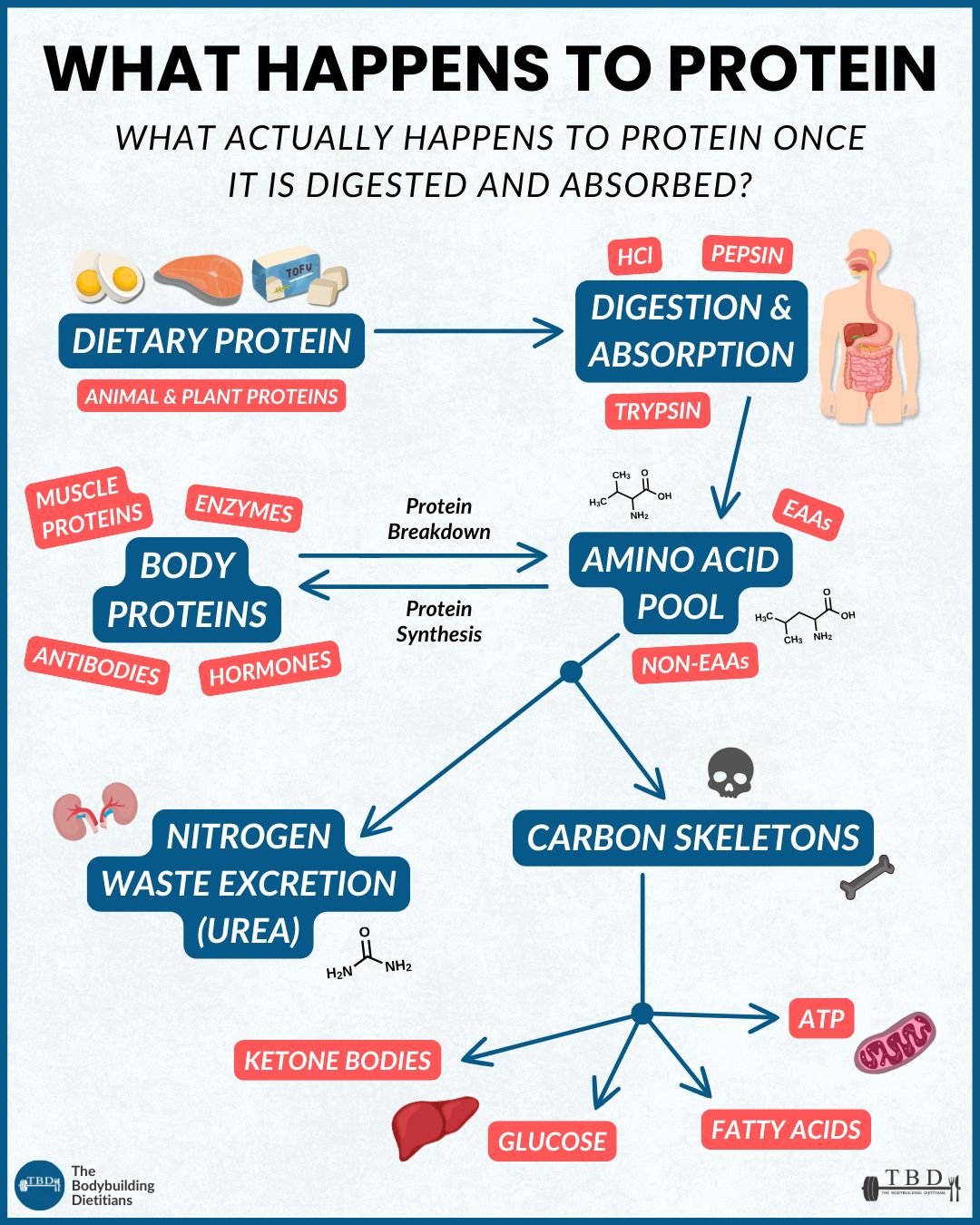
The metabolic pathway of dietary protein, from digestion through the amino acid pool to its multiple downstream fates including muscle protein synthesis, hormone and enzyme production, energy generation, and nitrogen waste excretion.
Protein metabolism is one of the more poorly understood areas in popular nutrition, and several persistent myths around it shape how lifters plan their intake. The idea that the body can only use 20 or 30 grams of protein per meal, the concern that excess protein converts directly to body fat, and the assumption that protein is primarily a muscle-building nutrient all reflect a partial picture of what dietary protein actually does once it enters the body.
A clearer understanding of the metabolic pathway, from digestion through the amino acid pool to its multiple downstream fates, removes the basis for several common concerns and clarifies why total daily protein intake and distribution matter more than worrying about per-meal limits or excess being wasted.
How Is Protein Digested and Absorbed?
Protein digestion begins in the stomach, where hydrochloric acid denatures the protein structure and the enzyme pepsin begins breaking peptide bonds. The partially digested protein then enters the small intestine, where pancreatic enzymes including trypsin, chymotrypsin, and carboxypeptidase complete the breakdown into individual amino acids and small peptides. These are absorbed across the intestinal epithelium into the bloodstream via specific transporter proteins.
Human protein digestion is highly efficient. Studies of protein digestibility consistently show absorption rates above 90 percent for animal proteins and slightly lower but still high rates for most plant proteins. The claim that any meaningful portion of dietary protein passes undigested into the colon at normal intake levels is not supported by the evidence.
This point matters for one of the most widely repeated claims in nutrition: that the body can only absorb 20 to 30 grams of protein per meal. The premise of the claim is incorrect at the absorption step. All protein consumed in a meal is absorbed and enters the amino acid pool. What varies with protein dose is not absorption itself but the downstream fate of the absorbed amino acids, which is a different physiological question.
A practical implication is that there is no biochemical penalty for eating a larger protein dose in a single meal beyond a slower absorption profile, which can actually be beneficial for sustained amino acid delivery. Plant proteins, mixed meals containing fat and fibre, and slower-digesting protein sources such as casein produce a more prolonged amino acid release than fast-digesting whey protein consumed alone, but the total amount absorbed is largely unaffected.
What Is the Amino Acid Pool?
The amino acid pool refers to the circulating reservoir of free amino acids in the blood and the intracellular fluid of body tissues, which the body draws from to meet protein synthesis demands across multiple tissues simultaneously.
This pool is supplied from two sources: dietary protein after digestion, and the continuous breakdown of existing body proteins through a process called proteolysis. The body is in a constant state of protein turnover, with proteins being synthesised and broken down throughout the day. Skeletal muscle turnover alone involves roughly 1 to 2 percent of total muscle protein being broken down and resynthesised every day, and the amino acids released through this process re-enter the pool to be used again.
The amino acid pool contains both essential amino acids (EAAs) and non-essential amino acids (non-EAAs). Essential amino acids cannot be synthesised by the body and must be obtained from dietary protein. There are nine of these: leucine, isoleucine, valine, threonine, methionine, phenylalanine, tryptophan, histidine, and lysine. Non-essential amino acids can be synthesised internally from other amino acids and metabolic intermediates, so their dietary supply is less critical to maintaining the pool.
Leucine occupies a particularly important role in this pool. It is one of the three branched-chain amino acids (BCAAs) and is the primary trigger for muscle protein synthesis through its activation of the mTOR signalling pathway. The leucine content of a protein source, alongside its overall EAA profile, is one of the main reasons protein quality differs between sources.
The amino acid pool is dynamic. The body continually adjusts allocation based on demand: a hard training session increases demand for amino acids in muscle recovery and repair, an immune challenge increases demand for amino acids in antibody and immune cell production, and growth or repair following injury shifts allocation toward structural tissues. The pool acts as a buffer that smooths supply and demand across the day, which is one reason daily total intake matters more than the precise composition of any single meal.
What Does the Body Use Amino Acids For?
The amino acids in the pool are used for far more than muscle building. Skeletal muscle is one significant destination, but it is one of many.
Skeletal muscle is the largest reservoir of body protein in most people and the destination most associated with dietary protein intake. Muscle protein synthesis (MPS) is the process through which dietary amino acids are incorporated into existing muscle tissue, supporting repair after training, adaptation to resistance exercise, and maintenance of lean mass during periods of restricted intake. Muscle protein synthesis is a biological process through which dietary protein stimulates the repair and growth of skeletal muscle, and it is the primary mechanism by which protein supports muscle gain and lean mass retention.
Enzymes are protein structures that catalyse virtually every biochemical reaction in the body, including digestion, energy production, hormone synthesis, and immune function. Enzyme turnover requires a continuous supply of amino acids, and the rate of synthesis adjusts based on metabolic demand.
Antibodies are protein structures produced by the immune system to identify and neutralise pathogens. Periods of immune challenge increase antibody synthesis demand, drawing more heavily on the amino acid pool. This is one reason adequate protein intake supports immune function alongside its role in muscle maintenance.
Hormones include several protein and peptide structures (such as insulin, glucagon, growth hormone, and thyroid hormones) that require amino acid building blocks for synthesis. Hormonal balance depends in part on adequate substrate availability from the amino acid pool.
Neurotransmitters including serotonin, dopamine, and noradrenaline are synthesised from specific amino acids, with tryptophan and tyrosine being particularly relevant precursors. Mood regulation, sleep, motivation, and cognitive function all depend on adequate substrate for neurotransmitter synthesis.
Structural tissues including skin, hair, nails, tendons, ligaments, and connective tissue are predominantly protein-based. Collagen, the most abundant structural protein in the body, is continuously synthesised and remodelled in response to mechanical stress, training load, and repair demands.
When dietary protein intake is adequate, the body has sufficient substrate to meet all of these demands simultaneously. When intake is chronically inadequate, the body prioritises essential functions including immune defence and enzyme production, often at the expense of muscle maintenance, which is why prolonged low-protein intake during dieting phases reliably produces lean mass loss.
What Happens to Amino Acids Not Used for Protein Synthesis?
Amino acids in the pool that are not used for synthesis are not stored as protein in the way that excess carbohydrate can be stored as glycogen or excess fat as adipose tissue. There is no dedicated protein storage depot. Instead, amino acids surplus to immediate synthesis demands enter one of several alternative pathways.
The first step for amino acids destined for energy use is deamination, the removal of the nitrogen-containing amine group from the amino acid structure. Deamination occurs primarily in the liver and produces two outputs: the nitrogen (in the form of ammonia, which is rapidly converted to urea for safe excretion) and the remaining carbon skeleton.
Urea is the body's primary mechanism for nitrogen waste excretion. Ammonia produced through deamination is converted to urea in the liver via the urea cycle and excreted by the kidneys in urine. This is a normal and well-regulated process. The notion that high protein intakes damage the kidneys in otherwise healthy individuals is not supported by current evidence, and large reviews have consistently failed to find harm at intakes within and above the standard sports nutrition range.
The carbon skeletons remaining after deamination have several possible fates depending on the specific amino acid and the body's energy status:
Energy production via ATP: Carbon skeletons can be oxidised in the citric acid cycle to produce ATP, the energy currency of the cell. Protein contributes approximately 10 to 15 percent of total energy expenditure at rest in most diets, with the proportion varying based on intake and demand.
Glucose synthesis (gluconeogenesis): Some carbon skeletons, particularly those from glucogenic amino acids, can be converted to glucose in the liver through gluconeogenesis. This pathway becomes more active during fasting, carbohydrate restriction, or prolonged endurance exercise, and supports stable blood glucose when dietary carbohydrate is limited.
Ketone body production: Carbon skeletons from ketogenic amino acids can be converted to ketone bodies, which serve as alternative fuel substrates particularly during fasting or carbohydrate restriction.
Fatty acid synthesis (de novo lipogenesis): A small proportion of carbon skeletons can theoretically be converted to fatty acids through de novo lipogenesis, but this pathway is metabolically expensive and contributes minimally to fat storage at typical protein intakes. The widely held belief that excess protein converts directly to body fat is not biochemically accurate. Protein contributes to fat gain only when total energy intake exceeds total energy expenditure, which is the same condition required for fat storage from any macronutrient source.
The thermic effect of protein is relevant here. Protein has the highest thermic effect of any macronutrient, with approximately 20 to 30 percent of its energy content used in digestion, absorption, and metabolic processing, compared to around 5 to 10 percent for carbohydrate and 0 to 3 percent for fat. This is one reason higher protein diets tend to support fat loss and body composition outcomes even when total calorie intake is matched.
Is There Really a 20 to 30 Gram Per Meal Protein Limit?
The 20 to 30 gram per meal protein cap is one of the most persistent and least accurate claims in nutrition. All protein consumed in a meal is absorbed regardless of dose, and the relevant question is not absorption but the muscle protein synthesis response and the downstream allocation of the absorbed amino acids.
The acute muscle protein synthesis response does follow a plateau pattern. Research consistently shows that the MPS response to a single meal reaches its maximum at approximately 0.4 grams of protein per kilogram of bodyweight (around 30 to 40 grams for most adults), with limited additional acute MPS response from larger doses in that immediate post-meal window.
A systematic review concluded that to maximise muscle protein synthesis, individuals should consume protein at approximately 0.4 grams per kilogram of bodyweight per meal across a minimum of four meals to reach a daily total of at least 1.6 grams per kilogram. The upper end of recommended intakes (2.2 grams per kilogram per day) corresponds to approximately 0.55 grams per kilogram per meal across the same four meals. Source: Schoenfeld and Aragon, 2018, Journal of the International Society of Sports Nutrition, 15:10.
More recent research has refined this picture. A 2023 isotope tracer study using a comprehensive feeding-infusion protocol showed that ingesting 100 grams of protein produced a greater and more prolonged anabolic response (lasting more than 12 hours) compared to 25 grams, with continued incorporation of amino acids into muscle protein over the extended postprandial period. The acute MPS rate per hour may plateau, but the duration of net positive protein balance extends with larger doses, and amino acids beyond the plateau threshold do not go to waste.
Ingestion of 100 grams of protein after resistance exercise produced a greater and more prolonged (over 12 hours) anabolic response compared to 25 grams of protein, with dose-dependent increases in plasma amino acid availability and continued incorporation into muscle protein. The findings indicate that the anabolic response to protein ingestion does not have a strict upper limit at the 20 to 30 gram per meal range as previously assumed. Source: Trommelen et al., 2023, Cell Reports Medicine, 4(12):101324.
The practical implication is that a lifter eating three protein-rich meals of 50 to 60 grams each is not wasting protein in the way the 20 to 30 gram claim would suggest. Larger doses produce a longer anabolic window, and amino acids in excess of the immediate MPS threshold contribute to other functions including enzyme synthesis, immune function, and the extended period of net positive protein balance.
The recommendation to distribute intake across three to five meals per day still has merit, but the basis for it is maximising the acute MPS response across the day rather than avoiding waste from larger doses. Fewer, larger meals are a valid pattern when meal frequency is constrained by schedule or preference, and they do not produce meaningfully worse muscle gain outcomes when total daily intake is adequate.
Why Does Protein Quality Matter?
Protein quality refers to a protein source's amino acid composition (particularly its essential amino acid content) and its digestibility. These two factors together determine how effectively a protein source supplies the substrates needed for muscle protein synthesis and other amino-acid-dependent functions.
The body can synthesise non-essential amino acids internally from other amino acids and metabolic intermediates, but essential amino acids must come from dietary protein. A protein source with a complete and well-balanced essential amino acid profile, including adequate leucine, provides the substrate needed to maximise MPS in a way that an incomplete or imbalanced source cannot.
Animal proteins (meat, fish, poultry, eggs, dairy) are generally considered higher quality protein sources because they contain all essential amino acids in proportions well-matched to human requirements, and their digestibility is high. Whey protein, derived from milk, contains a particularly high leucine content and is rapidly absorbed, which produces a strong acute MPS response.
Most plant proteins have a less complete essential amino acid profile and slightly lower digestibility. Legumes tend to be lower in methionine, while grains tend to be lower in lysine. The practical solution is straightforward: combining plant protein sources across a meal or across the day provides a complete amino acid profile, and the digestibility difference is small at adequate total protein intake. Plant-based lifters reaching 1.6 to 2.4 grams per kilogram per day from diverse plant sources can support muscle gain effectively, though they may benefit from slightly higher total protein intake than those eating animal proteins to compensate for the digestibility and amino acid profile differences.
Soy protein isolate and pea protein isolate are exceptions among plant proteins, with more complete essential amino acid profiles and higher leucine content than most whole plant foods. They produce MPS responses closer to those of whey and casein, particularly when consumed in slightly larger doses.
The implications for total daily intake are straightforward. A lifter consuming predominantly animal protein sources can reasonably target 1.6 to 2.2 grams per kilogram of bodyweight per day, while a lifter consuming predominantly plant protein sources may aim toward the higher end of that range or slightly above to account for the differences in amino acid profile and digestibility.
For further detail on how protein targets are set in relation to total energy availability and other macronutrients, the fuelling hierarchy article covers the broader context.
How Does This Affect Daily Protein Targets and Distribution?
The practical implications of protein metabolism for daily intake planning come down to three considerations: total daily amount, distribution across meals, and protein source quality.
Total daily protein intake is the variable with the strongest evidence base for supporting muscle gain and lean mass retention. The standard target range for resistance-trained individuals is 1.6 to 2.2 grams per kilogram of bodyweight per day at maintenance, with the upper end of this range (or slightly above, into 2.0 to 2.4 grams per kilogram) recommended during periods of caloric restriction to support lean mass retention during fat loss.
Distribution across three to five meals per day supports the acute MPS response by providing multiple opportunities for the body to enter a net positive protein balance state across the day. A reasonable target is 0.4 to 0.55 grams per kilogram per meal, with the higher end of the per-meal range becoming more relevant at higher total daily intakes.
The two- or six-meal patterns common at the extremes of meal frequency are workable when total daily intake is adequate, though they may sacrifice some of the optimisation possible with three to five evenly distributed meals. The practical decision usually comes down to lifestyle preferences and adherence rather than physiological optimisation.
Protein source quality matters most at the margins. At adequate total intake from a varied diet, the difference between an animal-protein-dominant and a plant-protein-dominant approach is small. At the extremes (very low total intake, very restrictive sources, or both), source quality becomes more relevant and may require slightly higher total intake or strategic combinations to ensure adequate essential amino acid availability.
Setting these targets in a way that fits a specific person's training demands, body composition goals, and dietary preferences is part of how we approach protein planning with coaching clients, alongside the broader nutrition and training context.
Practical Takeaways
All dietary protein is absorbed regardless of meal size. The widely cited claim that the body can only use 20 to 30 grams of protein per meal is not supported by the evidence on absorption.
The acute muscle protein synthesis response plateaus at approximately 0.4 grams per kilogram of bodyweight per meal, but amino acids beyond this threshold extend the duration of net positive protein balance rather than going to waste.
Excess protein does not directly convert to body fat. It contributes to fat gain only if total energy intake exceeds expenditure, which is the same condition required for any macronutrient to add body fat.
The amino acid pool supplies multiple competing demands including muscle, enzymes, antibodies, hormones, neurotransmitters, and structural tissues. Adequate intake supports all of these simultaneously.
A target of 1.6 to 2.2 grams of protein per kilogram of bodyweight per day distributed across three to five meals provides a solid foundation for resistance-trained individuals, with the upper end of this range or slightly above appropriate during fat loss phases.
Animal proteins generally have higher essential amino acid content and digestibility than plant proteins, but well-combined plant proteins at adequate total intake support muscle gain effectively for plant-based lifters.
Frequently Asked Questions
Does excess protein turn into fat?
Not directly. Excess protein contributes to fat gain only if total daily energy intake exceeds expenditure, which is the same condition required for any macronutrient to add body fat. The biochemical pathway for converting amino acids to fatty acids (de novo lipogenesis) is metabolically expensive and contributes minimally at typical protein intakes. Carbon skeletons from excess amino acids are more commonly used for energy production or converted to glucose than stored as fat.
How much protein can the body absorb in a single meal?
All protein consumed in a meal is absorbed. The 20 to 30 gram per meal absorption limit is a persistent myth that is not supported by the evidence. What does change with protein dose is the acute muscle protein synthesis response, which plateaus at approximately 0.4 grams per kilogram of bodyweight per meal, but amino acids beyond this threshold contribute to extended net positive protein balance and other physiological functions rather than going to waste.
Is high protein intake bad for the kidneys?
In otherwise healthy individuals, high protein intake within and above the standard sports nutrition range (1.6 to 2.4 grams per kilogram per day) has not been shown to cause kidney damage. Large reviews and prospective studies have consistently failed to find harm. Existing kidney disease is a different situation requiring medical guidance, but the concern about protein damaging healthy kidneys is not supported by current evidence.
What is the amino acid pool?
The amino acid pool is the circulating reservoir of free amino acids in the blood and intracellular fluid that the body draws from to meet protein synthesis demands across multiple tissues. It is supplied by dietary protein after digestion and by the continuous breakdown and resynthesis of existing body proteins. The pool acts as a buffer that smooths supply and demand across the day, supplying amino acids for muscle, enzymes, hormones, immune function, and structural tissues simultaneously.
Are animal proteins better than plant proteins for muscle gain?
Animal proteins generally have a more complete essential amino acid profile and higher digestibility, which produces stronger acute muscle protein synthesis responses gram for gram. The practical difference is small at adequate total intake from a varied diet. Plant-based lifters reaching 1.6 to 2.4 grams per kilogram per day from diverse protein sources, including soy, pea, legumes, grains, nuts, and seeds, can support muscle gain effectively, and may benefit from slightly higher total protein intake to compensate for the smaller digestibility and amino acid profile differences.
Should I distribute protein evenly across meals?
Distributing protein across three to five meals per day, with each meal containing roughly 0.4 to 0.55 grams per kilogram of bodyweight, optimises the acute muscle protein synthesis response across the day. Less even distributions still work effectively when total daily intake is adequate, and recent evidence suggests that larger boluses extend the duration of net positive protein balance rather than wasting amino acids. The choice of meal pattern usually comes down to lifestyle preferences and adherence rather than meaningful differences in physiological outcomes.
If you want help setting your protein targets, distributing intake across your training and lifestyle, and integrating this with the broader nutrition picture for your specific goals, you can enquire about coaching or book a consultation with our team below.