Hunger during a calorie deficit reflects several overlapping mechanisms, and the same calorie intake can produce very different hunger experiences depending on which of those mechanisms are most active. A framework covering ten drivers across four categories makes it possible to identify the most relevant one and address it directly.
Persistent hunger during a fat loss phase can reflect ten distinct drivers across four categories. Nutritional factors include inadequate protein intake, which reduces the hormonal signals that suppress appetite, and insufficient dietary fat, which contributes to early return of hunger after meals. Environmental factors include the food processing level of the diet and the food environment, both of which influence how much eating occurs independent of physiological appetite. Mechanical factors include low food volume and fibre, which limit the gastric stretch response that signals fullness, and fast eating, which outpaces the gut-to-brain satiety feedback loop. Adaptive factors include conditioned appetite responses to times, places, or activities, and the hormonal adaptations to prolonged calorie restriction that progressively elevate hunger over the duration of a diet. Hormonal factors include poor sleep, which acutely raises ghrelin and suppresses leptin, and elevated cortisol from stress or high training loads, which increases appetite independently of energy need. Most of these drivers are modifiable, and identifying the dominant one allows hunger to be addressed without changing the calorie deficit itself.
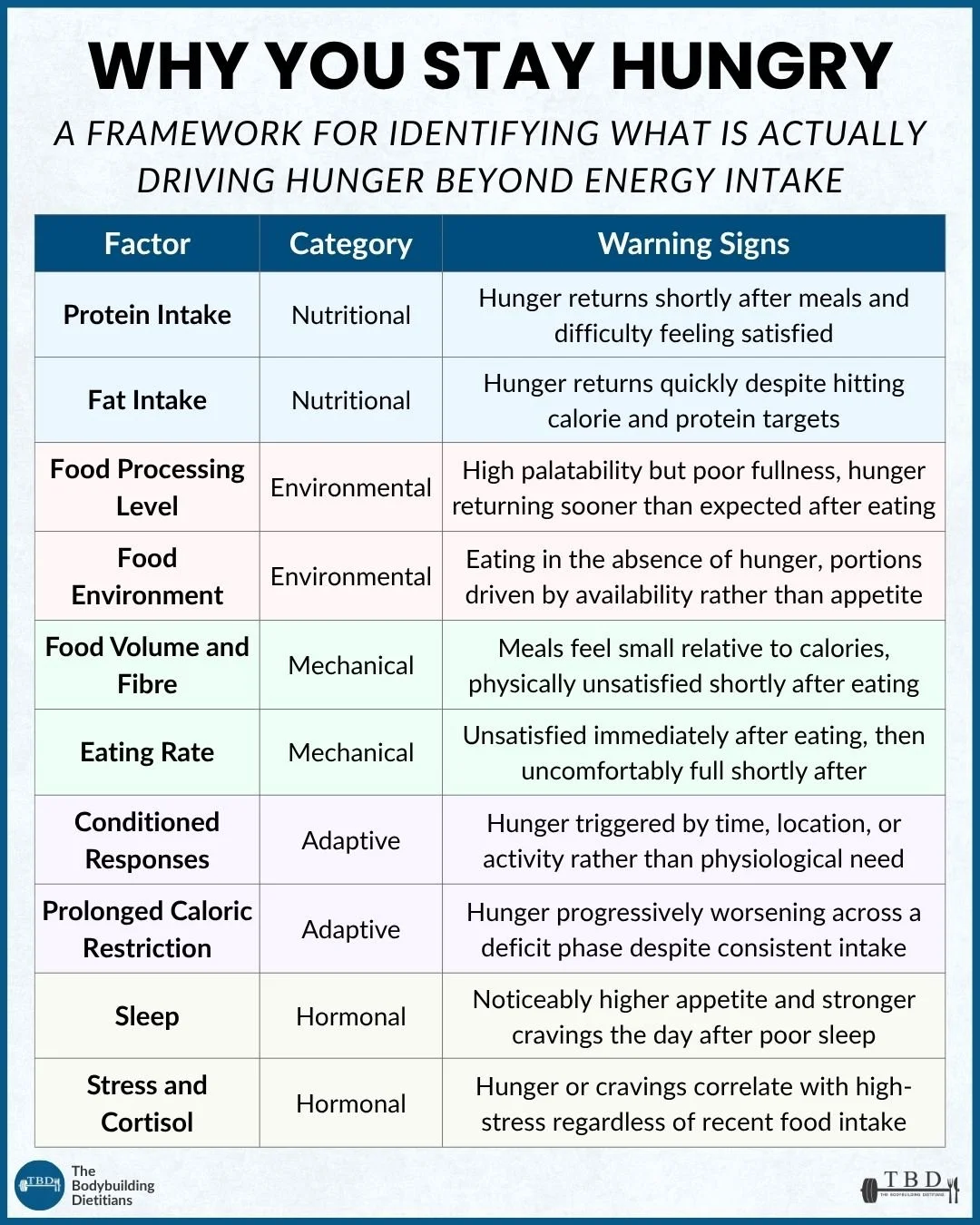
Hunger is not a single, uniform signal. People experiencing persistent hunger while dieting often respond by increasing restraint or tightening the dietary approach further, which tends to address the deficit but not the drivers that are making the deficit harder to tolerate. When those drivers are nutritional, environmental, mechanical, adaptive, or hormonal in origin, the relevant response is almost always something other than eating less.
The practical value of this framework is that most of the hunger drivers listed here are modifiable without changing the calorie deficit itself. Identifying which one is dominant in a specific person at a specific point in a diet makes it possible to reduce hunger meaningfully through targeted adjustments to food selection, meal structure, the food environment, or lifestyle variables. The dominant driver also tends to shift across the duration of a phase: early on it is most often nutritional or environmental, while later it becomes increasingly adaptive and hormonal, which is why hunger that was manageable in week four can feel considerably harder in week twelve on exactly the same intake.
What Nutritional Factors Drive Hunger Beyond Calorie Intake?
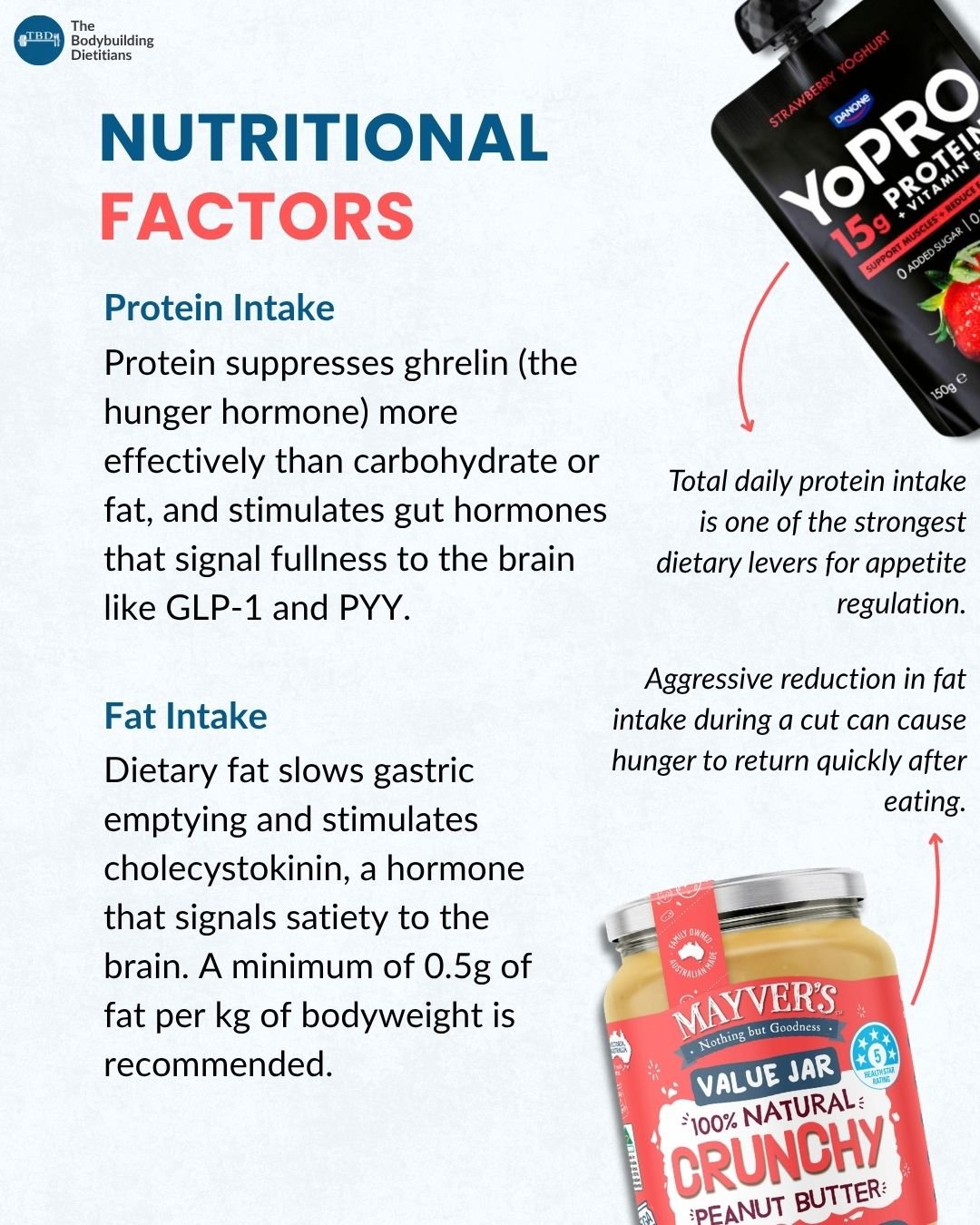
Two nutritional variables influence hunger independently of total calorie intake: protein and dietary fat. Both operate through distinct physiological mechanisms, and either being insufficient can produce a hunger experience that does not match the calorie level being consumed.
Protein intake: Protein suppresses ghrelin, the primary hunger-stimulating hormone, more effectively than either carbohydrate or fat. It also stimulates the release of gut hormones including GLP-1 (glucagon-like peptide-1) and PYY (peptide YY), which signal fullness to the brain through pathways that are relatively slow to act but produce durable post-meal satiety once activated. Total daily protein intake is one of the strongest available dietary levers for appetite regulation, and its effect on hunger operates independently of calorie content.
When protein intake falls below an adequate level during a fat loss phase, hunger tends to return shortly after meals despite the meal providing sufficient calories. The warning sign is difficulty feeling genuinely satisfied from meals that the tracking data suggests should be appropriate. Increasing protein toward the evidence-based range of 1.8 to 2.4 grams per kilogram of bodyweight typically reduces this pattern more effectively than adjusting other macronutrients.
Ghrelin is a peptide hormone produced primarily in the stomach that stimulates appetite and promotes fat storage. Leptin is produced by adipose tissue and signals satiety to the brain; its levels fall as fat mass decreases during a deficit, which is one of the reasons hunger increases over the course of a fat loss phase.
Dietary fat: Dietary fat slows gastric emptying, meaning that food leaves the stomach more slowly when fat is present in the meal, extending the window of post-meal fullness. Fat also stimulates the release of cholecystokinin (CCK), a gut hormone that suppresses appetite and signals satiety to the brain. When dietary fat is reduced too aggressively during a calorie deficit, particularly below approximately 0.5 grams per kilogram of bodyweight per day, the meal exits the stomach more quickly and hunger returns earlier than the calorie content of the meal would suggest it should.
The warning sign for insufficient dietary fat is hunger returning quickly after meals despite hitting calorie and protein targets. This distinguishes it from protein insufficiency, where the issue is difficulty reaching satisfaction in the first place. A minimum fat intake is worth maintaining even during aggressive deficits, and this is part of why the macro targets article covers fat alongside protein in its recommendations.
How Does the Food Environment Influence Hunger and Eating Behaviour?
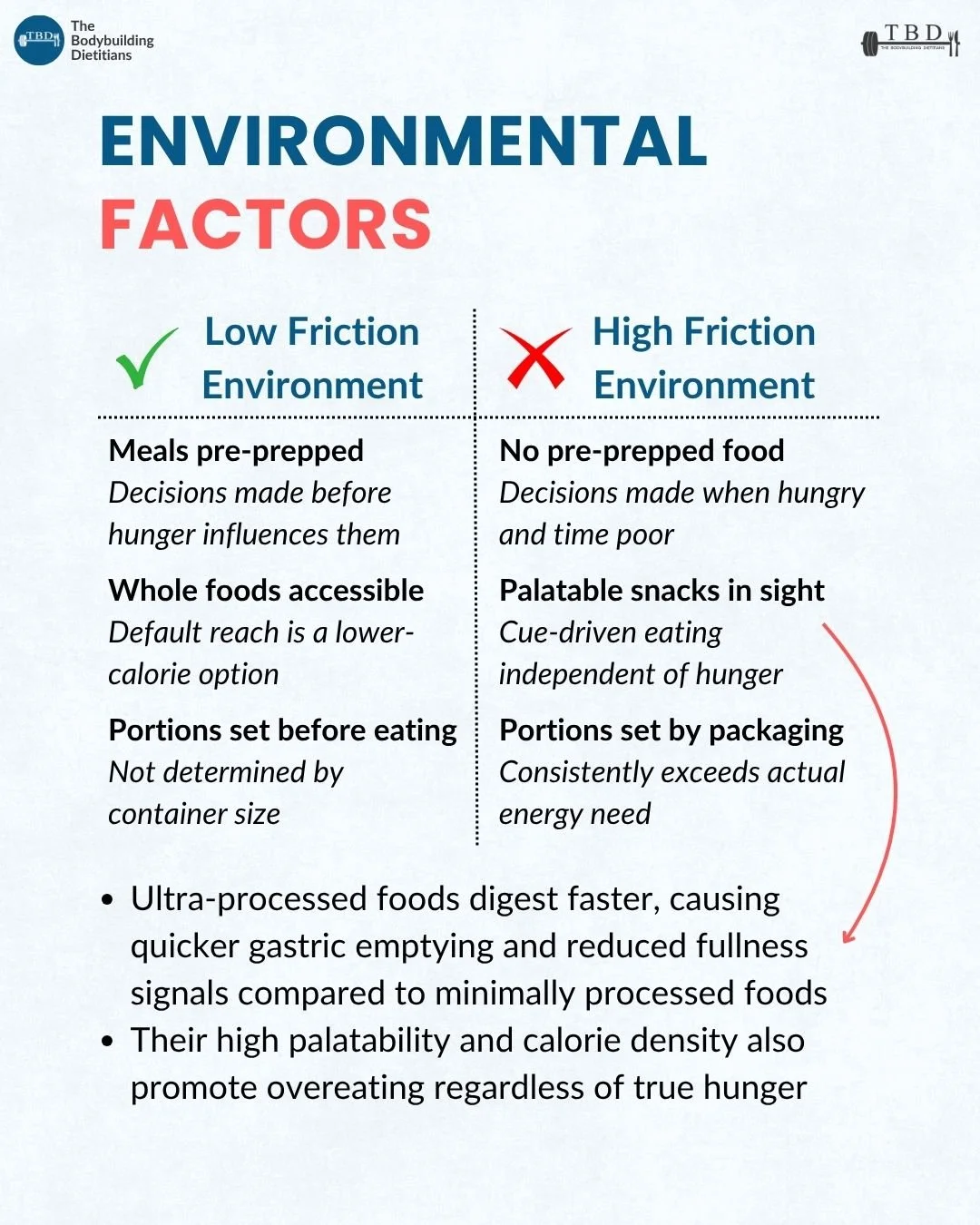
Two environmental variables drive eating behaviour independently of physiological hunger: the processing level of the foods in the diet and the structure of the eating environment. Both influence how much is eaten, but through different mechanisms.
Food processing level: Ultra-processed foods digest faster than minimally processed alternatives, producing quicker gastric emptying and reducing the stretch response that drives fullness signals. Their engineered combination of fat, sugar, salt, and refined texture produces a higher palatability that activates the brain's reward system in ways that extend eating beyond genuine energy need, a phenomenon that research consistently identifies as a driver of calorie overconsumption independent of hunger. A diet composed predominantly of ultra-processed foods tends to produce high palatability alongside poor mechanical fullness, meaning eating feels satisfying in the moment but hunger returns sooner and more strongly than an equivalent calorie intake from minimally processed foods.
Food environment: The food environment, meaning what foods are visible, accessible, and how decisions are made around eating, influences how much is consumed through its effect on cue-driven eating. When highly palatable foods are visible and accessible, portions are determined by packaging rather than appetite, and food decisions are made in a hungry and time-poor state, eating that occurs independent of physiological need becomes more likely. A low-friction environment, in which meals are prepared in advance, whole foods are the default accessible option, and portions are set before eating begins, removes many of the decision points at which cue-driven eating tends to occur.
The practical framework here is straightforward: a food environment that requires constant active resistance to food cues creates unnecessary cognitive burden. Restructuring the environment so that the default accessible option is a lower-calorie choice removes the need for that resistance.
How Do Mechanical Factors Affect Satiety Independent of Calorie Content?
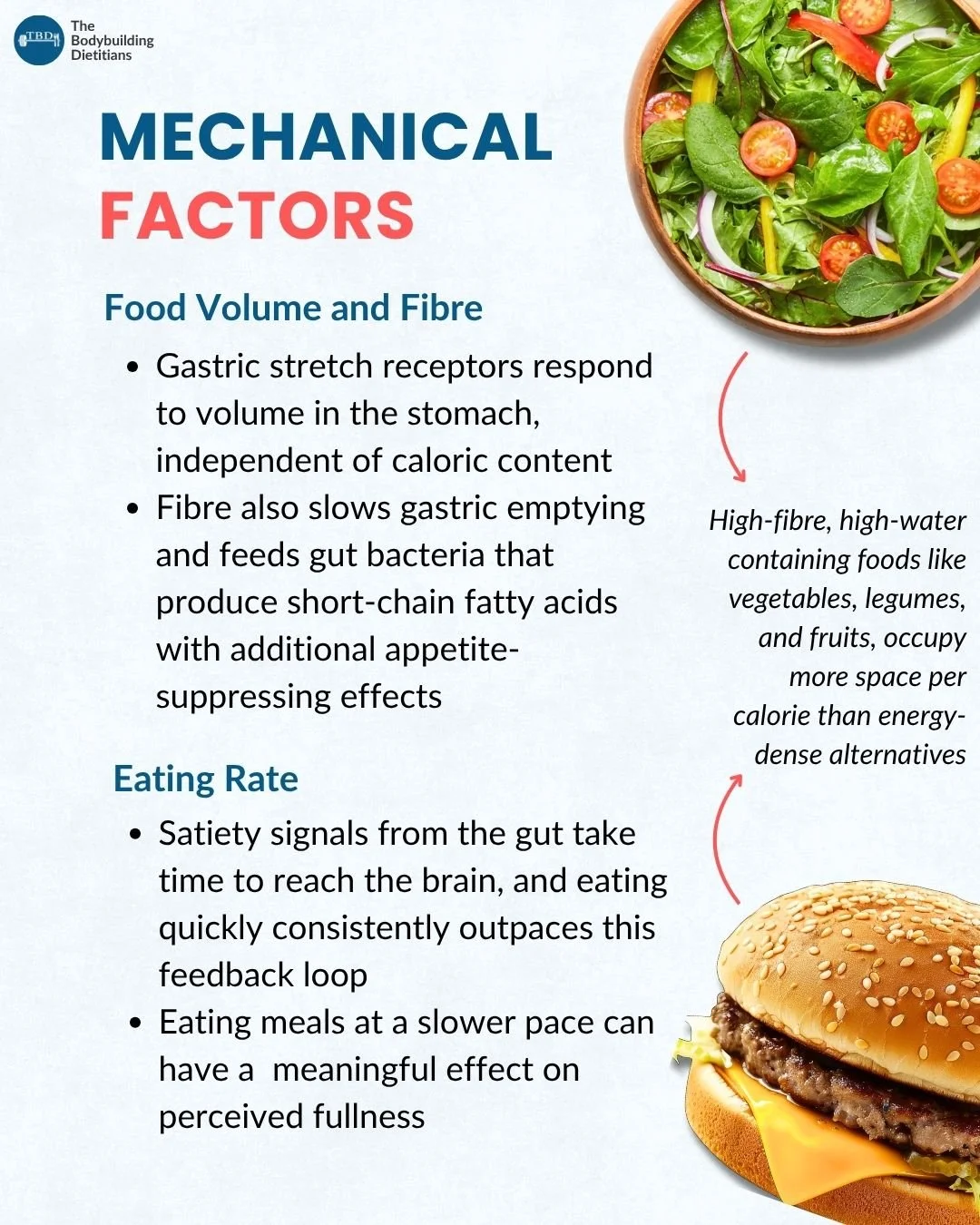
Mechanical satiety mechanisms operate through the physical properties of food in the digestive system rather than its energy content, which means they can be influenced by food selection and eating behaviour independently of the calorie total.
Food volume and fibre: Gastric stretch receptors in the stomach respond to physical volume, signalling fullness to the brain as the stomach expands. This response occurs independently of caloric content, which is why a large volume of low-calorie, high-water-content food can produce a stronger stretch signal than a smaller volume of calorie-dense food at the same total energy.
Fibre contributes to mechanical satiety through two pathways. Soluble fibre forms a gel in the digestive tract that slows gastric emptying and extends the period of post-meal fullness. And fibre reaching the large intestine serves as substrate for gut bacteria, which produce short-chain fatty acids including butyrate that have additional appetite-suppressing effects through gut hormone signalling. A meal that is low in both volume and fibre tends to feel physically small relative to its calorie content, producing physical unsatisfaction shortly after eating even when macros are on target.
Eating rate: Gut-to-brain satiety signalling takes time. After the stomach begins receiving food, gut hormones including GLP-1 and PYY are released in response to nutrient sensing in the small intestine, and these signals take approximately 15 to 20 minutes to register in the brain as fullness. Eating quickly enough to consume a significant calorie load before these signals arrive consistently outpaces the feedback loop that is designed to moderate intake.
The characteristic pattern of eating too quickly is feeling unsatisfied immediately after finishing a meal, followed by uncomfortable fullness 15 to 20 minutes later. Eating at a slower pace allows satiety signalling to catch up with intake, reducing the likelihood of consuming beyond actual energy need before the feedback loop registers. Research suggests that simply slowing the pace of eating can have a meaningful effect on total meal intake and perceived fullness without any change to food selection or quantity.
How Do Adaptive Factors Increase Hunger Over the Duration of a Diet?
Adaptive hunger mechanisms develop over time in response to sustained dietary restriction and learned behavioural associations, and they contribute increasingly to the hunger experience as a fat loss phase extends.
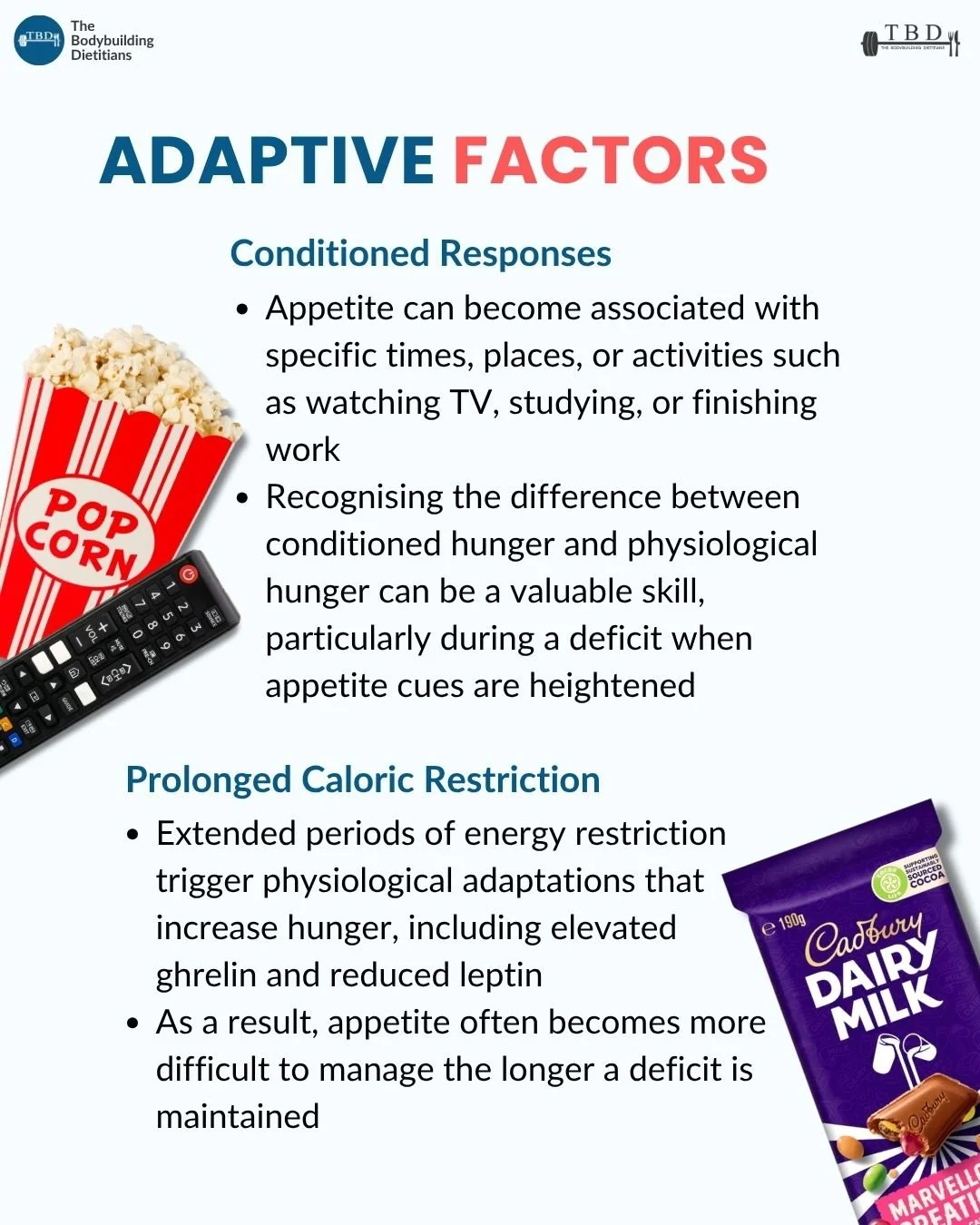
Conditioned responses: Appetite can become conditioned to specific times, places, or activities through repeated association. The experience of hunger when settling down to watch television, sitting at a study desk, or finishing a work shift may reflect a conditioned response that has developed because eating has repeatedly occurred in those contexts, rather than a physiological signal of energy need. Conditioned appetite responses can persist even when the underlying energy need has been met and are particularly salient during a calorie deficit when appetite signals are generally more active.
The value of recognising the difference between conditioned hunger and physiological hunger is practical: a conditioned response can often be interrupted by changing the context, introducing a non-food activity into the associated situation, or simply acknowledging the origin of the signal rather than acting on it. A physiological hunger signal in the same situation calls for a different response.
Prolonged calorie restriction: Extended energy restriction triggers predictable hormonal adaptations that progressively increase hunger over the duration of the deficit. Ghrelin rises as fat mass decreases and as the body perceives extended restriction as a threat to energy stores. Leptin falls as adipose tissue volume declines, weakening the satiety signal that suppresses appetite. Thyroid hormone activity reduces, sympathetic nervous system tone decreases, and spontaneous activity declines, all as part of the adaptive defence against a sustained calorie deficit.
The practical consequence is that appetite becomes harder to manage as a diet progresses, and this progressive worsening is a normal physiological feature of extended restriction rather than an indication that the dietary approach has failed. Diet breaks and refeeds address these adaptive responses by partially restoring the hormonal environment that prolonged restriction disrupts.
How Do Sleep and Stress Affect Hunger Hormones?
Hormonal factors drive hunger through changes to the ghrelin and leptin system that occur independently of food intake, making hunger elevation possible even when nothing in the diet has changed.
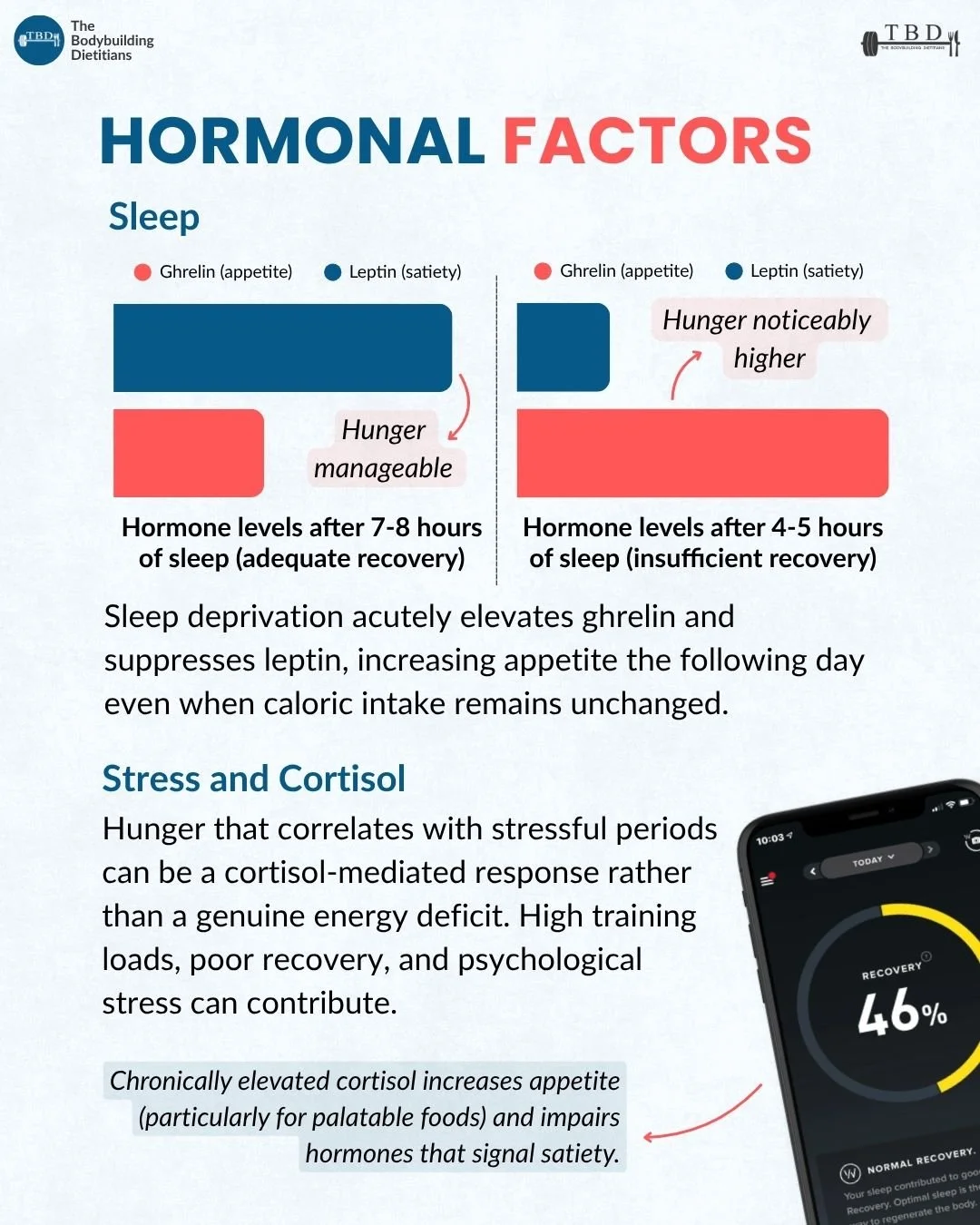
Sleep: Sleep deprivation produces one of the more reliable and acute hunger responses of any single variable in this framework. After a night of insufficient sleep, ghrelin levels rise substantially while leptin levels fall, producing a hormonal state characterised by stronger hunger signals, weaker satiety responses, and a shift in food preferences toward higher-calorie, more palatable options. These effects occur even when the following day's calorie intake remains unchanged from usual.
A controlled study by Spiegel et al. found that two nights of sleep restriction to four hours increased ghrelin concentrations by 28 percent and decreased leptin by 18 percent compared to a fully rested state, with participants reporting significantly increased appetite and preference for calorie-dense foods.
Source: Spiegel et al., 2004, Annals of Internal Medicine.
The bar charts in the carousel illustrate this pattern clearly: after adequate sleep of 7 to 8 hours, leptin is higher than ghrelin and hunger is manageable; after insufficient sleep of 4 to 5 hours, ghrelin substantially exceeds leptin and hunger is noticeably elevated. The warning sign is reliably higher appetite and stronger cravings the day after a poor night, which is a direct hormonal consequence of sleep deprivation rather than a change in energy balance.
Stress and cortisol: Hunger that correlates with stressful periods, high training loads, or poor recovery can reflect cortisol-mediated appetite stimulation rather than a genuine energy deficit. Chronically elevated cortisol increases appetite, particularly for highly palatable, energy-dense foods, through its effects on dopamine signalling and reward pathways. It also impairs the hormones that signal satiety, making it harder to feel full even from an adequate meal.
The warning sign for stress-mediated hunger is cravings and appetite that correlate with stressful periods regardless of recent food intake, particularly when the cravings are specifically for high-reward foods rather than reflecting a general sense of emptiness. High training loads, inadequate recovery, and psychological stress all contribute, which is why how someone manages recovery alongside their diet affects the hunger experience as much as their nutritional choices do.
Practical Takeaways
Hunger during a fat loss phase can reflect ten distinct drivers across four categories, and the dominant driver varies between individuals and across the duration of a diet. Identifying which one is most active allows it to be addressed directly without changing the calorie deficit.
Protein is the strongest dietary lever for appetite regulation. Inadequate protein intake produces difficulty reaching satisfaction from meals, while insufficient dietary fat produces early return of hunger after meals.
A low-friction food environment, where meals are prepared in advance, whole foods are the default accessible option, and portions are set before eating, reduces cue-driven eating that occurs independently of physiological appetite.
High-volume, high-fibre foods extend satiety by activating gastric stretch receptors and slowing gastric emptying. Eating more slowly allows gut-to-brain satiety signalling to register before intake has significantly exceeded actual need.
Conditioned appetite responses to times, places, or activities can be recognised and interrupted. Distinguishing conditioned hunger from physiological hunger is a practical skill that becomes especially useful during a deficit when appetite signals are generally more active.
Hormonal adaptations to prolonged restriction, including rising ghrelin and falling leptin, are a normal and predictable feature of extended dieting rather than a sign that the dietary approach has failed. Diet breaks and refeeds partially restore the hormonal environment.
Poor sleep acutely elevates ghrelin and suppresses leptin, producing reliably higher hunger the following day. Elevated cortisol from stress or high training loads increases appetite independently of energy need.
Frequently Asked Questions
Why am I always hungry even when eating enough calories?
Hunger can persist at adequate calorie intakes for several reasons beyond total energy. Inadequate protein intake reduces the gut hormone signals that suppress appetite. Low dietary fat reduces post-meal fullness duration. Low food volume and fibre limit the gastric stretch response that drives fullness. Highly processed foods produce poor mechanical satiety relative to their calorie content. Poor sleep acutely elevates hunger hormones. And prolonged calorie restriction produces adaptive hormonal changes that increase hunger over time regardless of intake. Identifying which of these is most active is more productive than simply reducing calories further.
Does protein actually reduce hunger?
Yes, through several distinct mechanisms. Protein suppresses ghrelin more effectively than carbohydrate or fat, and stimulates the release of GLP-1 and PYY, gut hormones that signal satiety to the brain. It also has a higher thermic effect than other macronutrients, meaning more energy is expended in processing it. Total daily protein intake is one of the strongest available dietary levers for appetite regulation, and increasing it toward the evidence-based range is one of the most reliable adjustments for reducing hunger during a calorie deficit.
Does eating slowly actually help with hunger?
Yes. Satiety signals from the gut take approximately 15 to 20 minutes to register in the brain after food enters the stomach. Eating quickly enough to consume a significant calorie load before these signals arrive consistently outpaces the feedback loop that is designed to moderate intake, producing the characteristic pattern of feeling unsatisfied immediately after a meal followed by uncomfortable fullness a short time later. Research supports that eating at a slower pace reduces total meal intake and improves perceived fullness without requiring any change to food selection or calorie target.
How does poor sleep increase hunger?
Sleep deprivation acutely elevates ghrelin and suppresses leptin, producing a hormonal state characterised by stronger hunger signals and weaker satiety responses. These effects are measurable the day after a single night of insufficient sleep and occur even when calorie intake remains unchanged. Food preferences also shift toward higher-calorie, more palatable options under sleep-deprived conditions. Improving sleep quality is therefore a legitimate and practical lever for managing appetite during a fat loss phase, independent of dietary changes.
Why does hunger get harder to manage later in a diet?
As a fat loss phase extends, the body produces predictable adaptive responses that progressively increase hunger. Ghrelin rises as fat mass decreases. Leptin falls as adipose tissue volume declines. Adaptive thermogenesis reduces metabolic rate and spontaneous activity. These adaptations are the body's physiological defence against sustained energy restriction, and they accumulate over time, which is why hunger that was manageable in the early weeks of a diet becomes harder to sustain at the same intake later. Diet breaks of approximately one to two weeks at maintenance calories partially restore these hormonal parameters and improve the capacity to continue the deficit productively.
Can stress cause hunger even when you have eaten enough?
Yes. Elevated cortisol from psychological stress, high training loads, or inadequate recovery increases appetite through its effects on dopamine signalling and reward pathways, particularly driving cravings for highly palatable, energy-dense foods. It also impairs the hormones that signal satiety, making it harder to feel full even from adequate meals. Hunger that reliably worsens during high-stress periods regardless of recent food intake suggests cortisol-mediated appetite stimulation as the primary driver, and the appropriate response involves addressing the stressor or managing recovery rather than reducing food intake further.
Understanding which of these factors is most active for a specific person at a specific point in their diet, and adjusting the approach accordingly, is a key part of what we work through with clients. If you want that kind of individual analysis applied to your own fat loss phase, you can enquire about coaching or book a consultation to get started.