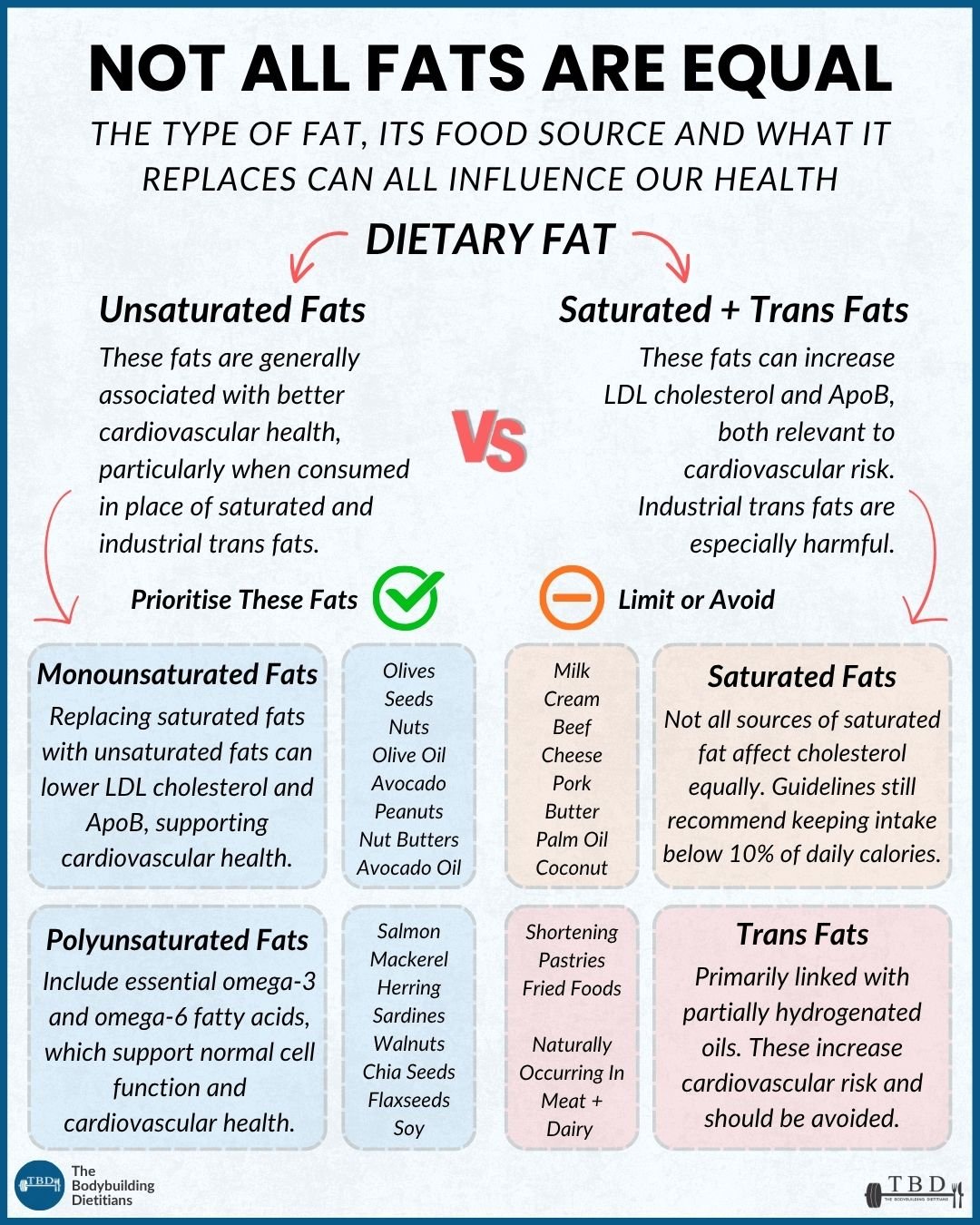
The saturated fat debate usually gets reduced to saturated versus unsaturated, but the type of fat, its food source, and what replaces it in the diet all shape its effect on cardiovascular health. This guide works through the markers that matter, the outcome evidence, and why food source and dietary pattern deserve as much attention as the fat type itself.
The effect of dietary fat on cardiovascular health depends on more than the saturated-versus-unsaturated distinction alone. Saturated fat generally raises LDL cholesterol when it replaces unsaturated fat, but LDL is not the only marker worth considering. ApoB reflects the number of circulating atherogenic lipoprotein particles and can give a more accurate indication of cardiovascular risk, especially when it and LDL cholesterol do not align, and saturated fat can raise both. Replacing certain saturated fatty acids with unsaturated fats, particularly polyunsaturated fats, can reduce ApoB as well as LDL. Looking at actual outcomes, a 2020 Cochrane review of trials involving more than 50,000 people found that reducing saturated fat intake lowered the relative risk of combined cardiovascular events by around 17%, though it showed little or no effect on overall mortality. The food source matters too, since foods contain more than isolated fatty acids, and different dairy products can produce different cholesterol responses despite similar saturated fat content. What replaces saturated fat also matters, with unsaturated fats offering greater cardiovascular benefit than refined carbohydrates. None of this makes saturated fat beneficial or means its effect on blood lipids can be ignored. For most people, a sensible approach is to prioritise unsaturated fats from foods such as olive oil, nuts, seeds, avocado, and oily fish, keep saturated fat within recommended levels, and minimise industrial trans fats.
The current conversation about dietary fat is missing some important context. Much of the discussion focuses on saturated versus unsaturated fat, which is a reasonable starting point, but understanding how dietary fat affects cardiovascular health means looking beyond those two categories alone. The type of fat, the food it comes from, and what it replaces in the diet all influence the outcome, and leaving any of them out produces an incomplete picture.
This article works through the markers used to assess cardiovascular risk, what the outcome evidence shows, why the food source of saturated fat matters, and why what replaces it may matter most of all. It is a cardiovascular-focused companion to the broader fat guide. For how much fat to eat, the three fat types, and how to distribute fat across meals, our complete guide to dietary fat covers the fundamentals, while this piece focuses specifically on saturated fat and heart health.
LDL cholesterol is the cholesterol carried on low-density lipoprotein particles, long used as a primary marker of cardiovascular risk because higher levels are associated with greater risk of heart disease.
Why Isn't Saturated Versus Unsaturated the Whole Story?
The saturated-versus-unsaturated framing is useful but incomplete, because it treats fat type as the only variable when food source and dietary context also shape the outcome. Saturated fat generally raises LDL cholesterol when it is consumed in place of unsaturated fat, which is one of the most consistent findings in nutrition, and that part of the picture is not in dispute.
What the simple framing misses is everything around that single effect. The same gram of saturated fat behaves differently depending on the food it arrives in, what it displaces in the diet, and which markers you measure its effect against. A piece built only on fat type will reach a cruder conclusion than one that accounts for these factors, which is why the saturated-versus-unsaturated split is best understood as the first layer of the question rather than the whole of it. The sections below work through the layers that the simple version leaves out.
Is LDL Cholesterol the Only Marker That Matters?
LDL cholesterol is an important marker but not the only one worth considering, and in some cases it does not tell the full story. A second marker, ApoB, measures something related but distinct, and it can give a more accurate reading of cardiovascular risk in the situations where the two diverge.
ApoB, or apolipoprotein B, is a protein found on the surface of the lipoprotein particles that contribute to cardiovascular disease, with one ApoB molecule per particle. Measuring ApoB therefore reflects the number of circulating atherogenic particles, the particles capable of lodging in artery walls, rather than the amount of cholesterol they carry. This distinction matters because it is possible to have an LDL cholesterol reading that looks reassuring while carrying a high number of particles, or the reverse, and when LDL cholesterol and ApoB do not align, ApoB tends to be the more reliable indicator of risk.
Saturated fat is relevant to both markers, because it can raise LDL cholesterol and ApoB. Research shows that replacing certain saturated fatty acids with unsaturated fats can reduce ApoB, not only LDL cholesterol, which strengthens the case that the swap affects the underlying particle burden rather than just the cholesterol figure. For most people these two markers move together, but the ApoB picture adds confidence to the conclusion that the type of fat influences cardiovascular risk rather than only a single blood measurement.
What Does the Outcome Evidence Show?
Beyond blood markers, the more important question is whether changing saturated fat intake affects actual cardiovascular events, and here the evidence is meaningful but more measured than the marker data alone might suggest. Markers like LDL and ApoB are useful because they predict risk, but trials measuring real outcomes are what test whether acting on them helps.
The strongest summary of that trial evidence is a large systematic review, which found a clear reduction in cardiovascular events from reducing saturated fat, alongside a more equivocal picture for mortality. This combination is worth holding onto, because it supports reducing saturated fat as a sensible target while cautioning against overstating the size of the effect.
A 2020 Cochrane review of randomised trials involving more than 50,000 participants found that reducing saturated fat intake for at least two years lowered the relative risk of combined cardiovascular events by around 17% (relative risk 0.83). The same review found little or no effect on all-cause or cardiovascular mortality. Source: Hooper et al., 2020, Cochrane Database of Systematic Reviews.
The practical reading of this is that reducing saturated fat appears to lower the risk of cardiovascular events such as heart attacks, which is a worthwhile outcome, while the evidence that it extends overall lifespan is weaker. That is a reason to treat saturated fat reduction as one sensible component of a heart-healthy diet rather than a single lever that determines how long someone lives, and it fits the broader principle that dietary patterns matter more than any one nutrient in isolation.
Why Does the Food Source of Saturated Fat Matter?
The food a saturated fat comes in affects how the body responds to it, because foods deliver far more than isolated fatty acids. The surrounding nutritional composition, sometimes called the food matrix, can change the effect of the same saturated fat depending on the food it is part of.
Dairy is the clearest example. Different dairy products can produce different cholesterol responses despite containing similar amounts of saturated fat, with the structure of the food and its other components, such as calcium and the fermentation involved in making cheese, appearing to influence the result. This is why the saturated fat in cheese does not necessarily behave identically to the same quantity of saturated fat in butter, even though a fatty acid breakdown would make them look comparable. The practical implication is that whole foods are a more useful unit of analysis than isolated nutrients, and that a varied diet of minimally processed foods is a sounder basis for decisions than tracking individual fatty acids, rather than reading this as licence to treat saturated fat in some foods as a free pass.
Confused by the Conflicting Saturated Fat Advice?
The saturated fat conversation has become confusing, with strong claims in both directions and little of the context that makes sense of them. If you want your fat intake, and your nutrition more broadly, built on the evidence rather than the loudest headline, our team works through exactly this with clients, matched to your health markers and goals.
Why Does What Replaces Saturated Fat Matter Most?
What saturated fat is replaced with in the diet may be the single most important factor, because the benefit of reducing saturated fat depends heavily on what takes its place. Removing saturated fat and substituting something no better, or worse, does not produce the same result as a favourable swap.
Replacing saturated fat with unsaturated fats, and polyunsaturated fats in particular, generally offers greater cardiovascular benefit than replacing it with refined carbohydrates. Cutting saturated fat only to replace it with white bread, sugary foods, or other refined carbohydrates tends to offer little cardiovascular advantage, which is part of why some older low-fat approaches disappointed. The useful version of the advice therefore focuses on where those calories go, directing them toward unsaturated sources such as olive oil, nuts, seeds, and oily fish rather than toward refined carbohydrates. This is also why the quality of the carbohydrates in a diet matters alongside the fats, a topic our guide to the carbohydrate hierarchy covers in terms of structure and food source.
What Is the Practical Approach to Dietary Fat and Heart Health?
The practical approach follows directly from the evidence, and it is reassuringly simple for all the nuance behind it. For most people, prioritising unsaturated fats, keeping saturated fat within recommended levels, and minimising industrial trans fats covers the cardiovascular bases well.
Prioritising unsaturated fats means building most of the fat in the diet around foods such as olive oil, nuts, seeds, avocado, and oily fish, which supply the monounsaturated and polyunsaturated fats associated with better cardiovascular outcomes. Keeping saturated fat within recommended levels means staying near the widely used guideline of below around 10 percent of total energy intake, which allows saturated fat from whole foods like dairy and meat without letting it dominate the fat profile. Minimising industrial trans fats is the least ambiguous part, since the partially hydrogenated oils found in some shortening, pastries, and fried foods raise cardiovascular risk and are worth avoiding wherever possible, and are distinct from the small amounts of trans fat that occur naturally in meat and dairy.
This does not make saturated fat beneficial, and its effect on blood lipids still matters. The point is that individual nutrients, food sources, and overall dietary patterns are best considered together rather than reducing the whole question to a single category. A varied diet built largely on minimally processed foods, with fat coming mostly from unsaturated sources, handles the complexity without requiring anyone to track fatty acids.
Practical Takeaways
The saturated-versus-unsaturated distinction is the starting point, but the type of fat, its food source, and what replaces it all shape the effect on cardiovascular health.
Saturated fat generally raises LDL cholesterol, and it can also raise ApoB, which reflects the number of atherogenic particles and can indicate risk more accurately when the two markers diverge.
A 2020 Cochrane review found reducing saturated fat lowered the relative risk of cardiovascular events by around 17%, with little or no effect on overall mortality, so it is one worthwhile component of a heart-healthy diet rather than a single decisive lever.
Food source matters, since different dairy products can produce different cholesterol responses despite similar saturated fat content. Whole foods are a more useful unit than isolated fatty acids.
What replaces saturated fat matters most. Unsaturated fats, especially polyunsaturated, offer greater cardiovascular benefit than refined carbohydrates.
For most people: prioritise unsaturated fats from olive oil, nuts, seeds, avocado, and oily fish, keep saturated fat below around 10% of energy, and minimise industrial trans fats.
Frequently Asked Questions
Is saturated fat bad for your heart?
Saturated fat generally raises LDL cholesterol and ApoB, both of which are relevant to cardiovascular risk, and a 2020 Cochrane review found that reducing it lowered the risk of cardiovascular events by around 17%. The picture is more nuanced than good or bad alone, because the food source and what replaces saturated fat both influence the outcome. For most people, keeping saturated fat within recommended levels while prioritising unsaturated fats is the sensible approach.
What is ApoB and why does it matter?
ApoB, or apolipoprotein B, is a protein carried on the lipoprotein particles that contribute to cardiovascular disease, with one molecule per particle, so measuring it reflects the number of atherogenic particles in the blood. It can indicate cardiovascular risk more accurately than LDL cholesterol in cases where the two do not align. Saturated fat can raise both markers, and replacing it with unsaturated fat can lower both.
Does reducing saturated fat help you live longer?
The evidence is mixed on mortality specifically. The 2020 Cochrane review found that reducing saturated fat lowered the relative risk of cardiovascular events by around 17%, but it found little or no effect on all-cause or cardiovascular mortality. This suggests reducing saturated fat is a worthwhile part of a heart-healthy diet for lowering event risk, rather than a single factor that determines lifespan.
Is the saturated fat in cheese the same as in butter?
Not necessarily. Different dairy products can produce different cholesterol responses despite containing similar amounts of saturated fat, because the food matrix, including components like calcium and the fermentation used to make cheese, influences the effect. This is an example of why whole foods are a more useful way to think about dietary fat than isolated fatty acids, and why a fatty acid breakdown alone does not fully predict how a food behaves.
Should I replace saturated fat with low-fat carbohydrates?
It depends on the carbohydrate. Replacing saturated fat with unsaturated fats, particularly polyunsaturated fats, generally offers greater cardiovascular benefit than replacing it with refined carbohydrates such as white bread and sugary foods. Shifting those calories toward olive oil, nuts, seeds, and oily fish is more beneficial than a simple low-fat swap, which is part of why some older low-fat approaches underdelivered.
How much saturated fat should I eat?
A widely used guideline is to keep saturated fat below around 10% of total energy intake, which at a 2,000 calorie diet is roughly 22 grams per day. This is a practical ceiling rather than a target to eliminate saturated fat entirely, since some will come naturally from whole foods like dairy and meat. The aim is to keep saturated fat from dominating the fat profile at the expense of unsaturated sources.
If you would like your dietary fat and overall nutrition built on the evidence and matched to your own health markers and goals, rather than the latest headline on saturated fat, our team can help. Enquire about coaching or book a consultation to get started.