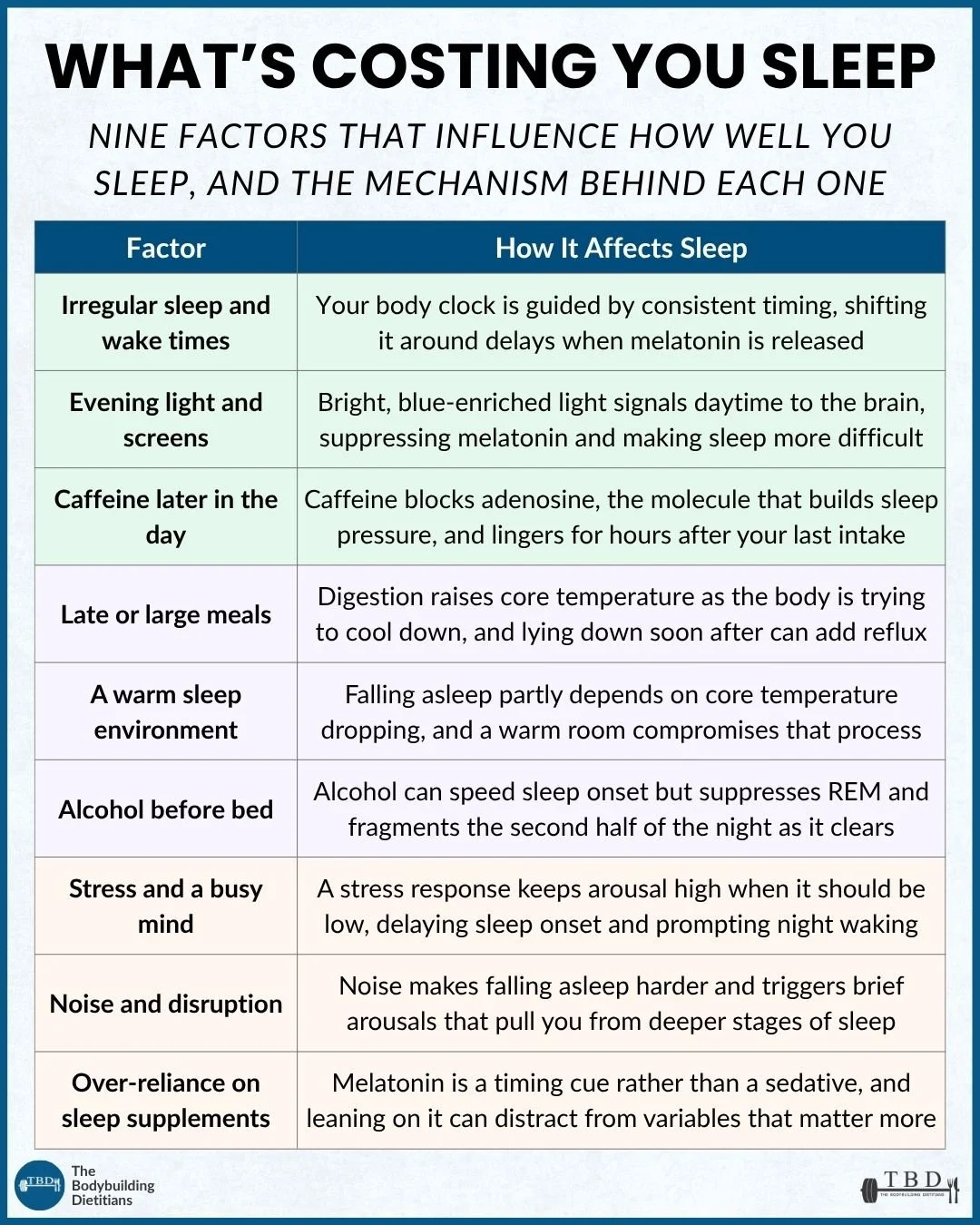
Nine everyday factors that influence sleep quality, each through a specific mechanism, which makes them easier to address once you know what they are doing.
Most sleep problems come down to a handful of everyday inputs that are easier to change once you understand what each one is doing. This guide works through nine common factors that influence how well you sleep, the mechanism behind each, and how to decide which ones are worth addressing first.
Nine common factors influence how well you sleep, and most people are affected by only a few of them at once. Irregular sleep and wake times and bright evening light both disrupt the circadian timing that governs melatonin release. Caffeine consumed later in the day blocks adenosine, the molecule that builds sleep pressure, and lingers for hours after your last intake. Late or large meals and a warm bedroom both interfere with the drop in core body temperature that sleep onset depends on. Alcohol can speed sleep onset but suppresses REM sleep and fragments the second half of the night. A stressed, busy mind keeps physiological arousal high when it should be falling, and noise triggers brief awakenings that pull you out of deeper sleep. Over-reliance on melatonin supplements is the ninth, because melatonin acts as a timing signal rather than a sedative, and leaning on it can distract from the inputs that matter more. The practical approach is to identify which of these apply to you and start with the easiest to control consistently, such as moving caffeine earlier, keeping sleep and wake times stable, cooling the room, and reducing bright light at night.
One of these nine things may be costing you sleep every night, and the frustrating part is that several of them are easy to miss. Caffeine can still be affecting you hours after your last coffee, a warm room can make it harder for core temperature to fall, bright evening light can delay melatonin release, and alcohol can help you fall asleep faster while making the second half of the night worse.
The useful way to approach a list like this is not to overhaul everything at once. Most people are affected by only a few of these factors at a time, so the practical step is to identify which ones are relevant to you and start with the easiest to control consistently. Understanding the mechanism behind each helps with that, because it tells you what a given change is doing rather than leaving you to follow generic advice on faith. Sleep supports almost everything you are trying to get out of your training and nutrition, and our article on sleep and body composition covers why that connection is so strong, from recovery and hormonal function to appetite regulation. This article is the practical companion, focused on the inputs that shape sleep quality in the first place.
Circadian rhythm is the roughly 24-hour internal clock that governs the timing of sleep, hormone release, and body temperature, and much of what follows comes back to keeping that clock well aligned.
How Do Your Body Clock and Evening Light Affect Sleep?
Your body clock runs on consistency, and both irregular timing and bright evening light disrupt it through the same hormone. When the timing of sleep drifts around from night to night, the release of melatonin, the hormone that signals to the body that it is time to sleep, shifts with it and becomes less predictable.
Melatonin is a hormone produced by the pineal gland in the evening that signals biological night to the body and helps initiate sleep. Its release is timed by the circadian clock, which takes its strongest cue from light. Keeping consistent sleep and wake times, including on weekends where possible, gives that clock a stable signal to anchor to, which is why a regular schedule tends to improve sleep quality even without any other change.
Evening light works against the same system from a different angle. Bright, blue-enriched light in the hours before bed, which is exactly the kind of light that screens and most indoor lighting produce, signals daytime to the brain and suppresses melatonin release, making sleep harder to initiate. Reducing bright light in the last hour or two before bed, dimming household lighting, and lowering screen brightness or using warmer tones all reduce that suppression. The effect of light is powerful enough that it is often the highest-value change for people whose evenings are spent under bright lights or in front of screens.
Why Does Caffeine Timing Matter More Than You Think?
Caffeine affects sleep for far longer than most people assume, because of how it works and how slowly the body clears it. Across the day, a molecule called adenosine builds up in the brain and creates what is known as sleep pressure, the mounting drive to sleep that peaks by the end of a long day. Caffeine blocks adenosine's action, which is why it makes you feel alert, but it does not remove the underlying sleep pressure, it only masks it.
The timing issue comes from how long caffeine lingers. Its half-life, the time taken for the body to clear half of a dose, is around five hours for many people, though this varies considerably with genetics, and it can be longer. A coffee at 4pm can therefore still have a meaningful amount of caffeine circulating at bedtime, quietly interfering with sleep depth even in people who feel they can fall asleep without trouble. Moving caffeine earlier in the day is one of the most reliable adjustments available, and for those sensitive to it, setting a personal cut-off time in the early afternoon often makes a noticeable difference. For a fuller look at caffeine's effects, dosing, and timing around training, our complete guide to caffeine covers it in detail.
Training in the Evening and Wondering Why Sleep Suffers?
Pre-workout formulas and afternoon coffee are near-universal among lifters, and the connection to poor sleep is one of the most commonly missed. If you are trying to balance training performance, caffeine, and recovery, our team factors sleep into how we structure training and nutrition for coaching clients rather than treating it as separate.
How Do Meals and Room Temperature Affect Sleep Through Body Heat?
Falling asleep depends partly on a drop in core body temperature, and both late meals and a warm room work against it. As the evening progresses, core temperature naturally falls, and this decline is part of the signal that helps sleep begin. Anything that keeps the body warmer than it should be at that point can make sleep onset harder.
Digestion is one such input. Processing a large meal raises metabolic heat production at a time when the body is trying to cool down, and lying down soon after eating can also allow stomach acid to move upward, adding reflux that disrupts sleep. Leaving a reasonable gap between the last substantial meal and bed, and keeping late meals smaller where a gap is not possible, both reduce this effect. This does not mean going to bed hungry, which brings its own problems, but rather avoiding a large meal immediately before lying down.
A warm bedroom compromises the same temperature drop from the outside. A room that is too warm makes it harder for the body to shed heat and reach the lower core temperature that sleep onset depends on, which is why a cooler sleeping environment tends to support better sleep than a warm one. For most people a bedroom on the cooler side of comfortable works better than a warm one, and adjusting bedding, ventilation, or cooling is a straightforward change with a clear mechanism behind it.
Why Does Alcohol Make Sleep Worse Even When It Helps You Fall Asleep?
Alcohol is deceptive because its most noticeable effect and its real cost point in opposite directions. It has a sedative action that can speed the transition into sleep, which is why a drink before bed feels as though it helps. The problem arrives later in the night.
As alcohol is metabolised and clears from the system, it suppresses REM sleep, the stage associated with dreaming and with important cognitive and emotional processing, and it fragments the second half of the night with more frequent awakenings. The result is sleep that is lighter and more broken through the back half of the night, even when the first half felt easy. This is why people often wake unrefreshed after drinking despite having fallen asleep quickly, and why alcohol close to bed is one of the clearer trade-offs on this list. Keeping alcohol earlier in the evening, leaving time before bed, and moderating the amount all reduce the disruption, since the effect on the second half of the night depends heavily on how much is still clearing as you sleep.
How Do a Busy Mind and a Noisy Room Disrupt Sleep?
Two of the remaining factors act by keeping the brain more active than sleep requires, one from the inside and one from the outside. A stress response keeps physiological arousal high at a time when it should be falling, which delays sleep onset and prompts waking through the night. When the mind is busy or stressed, the body maintains a level of alertness that is directly at odds with the wind-down that sleep needs.
Addressing this is less about a single technique and more about creating a genuine buffer between the demands of the day and sleep. A consistent wind-down routine, reducing stimulating activity in the last part of the evening, and practices that lower arousal such as slower breathing, reading, or writing down what is on your mind all help shift the body toward the lower-arousal state sleep requires. Persistent difficulty here can also reflect stress loads worth addressing more directly, and sleep is one of the variables we assess when progress stalls despite good training and nutrition, a pattern covered in our article on the five lifter archetypes.
Noise disrupts sleep from the outside through a related pathway. It makes falling asleep harder and triggers brief arousals that pull you out of the deeper stages of sleep, often without waking you fully or leaving any memory of it. These micro-awakenings degrade sleep quality even when total time in bed looks adequate. Reducing noise where possible, or masking it with a steady background sound such as a fan or white noise, limits these arousals and protects the deeper stages of sleep.
Is Melatonin the Sleep Fix It Is Made Out to Be?
Melatonin is widely treated as a sleep aid in the sedative sense, but that is a misunderstanding of what it does, and it is the factor most worth getting right. Melatonin is a timing cue rather than a sedative. It signals to the body when biological night is, which makes it useful for shifting the clock in situations like jet lag or a delayed sleep schedule, but it does not sedate you the way a sleeping tablet would.
The practical consequence is that leaning on melatonin as a nightly fix often disappoints, and worse, it can distract from the inputs that matter more. Someone taking melatonin every night while still scrolling under bright light, drinking coffee late, and sleeping in a warm room is addressing a timing signal while leaving the larger levers untouched. The factors covered above, consistent timing, evening light, caffeine, temperature, alcohol, and a settled mind, will do more for most people than any supplement. Melatonin's regulatory status also varies by country, and in Australia it is largely available on prescription, so it is worth checking local rules and speaking with a pharmacist or doctor rather than assuming it is a simple over-the-counter fix. Used deliberately for a timing problem it has a real role, but as a substitute for the fundamentals it rarely delivers what people hope.
Practical Takeaways
Most people are affected by only a few of these nine factors at once, so identify which apply to you and start with the easiest to control consistently rather than changing everything.
Consistent sleep and wake times plus reduced bright light in the evening keep circadian timing and melatonin release aligned, often the highest-value changes.
Caffeine has a half-life of around five hours and blocks the adenosine that builds sleep pressure, so moving it earlier in the day protects sleep depth even if you can still fall asleep.
Sleep onset depends on core temperature falling, so avoid large meals right before bed and keep the bedroom on the cooler side of comfortable.
Alcohol speeds sleep onset but suppresses REM and fragments the second half of the night, so keeping it earlier and moderate reduces the cost.
Melatonin is a timing cue rather than a sedative. It helps with jet lag or a shifted schedule but is no substitute for the behavioural fundamentals, and its availability varies by country.
Frequently Asked Questions
How late is too late for caffeine?
Caffeine has a half-life of around five hours for many people, though this varies with genetics, so a meaningful amount can still be present at bedtime from an afternoon coffee. As a general guide, keeping caffeine to the earlier part of the day, and for sensitive individuals setting a cut-off in the early afternoon, protects sleep depth. The right cut-off is individual, so it is worth testing what timing lets you sleep well.
Does alcohol actually help you sleep?
Alcohol can help you fall asleep faster because of its sedative effect, but it worsens sleep overall. As it clears from the body it suppresses REM sleep and fragments the second half of the night, which is why people often wake unrefreshed after drinking. Keeping alcohol earlier in the evening and moderating the amount reduces this disruption.
What is the best room temperature for sleep?
A cooler bedroom generally supports better sleep than a warm one, because falling asleep depends partly on a drop in core body temperature. A room on the cooler side of comfortable helps the body shed heat and reach that lower temperature, whereas a warm room works against it. Adjusting bedding, ventilation, or cooling is a simple change with a clear mechanism.
Does melatonin work as a sleep aid?
Melatonin works as a timing signal rather than a sedative, so it is useful for shifting the body clock in situations like jet lag or a delayed sleep schedule, but it does not sedate you the way a sleeping tablet does. Relying on it nightly often disappoints and can distract from more impactful changes like light, caffeine, and consistent timing. Its availability also varies by country, so check local rules.
Why do I wake up in the middle of the night?
Night waking has several common causes, including alcohol clearing from the system, a stress response keeping arousal high, noise triggering brief awakenings, and a warm room. Identifying which of these applies to you is the first step, since the fix differs for each. Persistent, unexplained night waking is worth discussing with a health professional.
Which sleep change should I make first?
Start with the factor that is both relevant to you and easiest to control consistently. For many people that is moving caffeine earlier, keeping sleep and wake times stable, cooling the bedroom, or reducing bright light in the evening. Making one change at a time also lets you see what helps rather than changing everything at once.
If you would like help fitting good sleep around your training, nutrition, and schedule rather than treating it as an afterthought, our team can build that into a plan with you. Enquire about coaching or book a consultation to get started.