A step-by-step framework for setting your calories first, then protein, fat and carbohydrate, with the numbers adjusted for whether your goal is fat loss, muscle gain or body recomposition.
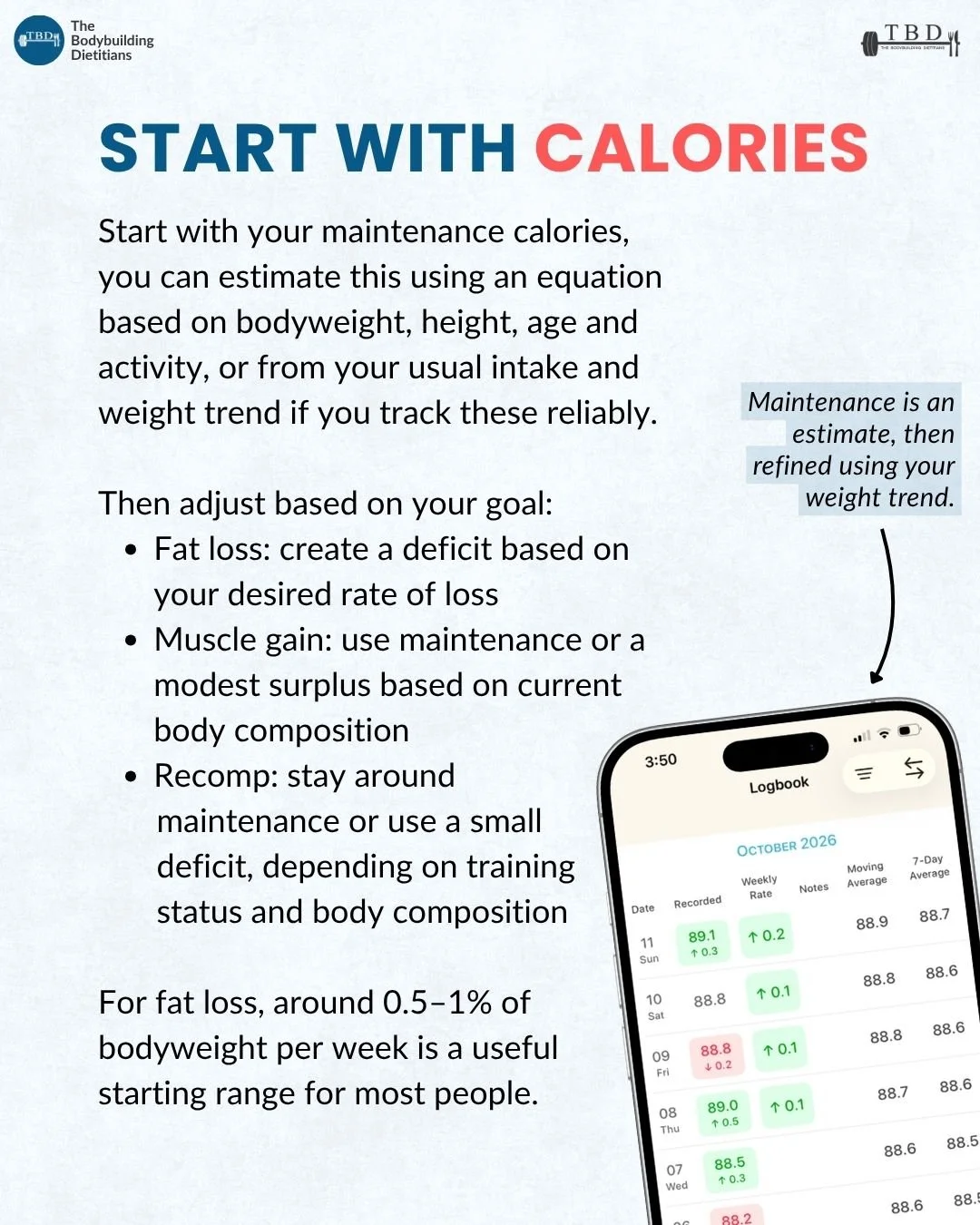
Setting your macros works best as an ordered sequence rather than four separate guesses. Start with your maintenance calories, estimated either from an equation based on bodyweight, height, age and activity, or from your usual intake and weight trend if you track them reliably, then adjust that figure for your goal. For fat loss, create a deficit sized to lose around 0.5 to 1% of bodyweight per week. For muscle gain, use maintenance or a modest surplus. For recomposition, stay near maintenance or use a small deficit depending on your training status and body composition. Set protein second, at roughly 2.0 to 2.4 grams per kilogram of bodyweight during fat loss and 1.6 to 2.2 grams per kilogram for muscle gain or recomposition. Set dietary fat third, at a minimum of around 0.5 grams per kilogram with 0.5 to 1.5 grams per kilogram as a practical range. Carbohydrate then fills the remaining calories, scaling up as training volume and intensity increase. The starting numbers matter less than knowing how to adjust them as a phase progresses.
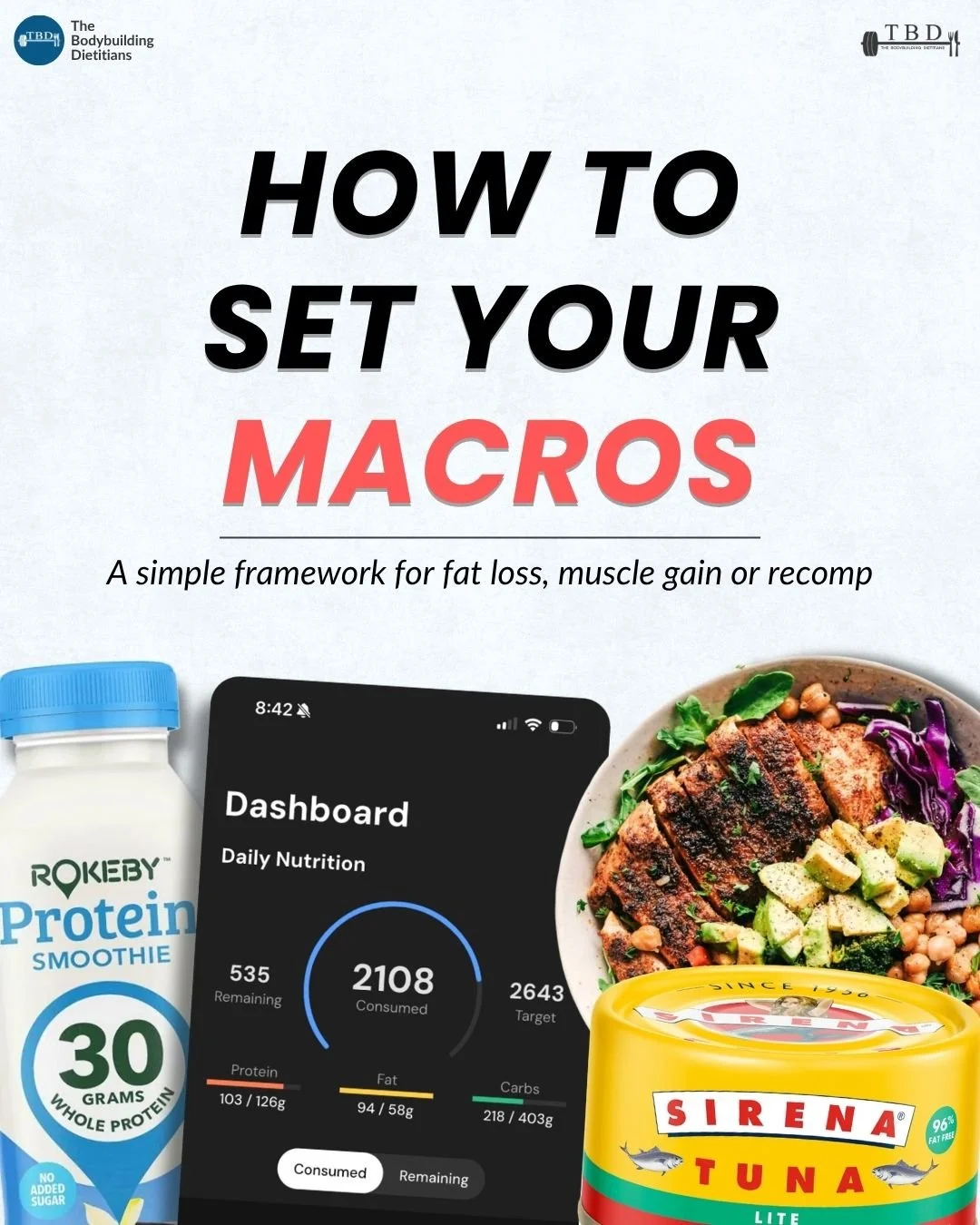
Most people set their macros in the wrong order, or in no particular order at all, pulling a protein number from one source and a carb number from another without a structure connecting them. A more useful approach treats macro setting as a sequence, where each number follows logically from the one before it. Calories come first because they determine the direction of body composition change. Protein comes next because it protects and builds muscle. Fat follows to cover its essential functions, and carbohydrate fills whatever calories remain.
Prefer to skip the maths? Our free calorie and macro calculator sets your calories and macros around your bodyweight, training, activity and goal, whether that is fat loss, muscle gain or recomposition. It gives you a solid starting point in a couple of minutes, and the rest of this article explains the reasoning behind the numbers it produces.
Why Start With Calories Rather Than Macros?
Calories come first because total energy intake determines whether you gain, lose or maintain weight, which sets the direction everything else works within. Protein, fat and carbohydrate shape how that energy is used, but they operate inside the boundary that total calories establish.
Energy balance describes the relationship between the calories you consume and the calories you expend, and it is the primary driver of whether bodyweight rises, falls or holds steady over time. Setting protein and carbohydrate targets before you know your calorie target means setting them without the one piece of information that gives them context, since the same protein intake behaves differently in a deficit than it does in a surplus. Starting with calories gives every macro that follows a reference point to sit within, which is why the sequence begins there.
How Do You Estimate Your Maintenance Calories?
Maintenance calories are the daily energy intake at which bodyweight stays stable, and they form the baseline you adjust up or down for your goal. There are two practical ways to estimate them, and each has a place depending on the data you already have.
Maintenance calories are the number of calories required to keep bodyweight stable over time, accounting for metabolism, activity and training.
The first method uses an equation based on bodyweight, height, age and activity level, which produces an estimate from population averages. This works well when you have no reliable intake history to draw on, and it is the approach most online calculators use. The second method uses your own data, taking your usual daily intake and pairing it with your weight trend over several weeks. If your weight has held steady on a known average intake, that intake is a close approximation of your maintenance by definition, and it tends to be more accurate than an equation because it reflects your actual physiology rather than a population average.
Either way, the first number is an estimate rather than a fixed truth. The more important step is refining it over the following weeks by tracking your weight trend and adjusting intake if the trend is not moving as the goal requires. A weekly average smooths out the daily fluctuations from water, food volume and digestion, and gives a far clearer signal than any single morning reading.
How Should Calories Change for Fat Loss, Muscle Gain or Recomp?
Once you have a maintenance estimate, the adjustment depends entirely on the goal, and the three common goals each call for a different starting position relative to maintenance.
For fat loss, the aim is a calorie deficit sized to your desired rate of loss. A useful starting range for most people is around 0.5 to 1% of bodyweight per week, which balances meaningful progress against the risk of losing muscle or compromising training when the deficit runs too aggressive. Leaner individuals and those prioritising performance tend to sit towards the slower end, while those carrying more body fat can often use the faster end comfortably.
In a study of elite athletes, a slower rate of weight loss of around 0.7% of bodyweight per week better supported lean mass retention and gain than a faster rate of around 1.4% per week, despite similar total fat loss. Source: Garthe et al., 2011, International Journal of Sport Nutrition and Exercise Metabolism.
For muscle gain, calories sit at maintenance or in a modest surplus, with the size of the surplus guided by current body composition and training status. A leaner, less experienced trainee can push a slightly larger surplus and use the extra energy productively, while someone already carrying more body fat benefits from keeping the surplus small to limit unnecessary fat gain. The principle of adjusting the approach to the individual is one reason we individualise nutrition for our coaching clients rather than applying a single surplus to everyone.
For recomposition, the goal of building muscle and losing fat at the same time, calories stay around maintenance or in a small deficit, with the right position depending heavily on training status and body composition. Recomposition tends to work most readily for those who are newer to training, returning after a break, or carrying enough body fat to fuel muscle growth from existing stores. Body recomposition is the process of gaining muscle and losing fat simultaneously, usually at or near maintenance calories rather than in a pronounced surplus or deficit.
How Much Protein Do You Need, and When Does It Change?
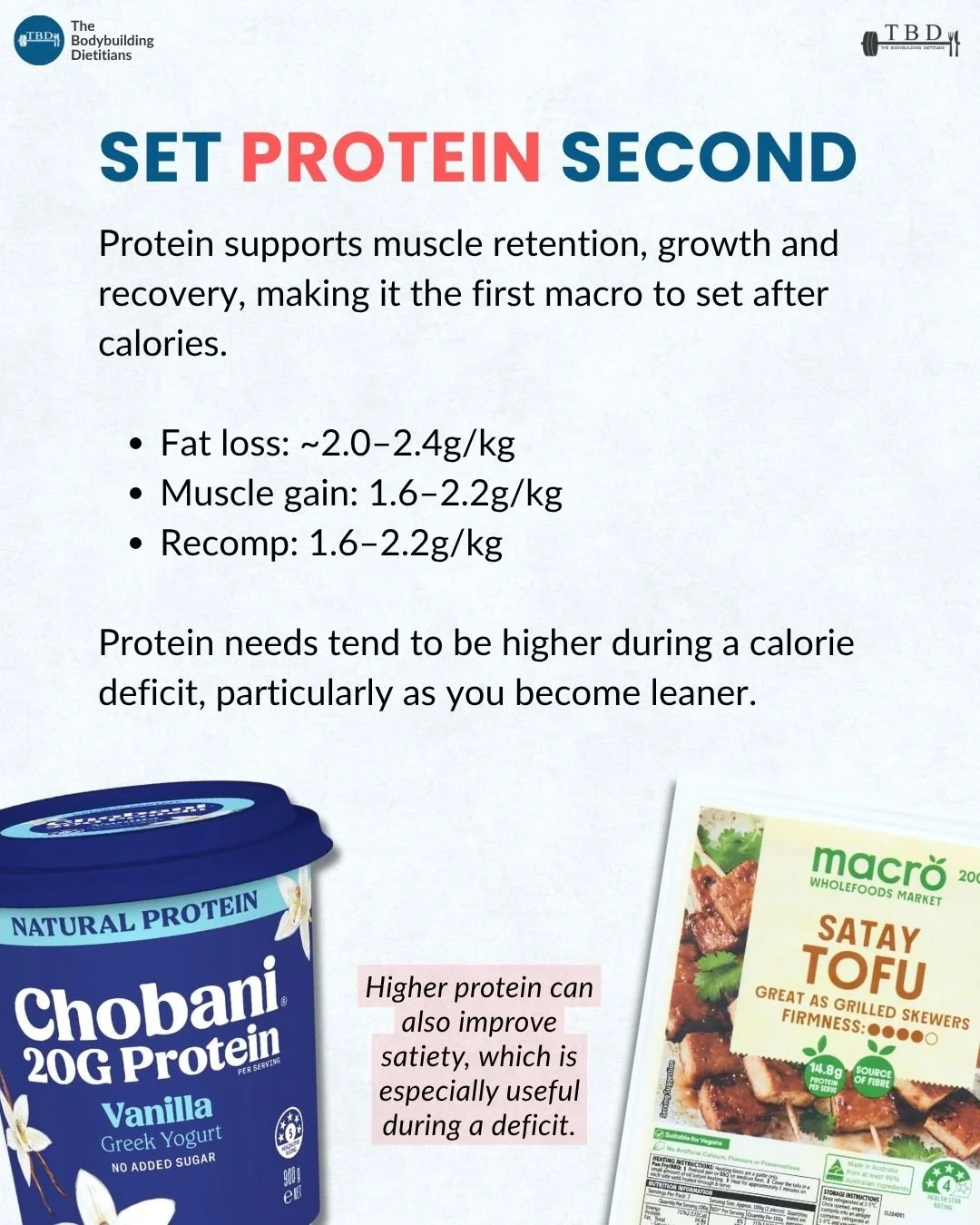
Protein is set immediately after calories because it supports muscle retention, growth and recovery, which makes it the macro with the most direct influence on body composition for anyone training. The target shifts with the goal, and it tends to rise as conditions become more demanding.
For muscle gain and recomposition, a range of 1.6 to 2.2 grams per kilogram of bodyweight covers the practical need for most people. For fat loss, the target moves higher, to around 2.0 to 2.4 grams per kilogram, because protein requirements increase in a calorie deficit and increase further as you become leaner. A deficit raises the body's tendency to break down lean tissue, and higher protein provides a buffer against that, alongside the secondary benefit of improved satiety when food intake is lower.
A meta-analysis of 49 studies found that protein supplementation increased muscle mass and strength gains with resistance training, with benefits plateauing at around 1.6 grams per kilogram of bodyweight per day on average. Source: Morton et al., 2018, British Journal of Sports Medicine.
The higher fat loss figures sit above that average plateau for a reason, since the 1.6 gram figure reflects the point of diminishing returns for building muscle at maintenance or in a surplus. Preserving muscle in a deficit is a different task, and the additional protein earns its place there. Protein is a macronutrient composed of amino acids that supports tissue repair, muscle growth and numerous metabolic processes, and across the ranges above it is the macro worth setting with the most confidence.
How Do You Set Dietary Fat?
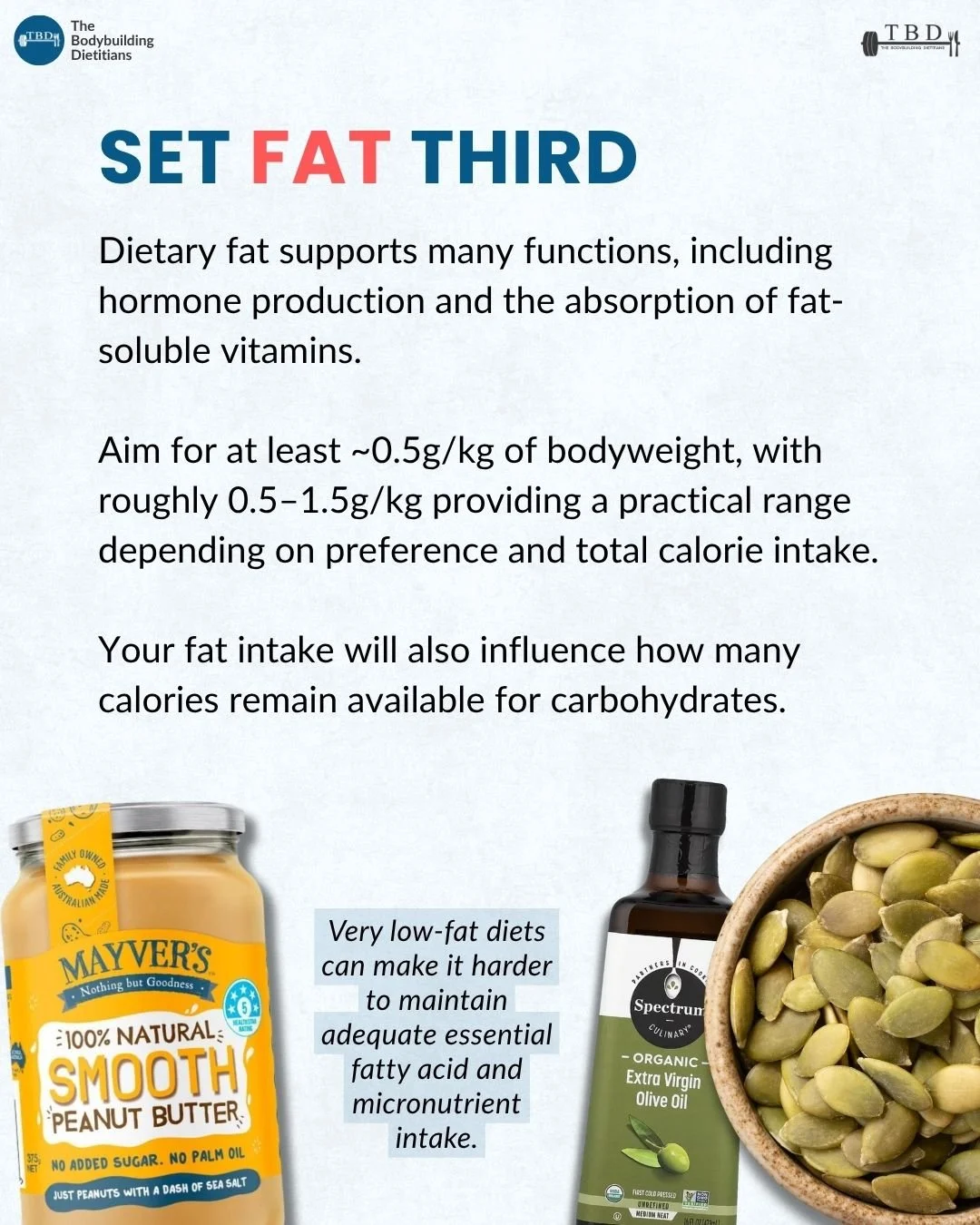
Dietary fat is set third, to a minimum that protects its essential functions before carbohydrate takes the remaining calories. Aiming for at least around 0.5 grams per kilogram of bodyweight covers the floor, with roughly 0.5 to 1.5 grams per kilogram providing a practical range depending on preference and total calorie intake.
Dietary fat supports hormone production and the absorption of fat-soluble vitamins, which is why pushing it too low for too long can create problems beyond the plate. Very low-fat diets can make it harder to maintain adequate essential fatty acid and micronutrient intake, so the minimum threshold is worth respecting even when calories are tight. Within the practical range, where you sit is partly a matter of preference, because fat and carbohydrate share the calories left after protein, and some people train and feel better with more of one than the other.
Why Do Carbohydrates Fill the Rest?
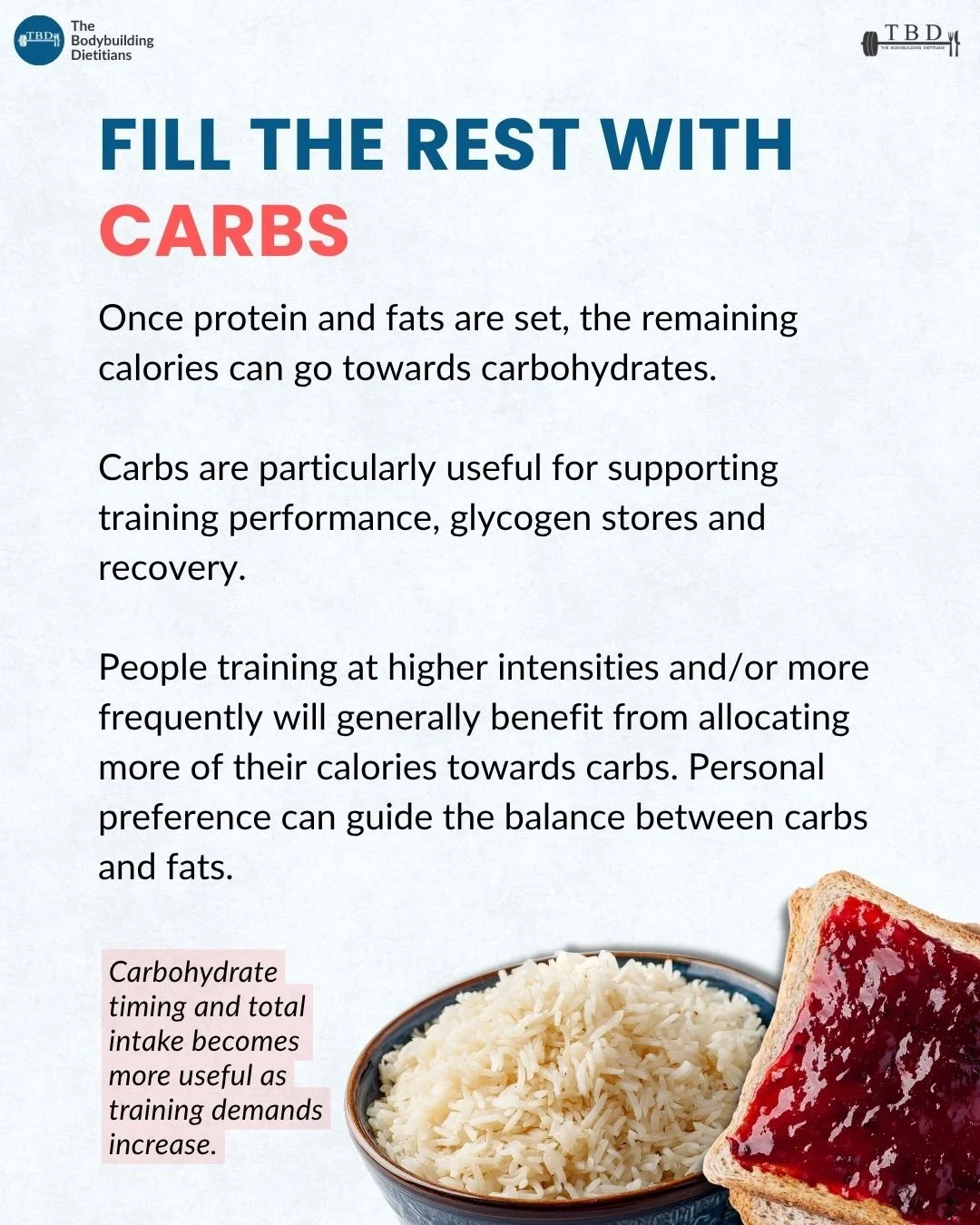
Carbohydrate is set last because it takes whatever calories remain after protein and fat are accounted for, which makes it the flexible variable rather than a fixed target. This is not a sign that carbohydrate matters least, since it is often the macro doing the most for training, but its quantity is most sensibly determined by what is left of the calorie budget.
Carbohydrate is particularly useful for supporting training performance, glycogen stores and recovery, and the amount that serves you well scales with how much you train. Glycogen is the stored form of carbohydrate found primarily in muscle and liver tissue, and it is the main fuel for higher-intensity training. People training at higher intensities or more frequently generally benefit from allocating more of their calories to carbohydrate, because the demand on glycogen is greater and the recovery cost is higher. The balance between carbohydrate and fat within the remaining calories can then follow personal preference, and the quality of those carbohydrate sources matters alongside the quantity.
Why Won't One Macro Split Suit Every Phase?
The same macro split rarely suits every phase because calories, training demands and goals all change over time, and the numbers that serve a building phase are not the numbers that serve a diet. Calories determine overall energy intake, while your macro targets shape how that intake supports your current phase, your training, your satiety and your food choices.
A higher-calorie building phase leaves more room for both carbohydrate and fat, and protein can sit towards the lower end of its range. A fat loss phase tightens the calorie budget, pushes protein higher to protect muscle, and often prioritises carbohydrate over fat to sustain training quality as energy drops. Someone increasing their training volume may need to move more calories towards carbohydrate regardless of the phase. The starting numbers are the straightforward part. The skill that separates a plan that keeps working from one that stalls is knowing when to move each number, and by how much, as the body responds across weeks and months.
Not sure when to change your numbers?
Setting a sensible starting point is the manageable part. Knowing when to adjust calories, how much to move protein as you get leaner, and when a split has stopped serving the phase is where most people get stuck. That ongoing calibration, matched to how you are responding week to week, is what our coaching is built around.
Practical Takeaways
Set macros in order: calories first, then protein, then fat, with carbohydrate filling the remaining calories. Each number is clearer once the one before it is set.
Estimate maintenance calories from an equation or from your own intake and weight trend, treat the first figure as a starting point, and refine it using a weekly weight average over the following weeks.
Adjust calories for the goal: a deficit for fat loss sized to around 0.5 to 1% of bodyweight per week, maintenance or a modest surplus for muscle gain, and maintenance or a small deficit for recomposition.
Set protein at roughly 2.0 to 2.4 grams per kilogram during fat loss and 1.6 to 2.2 grams per kilogram for muscle gain or recomposition, with the higher fat loss figure protecting muscle as you become leaner.
Set dietary fat to at least around 0.5 grams per kilogram, within a practical range of 0.5 to 1.5 grams per kilogram, before carbohydrate takes the rest.
Allocate more of the remaining calories to carbohydrate as training volume and intensity rise, and expect to adjust the whole split as phases and goals change.
Frequently Asked Questions
What order should you set your macros in?
Set calories first, because total energy intake determines whether you gain, lose or maintain. Set protein second, since it has the most direct influence on muscle retention and growth. Set dietary fat third to cover its essential functions, then let carbohydrate fill the remaining calories. Working in this order means each target has the context it needs from the ones set before it.
How do you calculate your maintenance calories?
You can estimate maintenance calories from an equation based on bodyweight, height, age and activity level, or from your own usual intake paired with your weight trend over several weeks. The second method is often more accurate because it reflects your actual physiology rather than a population average. Either way, treat the first figure as a starting estimate and refine it by tracking your weekly weight average and adjusting if the trend is not moving as your goal requires.
How much protein do you need for fat loss versus muscle gain?
For muscle gain or recomposition, 1.6 to 2.2 grams of protein per kilogram of bodyweight covers most needs. For fat loss, the target moves higher, to around 2.0 to 2.4 grams per kilogram, because protein requirements increase in a calorie deficit and rise further as you become leaner. The additional protein during a diet helps protect muscle and supports satiety when food intake is lower.
What is a good rate of weight loss for fat loss?
Around 0.5 to 1% of bodyweight per week is a useful starting range for most people. Slower rates towards the lower end tend to better preserve muscle and training performance, which suits leaner individuals, while those carrying more body fat can often use the faster end comfortably. Research in athletes found that a slower rate better supported lean mass than a faster one despite similar total fat loss.
Can you build muscle and lose fat at the same time?
Body recomposition, gaining muscle and losing fat simultaneously, is possible and tends to work most readily for those who are newer to training, returning after a break, or carrying enough body fat to fuel muscle growth. It usually happens around maintenance calories or in a small deficit rather than a pronounced surplus or deficit. For trained individuals who are already lean, progress through recomposition is slower and dedicated building or dieting phases are often more efficient.
Do your macros stay the same across every phase?
No. The same split rarely suits every phase because calories, training demands and goals change over time. A building phase allows more carbohydrate and fat with protein at the lower end of its range, while a fat loss phase tightens calories, raises protein and often prioritises carbohydrate over fat to protect training. Adjusting the numbers as the phase and your response change is more important than the starting split.