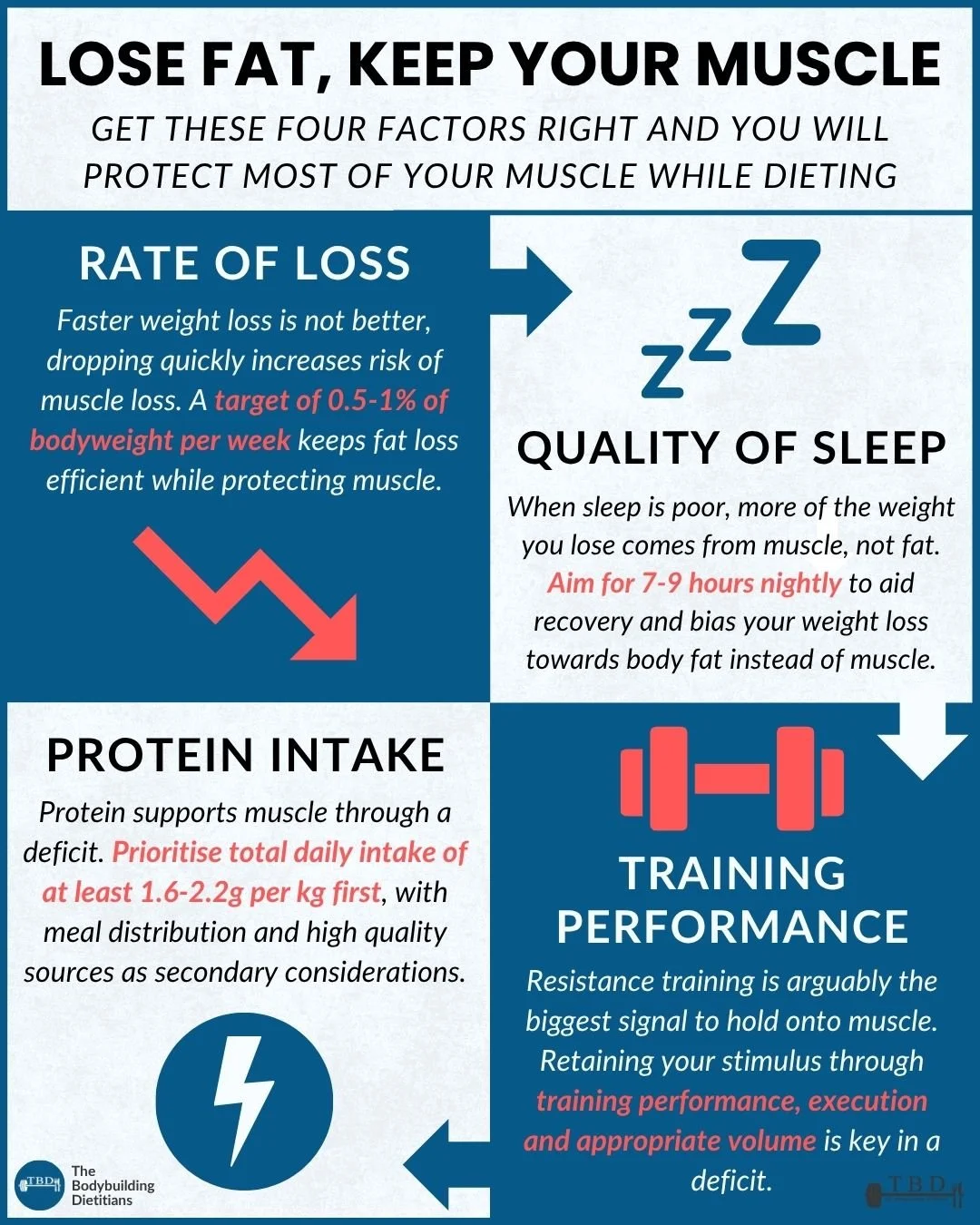
The four factors that most determine how much muscle you keep through a fat loss phase.
How you diet determines how much muscle you keep. For most people, muscle retention through a calorie deficit comes down to four factors, including the rate of weight loss, protein intake, resistance training, and sleep. This guide covers what each one does, why it matters, and how they interact as a diet gets harder.
Muscle retention during a calorie deficit comes down to four main factors, and getting them right lets most people keep the majority of their muscle while losing fat. The first is rate of loss: a target of roughly 0.5 to 1 percent of bodyweight per week keeps fat loss efficient while protecting lean mass, since faster loss raises the risk of shedding muscle. The second is protein: prioritising a total daily intake of at least 1.6 to 2.2 grams per kilogram of bodyweight, with meal distribution and food quality as secondary considerations. The third is resistance training, which is arguably the strongest signal to hold onto muscle, so maintaining training performance, execution, and appropriate volume through the deficit is what preserves the stimulus that built the muscle. The fourth is sleep, because when sleep is poor a greater share of the weight lost tends to come from muscle rather than fat, so aiming for 7 to 9 hours supports recovery and biases loss toward body fat. These factors become harder to manage as a diet runs longer, the deficit grows, or body fat gets low, which is why the leaner someone already is, the smaller the margin for an aggressive approach. Training experience, dieting history, how much needs to be lost, and any deadline all shape how the phase should be structured.
How you diet determines how much muscle you keep. Two people can reach the same fat loss goal and arrive in very different conditions, one holding onto nearly all their muscle and looking lean and full, the other smaller and flatter than they hoped, and the difference usually comes down to how the phase was run rather than how hard they tried.
For most people, muscle retention during a calorie deficit comes down to getting four variables right: the rate of weight loss, protein intake, resistance training, and sleep. When these are managed well, most people can keep the majority of their muscle through a fat loss phase, and those earlier in their training career may even gain some muscle while getting leaner. This article covers each of the four factors, how they interact as a diet gets harder, and why the same goal can call for very different approaches.
A calorie deficit is the state of consuming less energy than the body expends, which is the fundamental requirement for fat loss and the condition under which muscle must be actively protected.
Why Does Your Rate of Weight Loss Affect Muscle Retention?
The rate at which you lose weight is one of the largest determinants of how much of that weight comes from fat rather than muscle. A controlled rate of loss, around 0.5 to 1 percent of bodyweight per week, keeps fat loss efficient while protecting lean mass, whereas pushing the pace faster raises the risk of losing muscle alongside the fat.
The reason is that a larger deficit forces the body to draw on more of its own tissue to cover the energy gap, and beyond a certain point, an increasing share of that comes from muscle rather than fat. A moderate deficit stays within the range where the body preferentially mobilises fat, which is the outcome a fat loss phase is after. It also leaves more room to adjust later, since a phase that starts too aggressively has nowhere to go when progress slows. For most people, aiming for the lower end of that range as they get leaner protects muscle better than chasing the fastest possible loss. Our guide to how aggressive your calorie deficit should be covers how to set that rate for your own situation.
Evidence Physique athletes dieting at moderate rates of loss, around 0.5 to 1 percent of bodyweight per week, tend to retain more lean mass and experience less hormonal disruption than those using more aggressive deficits. Source: Helms, Aragon, and Fitschen, 2014, Journal of the International Society of Sports Nutrition.
How Much Protein Do You Need to Protect Muscle While Dieting?
Protein is the dietary variable that most directly supports muscle through a deficit, and meeting a sufficient daily total is the priority. Prioritising at least 1.6 to 2.2 grams of protein per kilogram of bodyweight per day covers the muscle-retention need for most people, with meal distribution and food quality as secondary refinements once the total is in place.
Adequate protein matters more in a deficit than in maintenance or a surplus, because the body is under more pressure to break down tissue for energy, and a higher protein intake helps offset that pressure and preserve lean mass. Hitting the daily total is the main lever, and spreading protein across three to five meals and choosing higher-quality, leucine-rich sources are worthwhile adjustments that come after the total is handled rather than before. Protein also supports satiety, which makes the deficit easier to adhere to, a secondary benefit that matters over a long phase.
A daily protein intake of around 1.6 grams per kilogram of bodyweight supports the preservation of lean mass and resistance-training adaptations, with intakes up to roughly 2.2 grams per kilogram providing a margin that suits dieting athletes managing a deficit. Source: Morton et al., 2018, British Journal of Sports Medicine.
Why Does Resistance Training Matter Most for Keeping Muscle?
Resistance training is arguably the single strongest signal telling the body to hold onto muscle during a deficit. Maintaining training performance, execution, and appropriate volume is what preserves the stimulus that built the muscle in the first place, which is why training is so central to retaining it.
Muscle is metabolically expensive to maintain, and in a deficit the body has a reason to let go of tissue it is not being pushed to use. Continuing to train with meaningful loads and good execution provides exactly that push, signalling that the muscle is still needed and should be preserved. The practical aim through a cut is to retain training quality rather than to chase new progress: holding loads and performance where possible, keeping execution tight so the target muscles are worked, and maintaining enough volume to provide a stimulus without adding fatigue the deficit cannot support. As energy and recovery decline later in a phase, protecting the quality of training matters more than the quantity, and trimming low-value volume can help preserve the performance that signals muscle retention. The failure mode to watch is a drop in training quality that quietly removes the very stimulus doing the work, a pattern our article on the five lifter archetypes covers through the junk-volume and under-recovered profiles.
How Does Sleep Affect Muscle Retention While Dieting?
Sleep has a larger and more direct effect on the composition of weight loss than most people expect. When sleep is poor, a greater proportion of the weight lost tends to come from muscle rather than fat, so aiming for 7 to 9 hours per night supports recovery and biases loss toward body fat instead of lean tissue.
The mechanism runs through several pathways at once. Inadequate sleep impairs recovery, raises hunger and appetite, and reduces training performance, and each of those works against muscle retention on its own. Together they shift the body toward a state where holding muscle becomes harder and adhering to the diet becomes harder as well. This is one of the clearer illustrations of how the four factors interact, since poor sleep directly undermines the training quality and recovery that factor three depends on.
In a crossover study, overweight adults on an identical calorie-restricted diet lost 55 percent less fat and around 60 percent more lean mass when sleeping 5.5 hours per night compared with 8.5 hours. Only about a quarter of the weight lost on short sleep came from fat, versus more than half on adequate sleep. This was a small study of 10 participants, but the direction of the effect is consistent with the wider evidence on sleep and recovery. Source: Nedeltcheva et al., 2010, Annals of Internal Medicine.
Why Do Two People With the Same Goal Need Different Approaches?
The four factors are consistent, but how aggressively they can be applied varies considerably from person to person. How lean someone already is, their training experience, their dieting history, how much they need to lose, and any deadline all shape how the phase should be structured, which is why the same fat loss goal can call for very different plans.
How lean someone already is matters a great deal. As body fat gets lower, maintaining muscle becomes more difficult and the margin for an aggressive deficit shrinks, so a lean competitor dieting down for a show needs a more conservative approach than someone with more fat to lose. The challenge also increases as a diet runs longer, the deficit grows, or recovery starts to deteriorate. Faster rates of loss raise the risk of losing lean mass, poorer sleep affects recovery, appetite, and training performance, and reduced training quality then makes it harder to maintain the stimulus that built the muscle, so the four factors compound on each other as a phase gets harder.
Not Sure How Aggressive Your Own Deficit Should Be?
The reason a generic plan often disappoints is that the right rate of loss, protein target, and training approach depend on where you are starting, how you have responded to dieting before, and how much time you have. Our team structures each fat loss phase around those specifics rather than a template, as part of how we plan nutrition for coaching clients.
When we plan a fat loss phase with a client, we weigh the target rate of loss, starting body composition, training history, recovery, previous dieting response, and the time available. Those factors together determine how aggressive the deficit can be and how long the phase should run. The goal is to create enough of a deficit to make meaningful progress while maintaining the conditions that allow muscle and training performance to be preserved, which is the balance the four factors exist to strike.
Practical Takeaways
Four factors most determine muscle retention in a deficit: rate of loss, protein intake, resistance training, and sleep. Getting them right lets most people keep the majority of their muscle.
Target roughly 0.5 to 1 percent of bodyweight lost per week. A controlled rate protects muscle, while faster loss increases the share that comes from lean mass.
Prioritise a daily protein intake of at least 1.6 to 2.2 grams per kilogram of bodyweight, with meal distribution and food quality as secondary refinements once the total is met.
Maintain training performance, execution, and appropriate volume. Resistance training is the strongest signal to hold onto muscle, and protecting training quality matters most as recovery declines.
Aim for 7 to 9 hours of sleep. Poor sleep shifts more of the weight lost toward muscle rather than fat and undermines recovery, appetite, and training.
The leaner you already are, the smaller the margin for an aggressive deficit. Training experience, dieting history, how much needs to be lost, and any deadline all shape how the phase should be structured.
Frequently Asked Questions
How fast should I lose weight to keep muscle?
A rate of roughly 0.5 to 1 percent of bodyweight per week keeps fat loss efficient while protecting lean mass for most people. Faster rates increase the share of weight lost that comes from muscle, and they leave less room to adjust when progress slows. The leaner you already are, the more it helps to stay toward the lower end of that range.
How much protein do I need in a calorie deficit?
Prioritising at least 1.6 to 2.2 grams of protein per kilogram of bodyweight per day covers the muscle-retention need for most people in a deficit. Meeting that daily total is the main priority, with distributing protein across three to five meals and choosing higher-quality sources as secondary refinements. Protein also supports satiety, which helps adherence over a longer phase.
Will I lose muscle if I do cardio while cutting?
Cardio does not inherently cause muscle loss when the four factors are managed well. The larger risks are an overly aggressive deficit, inadequate protein, reduced resistance-training quality, and poor sleep. Keeping resistance training as the priority stimulus, meeting protein needs, and controlling the rate of loss allows cardio to support the deficit without compromising muscle retention.
Does poor sleep really cause muscle loss when dieting?
Research indicates that inadequate sleep shifts the composition of weight loss toward muscle and away from fat, even on an identical calorie deficit. Poor sleep also raises appetite and reduces training performance and recovery, which compound the effect. Aiming for 7 to 9 hours per night supports recovery and biases loss toward body fat.
Can you build muscle while losing fat?
Some people can, particularly those earlier in their training career, those returning after a break, or those starting with higher body fat. For most trained lifters at lower body fat, keeping muscle while losing fat is the realistic goal rather than gaining it, and that itself is a strong outcome when the four factors are managed well. The leaner and more trained someone is, the harder simultaneous gain becomes.
Why does my friend use a different approach to the same goal?
How aggressively the four factors can be applied depends on starting body composition, training experience, dieting history, how much needs to be lost, and any deadline. A leaner or more experienced dieter generally needs a more conservative approach, while someone with more to lose has more margin. This is why two people with the same goal can need very different rates of loss and phase lengths.
If you would like help planning a fat loss phase around your own goals, starting point, and timeline, our team can structure the four factors into a plan that fits your situation. Enquire about coaching or book a consultation to get started.