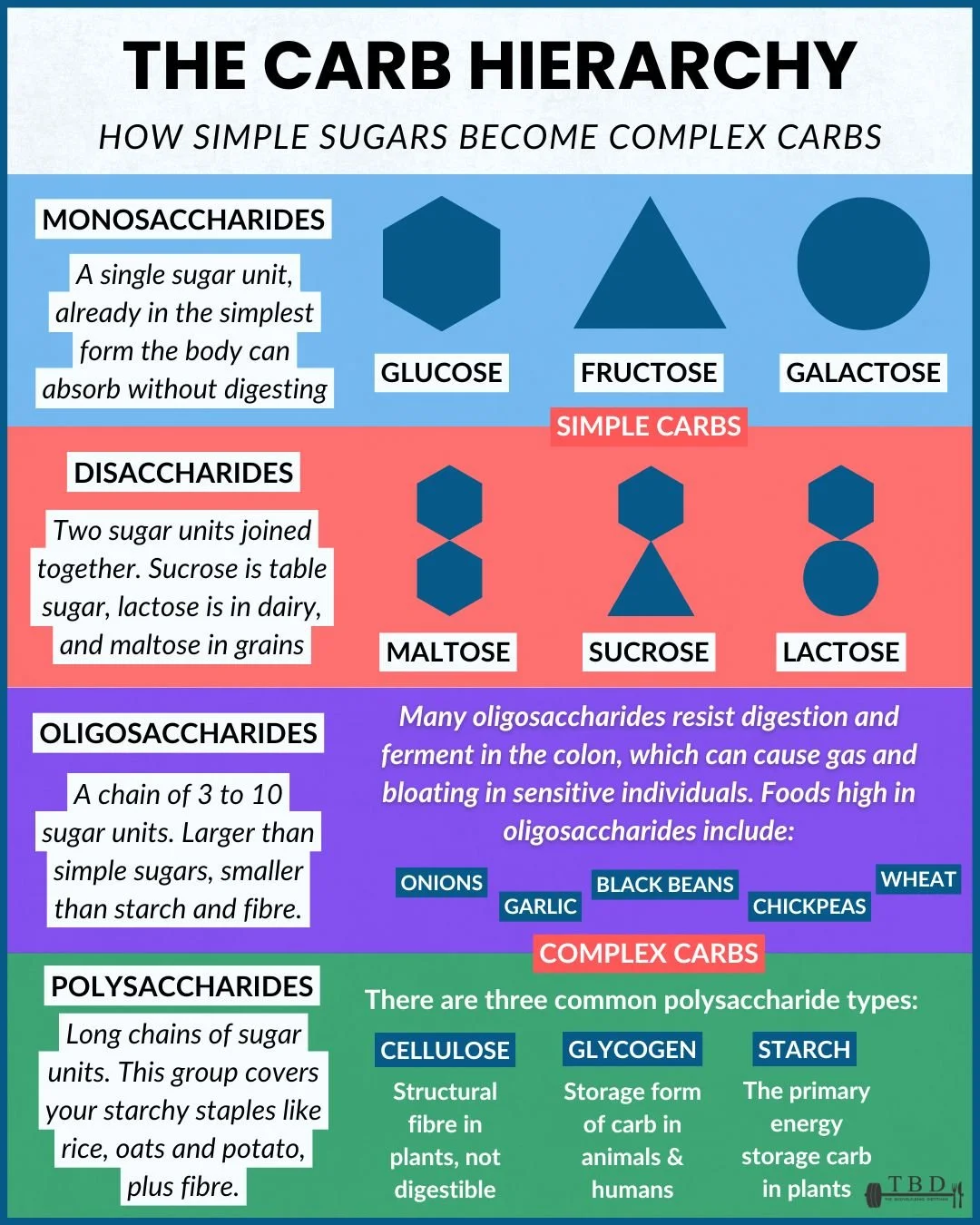
Carbohydrates classified by how many sugar units are linked together, from single sugars through to the long chains that make up starches and fibre.
Carbohydrates are classified partly by how many sugar units are linked together, from single sugars through to long chains. This guide explains that structure, why complex carbs are still built from sugars, and why a food's carbohydrate structure and what comes with it matter far more than whether it contains sugar.
Carbohydrates are classified partly by how many sugar units are linked together. Monosaccharides such as glucose, fructose, and galactose are single sugar units. Disaccharides such as sucrose, lactose, and maltose are two units joined together. These two groups make up what are commonly called simple carbohydrates. Oligosaccharides, which are chains of three to ten units, and polysaccharides, which are long chains including starch, glycogen, and fibre, make up the complex carbohydrates. During digestion, most digestible carbohydrate is eventually broken back down into monosaccharides before it can be absorbed, which means foods as different as oats, rice, fruit, milk, and table sugar can share many of the same underlying building blocks. What separates these foods is the structure of the carbohydrate and everything that comes with it, including fibre, water, micronutrients, protein, and fat, which together influence digestion, fullness, blood glucose response, and how useful a food is in a given situation. This is why judging a food purely on whether it contains sugar reveals very little about its overall nutritional value, and why understanding carbohydrate structure is a better framework for choosing foods around training, body composition, and general health.
Complex carbs are still built from sugars. The starch in a bowl of oats and the sugar in a spoonful of table sugar are made from the same basic units, just arranged differently, which is one of the more useful things to understand about carbohydrates and one of the least appreciated. Carbohydrates are classified partly by how many of these sugar units are linked together, and that structure, along with everything that comes packaged with it, is what separates foods that behave very differently in the body despite sharing the same building blocks.
This article works through the carbohydrate hierarchy from single sugars to long chains, explains what simple and complex carbohydrates are, and covers why structure is a better lens than sugar content for judging a food. It is a foundational guide. For how to apply this around training specifically, and for the detail on fibre, the relevant deep-dive articles are linked throughout.
A carbohydrate is a macronutrient made up of carbon, hydrogen, and oxygen, built from sugar units that range from a single molecule to chains of thousands, and it serves as the body's primary readily available energy source.
How Are Carbohydrates Classified?
Carbohydrates are classified partly by how many sugar units are linked together, which produces a hierarchy from the simplest single sugars up to long, complex chains. The four tiers are monosaccharides, disaccharides, oligosaccharides, and polysaccharides, and they are commonly grouped into simple carbohydrates and complex carbohydrates.
The single sugars and the two-unit sugars make up the simple carbohydrates. The longer chains, from the short oligosaccharides up to the long polysaccharides, make up the complex carbohydrates. This simple-versus-complex split is the framing most people have heard, and it is a reasonable starting point, though as this article covers later, the structure alone does not tell you as much about how a food behaves as the label suggests.
The reason the hierarchy matters at all comes down to digestion. During digestion, most digestible carbohydrate is eventually broken back down into monosaccharides before it can be absorbed across the intestinal wall. A long starch chain is progressively dismantled into its individual sugar units, which are then absorbed. This is why foods as different as oats, rice, potatoes, fruit, milk, and table sugar can contain many of the same underlying building blocks, and why the finished sugars that reach the bloodstream are similar even when the starting foods are not.
What Are Simple Carbohydrates?
Simple carbohydrates are the single and double sugar units: monosaccharides and disaccharides. They are the smallest carbohydrate structures and, in the case of monosaccharides, require no digestion before the body can absorb them.
Monosaccharides are single sugar units, the simplest form the body can absorb directly. The three dietary monosaccharides are glucose, the body's primary circulating sugar and main energy currency; fructose, found in fruit and honey; and galactose, which occurs mainly as part of the milk sugar lactose. Because they are already single units, monosaccharides are absorbed without needing to be broken down further.
Disaccharides are two sugar units joined together, and they are split into their component monosaccharides during digestion before absorption. The three common disaccharides are sucrose, which is table sugar and is made of glucose and fructose; lactose, the sugar in dairy, made of glucose and galactose; and maltose, found in grains, made of two glucose units. These are still simple carbohydrates despite requiring one step of digestion, because the chains are so short.
What Are Complex Carbohydrates?
Complex carbohydrates are the longer chains: oligosaccharides and polysaccharides. The "complex" label refers to the length and branching of the chains rather than to any inherent nutritional superiority, though these foods do often come packaged with more fibre and micronutrients.
Oligosaccharides are chains of roughly three to ten sugar units, larger than simple sugars but smaller than starch and fibre. Many oligosaccharides resist digestion in the small intestine and instead ferment in the colon, which can produce gas and bloating in sensitive individuals. Foods high in oligosaccharides include onions, garlic, black beans, chickpeas, and wheat, which is why these foods feature on low-FODMAP approaches used for digestive symptoms. The fermentation itself is not inherently a problem, and for most people these foods are valuable sources of fibre and prebiotics, a topic our guide to gut health for lifters covers in more depth.
Polysaccharides are long chains of sugar units, and this group covers the starchy staples along with much of dietary fibre. There are three common types worth knowing. Starch is the primary energy storage carbohydrate in plants and is what makes up the digestible carbohydrate in foods like rice, oats, and potatoes. Glycogen is the storage form of carbohydrate in animals and humans, held in muscle and liver, though it is a minor source in the diet since it exists mainly as the body's own stored carbohydrate rather than something eaten in quantity. Cellulose is the structural fibre in plants and is not digestible by humans, which makes it one of the components of dietary fibre. For the full detail on fibre types and how they behave, our complete guide to dietary fibre covers soluble, insoluble, and resistant starch fibre.
Why Does Carbohydrate Structure Matter More Than Whether a Food Contains Sugar?
The structure of a carbohydrate, and everything that comes packaged with it, tells you far more about a food than whether it technically contains sugar. Since most digestible carbohydrate ends up as monosaccharides anyway, the sugar content alone is a poor guide to a food's overall value.
What genuinely separates carbohydrate foods is the structure of the carbohydrate and the surrounding food matrix: the fibre, water, micronutrients, protein, and fat that come with it, along with the degree of processing. Those factors influence how quickly the carbohydrate is digested, how full the food makes you, the blood glucose response it produces, and how useful it is in a particular situation. A piece of whole fruit and a glass of fruit juice contain similar sugars, but the fibre and water in the whole fruit slow digestion and support fullness in a way the juice does not. This is also why the simple-versus-complex label is only a rough guide. Some starchy foods, which are technically complex, raise blood glucose quickly, while some simple sugars raise it more slowly, because glycaemic response depends on the whole food rather than the carbohydrate structure alone.
Glycaemic response refers to how quickly and how much a food raises blood glucose after eating, and it is shaped by fibre, fat, protein, processing, and cooking, not by carbohydrate structure in isolation.
The practical upshot is that judging a food purely through the lens of whether it contains sugar reveals very little about its overall nutritional value. A more useful question is what the food contributes overall, including its fibre, micronutrients, and how it fits the goal at hand.
Confused About Whether Carbs or Sugar Are the Problem?
If you have been left unsure whether to fear sugar, avoid carbs, or chase "complex" ones, the structure framework usually clears it up, but applying it to your own training and goals is where it gets specific. Our team builds carbohydrate choices and targets around each client's training, body composition, and preferences, as part of how we structure nutrition for coaching clients.
How Should You Choose Carbohydrates in Practice?
The best carbohydrate choice depends on the situation rather than on a blanket rule, and carbohydrate structure helps you match the food to the goal. The two situations that most often call for different choices are around training and across the rest of the day.
Around training, rapidly digested carbohydrate can be useful when the goal is to provide glucose quickly or to replenish muscle glycogen, which is where more refined, faster-digesting sources earn their place. For how to apply this to session timing and targets, our pre-workout nutrition guide covers carbohydrate amounts and food selection around training. At other times, foods such as whole grains, legumes, fruit, and starchy vegetables make it easier to reach higher fibre and micronutrient intakes while supporting fullness, which suits most meals across the day.
For general health, the guidance on sugar is more specific than "avoid it." The World Health Organisation recommends keeping free sugars, meaning added sugars plus those naturally present in honey, syrups, and fruit juice, below around 10 percent of total energy intake, with a conditional further reduction below 5 percent for additional benefit. Free sugars do not include the intrinsic sugars in whole fruit and milk, which sit within a food matrix of fibre, water, and nutrients. Keeping free sugars within that range leaves more room in the diet for foods that contribute fibre, micronutrients, and overall nutritional value. Understanding carbohydrate structure gives you a far better framework for these choices than a simple sugar label, whether the goal is training performance, recovery, body composition, appetite management, or general health.
Practical Takeaways
Carbohydrates are classified by how many sugar units are linked together: monosaccharides (single), disaccharides (two), oligosaccharides (three to ten), and polysaccharides (long chains).
Monosaccharides and disaccharides are simple carbohydrates; oligosaccharides and polysaccharides are complex. Complex carbs are still built from the same sugar units.
Most digestible carbohydrate is broken back down into monosaccharides before absorption, so foods as different as oats, fruit, and table sugar share many of the same building blocks.
What separates carbohydrate foods is structure plus the surrounding matrix of fibre, water, micronutrients, protein, and fat, which shapes digestion, fullness, and blood glucose response.
Simple versus complex is only a rough guide, since glycaemic response depends on the whole food rather than carbohydrate structure alone.
Use faster-digesting carbohydrates around training for quick fuel, and higher-fibre whole foods across the rest of the day. For general health, keep free sugars below around 10 percent of total energy.
Frequently Asked Questions
What is the difference between simple and complex carbohydrates?
Simple carbohydrates are single sugar units (monosaccharides like glucose) and two-unit sugars (disaccharides like sucrose). Complex carbohydrates are longer chains: oligosaccharides of three to ten units, and polysaccharides such as starch and fibre. The distinction refers to chain length, and both are ultimately built from the same sugar units, which is why the simple-versus-complex label is only a rough guide to how a food behaves.
Are complex carbs better than simple carbs?
Not inherently, though complex carbohydrate foods often come with more fibre and micronutrients, which makes many of them better choices for general health. What matters more than the simple-or-complex label is the whole food: its fibre, water, micronutrient content, and degree of processing. A fast-digesting simple carbohydrate can be the better choice around training, while higher-fibre complex carbohydrates suit most other meals.
Is sugar bad for you?
Sugar itself is not uniquely harmful, but high intakes of free sugars (added sugars plus those in honey, syrups, and fruit juice) crowd out more nutritious foods and are worth limiting. The World Health Organisation recommends keeping free sugars below around 10 percent of total energy. The intrinsic sugars in whole fruit and milk sit within a matrix of fibre, water, and nutrients and are not the target of that guidance.
Why do onions, garlic, and beans cause bloating?
These foods are high in oligosaccharides, carbohydrate chains of three to ten sugar units that often resist digestion in the small intestine and ferment in the colon instead. That fermentation can produce gas and bloating in sensitive individuals, which is why these foods feature on low-FODMAP approaches. For most people they are valuable sources of fibre and prebiotics, and the fermentation is not inherently a problem.
Is glycogen a carbohydrate we eat?
Glycogen is a polysaccharide and the storage form of carbohydrate in animals and humans, held in muscle and liver. It is a minor source in the diet, since it exists mainly as the body's own stored carbohydrate rather than something eaten in meaningful amounts. The carbohydrate we eat is mostly starch, sugars, and fibre, with the body then storing some of it as its own glycogen.
Does carbohydrate structure determine blood sugar response?
Only partly. Glycaemic response is shaped by the whole food, including its fibre, fat, protein, degree of processing, and cooking, not by carbohydrate structure alone. Some starchy complex carbohydrates raise blood glucose quickly, while some simple sugars raise it more slowly, which is why structure is a starting point rather than a complete predictor of how a food behaves.
If you would like your carbohydrate intake and food choices built around your training, goals, and lifestyle rather than a blanket rule about sugar or carbs, our team can structure that with you. Enquire about coaching or book a consultation to get started.