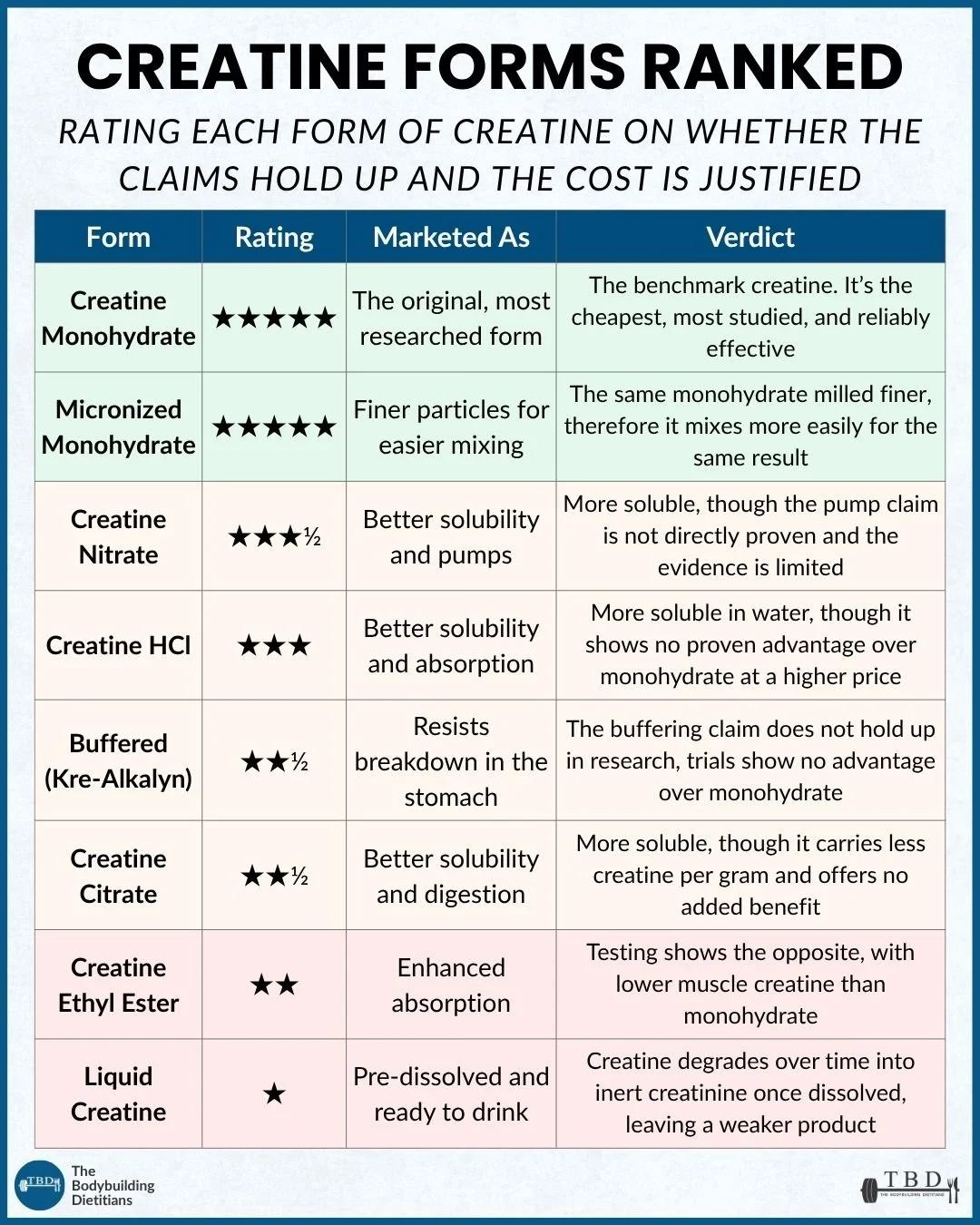
The supplement industry has produced a long list of creatine forms, each marketed as an upgrade on the original. This guide ranks the common forms on whether their claims hold up in research and whether the price is justified, so you can choose a product with confidence rather than on marketing.
Creatine monohydrate remains the best form to buy for almost everyone, and micronised monohydrate is equal to it, differing only in a finer particle size that mixes more easily for the same result and usually the same price. The alternative forms marketed as upgrades do not justify their higher cost. Creatine nitrate and creatine citrate are more soluble but offer no proven performance advantage, and citrate carries less creatine per gram. Creatine hydrochloride (HCl) is more soluble in water but shows no proven benefit over monohydrate at a higher price. Buffered creatine (Kre-Alkalyn) claims to resist breakdown in the stomach, but trials show no advantage over monohydrate. Creatine ethyl ester performs worse, with testing showing lower muscle creatine than monohydrate rather than the enhanced absorption it is marketed on. Liquid creatine is the weakest option, because creatine degrades into inert creatinine once dissolved and left over time, leaving a less effective product. For the overwhelming majority of people, plain or micronised creatine monohydrate at 3 to 5 grams per day is the most cost-effective, best-researched, and reliably effective choice, and the alternative forms mainly add cost rather than results.
Creatine monohydrate keeps surviving every new creatine trend. There are now plenty of creatine forms, blends, and dosing strategies on the shelf, each positioned as an improvement on the original, yet monohydrate remains the form worth buying for almost everyone. It is inexpensive, extremely well researched, and reliably effective, which is a combination none of the alternatives has managed to beat.
This article ranks the common creatine forms on two questions that matter at the point of purchase: does the marketing claim hold up in research, and is the higher price justified? For how creatine works, how to dose it, loading, timing, and the newer cognitive research, our complete guide to creatine covers the mechanism and usage in full. This piece is the buyer's comparison, focused specifically on choosing between the forms on the shelf.
Creatine is a compound stored mostly in skeletal muscle as phosphocreatine, where it helps rapidly regenerate the ATP that fuels high-intensity effort. Every form below aims to deliver creatine to muscle, and they differ mainly in how they are bound, how soluble they are, and how much they cost.
Why Does Creatine Monohydrate Rank First?
Creatine monohydrate ranks first because it is the benchmark every other form is measured against, and none has outperformed it. It is the original and most researched form, the cheapest per gram of actual creatine, and consistently effective for strength, power, and lean mass when taken at 3 to 5 grams per day.
The depth of the research base is the key point. Monohydrate has been studied across decades and hundreds of trials, which means its effects and its safety are better established than any alternative can claim. When a newer form is tested head-to-head against monohydrate, the realistic best case is that it matches monohydrate, and it usually does so at a higher price. That makes monohydrate the rational default for almost everyone, and the burden of proof sits with any alternative claiming to beat it.
Micronised monohydrate earns the same top rating, because it is the same compound rather than a different one. The only difference is that the powder has been milled into finer particles, which makes it mix more easily into water without changing what it does in the body. If the finer texture is worth it to you and the price is similar, it is a reasonable choice, but it delivers the same result as standard monohydrate rather than an upgraded one.
Do the More Soluble Forms Offer Any Real Advantage?
Several forms are marketed primarily on improved solubility, and while some genuinely do dissolve more readily, better solubility has not translated into better results. Creatine nitrate, creatine hydrochloride, and creatine citrate all sit in this group.
Creatine nitrate is more soluble and is often sold on the promise of better pumps, but that pump claim is not directly proven and the overall evidence for the form is limited. Creatine HCl is more soluble in water, which is its main genuine selling point, yet it shows no proven advantage over monohydrate for any performance outcome while costing more. Creatine citrate is also more soluble and is marketed on easier digestion, but it carries less creatine per gram than monohydrate, so you are paying more for a form that delivers less active compound per dose and offers no added benefit.
The common thread is that solubility is a convenience feature, not a performance one. Monohydrate dissolves well enough in most drinks, and any monohydrate that settles at the bottom of a glass is still consumed and absorbed. Paying a premium to solve a problem that barely affects the outcome is the pattern that runs through most of the alternative forms. For anyone who finds monohydrate hard to tolerate or mix, these forms are options, but they are solving comfort rather than adding results.
Paying Extra for a Creatine That Promises More?
If you have been reaching for the pricier forms on the assumption they work better, the evidence does not support the spend. Our team helps clients build supplement choices around what the research supports and what their goals need, as part of how we structure nutrition and supplementation for coaching clients.
Which Forms Are Marketed on Claims That Do Not Hold Up?
Two forms are sold on specific mechanisms that research has not supported: buffered creatine and creatine ethyl ester. These are the clearest cases of a marketing claim outrunning the evidence.
Buffered creatine, sold as Kre-Alkalyn, is marketed on the idea that its raised pH helps it resist breakdown in the stomach and therefore deliver more creatine to muscle. The buffering claim does not hold up when tested. Controlled trials comparing buffered creatine to monohydrate have shown no advantage for the buffered form on strength, body composition, or muscle creatine content, which leaves it as a more expensive way to achieve what monohydrate already does.
Creatine ethyl ester performs worse than that. It is marketed on enhanced absorption, but testing has shown the opposite result, with users reaching lower muscle creatine levels than they would on monohydrate. The ester bond that is supposed to improve delivery appears to make the compound less effective at raising the muscle creatine stores that produce the benefit. A form that underperforms the cheap benchmark while charging more for it is difficult to justify on any basis.
Why Is Liquid Creatine the Weakest Option?
Liquid creatine ranks last because of a stability problem that undermines the product before it is even consumed. It is sold as pre-dissolved and ready to drink, which is convenient in principle, but creatine is not stable in solution over time.
Once creatine is dissolved and left sitting in liquid, it gradually degrades into creatinine, an inert breakdown product that does not provide the benefits of creatine. A pre-dissolved product that has spent weeks or months in a bottle on a shelf has therefore lost some portion of its active creatine to this conversion, leaving a weaker and less reliable product than a powder mixed fresh. This is also the reason the standard advice is to mix powdered creatine shortly before drinking it rather than preparing it long in advance. The convenience of a ready-made liquid comes at the cost of the very thing you are paying for.
Practical Takeaways
Creatine monohydrate is the best form to buy for almost everyone: cheapest per gram, most researched, and reliably effective at 3 to 5 grams per day.
Micronised monohydrate is the same compound milled finer for easier mixing. It is equal to standard monohydrate, not an upgrade, so choose on price and texture preference.
More soluble forms (nitrate, HCl, citrate) offer convenience rather than better results, and citrate delivers less creatine per gram. None justifies its higher price for performance.
Buffered creatine (Kre-Alkalyn) and creatine ethyl ester are sold on mechanisms the research does not support. Ethyl ester has tested worse than monohydrate for muscle creatine.
Liquid creatine is the weakest option, because creatine degrades into inert creatinine once dissolved and left over time.
The premium forms mainly add cost rather than results, so paying more than monohydrate requires a specific reason such as genuine tolerance or mixing issues.
Frequently Asked Questions
What is the best form of creatine to take?
Creatine monohydrate is the best form for almost everyone. It is the cheapest per gram of actual creatine, has by far the deepest research base, and is reliably effective at 3 to 5 grams per day. Micronised monohydrate is equally good, differing only in a finer particle size that mixes more easily, so the choice between the two comes down to price and texture preference.
Is creatine HCl better than monohydrate?
Creatine HCl is more soluble in water than monohydrate, but it has not shown any proven performance advantage, and it typically costs more. The improved solubility is a convenience feature rather than a results feature, since monohydrate is absorbed effectively regardless of how completely it dissolves in the glass. For most people, monohydrate remains the more sensible choice on both evidence and cost.
Is micronised creatine worth the extra cost?
Micronised creatine monohydrate is the same compound as standard monohydrate, milled into finer particles so it mixes more easily. It delivers the same result rather than an enhanced one, so it is worth choosing only if the easier mixing matters to you and the price is similar. Paying a large premium for the micronised version is not justified, since the benefit is texture rather than effectiveness.
Does creatine ethyl ester work better than monohydrate?
No. Creatine ethyl ester is marketed on enhanced absorption, but testing has shown it produces lower muscle creatine levels than monohydrate, which is the opposite of its claim. Since the benefit of creatine comes from raising muscle creatine stores, a form that raises them less effectively is a poorer choice, and it usually costs more than monohydrate as well.
Why is liquid creatine not recommended?
Creatine is unstable once dissolved in liquid and gradually breaks down into creatinine, an inert compound that does not provide creatine's benefits. A pre-dissolved liquid product that has sat on a shelf for weeks or months has therefore lost some of its active creatine, leaving a weaker product. This is also why powdered creatine is best mixed shortly before drinking rather than prepared well in advance.
Do the expensive creatine forms justify their price?
For the overwhelming majority of people, no. The premium forms are marketed as upgrades on monohydrate, but the evidence shows they either match it at a higher price or, in some cases, perform worse. Unless you have a specific reason such as genuine difficulty tolerating or mixing monohydrate, the extra cost buys convenience or marketing rather than better results.
If you would like your supplement choices built around what the evidence supports and what your training and goals need, our team can help you cut the spend that does not earn its place. Enquire about coaching or book a consultation to get started.