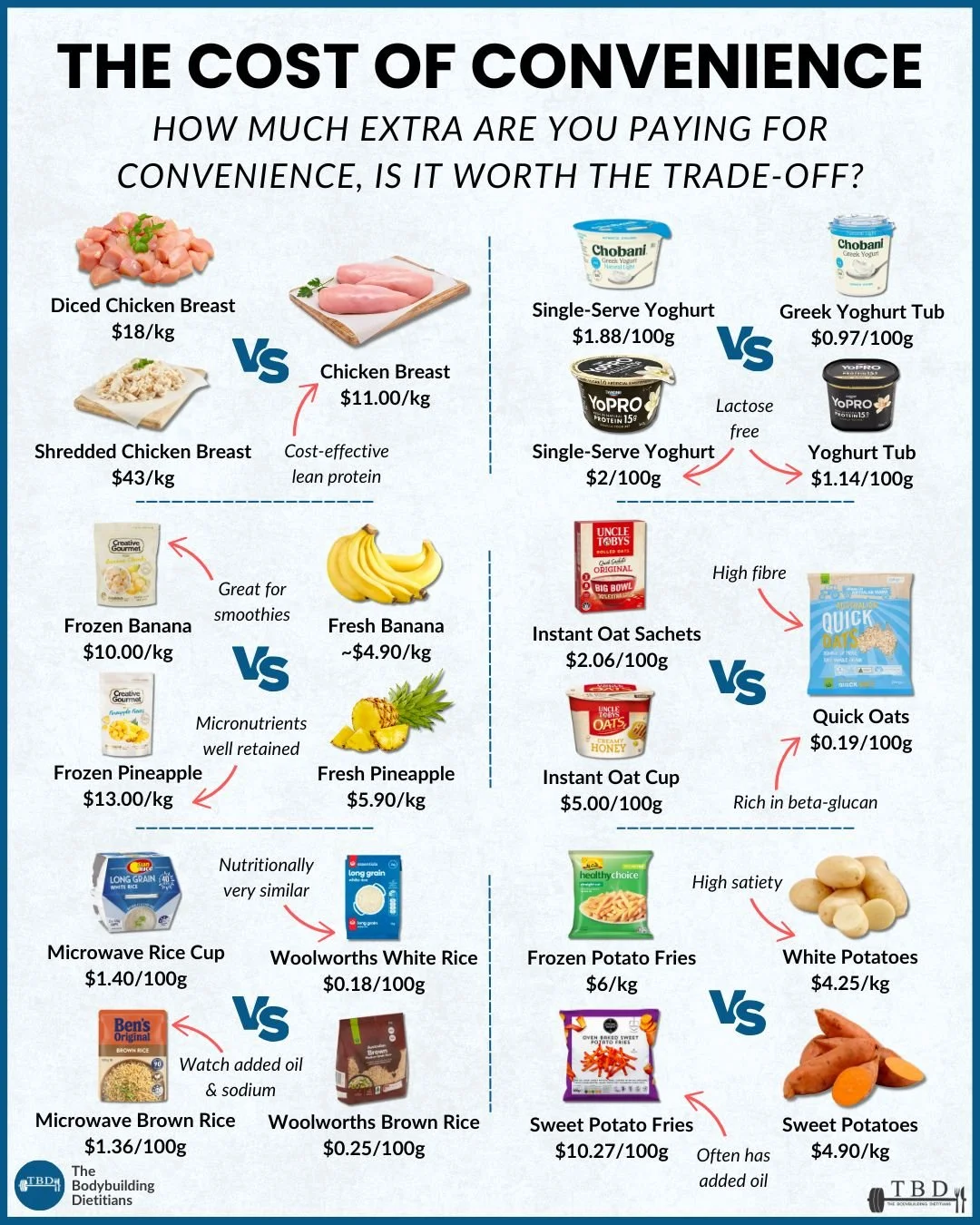
Representative Coles and Woolworths prices comparing convenient product formats against basic versions. The nutrition is often similar, so the premium largely buys convenience. Prices are non-sale and will vary by product and time.
Pre-cut chicken, single-serve yoghurt, microwave rice, and instant oats make eating well easier, but the convenience often carries a steep price premium. This guide covers how much extra you pay, when the nutrition changes, and how to decide where the premium is worth it and where a little preparation saves a lot.
Convenience foods can cost anywhere from slightly more to many times the price of the basic version, and the nutrition is often very similar. The premium pays for preparation, portioning, portability, storage, and reduced food waste rather than for better nutrition. The size of the premium varies enormously: frozen potato fries might cost around 1.4 times the price of whole potatoes, pre-shredded chicken around four times the price of whole chicken breast, and an instant oat cup can cost more than twenty times the price of the same oats bought in bulk. In many cases, such as plain microwave rice, frozen fruit, or a larger yoghurt tub versus single-serve pots, the underlying nutrition is close to identical, so the extra cost buys only convenience. In other cases, convenience changes the nutritional profile, with added oils increasing energy density and flavoured products often carrying more sugar or sodium. Whether the premium is worth paying depends on the person: someone who batch cooks regularly can save considerably by buying basic ingredients, while someone working long hours may get genuine value from foods that remove preparation and make eating well more consistent. The most cost-effective approach is to spend on convenience where it genuinely improves consistency and save where a little preparation creates very little friction.
The same nutrition can come at very different prices. Pre-cut chicken, single-serve yoghurt, microwave rice, frozen fruit, and instant oats all make eating well easier to execute, and that convenience is valuable. It also tends to carry a price premium that is far larger than most people realise, and in many cases the underlying nutrition is close to identical to the basic version sitting a shelf away.
This article covers how much extra convenience costs, when it changes the nutrition and when it does not, and how to decide where the premium earns its place. The aim is a framework for spending on convenience where it helps and saving where it does not, rather than a blanket rule to always buy basic or always buy convenient.
Energy density refers to the number of calories a food provides relative to its weight, and it is the variable most likely to change when a convenient format adds oil or fat that the basic version does not contain.
How Much More Do Convenience Foods Actually Cost?
The convenience premium varies enormously, from a modest markup to many times the price of the basic version. What makes it worth examining is that the premium is often invisible at the point of purchase, since a single-serve price tag rarely prompts the per-kilogram comparison that reveals it.
Some premiums are modest. Frozen potato fries cost roughly 1.4 times the price of whole potatoes, and diced chicken breast around 1.6 times the price of a whole breast you cut yourself. Others are substantial. Pre-shredded chicken breast can run close to four times the price of whole breast, single-serve yoghurt pots roughly twice the price of the same yoghurt in a large tub, and frozen fruit around twice the price of fresh. The largest premiums sit with heavily portioned pantry items. A microwave rice cup can cost nearly eight times the price of the same rice bought dry in a bag, and an instant oat cup can cost more than twenty times the price of the identical oats bought in bulk.
That last comparison is worth sitting with. The oats in a five-dollar-per-100-gram instant cup are nutritionally almost the same as quick oats at around 19 cents per 100 grams, which means the overwhelming majority of the price is paying for the cup, the portioning, and the ability to add water at a desk. None of that is wrong to pay for, but it is worth knowing that is what the money is buying, rather than assuming the pricier product is nutritionally superior.
Does Convenience Change the Nutrition, or Just the Price?
In many cases the convenient format is nutritionally close to identical to the basic version, so the premium buys only convenience. In other cases the processing that creates the convenience also changes the nutritional profile, and that distinction is the one worth paying attention to.
The formats that stay nutritionally similar are usually the plainest ones. Plain microwave rice is close to the same as rice you cook yourself, frozen fruit retains its micronutrients well and is useful for smoothies, and a large yoghurt tub is the same product as the single-serve pots of the same yoghurt, just portioned differently. Quick oats and instant oats are both oats with similar fibre, including the beta-glucan oats are valued for, so the difference there is cost and texture rather than nutrition. For these, buying the basic version costs less and sacrifices nothing nutritionally.
The formats that change the nutrition are usually the ones where processing adds something. Frozen potato and sweet potato fries often have added oil, which raises their energy density compared with plain potatoes you bake or boil, and flavoured versions of products such as oats or yoghurt frequently carry more added sugar or sodium than the plain version. This does not make them poor choices, but it does mean the comparison is no longer like-for-like, and reading the label matters more. The practical rule is that plain convenient formats usually match the basic version nutritionally, while flavoured or pre-cooked-in-oil formats are worth checking.
When Is the Convenience Premium Worth Paying?
Whether the premium is worth paying depends almost entirely on the person and their circumstances, which is why a blanket answer misses the point. The right question is not whether convenience foods are worth it in general, but whether a given premium buys something that genuinely improves how consistently you eat.
For someone who batch cooks regularly and has preparation built into their week, the premium often buys little they need, and buying basic ingredients can save a considerable amount over time without adding meaningful friction. For someone working long hours, travelling often, or struggling to eat consistently, the same premium can buy genuine value, because a convenient option that actually gets eaten beats a cheaper one that does not. A pre-cooked protein that turns a skipped meal into a balanced one is worth more than its markup, while paying four times the price to have chicken shredded when you have time to do it yourself is not.
The useful way to think about it is per outcome rather than per gram. If a convenience food meaningfully improves your consistency, the premium is buying an outcome that matters, and consistency is one of the strongest drivers of nutrition results. If it only saves a few minutes on a task you would happily do anyway, the premium is close to wasted. This is the same logic behind building a few reliable quick options for busy periods, which our guide to balanced convenience meals covers from the nutrition side.
Paying for Convenience You Don't Need, or Skipping the Kind That Would Help?
Most people are miscalibrated in one direction or the other: overpaying for convenience that saves little, or refusing it on days when it would have kept their nutrition on track. We help clients work out where each dollar of convenience earns its place, matched to their schedule and budget, as part of how we build nutrition plans.
How Do You Get Convenience Without Paying the Full Premium?
A few straightforward habits capture most of the benefit of convenience while avoiding the steepest premiums. The goal is to be deliberate about where you pay for convenience rather than defaulting to it across the board.
The prices on comparisons like this are usually based on representative, non-sale prices, and specials, bulk packs, and home-brand options can change the picture considerably. Stocking up on the convenience foods you use often when they are discounted is one of the simplest ways to keep the benefit while cutting the premium. Buying the basic version of the items where preparation is low-friction, such as cooking a large batch of rice rather than buying microwave cups, captures the biggest savings, since those pantry staples carry the largest premiums. Reserving convenience for the items and the moments where it most improves consistency, such as a busy work week or a protein source you struggle to prepare, concentrates the spend where it earns its place.
Batch preparation is the largest lever of all for anyone with some time, since cooking protein, grains, and vegetables in bulk turns basic ingredients into convenient ones at basic-ingredient prices. For how much structure different people benefit from, our article on whether meal plans work covers the trade-off between structure and flexibility.
Practical Takeaways
The convenience premium ranges from modest to enormous, from around 1.4 times the basic price for frozen fries up to more than twenty times for an instant oat cup versus bulk oats.
In many cases the nutrition is close to identical, so the premium pays for preparation, portioning, portability, storage, and reduced waste rather than for better nutrition.
Convenience sometimes changes the nutrition: added oils raise energy density in products like frozen fries, and flavoured products often carry more sugar or sodium. Plain formats usually match the basic version.
Whether the premium is worth it depends on the person. Batch cookers save most by buying basic ingredients; time-poor people get genuine value from foods that improve consistency.
Think per outcome, not per gram. A convenience food that meaningfully improves consistency is worth its premium; one that saves a task you would happily do anyway is not.
Cut the premium by stocking up on specials and bulk packs, buying basic where preparation is low-friction, and batch preparing, which turns basic ingredients into convenient ones at basic prices.
Frequently Asked Questions
Are convenience foods more expensive than cooking from scratch?
Usually yes, and often by far more than people expect. The premium ranges from around 1.4 times the basic price for something like frozen fries to more than twenty times for a heavily portioned item like an instant oat cup compared with bulk oats. The extra cost generally pays for preparation, portioning, and storage rather than for better nutrition.
Is the nutrition in convenience foods worse than fresh?
Often it is very similar, particularly for plain formats like microwave rice, frozen fruit, or a large yoghurt tub versus single-serve pots. Frozen fruit and vegetables retain their micronutrients well. The nutrition tends to change when processing adds something, such as oil in frozen fries or extra sugar and sodium in flavoured products, so plain versions are the most like-for-like.
Is frozen fruit as healthy as fresh?
Yes. Frozen fruit retains its micronutrients well, since it is typically frozen soon after picking, and it is useful for smoothies and for reducing waste. It often costs more per kilogram than fresh fruit in season, so the premium is mostly for convenience and shelf life rather than a nutritional difference.
Is microwave rice the same as cooked rice?
Plain microwave rice is nutritionally close to the same as rice you cook yourself from a bag, so the main difference is cost. Microwave cups can cost many times the price of dry rice per 100 grams, which makes them one of the clearer examples of paying a large premium purely for convenience. Flavoured microwave rice can add oil and sodium, so plain versions are the closest comparison.
When is it worth paying more for convenience foods?
It is worth paying when the convenience improves how consistently you eat, since consistency drives nutrition outcomes. For someone time-poor, a convenient option that gets eaten beats a cheaper one that gets skipped. It is less worth paying when it only saves a task you would happily do anyway, such as shredding chicken you have time to prepare.
How can I save money on convenience foods?
Buy convenience foods on special and in bulk when you use them often, buy the basic version of items where preparation is low-friction, and batch prepare where you can, which turns basic ingredients into convenient ones at basic-ingredient prices. Concentrating the spend on the items and moments where convenience most improves your consistency captures most of the benefit for the least cost.
If you would like help deciding where convenience earns its place in your nutrition and where a little preparation saves money without adding friction, our team can build that balance into a plan around your schedule and budget. Enquire about coaching or book a consultation to get started.