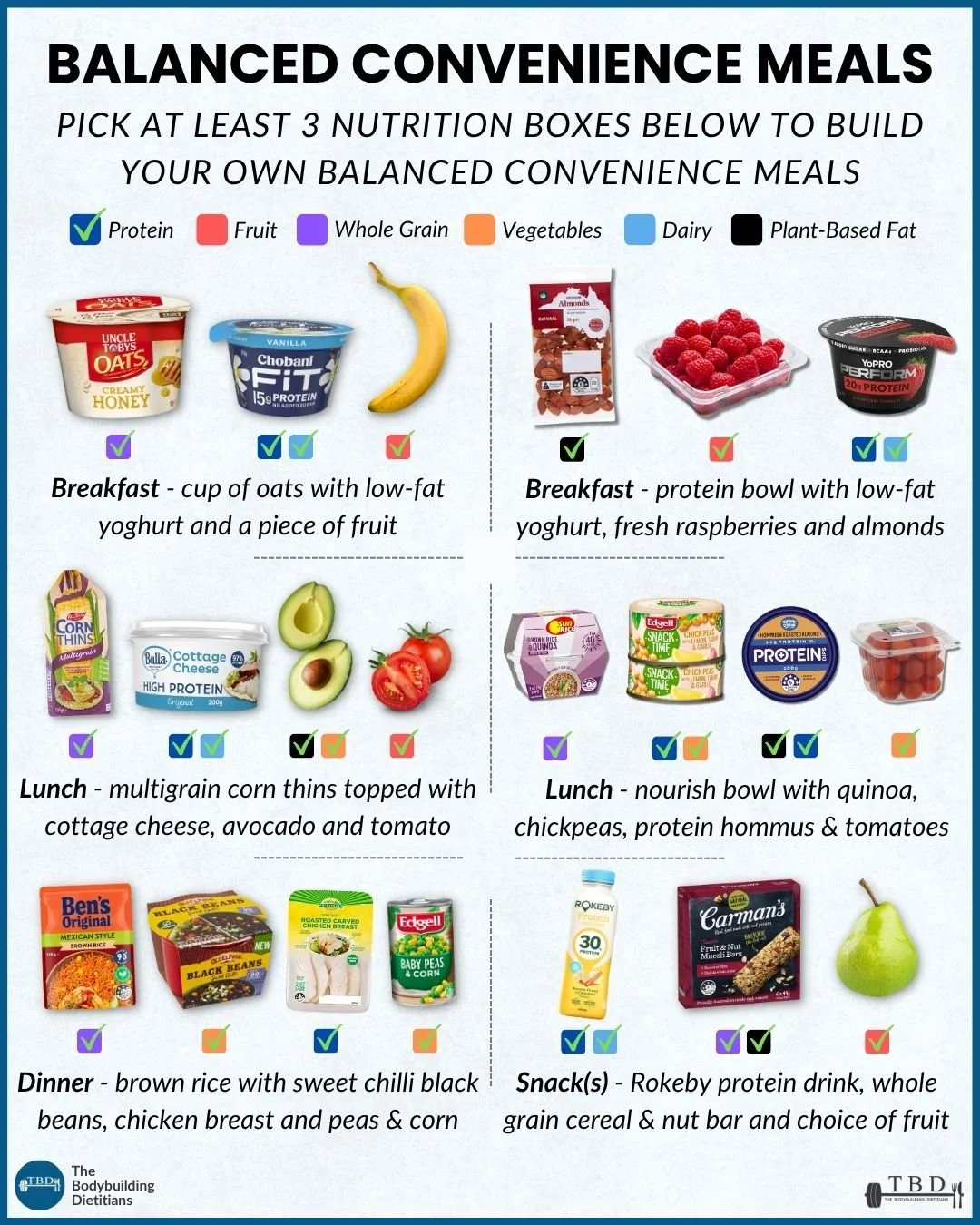
Balanced meals assembled from convenient, pre-packaged foods, each built from a protein, plant matter, a carbohydrate, and a source of fat.
Convenience does not have to come at the cost of meal quality. When time is limited, nutrition usually becomes less about what you know and more about what is easiest to put together, and having a few reliable options on hand can make a real difference to how consistently you eat across a busier week. The people who maintain good nutrition through demanding periods are rarely the ones with the most knowledge. They are the ones who have made the good option the easy one.
A useful approach is to build meals around four anchors: a protein source, some plant matter for fibre and micronutrients, a carbohydrate source that suits the meal, and an appropriate source of fat. Each of these can be bought in a convenient format, which means a balanced meal does not have to rely on cooking everything from scratch. This article covers each of the four anchors, the convenient formats that cover them, what assembled meals look like in practice, and why this matters for consistency. For the fuller meal-composition principle, including the fifth component of flavour that turns a nutritionally sound meal into one you will actually eat, our five-part meal framework covers how to build or audit any meal. This piece applies that thinking to the specific problem of eating well when time is short.
Dietary adherence refers to how consistently someone follows their intended nutrition approach over time, and it is one of the strongest predictors of whether a plan produces results, often outweighing the finer details of the plan itself.
What Are the Four Anchors of a Balanced Convenience Meal?
A balanced meal can be built reliably from four anchors, each contributing something distinct. A protein source supports muscle and satiety, plant matter provides fibre and micronutrients, a carbohydrate source suits the energy demands of the meal, and a source of fat rounds out the meal and supports the absorption of fat-soluble nutrients.
Thinking in anchors rather than recipes is what makes convenience eating work. A recipe requires following a specific set of steps with specific ingredients, which is exactly what falls apart on a busy day. Four anchors give you a flexible template instead: as long as each is present in some form, the meal is balanced, regardless of which specific products fill each slot on a given day. This is the same logic behind a well-built meal generally, with the practical difference that each anchor here is chosen for how easily it can be bought ready to use rather than prepared.
The anchors also map onto the categories worth covering across a day: protein at each meal, plant matter spread across meals for fibre and variety, carbohydrates matched to how active the day is, and fats rotated across sources for a broader nutrient profile. Hitting all four at a meal is the aim, though across a day the balance can shift between meals, with a lighter-vegetable breakfast offset by a vegetable-heavy lunch and dinner, for instance.
How Do You Build Balanced Meals From Convenient Foods?
The practical step is to keep a convenient option on hand for each of the four anchors, so any meal can be assembled from what is in the fridge and pantry without cooking. Each anchor has several ready-to-use formats that hold up well and store easily.
Protein. High-protein yoghurt, high-protein cottage cheese, pre-cooked or canned meat and fish such as carved chicken breast or canned tuna and salmon, and ready-to-drink protein beverages all deliver a substantial protein serving with no preparation. These are the backbone of a convenience meal, since protein is usually the anchor that takes the most effort to prepare from scratch.
Plant matter. Pre-washed salad kits, pre-cut and frozen vegetables, canned legumes such as chickpeas and black beans, and fresh fruit all provide fibre, micronutrients, and food volume with minimal effort. Frozen and canned options are worth emphasising here, since they store for a long time and remove the spoilage problem that makes fresh vegetables harder to rely on during a busy week.
Carbohydrate. Microwave pre-cooked rice and grains, pre-cooked quinoa, wholegrain wraps and bread, instant oats, and wholegrain crackers cover the carbohydrate anchor in formats that need little or no cooking. Matching the portion to how active the day is keeps the meal appropriate for the goal.
Fat. Pre-portioned nuts, nut butters, avocado, seeds, and products such as hommus provide the fat anchor and, in the case of nuts and seeds, some additional protein and fibre as well. Pre-portioned nuts in particular solve the main practical issue with nuts, which is that they are easy to over-serve when eating from a large bag.
A reasonable goal is to keep at least one convenient option for each anchor stocked at all times, so that a balanced meal is always a matter of assembly rather than cooking. A few brands make this concrete for an Australian shopper, with high-protein yoghurts, microwave rice pouches, canned legumes, and UHT protein drinks all widely available, though the specific products matter less than keeping each anchor covered.
What Do Balanced Convenience Meals Look Like in Practice?
Assembled from these anchors, a balanced convenience meal takes a minute or two to put together and still covers protein, fibre, carbohydrate, and fat. The examples below each combine a few ready-to-use products into a complete meal.
At breakfast, a cup of instant oats with high-protein yoghurt and a piece of fruit covers all four anchors, as does a protein bowl built from high-protein yoghurt, fresh raspberries, and a serving of almonds. At lunch, multigrain crackers topped with high-protein cottage cheese, avocado, and tomato make a quick balanced plate, and a nourish bowl of pre-cooked quinoa, canned chickpeas, hommus, and cherry tomatoes does the same with more volume. For dinner, microwave brown rice with canned black beans, pre-cooked carved chicken breast, and canned or frozen peas and corn is a complete meal assembled entirely from convenient formats. When something lighter is needed, a combination of snacks works too, such as a ready-to-drink protein beverage, a wholegrain muesli bar, and a piece of fruit.
The pattern across all of these is the same. Each pulls one or more items from each anchor, leans on products that need little or no preparation, and ends up balanced without any cooking. Once you have a handful of these combinations that you know work for you, eating well on a busy day becomes a matter of reaching for a known option rather than making a fresh decision each time.
Why Does Convenience Matter for Consistency?
Convenience matters because consistency, not perfection, is what drives nutrition outcomes, and consistency is hardest to maintain on exactly the days when time and energy are short. A plan that works only when someone has time to cook is a plan that breaks down during a busy week, which is often when it matters most.
The days where time, energy, and preparation are limited are the days where structure does the most work. On a relaxed day, most people can put together a reasonable meal without much thought. On a chaotic one, the default reach is whatever is fastest, and if the fastest option is also a balanced one that has been stocked in advance, the busy day stops being a day that undoes the week's progress. This is why building a small set of reliable convenience options is less about any single meal and more about protecting the overall consistency that produces results over months.
Does Your Nutrition Fall Apart on Busy Weeks?
If you eat well when you have time and struggle when you do not, the issue is usually structure rather than knowledge. We build nutrition plans that account for the busy days specifically, with convenient options and realistic defaults, as part of how we plan nutrition for coaching clients, because a plan that only works on good days is not much of a plan.
This is something worth planning deliberately rather than leaving to chance. Keeping the four anchors stocked in convenient formats, and having a few assembled combinations you can reach for without thinking, turns the hardest days to eat well on into ones where the good option is also the easy one. For more on using structure and meal templates to support consistency, our article on whether meal plans work covers how much structure different people actually benefit from.
Practical Takeaways
Build balanced convenience meals around four anchors: a protein source, plant matter for fibre and micronutrients, a carbohydrate source that suits the meal, and a source of fat.
Keep at least one convenient format for each anchor stocked, so a balanced meal is a matter of assembly rather than cooking.
Convenient protein includes high-protein yoghurt and cottage cheese, canned and pre-cooked meat and fish, and ready-to-drink protein beverages.
Plant matter, carbohydrate, and fat are all available in convenient formats too, from salad kits, frozen and canned vegetables, and canned legumes to microwave rice, wraps, and instant oats, and pre-portioned nuts, nut butters, and avocado.
Assemble a handful of combinations you know work, so eating well on a busy day becomes reaching for a known option rather than a fresh decision.
Consistency drives nutrition outcomes, and it is hardest on busy days, which is exactly where convenient balanced options protect the week's progress.
Frequently Asked Questions
Can convenience foods be part of a healthy diet?
Yes. Many convenient, pre-packaged foods are nutritionally sound, and building meals around a protein source, plant matter, a carbohydrate, and a fat produces a balanced result whether the components are cooked from scratch or bought ready to use. Convenience formats such as high-protein yoghurt, canned legumes, frozen vegetables, and microwave rice make balanced eating realistic on a busy schedule.
What are good high-protein convenience foods?
High-protein yoghurt and cottage cheese, canned tuna and salmon, pre-cooked carved chicken breast, and ready-to-drink protein beverages all provide a substantial protein serving with no preparation. These cover the protein anchor, which is usually the one that takes the most effort to prepare, and they store well enough to keep on hand for busy days.
How do I eat healthy when I have no time to cook?
Keep a convenient option on hand for each of four anchors: a protein source, plant matter, a carbohydrate, and a fat. A balanced meal then becomes a matter of assembly rather than cooking, such as microwave rice with canned beans, pre-cooked chicken, and frozen vegetables, or yoghurt with fruit and nuts. Having a few combinations you know work removes the decision on busy days.
Are pre-packaged balanced meals as good as home-cooked ones?
A meal assembled from convenient products can be just as balanced as a home-cooked one when it covers protein, plant matter, carbohydrate, and fat. Home cooking can offer more control over exact ingredients and portions, but on a busy day a balanced convenience meal is far better than skipping the meal or defaulting to a less balanced option, and consistency matters more than the cooking method.
How many food categories should a balanced meal include?
Aim to include each of the four anchors in some form: a protein source, plant matter for fibre and micronutrients, a carbohydrate source, and a fat. Hitting all four at a meal is the goal, though across a day the balance can shift between meals, with one meal lighter on vegetables offset by others that are heavier. Including a source from at least three or four of these categories at each meal is a reasonable practical target.
Why does convenience help with sticking to a nutrition plan?
Consistency is one of the strongest drivers of nutrition outcomes, and it is hardest to maintain on busy days when the fastest option usually wins. Making the balanced option also the fast option, by stocking convenient foods for each anchor, means a busy day no longer undoes the week's progress. The structure matters most precisely when time and energy are lowest.
If you would like help building a nutrition approach that holds up on your busiest weeks, not just your easiest ones, our team can structure it around your schedule, preferences, and goals. Enquire about coaching or book a consultation to get started.