A category breakdown of natural sweeteners, sugar alcohols, natural-derived sweeteners, and artificial sweeteners, covering caloric content, sweetness relative to sucrose, digestion impact, and what the current evidence does and does not support.
Sweeteners vary considerably in caloric content, glycaemic impact, digestive tolerance, and the quality of available safety evidence. Natural sweeteners such as sucrose, fructose, and honey provide 3 to 4 calories per gram and raise blood glucose to varying degrees. Sugar alcohols provide 0.2 to 2.6 calories per gram and are generally lower in glycaemic impact but can cause digestive symptoms at higher intakes, with erythritol being the best tolerated and sorbitol the most problematic. Natural-derived sweeteners including stevia and monk fruit provide essentially zero calories, have no glycaemic impact, and are well-supported for safety at typical intakes. Artificial sweeteners including aspartame, sucralose, and saccharin are also near-zero calorie, considered safe by all major regulatory bodies at typical intakes, and among the most extensively studied food additives available.
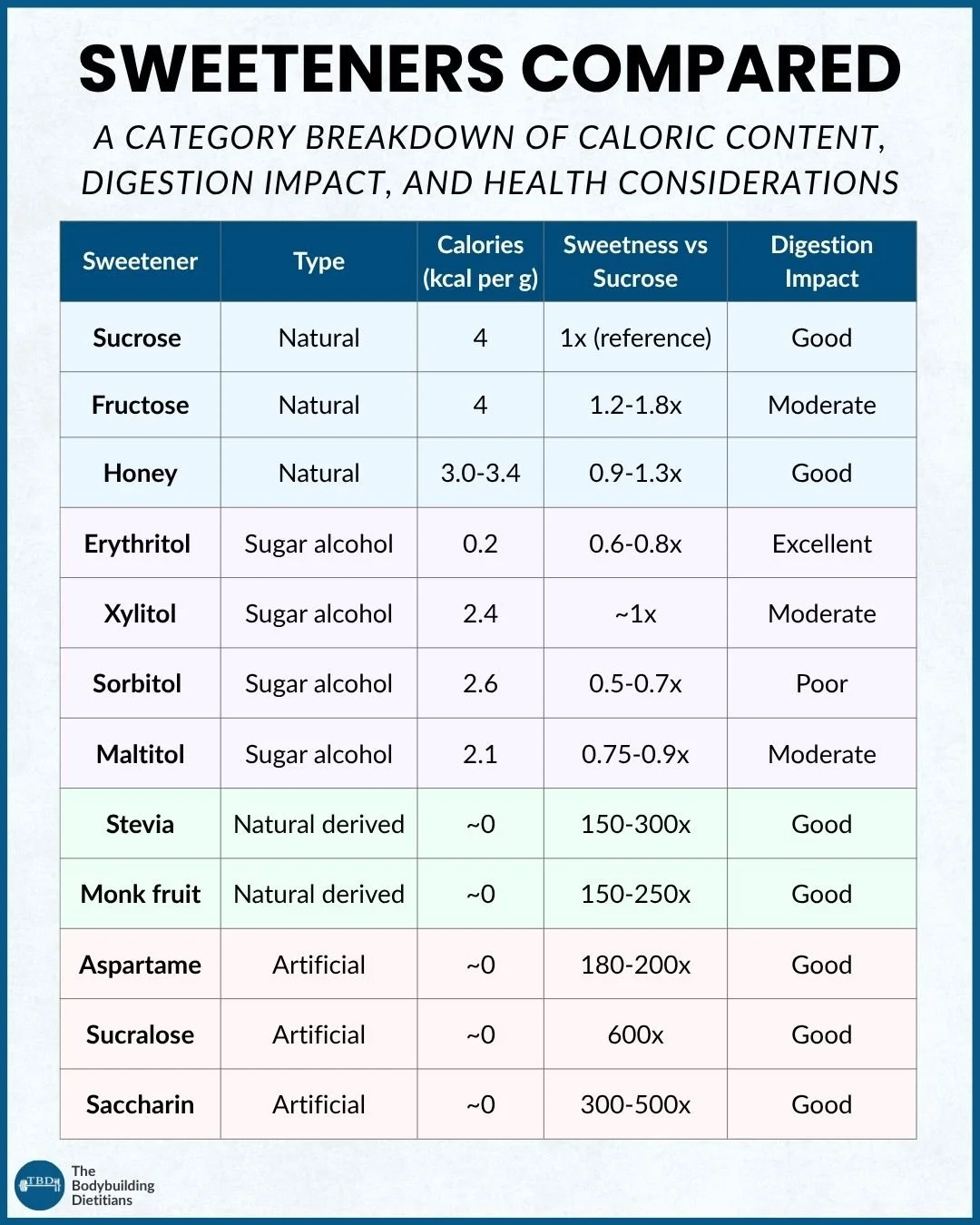
Sweeteners are present across a wide range of packaged foods, protein products, and beverages, often in combinations that most people are not fully aware of. Understanding how they differ matters practically: they vary in caloric content, glycaemic impact, digestive tolerance, the specific conditions under which they may cause problems, and the quality of long-term safety data available for each one. Treating them as a single category, either broadly safe or broadly problematic, does not reflect how different they actually are.
The evidence base across sweetener types is genuinely mixed in places. Some are among the most studied food additives in existence. Others have considerably less long-term human data. Emerging research into areas such as gut microbiome effects, cardiovascular associations, and metabolic responses continues to develop, and for several sweeteners the picture is still not complete. The goal here is to give a clearer account of what the most commonly consumed sweeteners are, how they differ, and what the current evidence does and does not support for each.
What Are the Categories of Sweeteners?
Sweeteners are broadly grouped into four categories based on their source and how they are produced: natural sweeteners, sugar alcohols, natural-derived sweeteners, and artificial sweeteners. Each category behaves differently in the body, and each carries a different practical profile depending on what the person using them is trying to achieve.
Natural sweeteners include sucrose, fructose, and honey. These provide meaningful calories and raise blood glucose to varying degrees. Sugar alcohols are a chemically distinct group that provide fewer calories than sugar and a lower glycaemic response, but can cause digestive symptoms depending on the specific compound and the amount consumed. Natural-derived sweeteners such as stevia and monk fruit are extracted from plant sources and provide essentially zero calories with no glycaemic impact. Artificial sweeteners including aspartame, sucralose, and saccharin are synthetically produced, near-zero calorie, and among the most extensively studied food additives in the regulatory literature.
How Do Natural Sweeteners Compare?
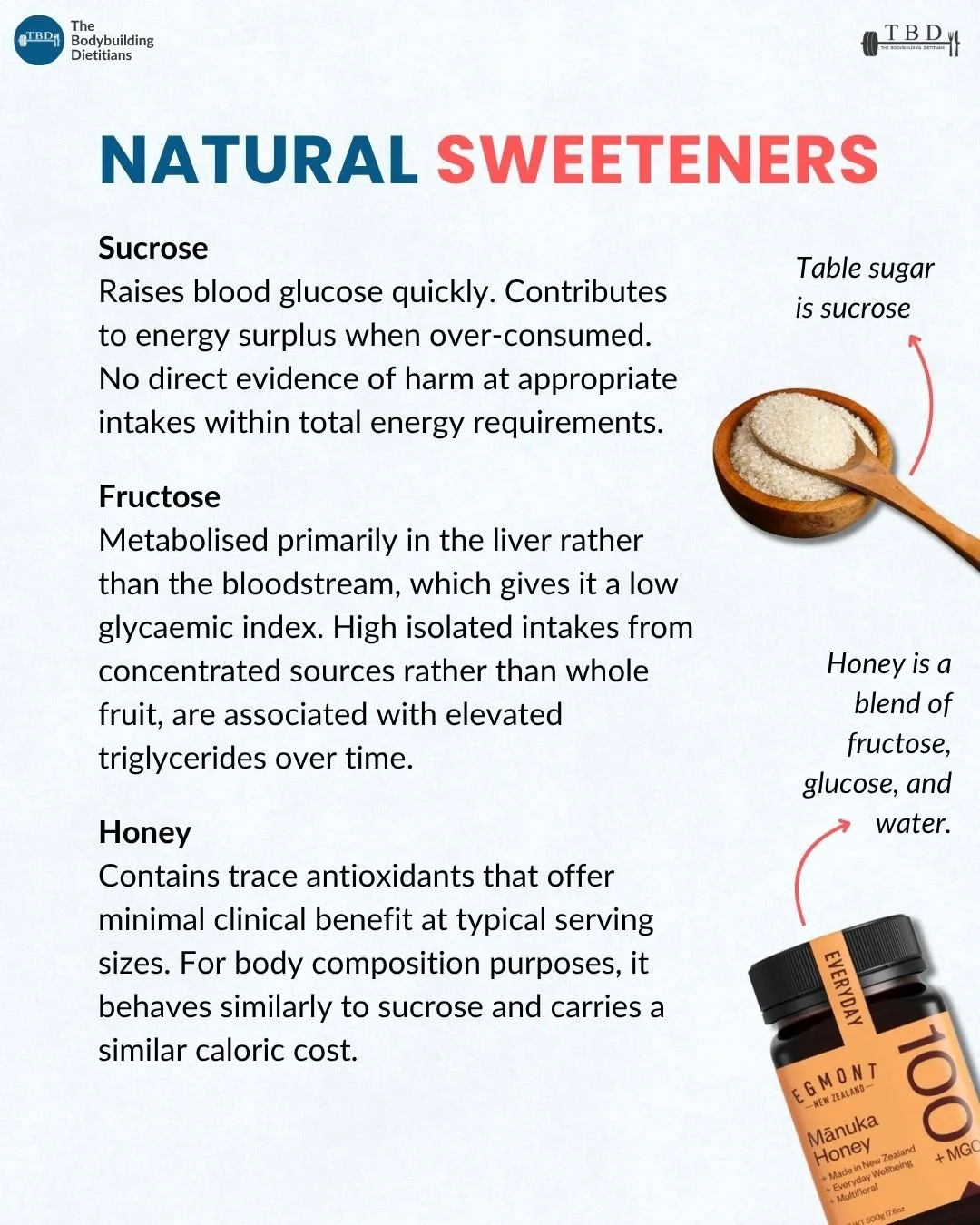
Sucrose is table sugar, a disaccharide made up of one glucose and one fructose molecule. It provides 4 calories per gram, raises blood glucose rapidly after consumption, and is the reference point against which the sweetness of all other sweeteners is measured. At appropriate intakes within total energy requirements, there is no direct evidence of harm from sucrose consumption. Its primary relevance to body composition is as a source of calories: it becomes a meaningful concern when its consumption contributes to a calorie surplus rather than because of anything chemically specific to sucrose itself.
Fructose provides 4 calories per gram but behaves differently from glucose in the body. It is metabolised primarily in the liver rather than entering the bloodstream as glucose does, which gives it a lower glycaemic index. High isolated fructose intakes from concentrated sources, such as high-fructose corn syrup in beverages and processed foods, are associated with elevated triglycerides and hepatic fat accumulation over time. The distinction between fructose in whole fruit, where it is embedded in a food matrix with fibre and water, and fructose from isolated or concentrated sources is important: the two behave differently in terms of absorption rate, metabolic impact, and the evidence around health risk.
Honey is a blend of fructose, glucose, and water with small amounts of other compounds. It provides 3.0 to 3.4 calories per gram depending on water content, and is slightly less calorie-dense than table sugar on a per-gram basis. Honey contains trace amounts of antioxidants and bioactive compounds, but at the serving sizes typically consumed, the clinical benefit of these compounds is minimal. For body composition purposes, honey behaves similarly to sucrose and carries a comparable caloric cost. The perception of honey as a substantially healthier alternative to sugar is not well-supported by the evidence when the two are compared at equivalent serving sizes within a total dietary context.
How Do Sugar Alcohols Differ From Each Other?
Sugar alcohols, also called polyols, are a class of carbohydrates that provide fewer calories than sucrose and produce a lower glycaemic response. They differ considerably from each other in terms of digestive tolerance, caloric content, and specific health properties, and understanding those differences is practically relevant for anyone using products that contain them.
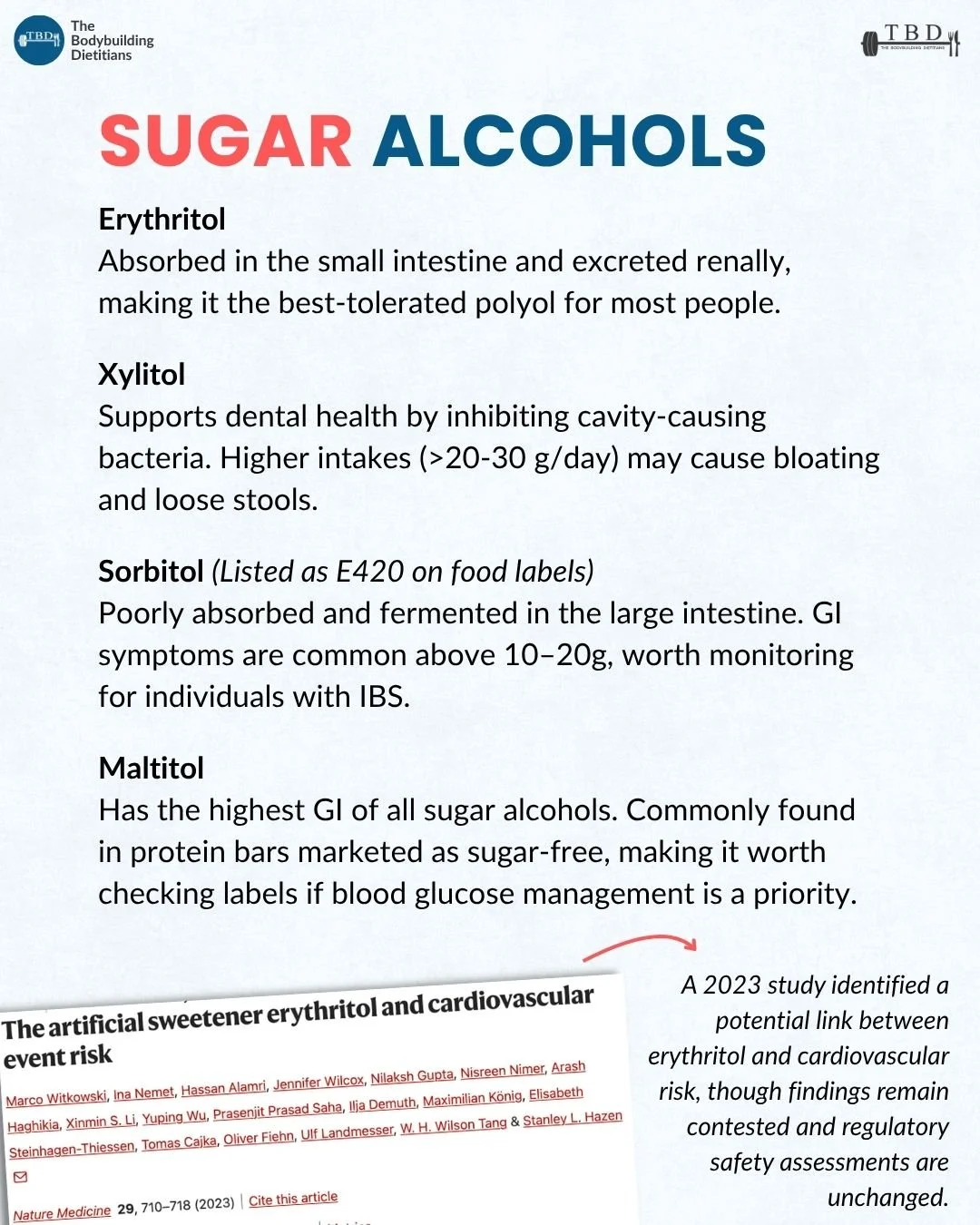
Erythritol provides approximately 0.2 calories per gram, making it effectively negligible in caloric terms. It is absorbed in the small intestine and excreted renally rather than reaching the large intestine in significant quantities, which is why it is the best-tolerated polyol for most people and produces minimal digestive symptoms even at higher intakes. A 2023 study published in Nature Medicine identified a potential association between elevated plasma erythritol levels and cardiovascular event risk, generating considerable media attention. The findings warrant awareness but should be interpreted with caution: the study was observational, plasma erythritol levels reflect endogenous production as well as dietary intake, and all major regulatory bodies have maintained their safety assessments for erythritol unchanged. The research is ongoing and the picture is still developing.
Xylitol provides 2.4 calories per gram and has a sweetness approximately equivalent to sucrose. It has well-established benefits for dental health through its ability to inhibit the growth of cavity-causing bacteria, particularly Streptococcus mutans, which is why it is commonly used in sugar-free gum and dental products. At higher intakes above approximately 20 to 30 grams per day, xylitol can cause bloating and loose stools due to incomplete absorption and fermentation in the large intestine. An important practical note: xylitol is toxic to dogs and should be kept away from pets.
Sorbitol provides 2.6 calories per gram but is poorly absorbed in the small intestine and reaches the large intestine where it is fermented by gut bacteria, producing gas and drawing water into the bowel. Gastrointestinal symptoms including bloating, cramping, and loose stools are common at intakes above 10 to 20 grams, and sorbitol is particularly worth monitoring for individuals with irritable bowel syndrome, where it is classified as a high-FODMAP compound. It appears on food labels as E420 and is commonly found in sugar-free confectionery and some fruit products.
Maltitol provides 2.1 calories per gram and has the highest glycaemic index of all sugar alcohols, sitting meaningfully above the other polyols in this regard. It is frequently used in protein bars and confectionery marketed as sugar-free, which makes it worth checking for on labels when blood glucose management is a priority. The "sugar-free" claim on a product containing maltitol is technically accurate but practically misleading for anyone monitoring glycaemic response, because maltitol raises blood glucose at a rate that is not trivial relative to sucrose.
What Are Natural-Derived Sweeteners and Are They Safe?
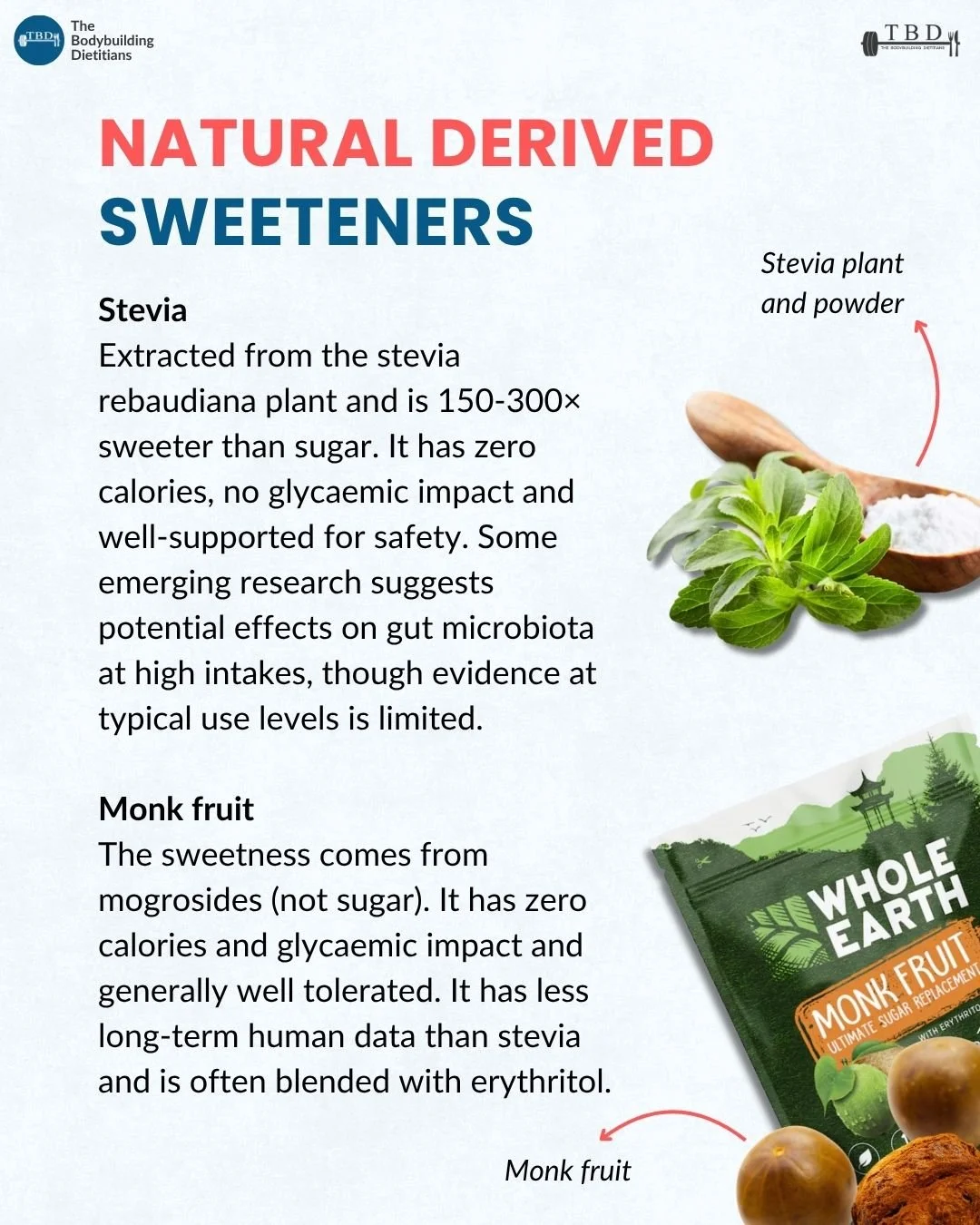
Natural-derived sweeteners occupy a middle ground between natural sweeteners and artificial ones. They are extracted or concentrated from plant sources rather than synthesised, but they undergo processing to achieve the concentrated form in which they are used commercially. Both stevia and monk fruit provide essentially zero calories and have no meaningful glycaemic impact.
Stevia is extracted from the leaves of the Stevia rebaudiana plant and is 150 to 300 times sweeter than sucrose depending on which steviol glycosides are present. It has zero calories, produces no glycaemic response, and has a well-established safety profile across decades of use and regulatory review. Some emerging research suggests potential effects on gut microbiota composition at high intakes, but the evidence at typical use levels, such as amounts found in a few servings of a stevia-sweetened beverage per day, is limited and has not translated into any change in safety guidance. Stevia does have a characteristic aftertaste that some people find bitter, particularly at higher concentrations, which is the primary practical limitation on its use.
Monk fruit sweetener derives its sweetness from compounds called mogrosides, which are not sugars. It provides zero calories and has no glycaemic impact. It is generally well tolerated and has a cleaner taste profile than stevia for many people, which is one reason it has grown in popularity in recent years. Its primary limitation is that it has less long-term human data than stevia, simply because it is newer to widespread use. It is commonly blended with erythritol in commercial products to improve its functional properties and texture.
What Does the Evidence Show for Artificial Sweeteners?
Artificial sweeteners are among the most thoroughly studied food additives available, and their safety profiles at typical intake levels are well-established across decades of regulatory review. The narrative around artificial sweetener safety is considerably more nuanced than either the "completely harmless" or "definitely dangerous" framings that circulate widely.
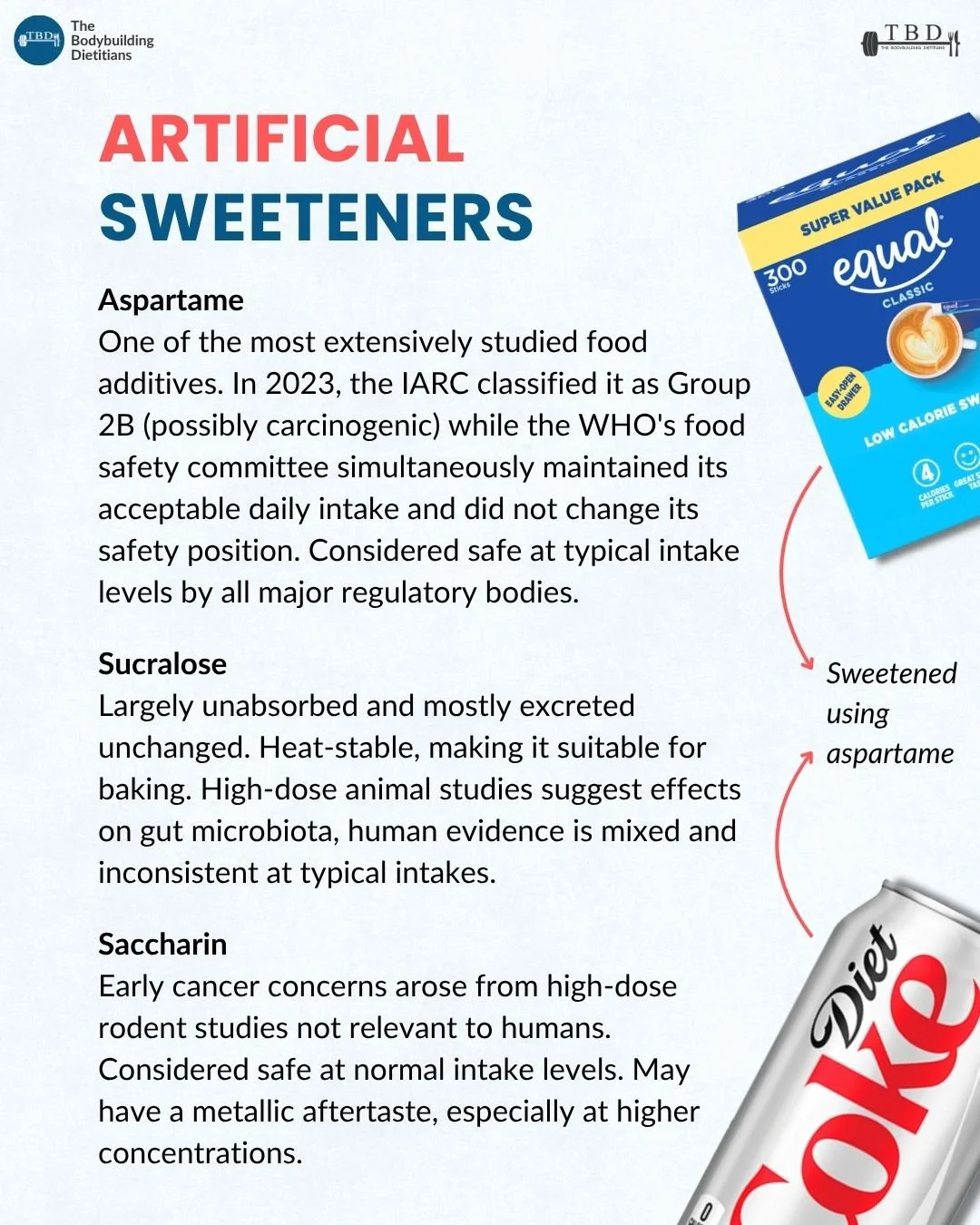
Aspartame is one of the most extensively studied food additives in existence. It provides approximately 4 calories per gram but is used in such small quantities due to its high sweetness intensity (180 to 200 times sucrose) that its caloric contribution is negligible. In 2023, the International Agency for Research on Cancer classified aspartame as Group 2B, meaning "possibly carcinogenic to humans." This classification was widely reported but widely misunderstood: Group 2B is the lowest tier of concern in IARC's hazard classification system, covering agents where the evidence is limited or not yet established in humans. Crucially, the WHO's food safety committee, JECFA, simultaneously reviewed the same evidence and maintained its acceptable daily intake for aspartame without change, explicitly stating that the evidence was not sufficient to revise the safety position. Aspartame is considered safe at typical intake levels by all major regulatory bodies including Food Standards Australia New Zealand.
Sucralose is approximately 600 times sweeter than sucrose, is largely unabsorbed by the body, and is mostly excreted unchanged. It is heat-stable, which makes it suitable for baking in a way that some other sweeteners are not. High-dose animal studies have suggested effects on gut microbiota composition, and some human studies have shown modest effects at very high intakes, but the evidence at intakes typical of normal dietary use is mixed and inconsistent. It remains approved and considered safe by all major regulatory bodies at normal consumption levels.
Saccharin is 300 to 500 times sweeter than sucrose and provides essentially zero calories. Early concerns about cancer risk arose from studies in the 1970s showing bladder tumours in rodents at very high doses, but subsequent research established that the mechanism by which saccharin caused tumours in rodents does not apply to humans, and saccharin was removed from the US National Toxicology Program's list of potential carcinogens in 2000. It is considered safe at normal intake levels and is approved by all major regulatory bodies. Its primary practical limitation is a metallic aftertaste that becomes more noticeable at higher concentrations.
A comprehensive review of low-calorie sweetener safety by the European Food Safety Authority concluded that approved sweeteners at their established acceptable daily intakes do not pose a safety concern for the general population, with individual sweeteners reviewed on the basis of the full available evidence base.
Source: EFSA Panel on Food Additives and Nutrient Sources, multiple systematic reviews.
How Should Sweetener Choice Be Made in Practice?
The practical decision around sweetener use is less about identifying the single safest option and more about understanding which sweetener properties are most relevant to a given person's situation.
For individuals managing calorie intake, near-zero calorie sweeteners from any category (natural-derived or artificial) achieve the goal of providing sweetness without meaningful caloric cost. The differences in safety profiles between stevia, monk fruit, aspartame, sucralose, and saccharin at typical intake levels are modest, and the choice can reasonably be made on the basis of taste preference and tolerance.
For individuals with gut health concerns or who are following a low-FODMAP approach, sugar alcohol selection matters considerably. Erythritol is the most appropriate option for most people, with xylitol suitable at lower amounts and sorbitol and maltitol worth avoiding or limiting. Checking ingredient labels on protein bars and sugar-free products is practical and worthwhile, as maltitol in particular is widely used in products where the label does not make its glycaemic impact obvious.
For individuals managing blood glucose, maltitol is the sugar alcohol most worth being cautious about, and the near-zero calorie options are generally more appropriate across the board. Natural sweeteners including honey are not meaningfully different from sucrose in their glycaemic effect and should not be relied upon as lower-impact alternatives.
Practical Takeaways
Sweeteners fall into four categories with meaningfully different properties: natural sweeteners (sucrose, fructose, honey), sugar alcohols (erythritol, xylitol, sorbitol, maltitol), natural-derived sweeteners (stevia, monk fruit), and artificial sweeteners (aspartame, sucralose, saccharin).
Natural sweeteners provide 3 to 4 calories per gram and raise blood glucose. Their primary relevance to body composition is as a calorie source rather than as chemically harmful substances at appropriate intakes.
Sugar alcohols vary considerably in digestive tolerance. Erythritol is the best tolerated and effectively calorie-free. Sorbitol is the most problematic for GI symptoms and is particularly worth avoiding for individuals with IBS. Maltitol has the highest glycaemic index of all polyols and is worth checking for on sugar-free product labels.
Stevia and monk fruit provide zero calories, have no glycaemic impact, and are well-supported for safety at typical intakes. Both are reasonable choices for anyone wanting a near-zero calorie sweetener with a plant-derived origin.
Aspartame's 2023 IARC Group 2B classification does not indicate it is dangerous at normal intakes. All major regulatory bodies, including the WHO's food safety committee, maintained their safety positions unchanged following this review.
At typical dietary intakes, all approved sweeteners are considered safe by major regulatory bodies. Differences between them at these levels are less significant than the framing in much public discourse suggests.
For gut health and low-FODMAP contexts, sweetener selection matters more than in most other situations. Erythritol is generally the most appropriate sugar alcohol choice in this context.
Frequently Asked Questions
Are artificial sweeteners safe?
At typical dietary intakes, artificial sweeteners approved by major regulatory bodies are considered safe. Aspartame, sucralose, and saccharin have all been subject to extensive regulatory review and carry established acceptable daily intake levels. Aspartame's 2023 IARC Group 2B classification is frequently misinterpreted as a safety warning; it reflects a preliminary hazard classification based on limited evidence and did not lead to any change in the acceptable daily intake or safety guidance from any major food safety authority.
Is erythritol safe after the 2023 cardiovascular study?
The 2023 Nature Medicine study identifying an association between plasma erythritol levels and cardiovascular event risk raised a legitimate research question but does not constitute evidence that dietary erythritol at normal intakes causes cardiovascular harm. The study was observational, could not establish causation, and plasma erythritol reflects endogenous production as well as dietary intake. All regulatory bodies have maintained their safety assessments for erythritol unchanged. Ongoing research will clarify the picture further, and for individuals with existing cardiovascular risk factors who are consuming large amounts of erythritol daily, it may be a reasonable precaution to discuss the emerging evidence with a healthcare professional.
Is stevia better than artificial sweeteners?
Stevia and artificial sweeteners are broadly comparable in their primary functional properties: both provide negligible calories and have no meaningful glycaemic impact. Stevia's advantage is that it is derived from a plant source, which some people prefer for personal reasons, and it has a somewhat longer track record in global use. Artificial sweeteners have more extensive regulatory review data available. At typical use levels, the safety differences between them are modest, and the choice can reasonably be made on the basis of taste preference and individual tolerance.
Does honey have health benefits compared to sugar?
Honey contains small amounts of antioxidants and bioactive compounds that table sugar does not, but at typical serving sizes the clinical benefit of these is minimal. For body composition purposes, honey behaves similarly to sucrose and carries a comparable caloric cost. The perception of honey as a significantly healthier alternative to sugar is not well-supported when both are compared at equivalent serving sizes within a total dietary context. Some specific honey types, including manuka honey, have better-evidenced antimicrobial properties, but these are relevant to topical applications and specific therapeutic contexts rather than everyday dietary use.
Why does maltitol cause problems even though it is listed as sugar-free?
Maltitol is technically not a sugar by regulatory definition, which allows products containing it to carry a "sugar-free" label. However, maltitol has the highest glycaemic index of all sugar alcohols and raises blood glucose at a rate that is not trivial compared to sucrose. For individuals managing blood glucose, this distinction matters considerably. Maltitol is also incompletely absorbed and can cause digestive symptoms at higher intakes, similar to other sugar alcohols, though generally to a lesser degree than sorbitol.
Which sweetener is best for people with IBS?
Erythritol is the most appropriate sugar alcohol for individuals with IBS, as it is absorbed in the small intestine and does not reach the large intestine in meaningful quantities. Sorbitol is a high-FODMAP compound and is likely to trigger symptoms in IBS and should generally be avoided. Xylitol and maltitol sit between these in terms of FODMAP load and are better tolerated at modest amounts. Natural-derived and artificial sweeteners such as stevia, monk fruit, aspartame, and sucralose are generally well tolerated and do not contribute to FODMAP load.
If you would like support navigating food labelling, ingredient selection, or dietary choices that affect digestive health and body composition, our team can help you make sense of the evidence and apply it to your specific situation. You can book a consultation or enquire about coaching to get started.