Plateaus are rarely caused by one variable in isolation. Training effort, recovery, energy intake, sleep, diet quality, and consistency all influence how well someone continues adapting, and the limiting variable is usually found in how those factors interact rather than in any one of them alone. This is a typology of the five most common lifter archetypes when progress stalls, with the specific limiter each one faces and the practical fix that addresses it.
Five common lifter archetypes appear when physique progress stalls, each with a distinct pattern of strengths and weaknesses across training effort, training quality, energy intake, recovery, nutrition quality, and consistency. The Under-Fueller trains hard with high nutrition quality and consistency but doesn't eat enough to support the training load, limiting adaptation and recovery. The Overtrainer does everything well but pushes training volume beyond recovery capacity, producing accumulating fatigue that eventually degrades session quality. The Chronic Dieter has spent too long in a calorie deficit, which has reduced training quality, recovery, and the resources available for muscle growth. The Junk-Volume Lifter has adequate nutrition and recovery but performs too many low-quality sets that lack proximity to failure, progression, or effective execution. The Burnout Risk has training, nutrition, and consistency all in place but chronically underslept, which caps recovery capacity and tolerance to higher workloads. The specific fix depends on which archetype applies, and identifying the correct one matters more than adding new variables to optimise. Most plateaued lifters have one of these five patterns in some form, and addressing the specific archetype tends to produce meaningful progress faster than a general overhaul.
Plateaus are rarely caused by one variable in isolation. Training effort, recovery, energy intake, sleep, diet quality, and consistency all influence how well someone can continue adapting, and the limiting factor is usually found in the way those variables interact rather than in any one of them by itself.
The challenge is working out which variable is placing the greatest constraint on progress at that point in time, then adjusting it in a way that improves the overall approach rather than simply changing more things unnecessarily. Most plateaued lifters fit one of five recognisable archetypes, each with a distinct pattern of strengths and weaknesses across the six variables that drive progress: training effort, training quality, energy intake, recovery, nutrition quality, and consistency.
This article walks through the five archetypes: the Under-Fueller, the Overtrainer, the Chronic Dieter, the Junk-Volume Lifter, and the Burnout Risk. Each section covers what the specific pattern looks like, what it's holding back, and how to fix it, with links to the deeper articles in the library that cover each fix in more depth.
Archetype 1: The Under-Fueller
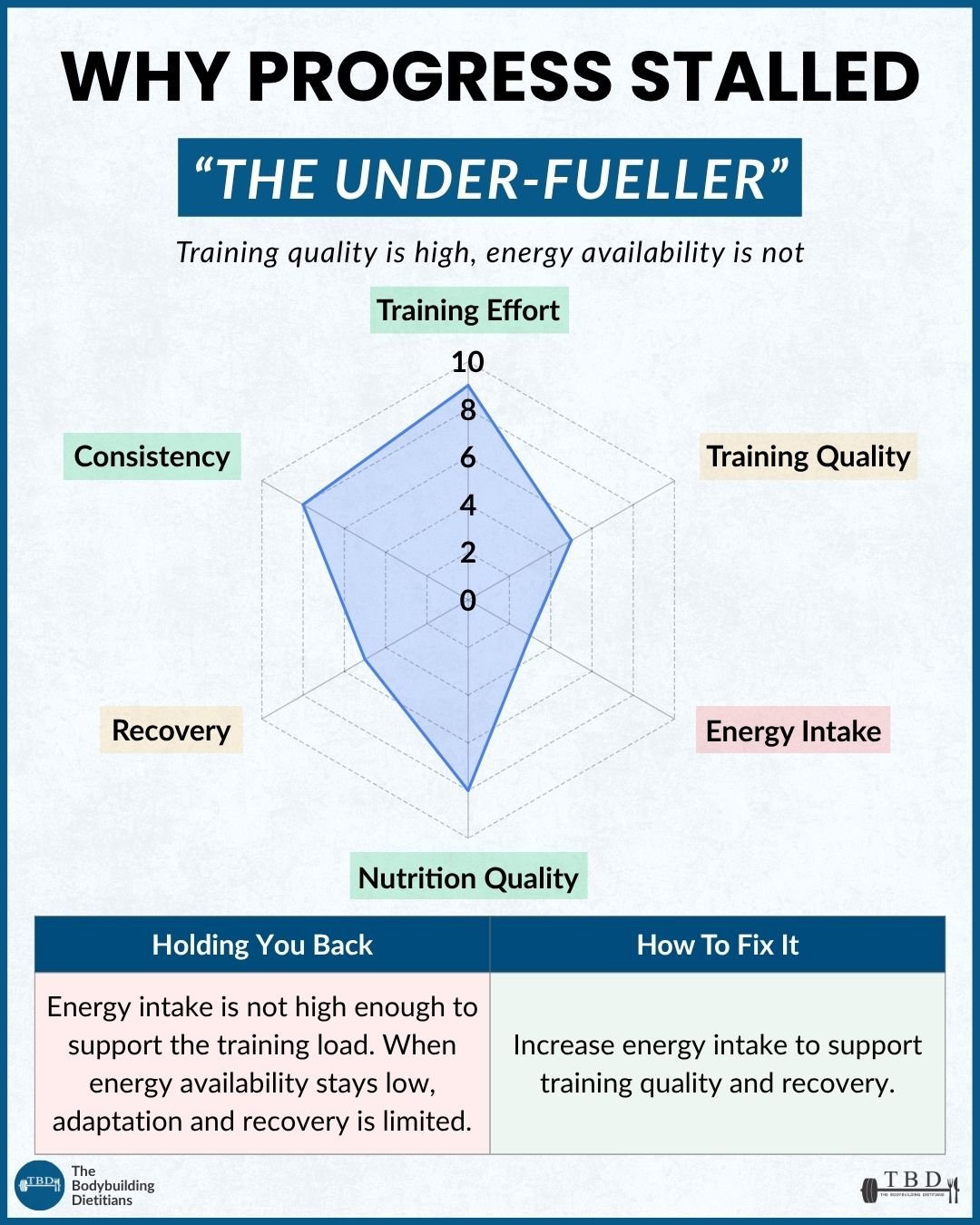
The Under-Fueller trains hard with high-quality nutrition and consistent execution, but doesn't eat enough total calories to support the training load. Training effort and quality both score high, nutrition quality is strong, and consistency is solid, but energy intake sits low and recovery is limited as a result.
The specific pattern that produces this archetype usually involves lifters who have focused heavily on food quality without paying equal attention to calorie adequacy. A diet built around whole foods, high protein, and adequate micronutrients can still fall short on total calories, particularly for lifters with high training volumes, physical occupations, or high non-exercise activity that increases total daily energy expenditure.
The signs that identify this archetype include training performance that doesn't reflect the effort being put in, unexplained fatigue during and between sessions, difficulty gaining muscle mass despite consistent progressive training, and body weight that stays stubbornly stable or drifts downward despite the intention to gain or maintain. Recovery between sessions often takes longer than it should, and morning readiness for training may feel below where the effort levels would suggest.
The fix is straightforward: increase energy intake enough to support the actual training load. For most Under-Fuellers, this means adding 200 to 400 calories per day above the current intake and reassessing training quality, recovery, and body weight trajectory after 2 to 4 weeks. The specific increase depends on current intake, training volume, and individual context.
For a related look at why individual calorie needs vary substantially between lifters who look similar on paper, our article on why calorie needs vary between individuals covers the framework for identifying your own maintenance accurately.
Archetype 2: The Overtrainer
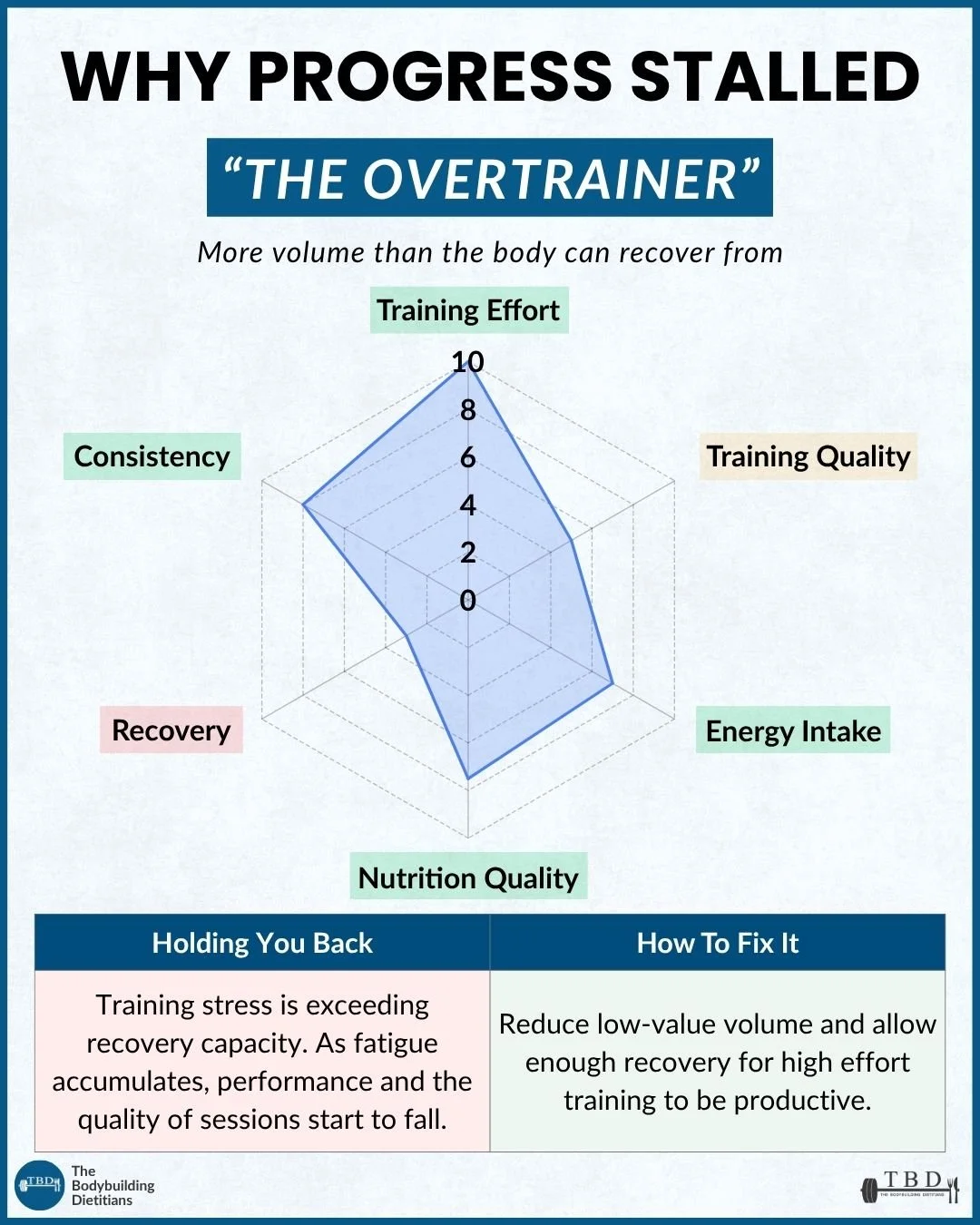
The Overtrainer does most things well but pushes training volume beyond what recovery can support. Training effort, energy intake, nutrition quality, and consistency all score high, but training quality has started to degrade and recovery is compromised.
The specific pattern that produces this archetype usually involves lifters who have added volume as a fix for slowing progress, or who have maintained a high-volume program past the point where recovery capacity can support it. High-volume training is genuinely productive for many lifters up to a certain point, but there's a threshold beyond which additional volume produces accumulating fatigue rather than additional adaptation.
The signs that identify this archetype include training performance that has plateaued or declined across recent weeks despite consistent effort, persistent muscle soreness that doesn't resolve between sessions, elevated resting heart rate, reduced motivation for training that doesn't reflect normal weekly fluctuations, and a general sense of accumulated fatigue that doesn't lift with a normal weekend of rest.
The fix involves reducing low-value volume and allowing enough recovery for the remaining high-effort work to be productive. Practically, this often looks like removing 20 to 30 percent of the current weekly volume (particularly from lifts with lower priority or higher fatigue cost), running a deload week at 40 to 50 percent of normal volume to reset accumulated fatigue, and then rebuilding volume more gradually while monitoring whether training performance actually improves.
The instinct to add more when progress stalls is one of the more common patterns in dedicated lifters, and it produces this specific archetype more often than the alternative pattern of doing too little.
Archetype 3: The Chronic Dieter
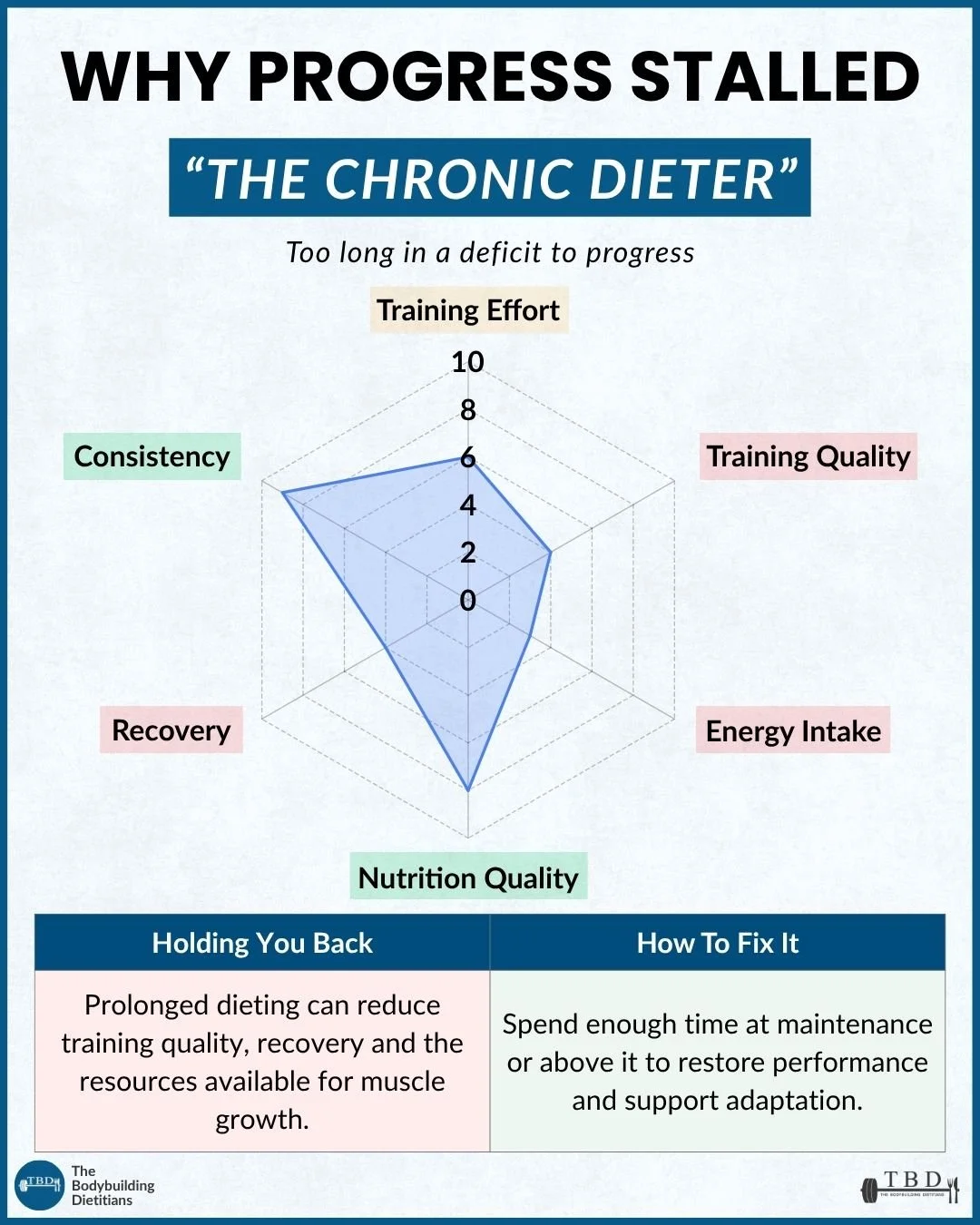
The Chronic Dieter has spent too long in a calorie deficit, which has progressively reduced training quality, recovery, and the resources available for muscle growth. Consistency is often still in place and nutrition quality can be high, but training effort has moderated, energy intake is low, recovery is limited, and training quality has fallen from what it once was.
The specific pattern that produces this archetype usually involves lifters cycling through repeated fat loss phases without adequate maintenance or gaining time between them, or lifters in extended contest prep cycles who haven't allowed sufficient recovery periods afterward. The physiological adaptations to sustained energy deficit include reduced thyroid output, elevated cortisol, reduced leptin signalling, and decreased spontaneous activity, all of which compound to make continued training and adaptation harder as the deficit extends.
The signs that identify this archetype include training performance that has been declining across months rather than weeks, persistent hunger disproportionate to intake, sleep quality that has degraded during the extended dieting period, mood decline that tracks with the diet rather than resolving between phases, and body composition changes that have slowed dramatically or stopped despite continued deficit.
The fix is to spend enough time at maintenance or above it to restore performance, recovery, and hormonal function. For most Chronic Dieters, this means at least 12 to 20 weeks at maintenance or in a modest surplus before considering another fat loss phase. Reverse dieting protocols that gradually increase calorie intake from the diet endpoint to true maintenance are one useful practical approach, and the length of the maintenance phase should generally match or exceed the length of the preceding deficit for optimal recovery.
Archetype 4: The Junk-Volume Lifter
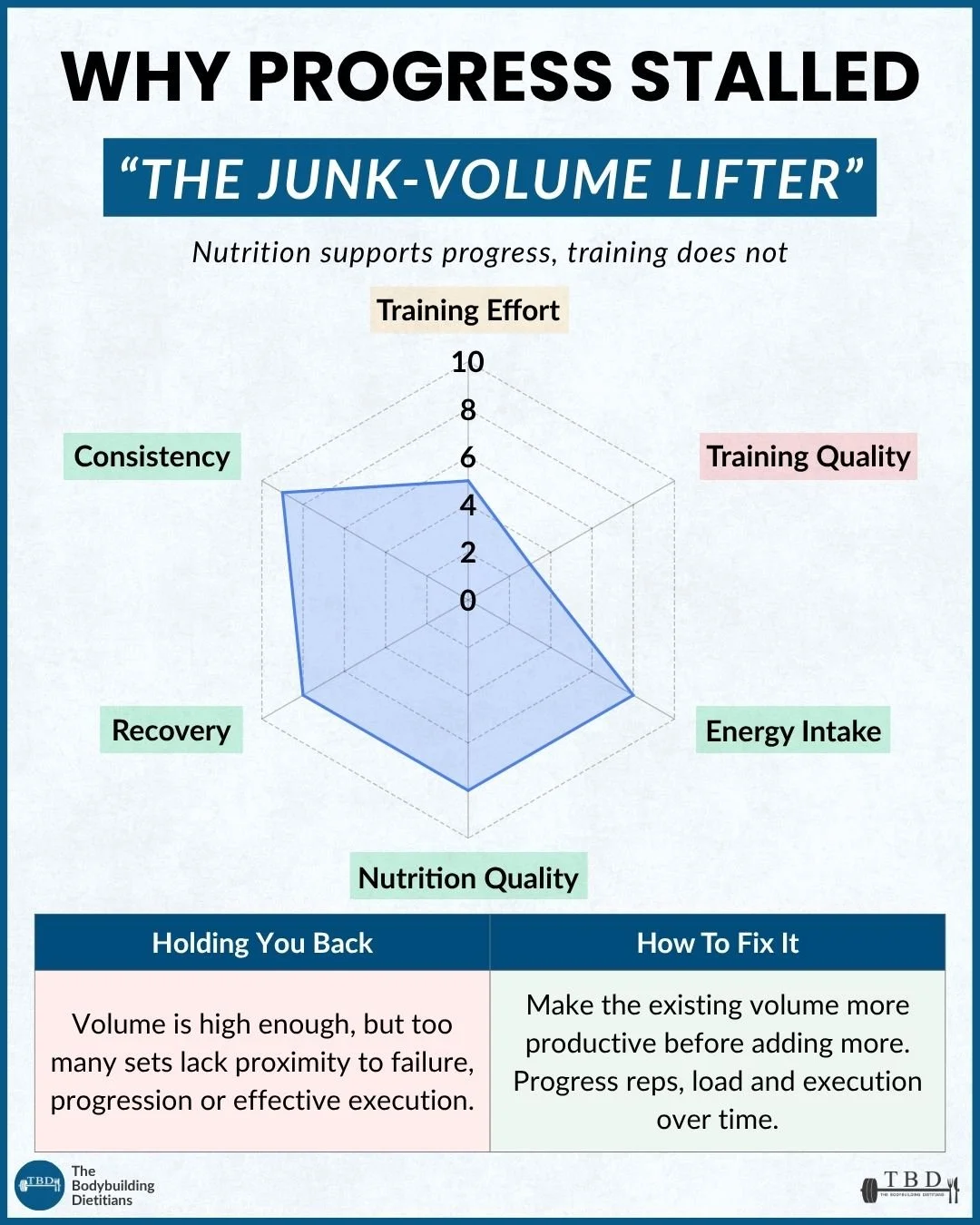
The Junk-Volume Lifter has adequate energy intake, recovery, nutrition quality, and consistency, but training quality is low. Total volume is often high, sometimes very high, but too many of the sets lack proximity to failure, progression across sessions, or effective technical execution.
The specific pattern that produces this archetype usually involves lifters who have added volume as a fix for slowing progress without addressing whether the existing volume was actually being executed at a level that would produce adaptation. Junk volume looks like productive volume from the outside (sets completed, exercises programmed, gym time logged), but the sets aren't providing the mechanical tension and metabolic stress that drive muscle protein synthesis.
The signs that identify this archetype include high total weekly volume that doesn't produce corresponding strength or muscle progress, sets consistently ending well before genuine failure or muscular exhaustion, load or reps that haven't meaningfully increased across weeks or months for specific lifts, technical execution that transfers tension away from the target muscle, and a general sense that the training is happening without the physical demand that harder training would produce.
The fix is to make existing volume more productive before adding more. Practically, this involves reducing weekly volume by 20 to 30 percent while dramatically increasing the intensity and quality of the remaining sets, ensuring most working sets are taken within 1 to 3 reps of failure with intent, progressing load or reps on specific compound lifts across weeks with a specific tracking system, and prioritising technical execution that actually loads the target muscle through a full range of motion.
Junk volume is one of the more common training issues in advanced lifters specifically, because the response to slowing progress is typically to add more sets rather than to make existing sets more productive. The correction usually feels counterintuitive because it involves doing less to progress faster.
Archetype 5: The Burnout Risk
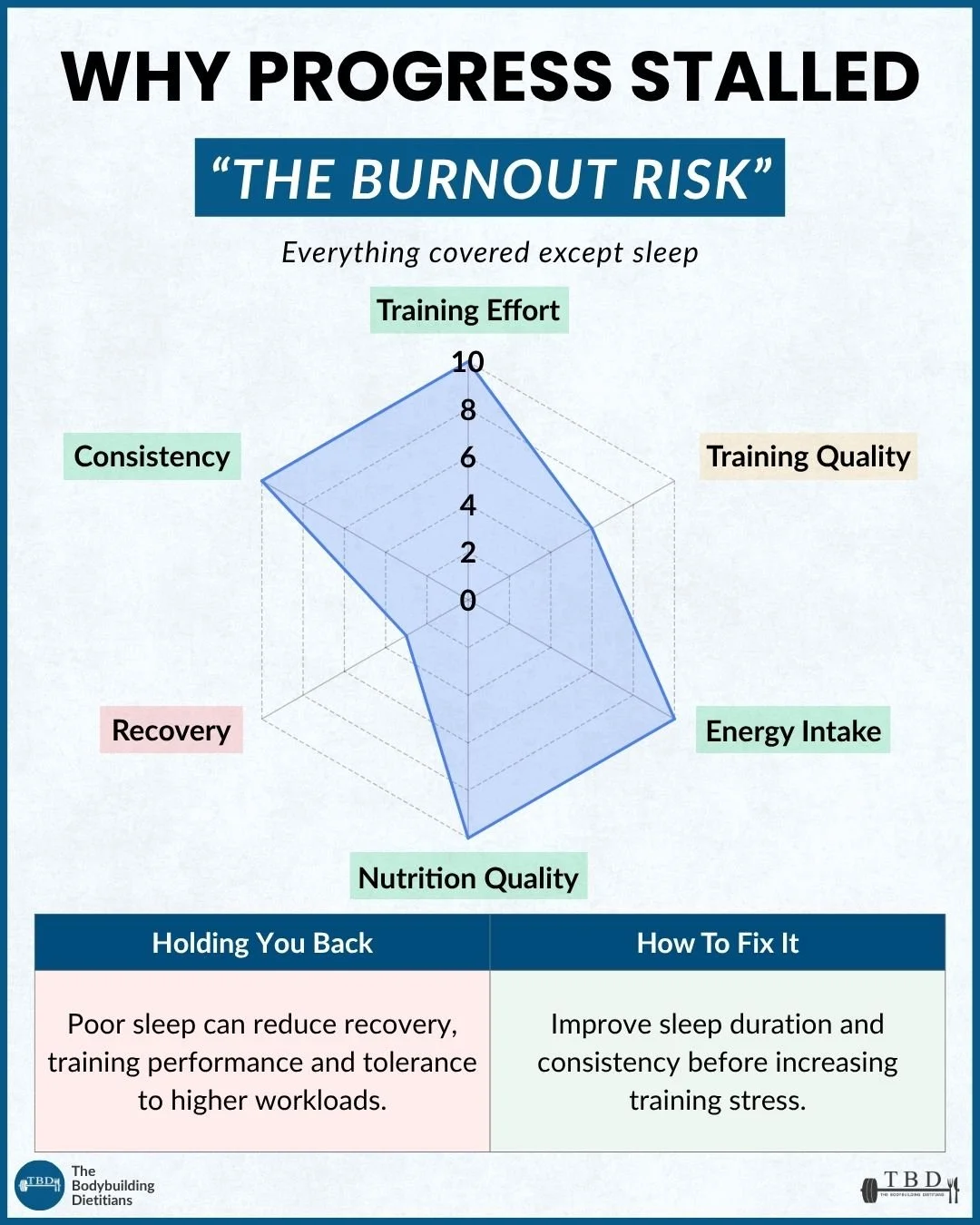
The Burnout Risk has training effort, training quality, energy intake, nutrition quality, and consistency all in place, but recovery is limited by chronically inadequate sleep. Everything looks solid except the one variable that determines how much of the rest can actually produce adaptation.
The specific pattern that produces this archetype usually involves lifters with demanding careers, family obligations, or lifestyle patterns that limit sleep to under 6.5 hours per night on a sustained basis. Sleep restriction affects nearly every physiological process relevant to training adaptation: muscle protein synthesis, hormonal environment, cognitive function, perceived exertion, recovery capacity, and appetite regulation. Even well-executed training and nutrition can't fully compensate for chronic sleep restriction.
The signs that identify this archetype include self-reported sleep consistently below 6.5 to 7 hours per night, morning training performance that feels harder than the previous night's sleep would suggest, elevated hunger and appetite disproportionate to intake, mood decline that tracks with sleep quality rather than training or nutrition variables, and a plateau in training progression that doesn't respond to program changes or increased calorie intake.
The fix is to improve sleep duration and consistency before increasing training stress. For most Burnout Risks, this means prioritising sleep as a specific behavioural target rather than an incidental variable, addressing sleep environment (temperature, light, noise, screen exposure before bed), and being honest about lifestyle changes that would need to occur to sustainably increase sleep by 30 to 60 minutes per night. In some cases, the correction requires reducing training volume temporarily while sleep improves, because adding training stress on top of chronic sleep restriction typically produces further burnout rather than adaptation.
Not Sure Which Archetype Currently Applies to You?
The five archetypes above describe distinct patterns, but most plateaued lifters have some overlap between two or more of them, and the specific limiter isn't always obvious from self-assessment. Identifying which archetype currently applies to you (or which specific combination) is where an outside perspective produces quicker results than working through it alone. Our team works with clients on this specifically, looking at the full picture of training, nutrition, recovery, and lifestyle variables together to identify the actual bottleneck rather than the assumed one.
How to Work Out Which Archetype Applies to You
Several practical approaches help identify the specific archetype driving a current plateau.
Start with the fundamentals check. Before assessing the specific archetypes, honestly answer three questions. Is your sleep consistently at 7 or more hours per night? Is your training progressing on specific lifts across weeks or months? Is your calorie intake genuinely matched to the phase you're in (a surplus for gaining, a deficit for fat loss, or maintenance)? If any of these three answers is no, that gap is almost certainly your current limiter and the archetype it points to is the one to address first.
Compare your pattern to the five archetype signatures. Each archetype has a distinct combination of strengths and weaknesses. If your training effort and consistency are high but progress has stalled, you're likely either the Under-Fueller (if calorie intake is low), the Overtrainer (if training volume has crept up), the Junk-Volume Lifter (if training quality has dropped), the Burnout Risk (if sleep is short), or the Chronic Dieter (if you've spent most of the last year in a deficit).
Address one archetype at a time. Attempting to fix multiple archetypes simultaneously tends to produce partial improvements across all of them rather than meaningful change in any single one. Identifying the archetype that best matches your current pattern and addressing that specifically over 8 to 12 weeks typically produces more meaningful progress than an attempted overhaul across all five areas.
Give the correction time to produce results. Fixing the Under-Fueller pattern by increasing calories produces measurable improvements in training performance and recovery within 2 to 4 weeks. Fixing the Overtrainer pattern with reduced volume and a deload produces measurable improvements within 3 to 6 weeks. Fixing the Chronic Dieter pattern with a maintenance phase requires 12 to 20 weeks or longer for full recovery. Fixing the Junk-Volume Lifter pattern by making volume more productive produces measurable strength gains within 6 to 16 weeks. Fixing the Burnout Risk pattern by extending sleep produces measurable improvements within 1 to 2 weeks of consistent implementation.
Practical Takeaways
Plateaus are rarely caused by one variable in isolation. Training effort, recovery, energy intake, sleep, diet quality, and consistency all influence how well a lifter continues adapting, and the limiting variable is usually found in how those factors interact rather than in any one alone.
Five common lifter archetypes appear when physique progress stalls: the Under-Fueller (high training and nutrition quality but low energy intake), the Overtrainer (high effort but excessive volume), the Chronic Dieter (too long in a deficit), the Junk-Volume Lifter (adequate volume but low training quality), and the Burnout Risk (everything covered except sleep).
Each archetype has a specific fix that addresses its particular limiter. Increasing energy intake resolves the Under-Fueller. Reducing volume and running a deload resolves the Overtrainer. Extended maintenance restores the Chronic Dieter. Making existing volume more productive addresses the Junk-Volume Lifter. Extending sleep resolves the Burnout Risk.
Before assessing specific archetypes, verify the three fundamentals: sleep consistently at 7 or more hours, training progression on specific lifts, and calorie intake matched to the phase. If any of these is compromised, that gap is almost certainly the current limiter regardless of which archetype it points to.
Address one archetype at a time rather than attempting to fix multiple simultaneously. The correction typically requires 2 to 20 weeks to produce measurable results depending on the specific archetype.
Most plateaued lifters have some overlap between two or more archetypes. Identifying the specific combination that currently applies requires honest self-assessment across all six variables, and an outside perspective often produces quicker results than working through it alone.
Frequently Asked Questions
What is the most common reason lifters plateau?
The most common reason lifters plateau depends on the specific archetype currently applying to them, but the five most common patterns are: not eating enough to support the training load (the Under-Fueller), doing more training volume than the body can recover from (the Overtrainer), spending too long in a calorie deficit (the Chronic Dieter), performing high volumes of low-quality training (the Junk-Volume Lifter), and chronic sleep restriction limiting recovery capacity (the Burnout Risk). Identifying which pattern applies matters more than adding new variables to optimise.
How do I know if I'm overtraining or undertraining?
Overtraining typically produces high training effort with declining training quality, accumulating fatigue, persistent soreness, and stalled or declining performance across weeks. Undertraining typically produces adequate recovery and energy availability but insufficient training stimulus to drive adaptation, with progression stalling not from fatigue but from insufficient mechanical or metabolic stress. The distinction matters because the fix is opposite: overtraining requires reduced volume and a deload, while undertraining requires increased volume, intensity, or both. If in doubt, an honest audit of training progression on specific lifts across the last 8 to 12 weeks usually reveals which pattern applies.
Can chronic dieting cause a plateau?
Yes. Prolonged calorie deficits produce physiological adaptations that reduce training quality, recovery capacity, and the resources available for continued muscle growth. Extended dieting phases without adequate maintenance or gaining time between them can leave a lifter in a chronically compromised state where continued fat loss becomes progressively harder and muscle preservation becomes limited. The specific fix is spending enough time at maintenance or above it to restore performance and hormonal function, typically 12 to 20 weeks minimum before considering another fat loss phase.
How much sleep do I need to make progress?
For most lifters, 7 to 9 hours per night is the range where recovery, training performance, and body composition outcomes are optimised. Chronic sleep restriction below 6.5 to 7 hours produces measurable impairments in muscle protein synthesis, training performance, appetite regulation, and hormonal function that even well-executed training and nutrition can't fully compensate for. The Burnout Risk archetype specifically describes lifters where everything except sleep is in place, and the fix is prioritising sleep as a specific behavioural target rather than treating it as an incidental variable.
What should I do if I fit multiple archetypes?
Address one archetype at a time rather than attempting to fix all of them simultaneously. Start with the archetype whose fix is likely to produce the fastest measurable results (typically the fundamentals: sleep for the Burnout Risk, calorie increase for the Under-Fueller, or volume reduction for the Overtrainer). Give the correction 4 to 12 weeks to produce measurable results before reassessing whether the primary limiter has resolved. Once the first archetype's fix has produced improvement, reassess whether a second archetype still applies and address it in the same structured way.
If you want help identifying which of the five archetypes currently applies to you, and building a plan that addresses the specific limiter rather than continuing to change variables that aren't the actual bottleneck, our team can build a plan matched to your specific situation. You can enquire about coaching or book a consultation with our team.