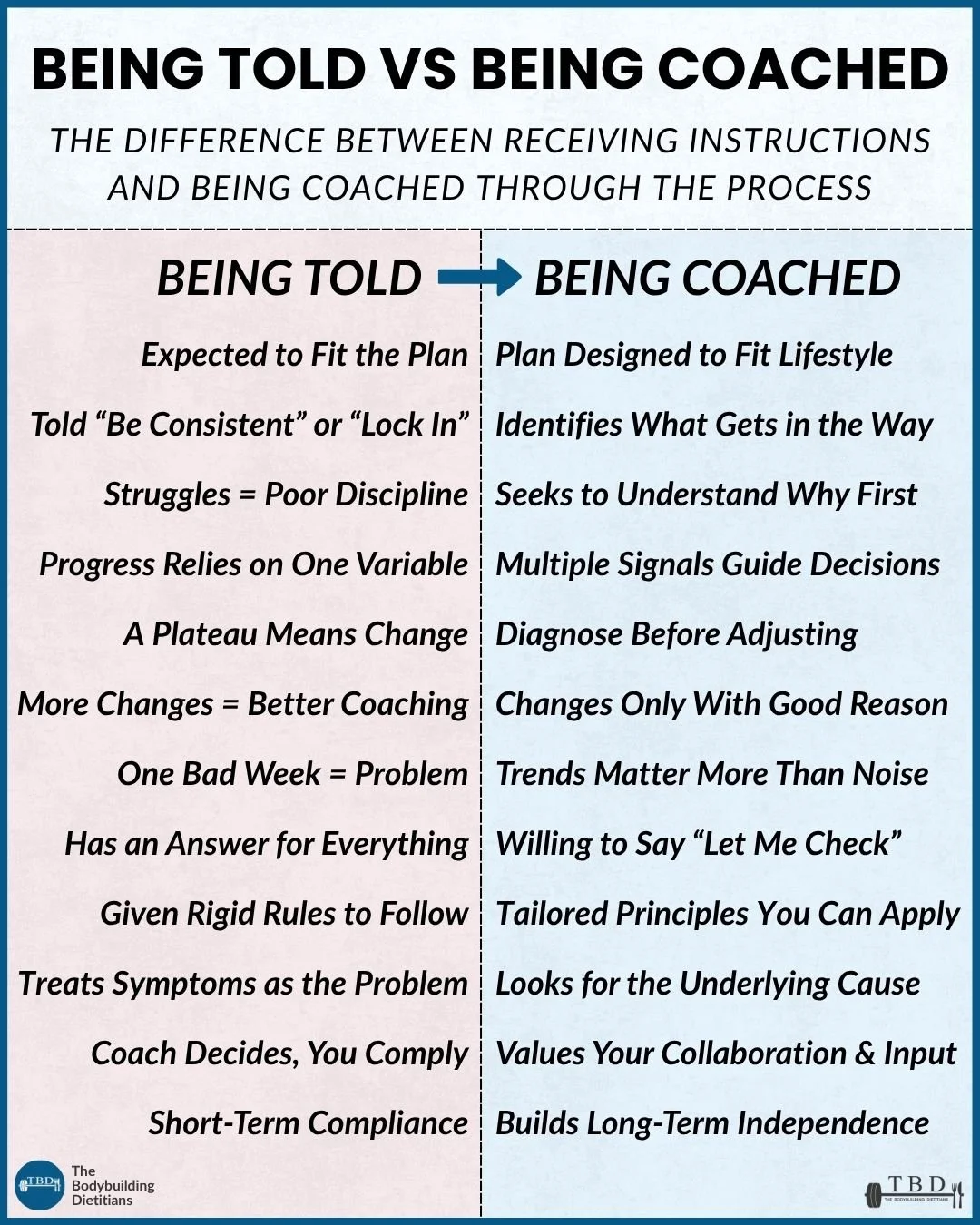
Anyone can hand you a plan and tell you to follow it. Coaching is a different skill, and it is not always the right approach for every person or moment. This guide explains what separates being told what to do from being coached through the process, and why the distinction is worth understanding whether you are looking for a coach or evaluating the one you already have.
Being told what to do and being coached are not the same thing, and neither is inherently better. Some people want clear instructions and thrive with a straightforward plan, and a good coach recognises when that is the right fit. The distinction becomes important when someone is not just given a set of rules to follow, but has a coach who designs the plan around their lifestyle, seeks to understand why a struggle is happening before addressing it, weighs multiple signals rather than reacting to any single data point, is willing to say "let me check" instead of manufacturing an answer, and values collaboration over compliance. Being told what to do can now be automated by an app, a template, or an AI tool. Coaching is the part that resists automation: diagnosing why something is not working, knowing when to leave a plan alone, and building the independence that eventually reduces how much coaching someone needs. How someone is best coached still depends on the individual, their preferences, and their lifestyle, so the goal is not to reject structure but to recognise whether the structure is being adapted to you or you are being adapted to it.
Anyone can be told what to do. Coaching is a different skill. There is nothing wrong with being told what to do: some people want clear instructions, respond well to being told to stay consistent, and thrive with a straightforward plan. For them, that approach works, and a good coach recognises this rather than overcomplicating something that does not need it.
The point is that this is rarely one-size-fits-all. How someone is best coached depends on the person in front of you: how they like to work, what they respond to, and what their lifestyle looks like. Some people need structure and accountability. Others need the reasoning explained before they will commit, or the plan bent around a demanding job or a busy schedule. There is no single correct method, and good coaches adjust their style to the individual rather than applying the same template to everyone.
What sits underneath all of it is a distinction worth naming. Being told what to do is something a plan, an app, or an AI tool can now do instantly. Coaching is the part that is harder to automate: understanding why someone is struggling, reading more than one variable before making a change, knowing when to leave things alone, and building the kind of independence that eventually makes someone need a coach less. This article walks through what that distinction looks like in practice, across how a plan gets built, how struggles get addressed, how decisions get made, and how the relationship itself is structured.
How Does a Coach Build a Plan Around Someone, Rather Than the Other Way Around?
The starting point of the difference is who the plan is built for. Being told what to do usually means being expected to fit the plan; being coached usually means the plan is designed to fit the lifestyle.
A rigid set of rules applied the same way to every client treats the plan as fixed and the person as the variable that has to adapt. A coach working the other way around starts from how someone lives: their work schedule, their social commitments, their training history, and the foods and routines they can sustain, and builds the structure around that. This is also where tailored principles differ from rigid rules. A rule tells someone exactly what to do in one situation and leaves them stuck the moment the situation changes. A principle, properly explained, travels with the person into situations the plan never explicitly covered, which is why one produces someone who can only follow instructions and the other produces someone who can actually make decisions.
Why Does Understanding "Why" Matter More Than Repeating "Be Consistent"?
When a client is struggling, the reflex response is often to repeat the instruction louder: be consistent, lock it in, try harder. Coaching starts from a different question, which is why the struggle is happening in the first place.
Telling someone struggling with adherence to simply be more consistent treats the symptom as the whole problem, when consistency is usually the downstream result of something else: a schedule that does not fit the plan, a level of hunger the deficit was not built to handle, or a lack of clarity about why a particular target matters. Reframing struggle as poor discipline is rarely accurate and rarely useful, because it gives the person nothing to act on beyond trying harder at something that was not built to fit their life in the first place. Seeking to understand why first, then identifying the specific thing getting in the way, produces a fix that actually addresses the cause rather than papering over it. A client who is not hitting protein targets because their work schedule leaves no time to cook needs a solution to that constraint, not a reminder to be more disciplined about a target that was never realistic for their week.
How Does a Coach Decide When to Actually Change Something?
Decision-making is where the difference becomes most visible over time. Being told what to do often means progress is judged against a single variable, and any deviation triggers a change. Coaching means weighing multiple signals before deciding anything needs to move.
A plateau on the scale in a single week is not automatically a signal that something is wrong. Bodyweight fluctuates for reasons that have nothing to do with fat loss or muscle gain: water retention, sodium intake, training volume, sleep, and the timing of the last meal before weighing in all move the number independently of the underlying trend. A coach who diagnoses before adjusting is looking at the trend across several weeks, alongside training performance, energy, hunger, and sleep, rather than reacting to one data point in isolation. This is also why more changes do not equal better coaching. Adjusting calories, training, or cardio every time a single week looks off produces a constantly shifting target that a client can never adapt to, and it usually reflects a coach reacting to noise rather than identifying a genuine trend. Changes made only with good reason, once several data points agree on a direction, tend to produce steadier and more sustainable progress than changes made reactively.
Why Is "Let Me Check" a Sign of Good Coaching Rather Than a Weakness?
A coach who has an answer for absolutely everything, instantly and with total confidence, is often pattern-matching to a familiar case rather than genuinely assessing the one in front of them. Being willing to say "let me check" is a sign that the answer is actually being worked out rather than recycled.
Physiology and individual response vary enough that not every question has an immediately obvious answer, and the honest response to something uncertain is to look into it properly rather than supply a confident-sounding guess. This matters more than it might seem, because a coach who never admits uncertainty is either working with a narrower and more rigid set of answers than the situation calls for, or is prioritising the appearance of expertise over getting the answer right. Neither serves the client as well as a coach who treats "I am not sure, let me check" as a normal and expected part of doing the job properly.
Been Handed a Plan Without Ever Being Told Why?
If you have followed instructions without understanding the reasoning behind them, or watched a coach change your plan every week without a clear reason, that is usually a sign of being told rather than being coached. Our team builds plans around the person, explains the reasoning behind every decision, and only changes course when the data actually supports it.
Why Does Collaboration Build Better Long-Term Outcomes Than Compliance?
The last piece of the distinction is the structure of the relationship itself. A model where the coach decides and the client complies produces short-term compliance at best. A model built on collaboration and input tends to produce something more durable: long-term independence.
This lines up with established psychological research on motivation. Self-determination theory, developed by Deci and Ryan, identifies autonomy, the sense of having genuine input and choice, as one of the core psychological needs that drives sustained, intrinsically motivated behaviour, as opposed to behaviour that is only maintained through external control. A client who understands the reasoning behind their plan and has genuine input into how it is built is engaging with something closer to autonomous motivation. A client who is told what to do and expected to comply is relying on external motivation, which tends to be far less durable once the coach is no longer watching.
Self-determination theory identifies autonomy, competence, and relatedness as core psychological needs, and satisfying them, particularly through genuine input and choice, is associated with more sustained, intrinsically motivated behaviour compared to externally controlled compliance. Source: Deci and Ryan, Self-Determination Theory.
The practical result is a client who, over time, needs less oversight rather than more. Coaching built on collaboration teaches the reasoning behind decisions, which means the client eventually starts recognising the same patterns and making sound calls independently. Coaching built on compliance never transfers that skill, since the client has only ever been told what to do rather than shown why.
Practical Takeaways
Neither being told what to do nor being coached is inherently better. Some people thrive with clear instructions, and a good coach recognises when that fits.
The core distinction is whether the plan is built around the person's lifestyle or the person is expected to fit a fixed plan.
Struggles are usually a signal to understand why, not a discipline problem to be told to fix harder.
Sound decisions come from weighing multiple signals and trends over time, not reacting to a single data point like one flat week or a bad scale reading.
A coach willing to say "let me check" is being more honest than one who has an instant answer for everything.
Collaboration and genuine input build the kind of independence that compliance alone never does.
Frequently Asked Questions
What is the difference between being told what to do and being coached?
Being told what to do means following a fixed set of instructions, often the same for everyone, regardless of individual circumstances. Being coached means the plan is built around the specific person, with the reasoning explained, multiple signals considered before changes are made, and genuine collaboration in the process.
Is it bad to want clear instructions rather than a lot of explanation?
No. Some people respond well to clear, direct instructions and thrive with a straightforward plan, and a good coach recognises this and adjusts their style accordingly. The issue is not wanting structure, it is whether that structure has been built with the individual in mind.
How do you know if a coach is diagnosing a problem or just reacting to it?
A coach who is diagnosing looks at trends across multiple weeks and several signals, such as training performance, energy, hunger, and sleep, before making a change. A coach who is reacting tends to adjust the plan every time a single data point, like one flat week on the scale, looks off.
Why does a coach saying "let me check" matter?
It signals that the coach is genuinely assessing the specific situation rather than supplying a confident-sounding answer from memory. Not every question has an immediately obvious answer, and being willing to look into something properly is more useful than a fast answer that has not actually been considered.
Can an app or AI tool replace coaching?
An app or AI tool can deliver instructions and a plan effectively, since that part of the process can now be automated. What is harder to automate is understanding why a specific person is struggling, weighing multiple signals before deciding to change something, and building genuine collaboration and long-term independence, which is the part of coaching that still requires a person doing the job properly.
Why does collaboration lead to better long-term results than just following instructions?
Collaboration gives someone genuine input and an understanding of the reasoning behind their plan, which research on motivation associates with more sustained, self-driven behaviour. Compliance alone relies on external direction, which tends to hold up only while someone is actively being told what to do, rather than building the independence to make sound decisions without it.
If you want a plan built around your lifestyle rather than the other way around, and a coach who explains the reasoning behind every decision, our coaching is built on exactly that approach. You can enquire about working with our team or book a consultation to talk through what coaching would look like for you.