Different coloured plants contain different phytonutrients, micronutrients, and fibre types. Building variety across the colour spectrum tends to produce a broader nutrient profile than any narrower plant rotation, regardless of how nutrient-dense the individual foods are. This is a guide to what each colour category actually delivers, and why plant variety matters as much for long-term health as the total number of vegetables and fruits consumed.
Different coloured plants deliver different combinations of phytonutrients, micronutrients, fibre types, and prebiotic compounds. Green plants like broccoli, kale, spinach, and Brussels sprouts contribute vitamin K, folate, lutein, zeaxanthin, and sulforaphane. Red, blue, and purple plants like berries, tomatoes, eggplant, and red cabbage contribute anthocyanins, lycopene, resveratrol, and ellagic acid. Yellow and orange plants like carrots, sweet potato, pumpkin, and citrus contribute beta-carotene, vitamin A, bioflavonoids, and vitamin C. White plants like garlic, onion, cauliflower, and mushrooms contribute allicin, quercetin, and anthoxanthins. No single colour category is nutritionally superior to the others. The practical goal is to build variety across the spectrum rather than concentrating intake in a narrow rotation of a few favourites. For most people, this looks like including foods from at least three colour categories per day and rotating across all five categories over the course of a week. Individual colour categories don't need to be represented equally, but a diet dominated by only one or two colour groups tends to leave meaningful phytonutrient and micronutrient gaps that a more varied intake would fill.
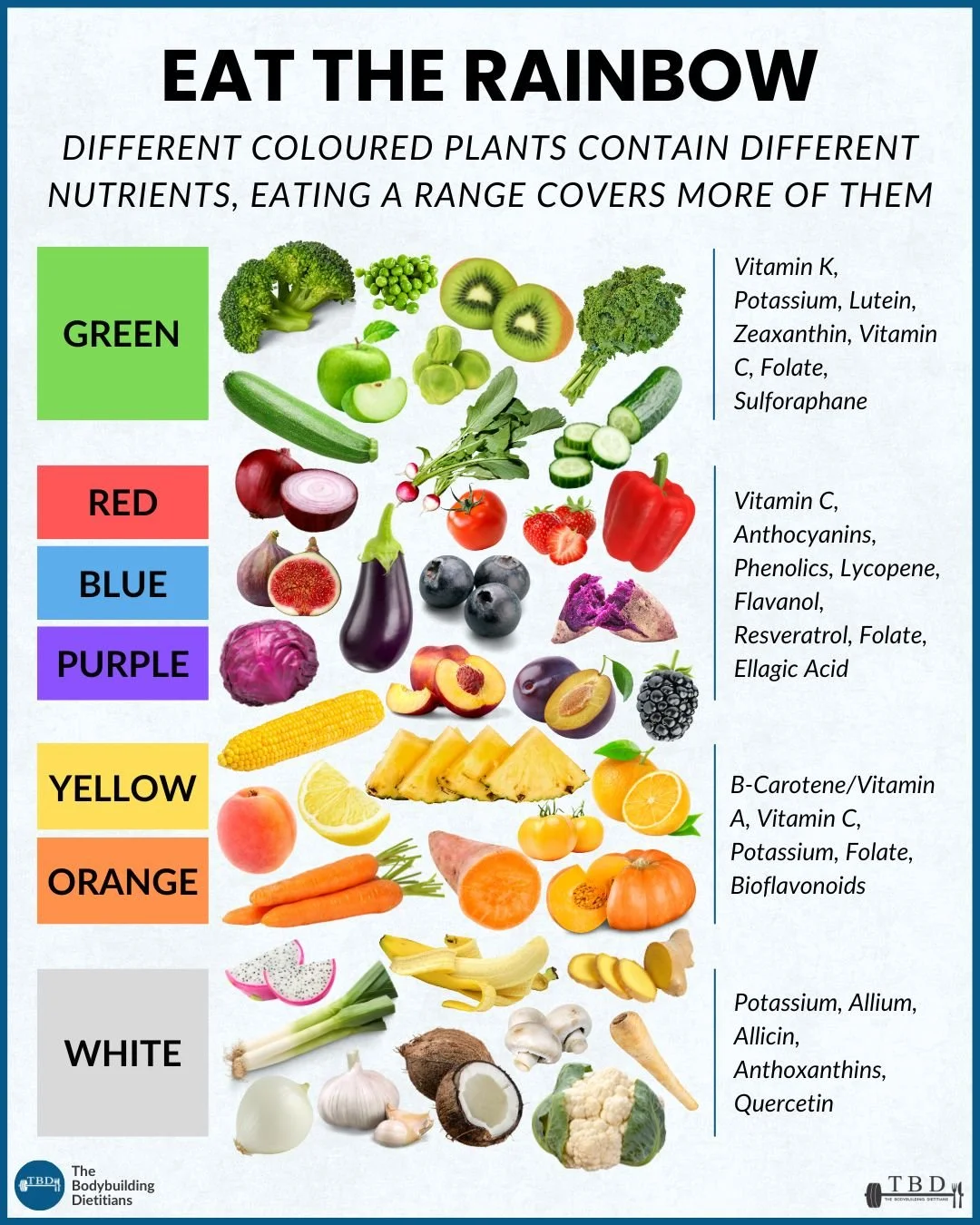
The colour categories in plant foods and the phytonutrients most associated with each. Building variety across the spectrum tends to produce a broader nutrient profile than concentrating intake in a narrower rotation.
The healthiest plant is often the one you're not currently eating. Dietary guidelines consistently emphasise variety in plant foods, and for good reason. Different coloured plants contain different combinations of phytonutrients, micronutrients, fibre types, and prebiotic compounds. Eating across the colour spectrum tends to produce a broader nutrient profile than concentrating intake in a narrow rotation of a few favourites, regardless of how nutrient-dense those individual favourites happen to be.
This isn't primarily about how the plate looks. It's about the underlying biochemistry. Each colour category is dominated by specific families of compounds: anthocyanins in the reds, blues, and purples; carotenoids in the yellows and oranges; glucosinolates and sulphur compounds in many of the whites and cruciferous greens; and vitamin K, folate, and lutein-family compounds in the greens. Each family carries its own combination of documented benefits spanning cardiovascular support, cognitive function, immune regulation, and gut microbiota effects, and no single family fully substitutes for the others.
This article walks through what each colour category actually delivers, why the specific compounds matter, how much variety is worth aiming for practically, and how to build broader colour coverage into an existing food rotation without overhauling the diet. It's designed as a reference for readers looking to expand plant variety deliberately rather than a call to eat more vegetables in general.
Why Do Different Coloured Plants Deliver Different Nutrients?
The colours in fruits and vegetables come from specific plant compounds that also happen to be biologically active in humans. Anthocyanins produce the deep red, blue, and purple colours in berries and eggplant. Carotenoids produce the yellow and orange colours in carrots, sweet potato, and pumpkin. Chlorophyll produces the green colour in leafy vegetables and often correlates with the presence of other beneficial compounds like folate and vitamin K. Sulphur compounds produce the whites of garlic, onions, and cauliflower.
The evolutionary reason plants produce these compounds is protection: from ultraviolet radiation, from oxidative damage, from insects and pathogens, and from environmental stressors. The compounds that protect plants from these stressors often turn out to have overlapping effects in humans, contributing to processes like reducing oxidative stress, supporting cardiovascular function, modulating inflammation, and interacting with the gut microbiota in ways that support overall health.
A body of observational and mechanistic research has documented that higher plant food diversity is associated with reduced risk of cardiovascular disease, certain cancers, type 2 diabetes, and all-cause mortality. The effects appear to work through multiple parallel mechanisms including improved lipid profiles, better glycaemic control, reduced inflammation, improved gut microbiota diversity, and enhanced antioxidant capacity. The specific combination of compounds delivered by variety appears more important than any single compound in isolation. Source: Aune et al., 2017, International Journal of Epidemiology, 46(3):1029-1056; Wang et al., 2021, Circulation, 143(17):1642-1654.
Several practical implications follow from this. First, no single plant or plant category delivers the full range of compounds humans benefit from. Second, higher variety tends to compound rather than average out: eating five different plant foods delivers more diverse nutrients than eating five servings of the same food. Third, the specific benefits documented in the epidemiological data track dietary patterns across weeks and years rather than single meals or days, meaning consistency of variety matters more than any single day's plant intake.
What Do Green Plants Deliver?
Green plants include leafy greens (spinach, kale, silverbeet, rocket, lettuces), cruciferous vegetables (broccoli, Brussels sprouts, cabbage, bok choy), herbs (parsley, coriander, mint, basil), and other greens (peas, green beans, zucchini, cucumber, green apple, kiwifruit, avocado).
The specific compounds most associated with the green category include vitamin K (particularly K1 from leafy greens, which supports blood clotting and bone metabolism), folate (which supports cellular processes including DNA synthesis and red blood cell production), and the carotenoids lutein and zeaxanthin (which concentrate in the eye and support eye health across age). Cruciferous vegetables specifically deliver sulforaphane and related sulphur compounds, which have been extensively researched for their potential roles in supporting the body's antioxidant response and detoxification pathways.
Green vegetables tend to be nutrient-dense per calorie (typically 15 to 50 calories per 100 grams for the leafy varieties) and high in fibre and water content. This makes them particularly useful for people managing calorie intake without wanting to reduce food volume, since a large serving of leafy greens contributes meaningful volume and micronutrient content at very low calorie cost.
Practical inclusion targets: aim for at least one substantial serving of leafy or cruciferous greens per day, and rotate across a few different types across the week rather than eating the same green vegetable exclusively. A common practical rotation might include leafy greens (spinach or kale) in one meal, cruciferous (broccoli or Brussels sprouts) in another, and herbs or other greens distributed across other meals.
What Do Red, Blue, and Purple Plants Deliver?
The red, blue, and purple category groups together plants whose colour comes primarily from anthocyanins (a family of flavonoid compounds) or from lycopene (a carotenoid that produces the red in tomatoes and watermelon). This category includes berries (blueberries, raspberries, strawberries, blackberries), stone fruits (plums, cherries, peaches with red flesh), tomatoes and red capsicum, eggplant, red cabbage, red onion, purple sweet potato, figs, and pomegranate.
The specific compounds most associated with this category include anthocyanins (documented for potential roles in cardiovascular health, cognitive function, and reduced oxidative stress), lycopene (particularly concentrated in cooked tomato products and associated with cardiovascular and prostate health), resveratrol (found in the skins of red grapes and berries, with a mixed research base that has been overstated in supplement marketing), ellagic acid (found in berries and pomegranate), and vitamin C (particularly concentrated in strawberries and red capsicum).
The berry subcategory specifically is one of the most nutrient-dense plant food categories per calorie. Berries deliver substantial polyphenol content alongside meaningful fibre and vitamin C at relatively low calorie density (typically 40 to 65 calories per 100 grams for the common varieties). Regular berry intake has been associated with cardiovascular and cognitive benefits in multiple observational studies, and berries are one of the plant food categories most consistently recommended across dietary guidelines and long-lived population studies.
Practical inclusion targets: aim for at least one serving of berries or red/purple fruits or vegetables per day where possible. Practical options include frozen berries as an affordable year-round source (nutritionally comparable to fresh), cooked tomato products (pasta sauce, canned tomatoes, tomato-based dishes) which increase lycopene bioavailability, and red cabbage or purple sweet potato as rotating vegetable options.
What Do Yellow and Orange Plants Deliver?
The yellow and orange category is dominated by plants whose colour comes primarily from carotenoids (particularly beta-carotene, which the body converts to vitamin A). This category includes carrots, sweet potato, pumpkin, butternut squash, orange capsicum, yellow tomatoes, corn, mango, papaya, apricots, peaches, pineapple, oranges, lemons, and grapefruit.
The specific compounds most associated with this category include beta-carotene and other provitamin A carotenoids (which the body can convert to vitamin A as needed, supporting vision, immune function, and cellular processes), vitamin C (particularly concentrated in citrus and yellow capsicum), potassium (a mineral important for cardiovascular and neuromuscular function that many people fall short of), folate, and bioflavonoids (a broad group of plant compounds with documented roles in cardiovascular and cognitive health).
Sweet potato, carrot, and pumpkin specifically are useful sources of beta-carotene that also happen to be reasonably affordable and shelf-stable. For people wanting to increase carotenoid intake without changing food preferences dramatically, adding a serving of one of these three vegetables to a main meal is one of the easier practical adjustments available. Cooking with a small amount of fat (olive oil, butter, cream) improves carotenoid absorption because carotenoids are fat-soluble, and cooking generally improves carotenoid bioavailability rather than reducing it.
Citrus fruits deliver vitamin C efficiently but also contribute bioflavonoids that appear to work synergistically with vitamin C on absorption and cellular effects. Whole citrus fruits provide more benefit than juice for most purposes because whole fruit includes fibre and the peel-adjacent compounds that juicing typically discards.
Practical inclusion targets: aim for at least one orange or yellow vegetable serving per day (sweet potato, carrot, pumpkin, orange capsicum) plus regular citrus intake (one to three servings per week, or daily during citrus season).
What Do White Plants Deliver?
The white category is more heterogeneous than the coloured categories but includes several important groups: alliums (garlic, onions, leeks, spring onions, shallots), cruciferous whites (cauliflower, white cabbage, kohlrabi), starchy whites (potato, parsnip), mushrooms, and some fruits (banana, pear, apple flesh, dragon fruit).
The specific compounds most associated with this category include allicin and other sulphur compounds (from the allium family, associated with cardiovascular and immune effects), quercetin (a flavonoid found in onions and apples with documented antioxidant activity), anthoxanthins (the pale-colour equivalent of anthocyanins), potassium (particularly concentrated in bananas and potatoes), and various B vitamins.
Alliums specifically are notable because they contribute meaningful flavour to cooking while also delivering compounds with documented cardiovascular and immune effects. Regular allium consumption has been associated with reduced cardiovascular disease risk and improved lipid profiles in multiple studies, and the culinary utility of onions and garlic makes them one of the easier plant food categories to include consistently.
Mushrooms are the one plant food category (technically fungi rather than plants, but grouped here for practical purposes) that also delivers meaningful vitamin D when exposed to UV light during growing or after harvest. Mushrooms sold as "UV-exposed" or "high vitamin D" varieties can contribute usefully to vitamin D intake, particularly for people with limited sun exposure or documented deficiency.
Practical inclusion targets: aim for regular allium use in cooking (most main meals for lifters interested in cardiovascular health), and include at least a few servings of white vegetables per week (cauliflower, mushrooms, potatoes as a starchy carbohydrate contribution).
Not Sure Where Your Diet Is Narrow?
For most people, plant food variety is one of the specific areas where an outside perspective produces quicker improvements than self-assessment. Auditing a food rotation for colour and category coverage is straightforward on paper but often reveals gaps that feel invisible from inside the current pattern (a lifter who eats broccoli daily may not realise they're rotating across two greens instead of five, or that their fruit intake is essentially just bananas and berries with no citrus or orange). Our team works with clients on the specific food selection audit alongside the broader nutrition plan, matched to preferences and cost rather than a generic recommendation.
How Much Variety Do You Actually Need?
The specific target for plant food variety isn't sharply defined by research, but several practical guidelines are worth noting.
Aim for at least 30 different plant foods per week. This target became popular after research from the American Gut Project suggested that people consuming 30 or more different plant foods per week had meaningfully more diverse gut microbiomes than those consuming fewer than 10. The specific number isn't magic, but it captures a useful direction: variety across many foods matters, and rotating a smaller rotation more frequently doesn't fully substitute for eating a broader range of options.
Include something from each colour category most days. Rather than tracking specific compound intake, the practical proxy is aiming for at least three colour categories per day and rotating across all five categories over the course of a week. This produces broader nutrient coverage than concentrating intake in one or two colour groups regardless of how much of those groups you eat.
Prioritise breadth over volume within colour categories. Eating 500 grams of broccoli every day delivers less nutrient variety than eating 200 grams of a rotation across broccoli, kale, spinach, and Brussels sprouts. The specific compounds vary meaningfully between cruciferous vegetables, and no single option covers what the others do.
Include herbs and spices as legitimate contributors. Fresh herbs (parsley, coriander, mint, basil, dill) and dried spices (turmeric, cumin, cinnamon, ginger, garlic powder) count toward plant variety and often deliver concentrated phytonutrients per gram. A meal seasoned with garlic, ginger, turmeric, and coriander contributes multiple plant foods to the daily total in small volumes.
Frozen and canned plant foods count. For affordability and practicality, frozen vegetables and canned tomatoes, beans, and fruits are legitimate sources of the same phytonutrients that fresh produce delivers. In some cases (frozen berries, canned tomatoes), the processed versions retain phytonutrient content as well or better than fresh alternatives that have been sitting in transit for days.
Recognise that variety is a habit, not a single decision. The people who eat 30+ plant foods per week aren't tracking against a specific list. They've built a shopping pattern that rotates across categories, a cooking pattern that includes multiple vegetables in most meals, and a snacking pattern that includes fruit and nuts alongside other options. Building the underlying habits produces the variety as a byproduct.
Practical Takeaways
Different coloured plants deliver different phytonutrients, micronutrients, fibre types, and prebiotic compounds. Building variety across the colour spectrum tends to produce a broader nutrient profile than any narrower plant rotation.
Green plants deliver vitamin K, folate, lutein, zeaxanthin, vitamin C, and sulforaphane. Red, blue, and purple plants deliver anthocyanins, lycopene, resveratrol, and ellagic acid. Yellow and orange plants deliver beta-carotene, vitamin A, potassium, and bioflavonoids. White plants deliver allicin, quercetin, and various sulphur compounds.
No single colour category is nutritionally superior. Green sits alongside orange, not above it. The specific goal is coverage across the spectrum rather than concentration in any one category.
A practical target is 30+ different plant foods per week, with at least three colour categories represented per day and all five categories covered over the course of a week.
Frozen and canned plant foods are legitimate sources of the same phytonutrients as fresh produce, and often more affordable and convenient. Herbs and spices count as plant foods.
Prioritise breadth over volume within colour categories. Rotating across multiple options within each category produces broader nutrient coverage than eating large amounts of the same option repeatedly.
Frequently Asked Questions
What does "eat the rainbow" actually mean?
Eating the rainbow refers to including plant foods from across the colour spectrum in the diet, rather than concentrating intake in one or two colours. Different colours indicate different families of phytonutrients: anthocyanins in reds and purples, carotenoids in yellows and oranges, sulphur compounds in whites and cruciferous greens, and chlorophyll and vitamin K in greens. Each family contributes different benefits, and building variety across the spectrum produces broader nutrient coverage than any narrower rotation.
How many different plant foods should I eat per week?
Aiming for 30 or more different plant foods per week is a commonly cited target based on research suggesting this level of variety supports gut microbiome diversity. The specific number isn't magic, but the direction is useful: broader variety produces broader nutrient coverage. Herbs, spices, nuts, seeds, whole grains, and legumes all count toward the total, so hitting 30+ per week is more achievable than it initially sounds.
Do frozen vegetables have the same nutrients as fresh?
For most nutrients, yes. Frozen vegetables are typically harvested at peak ripeness and frozen quickly, which preserves most vitamin and phytonutrient content. In some cases (particularly for vegetables that spend days in transit), frozen options may actually retain more nutrients than fresh alternatives. Canned vegetables and fruits also retain most nutrients, with some loss of vitamin C but preservation of most other compounds. Both frozen and canned options are legitimate contributions to daily plant food intake.
Which vegetables are healthiest?
No single vegetable is universally healthiest, and rankings that suggest otherwise tend to reflect the specific nutrients being prioritised rather than a genuine overall ranking. Leafy greens (spinach, kale) score well on vitamin K, folate, and calorie density. Cruciferous vegetables (broccoli, Brussels sprouts) score well on sulforaphane and glucosinolates. Berries score well on anthocyanins per calorie. Sweet potato scores well on beta-carotene and satiety per calorie. The practical answer is that variety across categories matters more than any single choice within them.
Do I need to eat all colours every day?
Not strictly. Aiming for at least three colour categories per day and all five categories over the course of a week is a more practical target than trying to hit all five colours daily. Some days will be heavier on greens and yellows, others heavier on reds and whites. The weekly variety matters more than any single day's coverage.
Does drinking a smoothie count as eating plants?
Yes, and blended plant foods deliver most of the same phytonutrients as the same foods eaten whole. The specific consideration with smoothies is that they can be easy to overconsume for calories relative to whole fruits and vegetables, and drinking a smoothie may produce less satiety than eating the same ingredients whole. For people concerned about calorie intake, smoothies are best used as a way to consume more variety than eating alone would allow rather than as a replacement for whole food meals.
If you want help auditing your current food rotation for colour and category variety, identifying where the diet is currently narrow, and building broader plant food intake into a plan that fits your goals, budget, and preferences, our team can build a plan matched to your specific situation. You can enquire about coaching or book a consultation with our team.