A mini-cut is a short, more aggressive period of fat loss, usually run for two to eight weeks. Its main purpose is to reset body composition quickly so a building phase can continue productively, rather than to get stage-lean. This guide covers what a mini-cut is, why the building-phase logic matters more than the fat-loss framing, how to set the deficit and protect training, and the specific situations where running one is the wrong call.
A mini-cut is a short, more aggressive period of fat loss, generally lasting two to eight weeks, defined by a deficit larger than a standard diet combined with a deliberately brief timeframe. Its primary purpose is to extend a building phase: body fat cannot climb indefinitely without the quality of a muscle-gaining phase declining, and a short correction returns body composition to a more productive starting point without committing to the much longer diet that would otherwise be needed later. A secondary benefit is restored appetite, which helps people who struggle to eat enough while gaining. In practice, a mini-cut aims for roughly 1 to 1.5 percent of bodyweight lost per week, created by lowering energy intake around 500 to 1000 calories below maintenance, with the reduction drawn from dietary fat (kept above about 0.3 g/kg) and carbohydrate while protein stays high and training intensity is maintained. A useful frequency guide is at least a one-to-four ratio between weeks dieting and weeks gaining or at maintenance, so a four-week mini-cut is followed by at least sixteen weeks of progressing. Mini-cuts suit experienced dieters and physique competitors who already understand how their training, hunger, and recovery respond to a rapid deficit, and they are best viewed as a targeted tool rather than a default method of fat loss. The evidence supports muscle retention across short aggressive deficits when protein is high and lifting is maintained, though slower diets hold a slight advantage for retention, so the practical case rests on efficiency and momentum rather than physiological superiority.
There is a time and place for faster fat loss. A short, more aggressive deficit becomes useful when body fat has climbed enough to start reducing the quality of a muscle-building phase, and used well it can return someone to a better position to keep gaining without committing to a much longer dieting phase. The strategy is genuinely valuable in the right context, and it is just as genuinely misapplied when it becomes a default way to lose fat.
The important part is context. Mini-cuts tend to suit people who already have experience dieting, adhere well to a structured deficit, and understand how their training, hunger, and recovery respond when calories come down quickly. For someone still learning to manage a moderate deficit, there is usually more value in building those skills first.
This article walks through what a mini-cut actually is, why the main reason to run one is to extend a building phase, how to work out when the timing is right, how to set the deficit and protect training while you run it, and the practical considerations that determine whether it is the correct choice for you at all. For a related look at how a prolonged deficit becomes its own limiter, our article on the five lifter archetypes when progress stalls covers the chronic dieter pattern in more depth.
Muscle protein synthesis is the biological process through which dietary protein stimulates the repair and growth of skeletal muscle, and protecting it is the central concern across any aggressive deficit.
What Is a Mini-Cut, and How Is It Different From a Normal Diet?
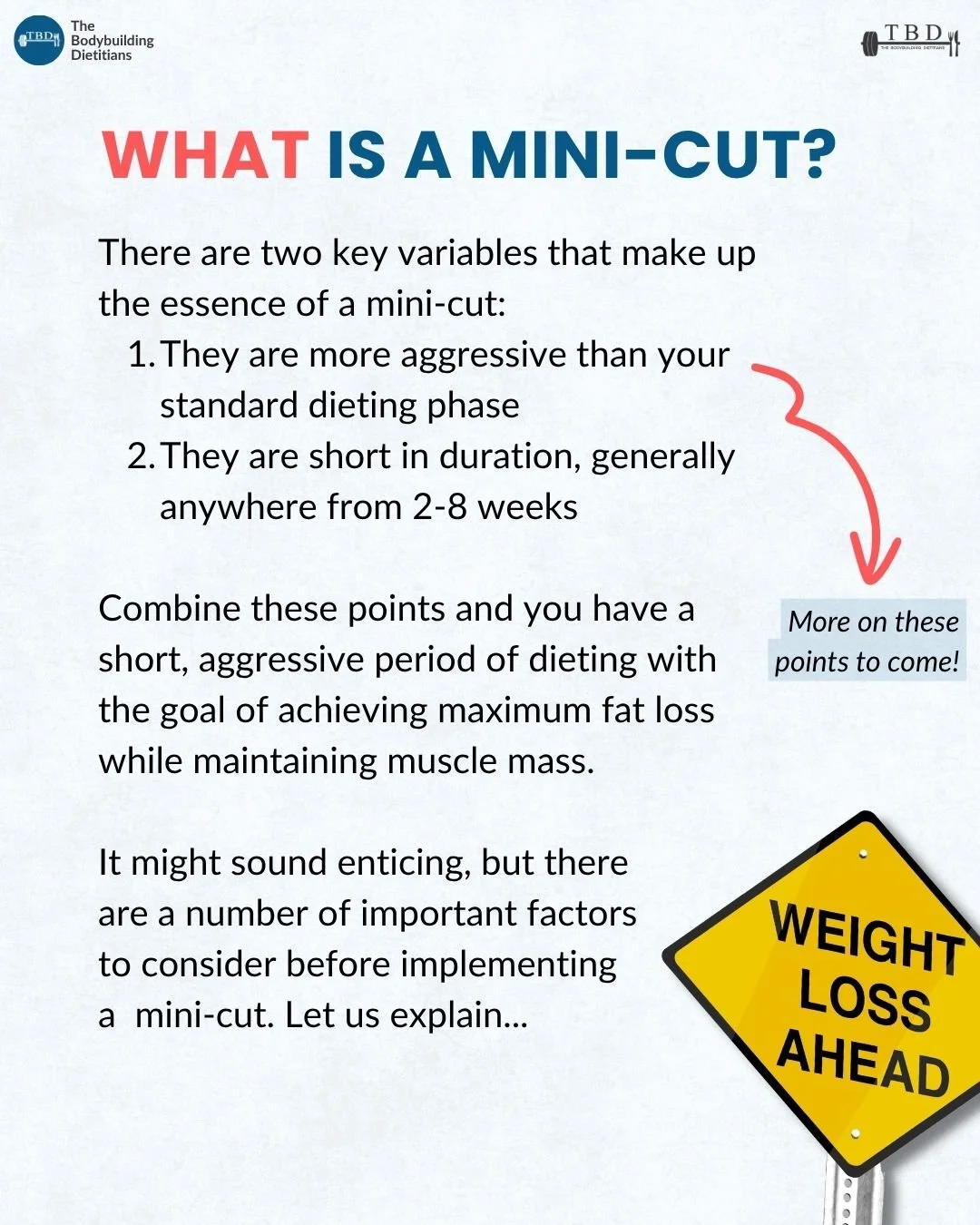
A mini-cut is a short, more aggressive period of fat loss, typically two to eight weeks in length. Two features define it: the deficit is larger than a standard dieting phase, and the timeframe is deliberately brief.
The specific characteristic that separates a mini-cut from an ordinary diet is that short timeframe doing more work than it first appears. Fat comes off faster, the end point is always in sight, and the whole phase finishes before the fatigue and metabolic adaptation of a longer diet fully accumulate. Most of the practical advantages of a mini-cut come from keeping the demanding part of dieting brief, which is why the duration is treated as a defining variable rather than an incidental one.
The trade-off is that a faster rate of loss places heavier demands on training, recovery, and appetite across those few weeks. A standard diet spreads a smaller deficit over a longer period, which is gentler week to week but keeps the person in a deficit for far longer overall. A mini-cut inverts that: a sharper deficit for a shorter time. Whether the inversion is worth it depends almost entirely on context, which the rest of this guide works through.
Why Would You Run a Mini-Cut?
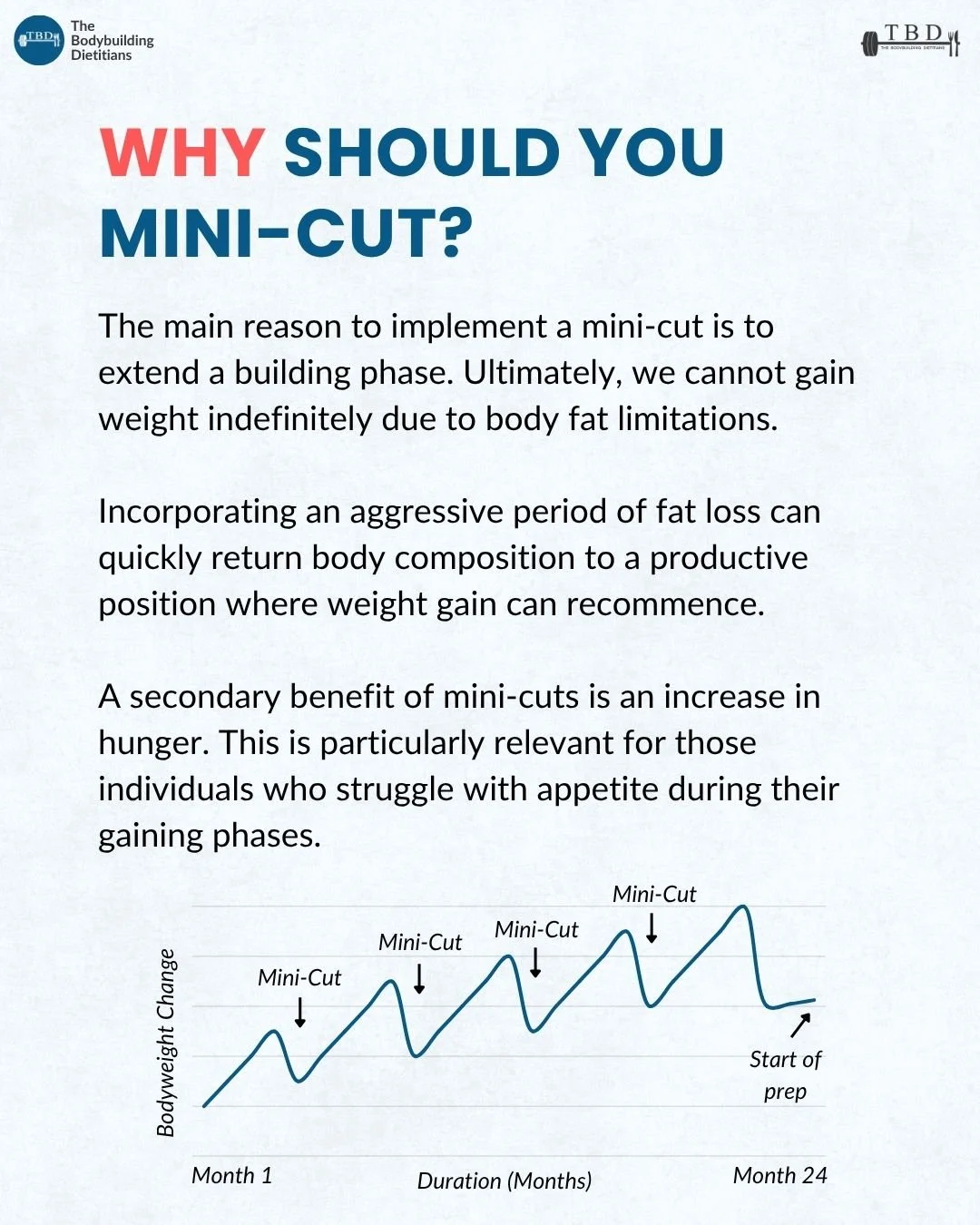
The main reason to run a mini-cut is to extend a building phase. Body fat cannot climb indefinitely without the quality of a muscle-building phase declining, so a short correction returns body composition to a more productive position and lets gaining resume.
The specific logic that makes this the primary use case is that a building phase is not open-ended. As bodyweight climbs, a growing share of the gain tends to be fat rather than muscle, insulin sensitivity can drift, and the person often ends up further from a physique they are happy to maintain. A mini-cut resets that starting point over a few weeks rather than committing to the much longer dieting phase that would otherwise be needed later. Across a full training year, this is what allows several productive gaining blocks to sit end to end, punctuated by brief corrections, rather than one long build followed by one long and demoralising diet.
The secondary benefit worth naming is appetite. A short aggressive deficit tends to restore hunger, which is particularly useful for people who struggle to eat enough during gaining phases. Appetite often blunts as bodyweight and food intake climb, and a brief period of eating less can bring it back, making the return to a surplus considerably easier.
For competitors, the same logic applies with sharper edges. Staying within reach of stage condition across an improvement season makes the eventual contest prep shorter and less punishing. Managing that balance across a full year is one of the areas where structured bodybuilding coaching earns its place, because the timing of each correction depends on how the individual athlete is actually tracking.
A review of resistance-trained athletes in caloric restriction found that the ability to spare lean mass is mediated by training experience, pre-diet training volume, and the size of the energy deficit, with adequate protein intake as a consistent requirement. Source: Roth et al., 2022, European Journal of Applied Physiology.
When Should You Run a Mini-Cut?
Frequency matters. Running mini-cuts too often interrupts training and muscle-gain momentum, while leaving them too late creates a much larger fat-loss phase down the track.
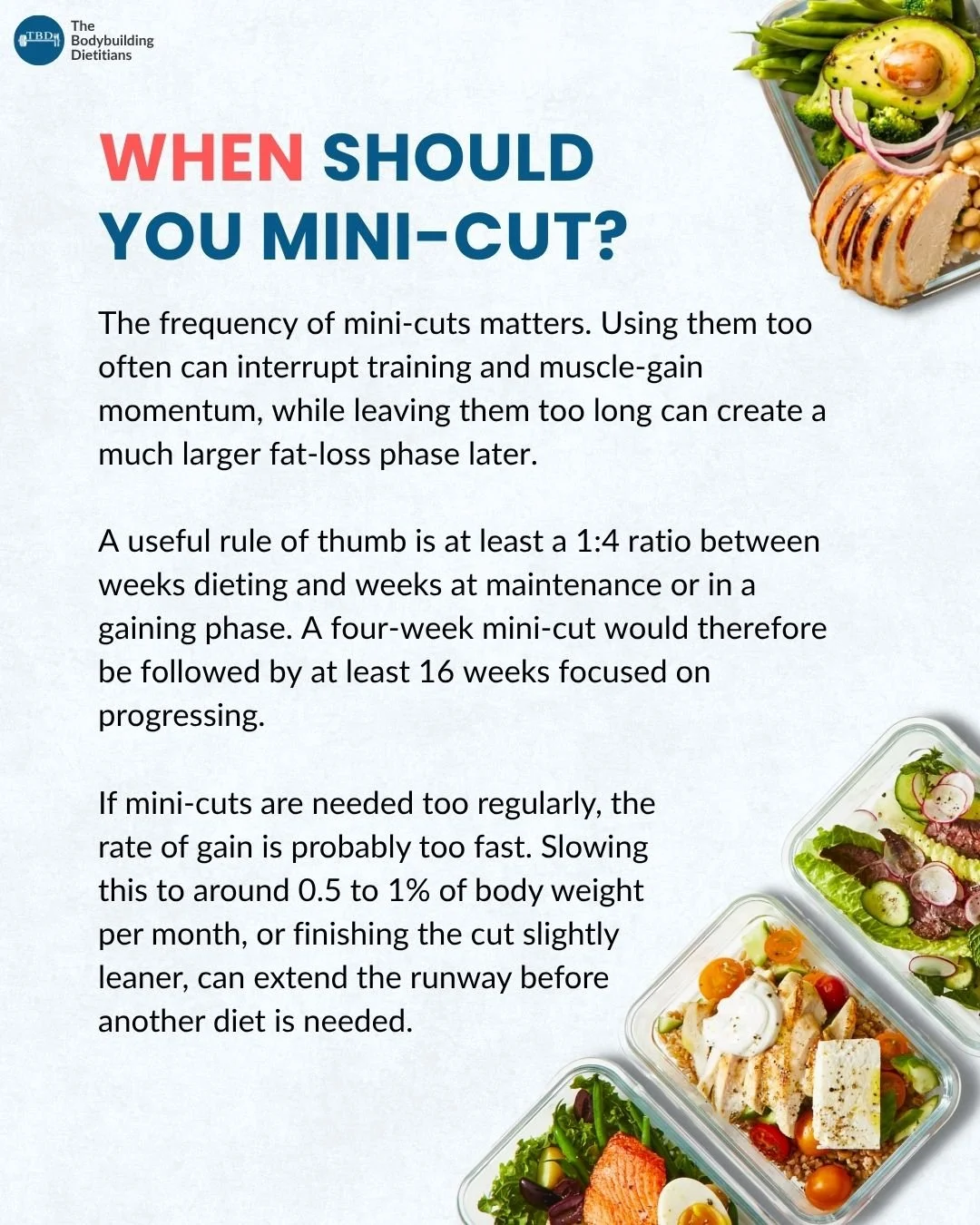
The specific pattern that keeps frequency sensible is a rule of thumb of at least a one-to-four ratio between weeks spent dieting and weeks spent at maintenance or gaining. On that basis, a four-week mini-cut would be followed by at least sixteen weeks focused on progressing. The ratio is a guide rather than a rule, but it holds the shape of the year in place: the great majority of the time should be spent building, with fat-loss phases as the occasional correction.
The signs that a mini-cut is being reached for too often usually point back to the rate of gain rather than the mini-cut itself. If corrections keep becoming necessary, the rate of gain is probably too fast. Slowing gain to somewhere around 0.5 to 1 percent of bodyweight per month, or finishing the cut slightly leaner, extends the runway before another diet becomes necessary. This is often the more useful adjustment, because frequent mini-cuts are usually a symptom of a gaining phase adding fat faster than it needs to. There is also a pattern where repeated short gaining phases, each ended by a mini-cut, add up to very little muscle over a year, since the total time spent in a genuine surplus stays too short for tissue to accrue; our article on why gaining phases keep failing covers that cycle and why a single sustained phase usually produces more than several interrupted ones.
The best moment to begin is when fatigue is low, ideally at the start of or early within a training block. Starting a demanding deficit on top of accumulated fatigue rarely goes well, and the early portion of a training block is where recovery capacity is highest. Setting the right rate of gain in the first place does more to reduce how often mini-cuts are needed than the cuts themselves ever will, and our article on how fast you should bulk covers the training-age-adjusted targets that keep fat gain in check.
How Do You Implement a Mini-Cut?
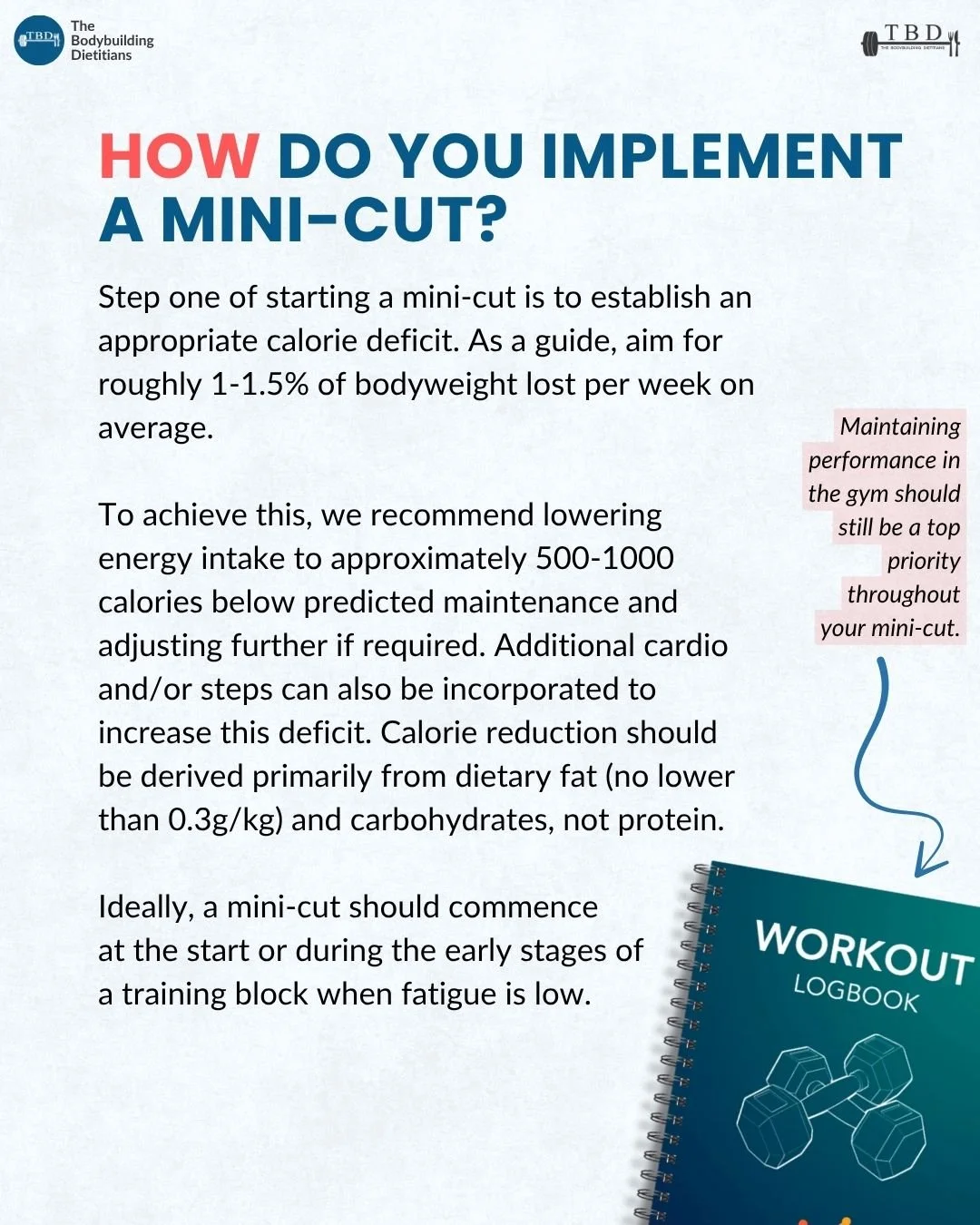
The first step is establishing an appropriate deficit. As a guide, aim for roughly 1 to 1.5 percent of bodyweight lost per week on average, which is faster than a standard diet by design.
The specific method for hitting that rate is to lower energy intake to approximately 500 to 1000 calories below predicted maintenance, then adjust based on how bodyweight actually responds over the first couple of weeks. Additional cardio or daily steps can widen the deficit where needed, though it is generally wise to leave some of that capacity in reserve rather than pulling every lever at once. Where the calories come from matters as much as the total: the reduction should come primarily from dietary fat, kept no lower than around 0.3 g/kg of bodyweight to protect hormonal function, and from carbohydrate, while protein stays high. Keeping protein elevated is the single most important dietary variable for holding on to muscle across a deficit.
Training is the other half of the equation. Maintaining performance in the gym should remain a top priority throughout, because the training stimulus is what signals the body to keep the muscle it has. Load and effort should stay high, with training volume trimmed only if recovery genuinely starts to suffer. This is one reason a mini-cut is best commenced when fatigue is low, since there is more room to hold intensity before recovery becomes limiting. The same four skills that make any fat-loss phase work (energy balance, protein, adherence, and progress tracking) apply here at a compressed timeline, and our article on losing fat while keeping muscle covers each in more depth.
Energy density refers to the number of calories a food provides relative to its weight or volume, and shifting toward lower-energy-density foods can make a mini-cut deficit considerably more comfortable to sustain.
Comparisons of faster and slower fat-loss approaches suggest that slower dieting holds a slight advantage for muscle retention, while shorter aggressive phases retain muscle well when protein is high and resistance training is maintained. The practical case for a mini-cut rests on efficiency and momentum rather than being physiologically superior for muscle preservation. Source: Murphy and Koehler, 2022, Scandinavian Journal of Medicine and Science in Sports.
What Should You Consider Before Starting?
A mini-cut is best viewed as a targeted tool rather than a default way to lose fat, and a few practical realities determine whether it is the right choice.
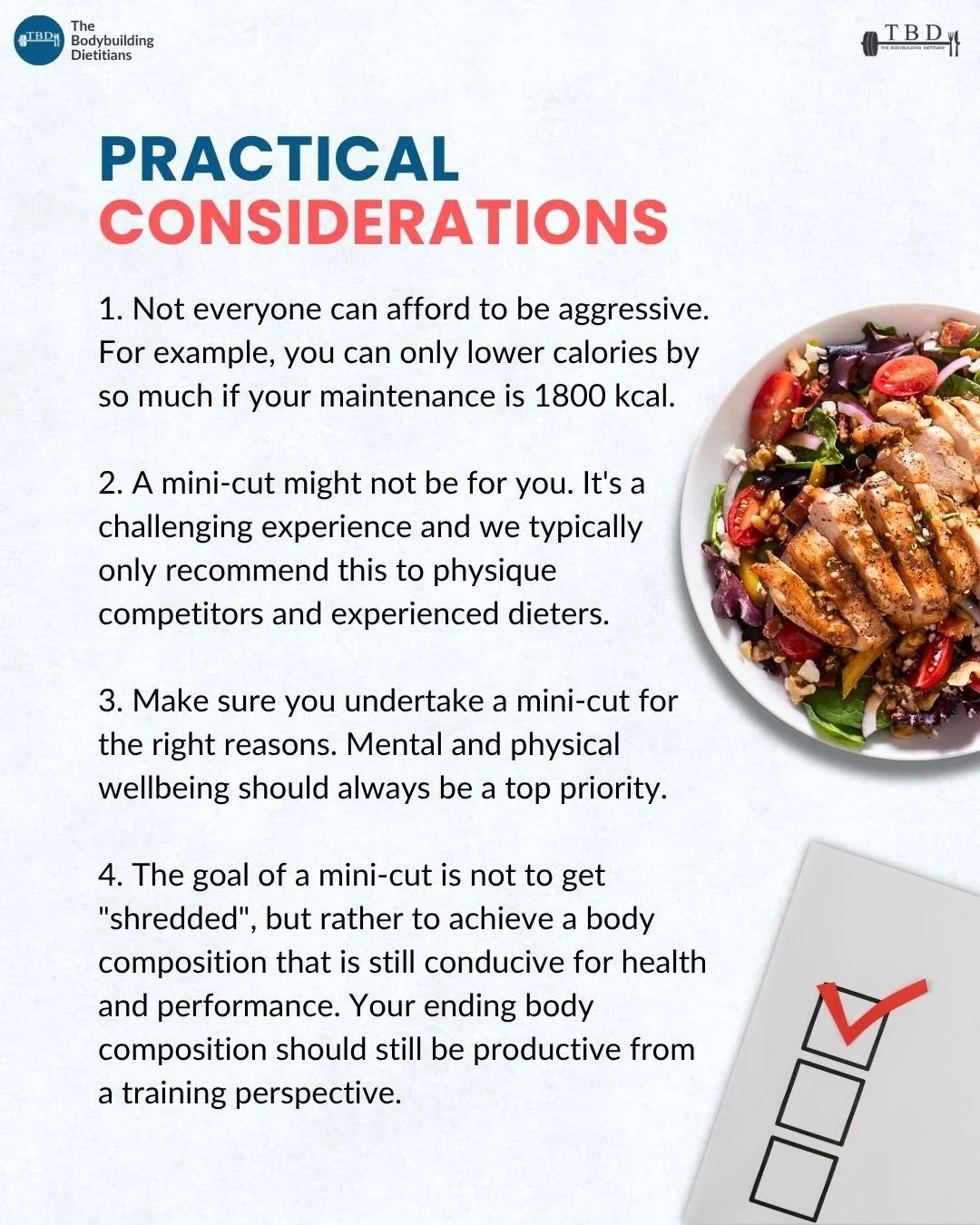
The first consideration is calorie headroom. Not everyone can afford to be aggressive, and if maintenance sits around 1800 calories there is only so far intake can drop before the diet becomes difficult to sustain or nutritionally thin. Someone with a higher maintenance has far more room to create a meaningful deficit while still eating enough.
The second is suitability. A mini-cut may not suit you at all: it is a demanding experience, and it tends to be most appropriate for physique competitors and experienced dieters who already understand how their body responds to a deficit. For someone still learning to manage a moderate diet, there is usually more long-term value in building those skills first. This is the point where many people recognise their own situation, and matching the approach to the person rather than the trend is exactly what individualised, dietitian-led guidance is for.
Not Sure Whether a Mini-Cut Fits Where You Are Right Now?
Deciding whether a faster deficit is worth the demands it places on your training and recovery depends on your experience, your current body composition, and where you sit in your training year. Our team builds that judgement into an individualised plan matched to you, rather than applying a template.
The third consideration is motivation. The reason for running a mini-cut matters, mental and physical wellbeing should stay ahead of any aesthetic target, and one undertaken out of frustration or urgency rarely ends well. The fourth is the end point: the goal is not to get shredded, but to reach a body composition that still supports health and training, so gaining can resume from a productive position.
Practical Takeaways
A mini-cut is a short, aggressive fat-loss phase, usually two to eight weeks, whose main purpose is to extend a building phase rather than to get stage-lean.
Aim for roughly 1 to 1.5 percent of bodyweight lost per week, created by lowering intake around 500 to 1000 calories below maintenance and cutting fat and carbohydrate while protein stays high.
Keep dietary fat above about 0.3 g/kg of bodyweight, and keep training intensity high throughout, since the training stimulus is what protects muscle during a deficit.
Start when fatigue is low, ideally at the beginning of a training block, and use a rough one-to-four ratio of dieting weeks to gaining weeks.
Needing mini-cuts too often usually means the rate of gain is too fast; slowing gain to around 0.5 to 1 percent of bodyweight per month extends the runway before another diet is needed.
Mini-cuts suit experienced dieters and competitors more than beginners, who generally benefit more from mastering a moderate deficit first.
Frequently Asked Questions
How long should a mini-cut last?
Most mini-cuts run for two to eight weeks, with three to four weeks being a common choice. The phase is kept short deliberately, so that fat loss happens before the fatigue and appetite changes of a longer diet accumulate. The right length depends on how much fat needs to come off and how well training and recovery hold up as the weeks progress.
Will I lose muscle during a mini-cut?
Muscle loss is unlikely if protein stays high and resistance training is maintained at a good intensity. Slower diets hold a slight edge for muscle retention, but a well-run mini-cut retains muscle well while achieving fat loss much faster. The practical trade-off is efficiency and momentum rather than a physiological advantage, which is why execution around protein and training matters so much.
Are mini-cuts suitable for beginners?
For most beginners, no. A mini-cut is demanding and works best for people who already understand how their training, hunger, and recovery respond to a deficit. Newer dieters usually gain more from learning to run a moderate diet first, which builds the adherence and self-awareness that make a faster deficit manageable later.
How large should the calorie deficit be?
A common starting point is around 500 to 1000 calories below maintenance, aiming for roughly 1 to 1.5 percent of bodyweight lost per week. The exact figure should be adjusted based on how bodyweight responds over the first couple of weeks. The reduction should come mainly from dietary fat and carbohydrate, with protein kept high to protect muscle.
How often can I run a mini-cut?
A useful guide is at least four weeks of gaining or maintenance for every week of dieting, so a four-week mini-cut is followed by at least sixteen weeks of progressing. Needing them more frequently usually signals that the rate of weight gain during building phases is too high. Slowing the rate of gain often removes the need for such regular corrections.
Do mini-cuts help with appetite?
Yes. A short aggressive deficit often restores hunger, which is helpful for people who struggle to eat enough during a gaining phase. Returning to a surplus afterward tends to feel easier because appetite has been reset, making the following building phase more sustainable.
If you want help deciding whether a mini-cut fits your current phase, and how to run one without stalling your progress, our team can build a plan matched to your specific situation across training, nutrition, and body composition. You can enquire about coaching or book a consultation with our team.