Peak week is one of the least researched areas in physique sport, which is exactly why it is so easy to get wrong in the final few days. This guide covers the physiological and psychological errors that most often undo a good prep in the last week, and the calmer, tested approach that protects the conditioning already built.
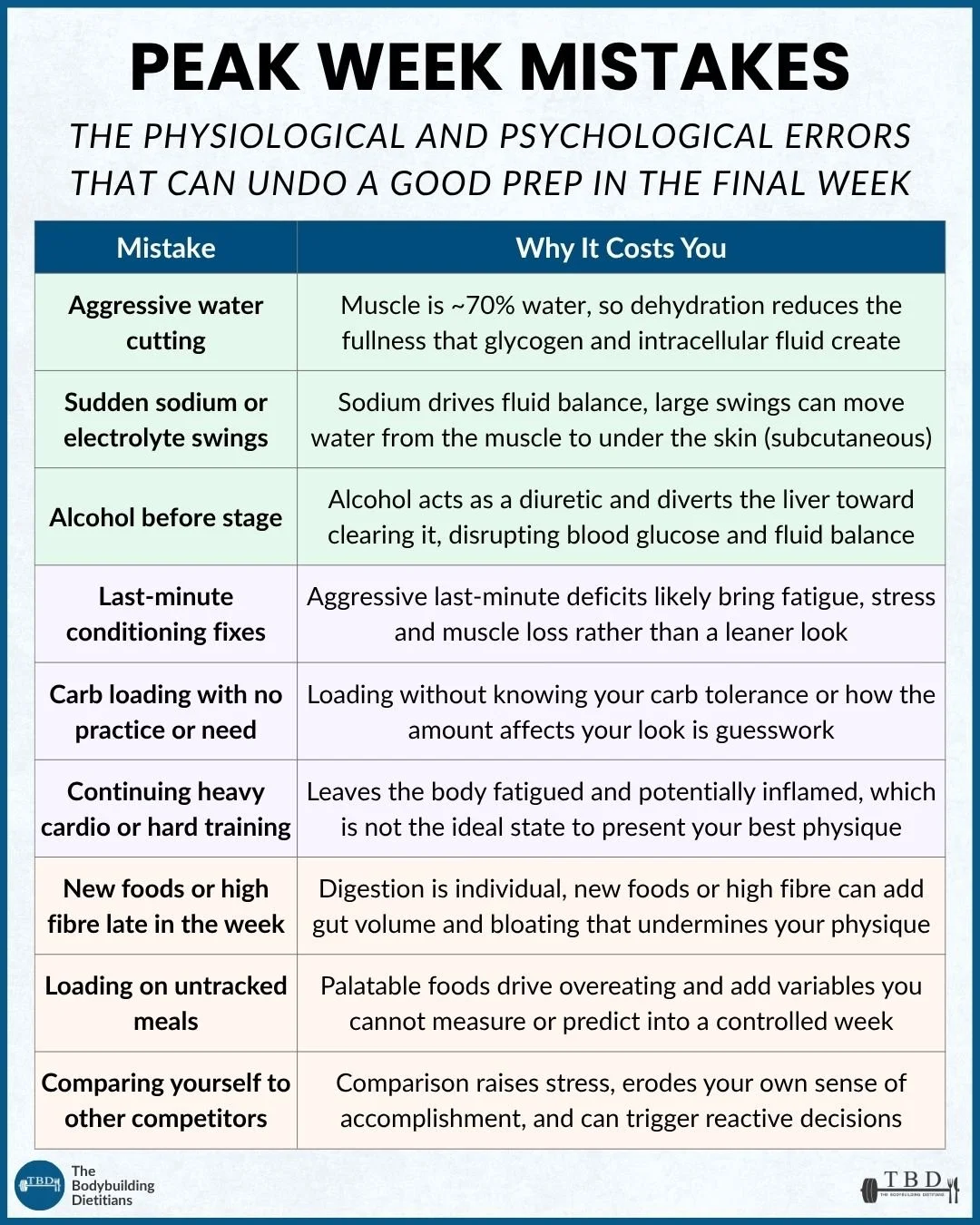
The most reliable way through peak week is to avoid anything drastic and to work only with strategies already tested earlier in the prep. Peak week has very little direct research behind it, so the safest ground is a set of principles rather than a specific protocol. The errors that most often cost a competitor in the final week are physiological: aggressive water cutting, sudden sodium or electrolyte swings, alcohol close to the show, last-minute aggressive dieting, and carb loading without knowing individual tolerance. Others are practical and psychological: continuing heavy cardio or hard training when a taper is needed, introducing new or high-fibre foods late, loading on untracked meals, and comparing yourself to other competitors in a way that drives reactive decisions. Peak week exists to put the finishing touches on a physique already refined across the prep, to load carbohydrates if and when it suits the individual, and to respect how fatigue, fluid balance, and fullness behave. Because so much can appear to work, something working for one competitor is not a reason for another to adopt it. Arriving in genuine stage-lean conditioning through a well-structured prep matters far more than any manipulation attempted in the last seven days, and the calmest, most tested approach is almost always the one that presents the best physique.

Peak week is one of the least understood areas in physique sport. Unlike much of what gets coached day to day, there is very little direct research on peaking, simply because the space has barely been studied. What fills that gap is a mix of scientific principle and what has worked for past competitors, and the line between the two often blurs. Methods pass from coach to client, get shared on social media, and are repeated until they feel like fact, whether or not the evidence was ever there.
The result is that a lot of things can appear to work, and that is exactly what makes peak week difficult. Something working for one competitor does not mean it belongs in everyone's plan, and plenty of athletes have succeeded despite their peak week rather than because of it. The safest ground, when the research is thin, is a set of principles rather than a specific protocol.
This article walks through the nine errors that most often undo a good prep in the final week, grouped into the physiological (water, sodium, alcohol, last-minute dieting, and carb loading) and the practical and psychological (training, food choices, untracked loading, and comparison).
Why Is Peak Week So Easy to Get Wrong?
Peak week is difficult because the evidence is thin and the stakes feel high, which is the exact combination that pushes people toward drastic decisions. When a competitor is days out and nervous, the temptation is to reach for a big intervention, and that is usually where good preps come undone.
The specific problem is that peak week has almost no direct research base, so most of what circulates is inherited practice dressed up as protocol. A method that coincided with one athlete looking good on stage gets credited with the outcome, then passed along as if it caused it. Because so many different approaches have sat alongside good results, almost anything can be defended after the fact, which makes it very hard to separate what worked from what merely did not get in the way.
The useful response is to lower the ambition of the week. Peak week is not the place to gamble on a large payoff, because that was never its purpose. It exists to put the finishing touches on a physique already refined across the prep, to load carbohydrates if and when it suits the individual, and to respect how fatigue, fluid balance, and fullness behave. The competitor who treats it as a fine-tuning window almost always presents better than the one who treats it as a last chance to transform.
Which Physiological Errors Cost the Most in Peak Week?
The physiological mistakes cluster around fluid, sodium, alcohol, aggressive last-minute dieting, and untested carb loading. Each shares the same underlying flaw: it introduces a large, unpredictable variable into a week that rewards stability.
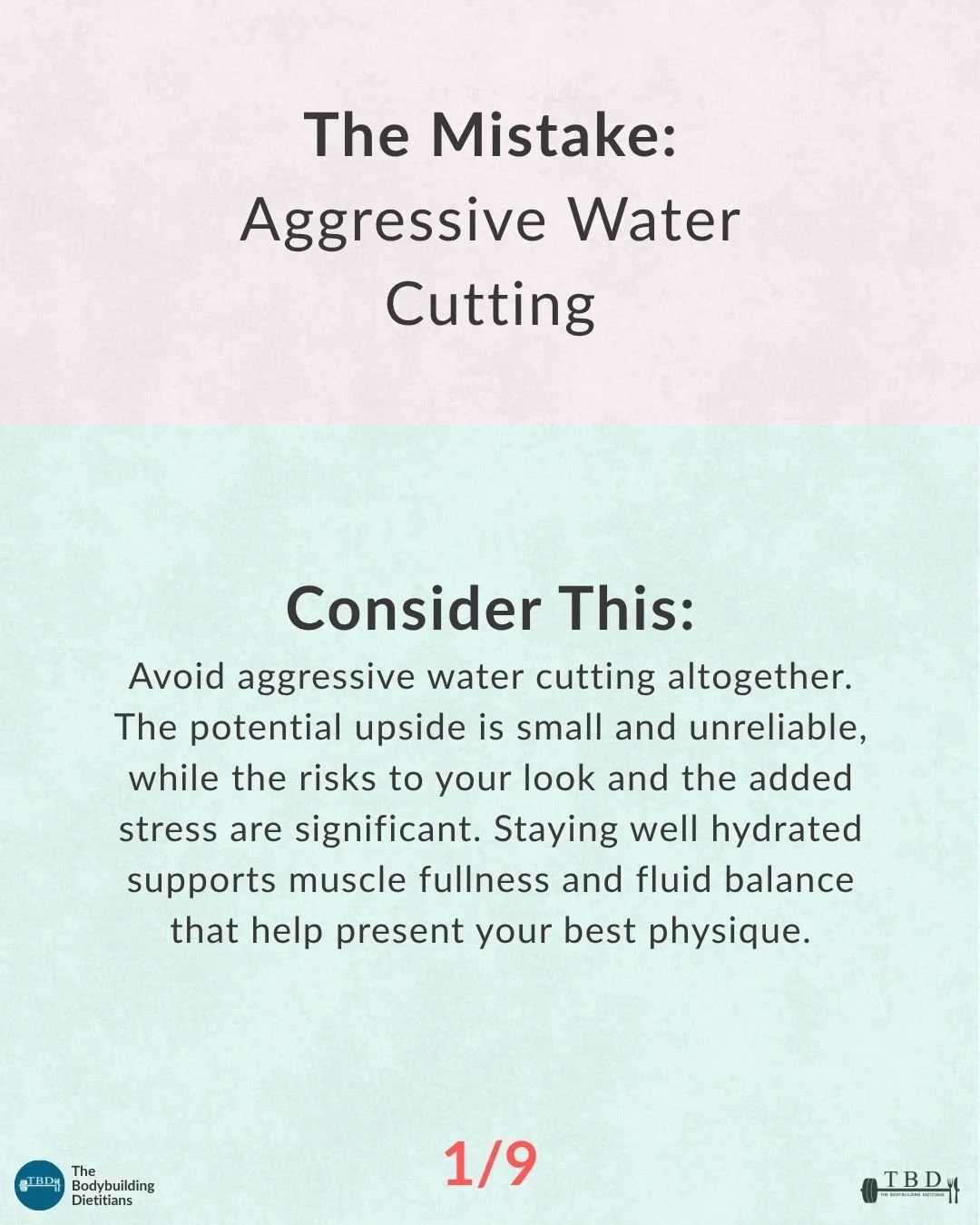
Aggressive water cutting is the clearest example. Muscle is roughly 70 percent water, so pulling fluid hard reduces the intracellular water that creates fullness, not just the subcutaneous water a competitor wants to shed. The potential upside is small and unreliable, the downside to the look is real, and the added physiological stress arrives at the worst possible time. Staying well hydrated supports the muscle fullness and fluid balance that present a physique at its best, which is why the tested default is to leave aggressive water manipulation alone.
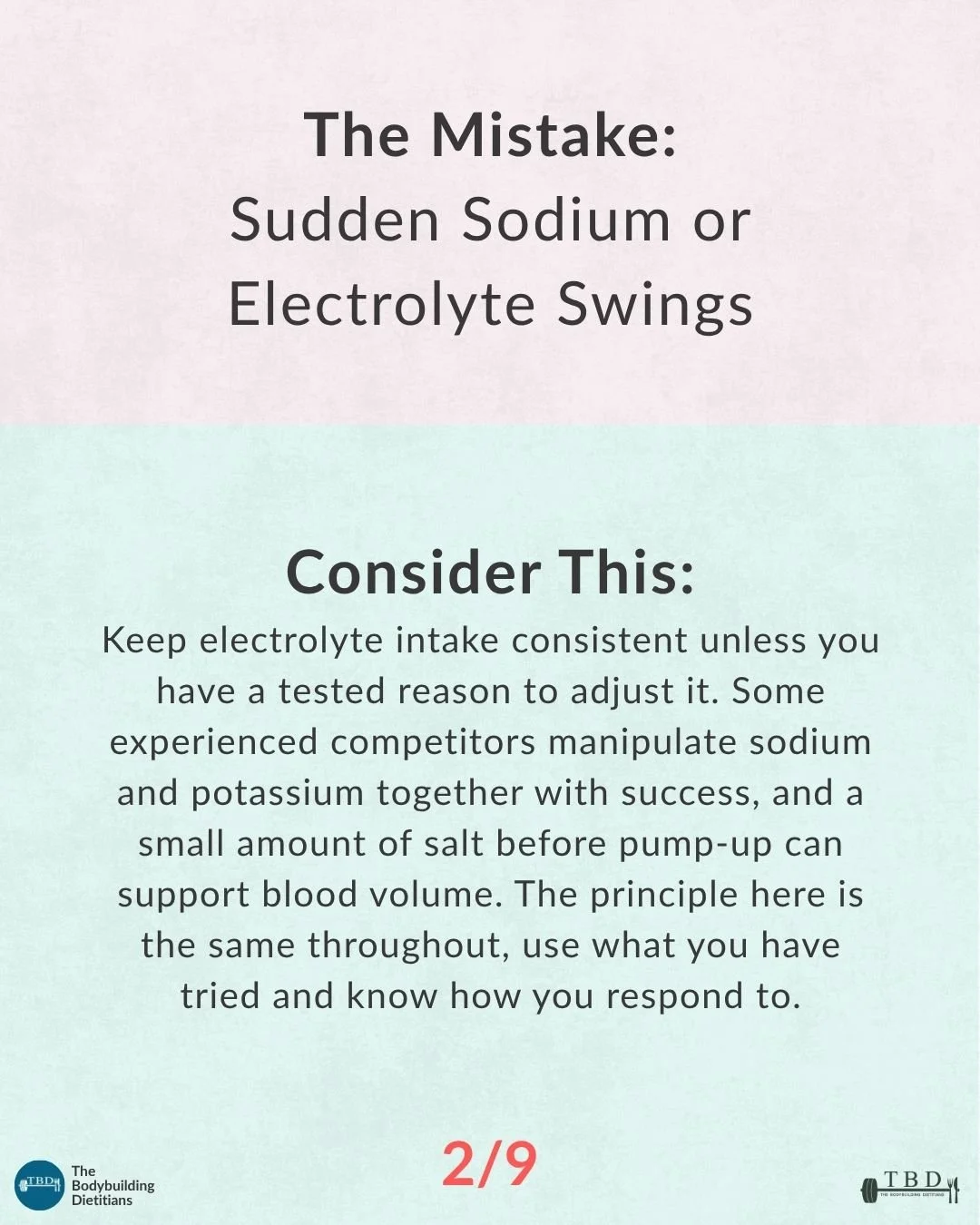
Sudden sodium or electrolyte swings work against a competitor for a related reason. Sodium drives fluid balance, and large swings can move water from inside the muscle to under the skin. Keeping electrolyte intake consistent is the sensible default. Some experienced competitors do manipulate sodium and potassium together with success, and a small amount of salt before pump-up can support blood volume, but those are moves for people who have tested them and know how they respond, not first attempts in the final week.
Alcohol close to a show adds unpredictability with no offsetting benefit. It acts as a diuretic and diverts the liver toward clearing it, disrupting blood glucose and fluid balance in the process. The physiological effects work against the look, and the unpredictability alone makes it not worth the risk.
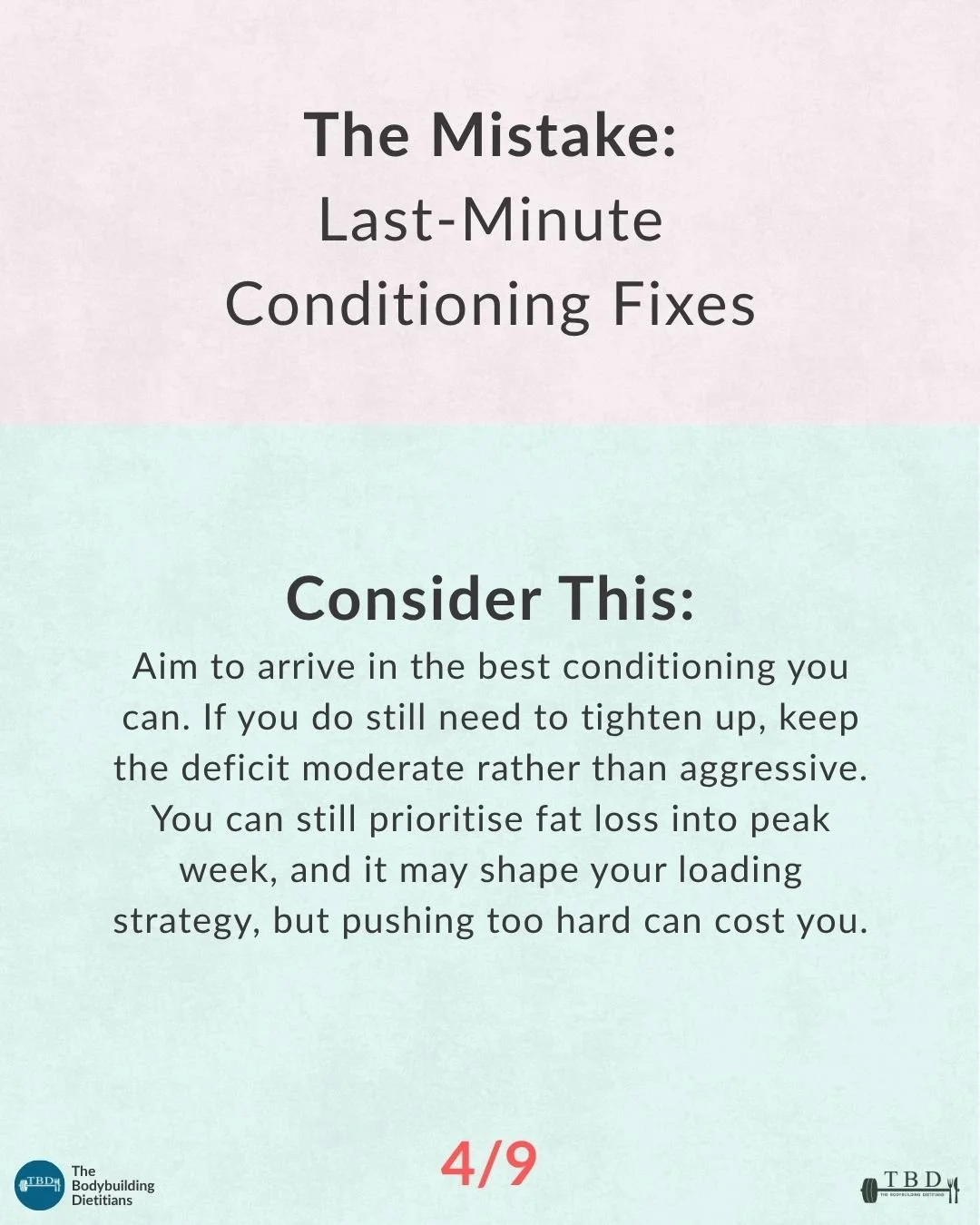
Last-minute conditioning fixes are the trap that catches nervous competitors. Aggressive deficits in the final days tend to bring fatigue, stress, and muscle loss rather than a leaner appearance. Arriving in the best conditioning you can is the goal, and if some tightening is still needed, a moderate deficit is workable and may shape the loading strategy. Pushing too hard this late usually costs more than it returns.
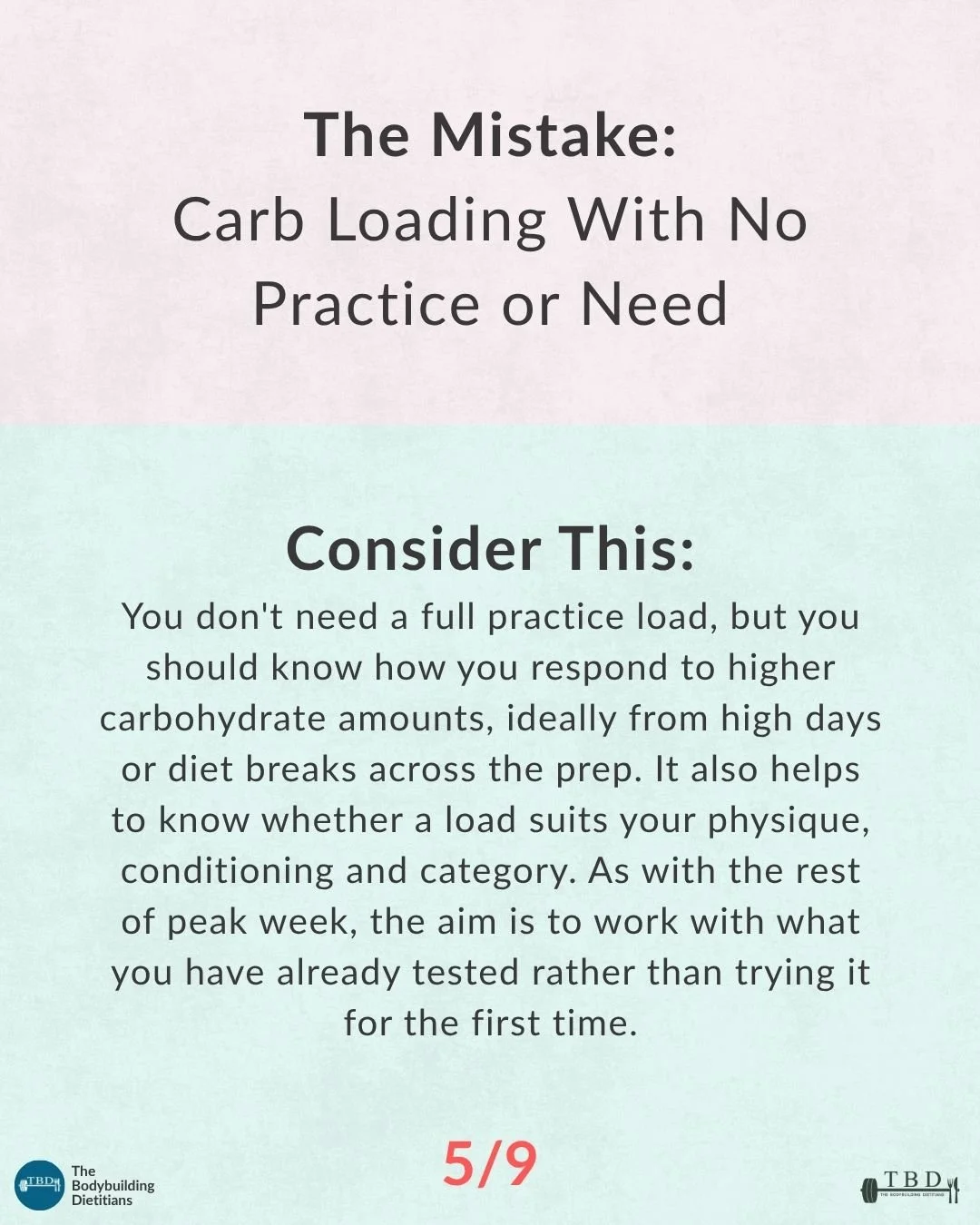
Carb loading rounds out the physiological group. A full practice load is not essential, but knowing how you respond to higher carbohydrate amounts is, ideally from high days or diet breaks accumulated across the prep. Whether a given load suits your physique, conditioning, and category is information best gathered in advance. The aim, as with the rest of peak week, is to work with what you have already tested rather than trying it for the first time when it matters most.
Which Practical and Psychological Errors Undo a Prep?
The remaining errors are behavioural rather than strictly physiological, and they undo preps just as effectively. Training choices, food selection, untracked loading, and comparison all introduce avoidable variability into the final week.
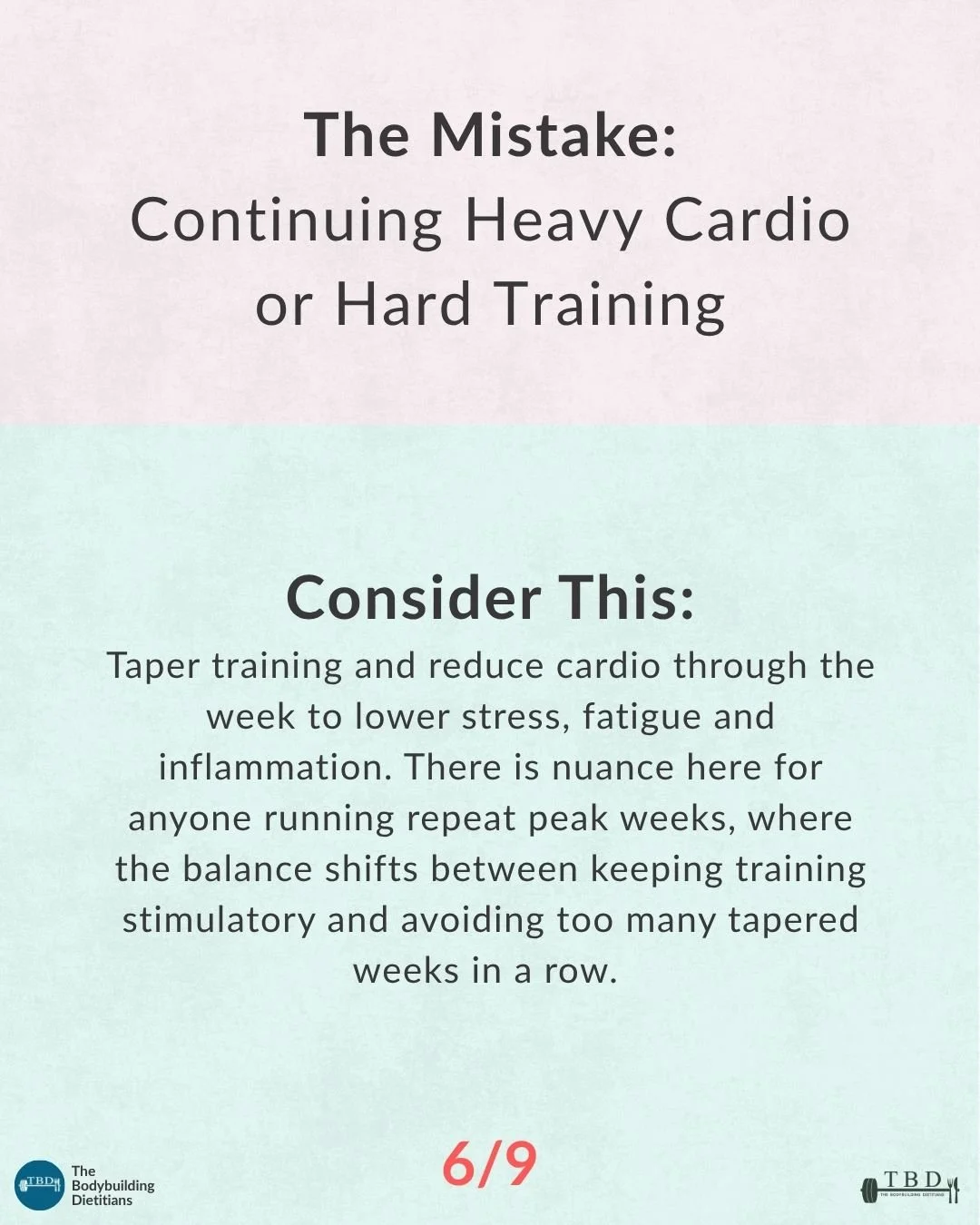
Continuing heavy cardio or hard training is the first. Tapering training and reducing cardio through the week lowers the stress, fatigue, and inflammation that leave a physique looking flat rather than recovered. There is genuine nuance for anyone running repeat peak weeks, where the balance shifts between keeping training stimulatory and stacking too many tapered weeks in a row, but for a single show the taper is almost always the right call.
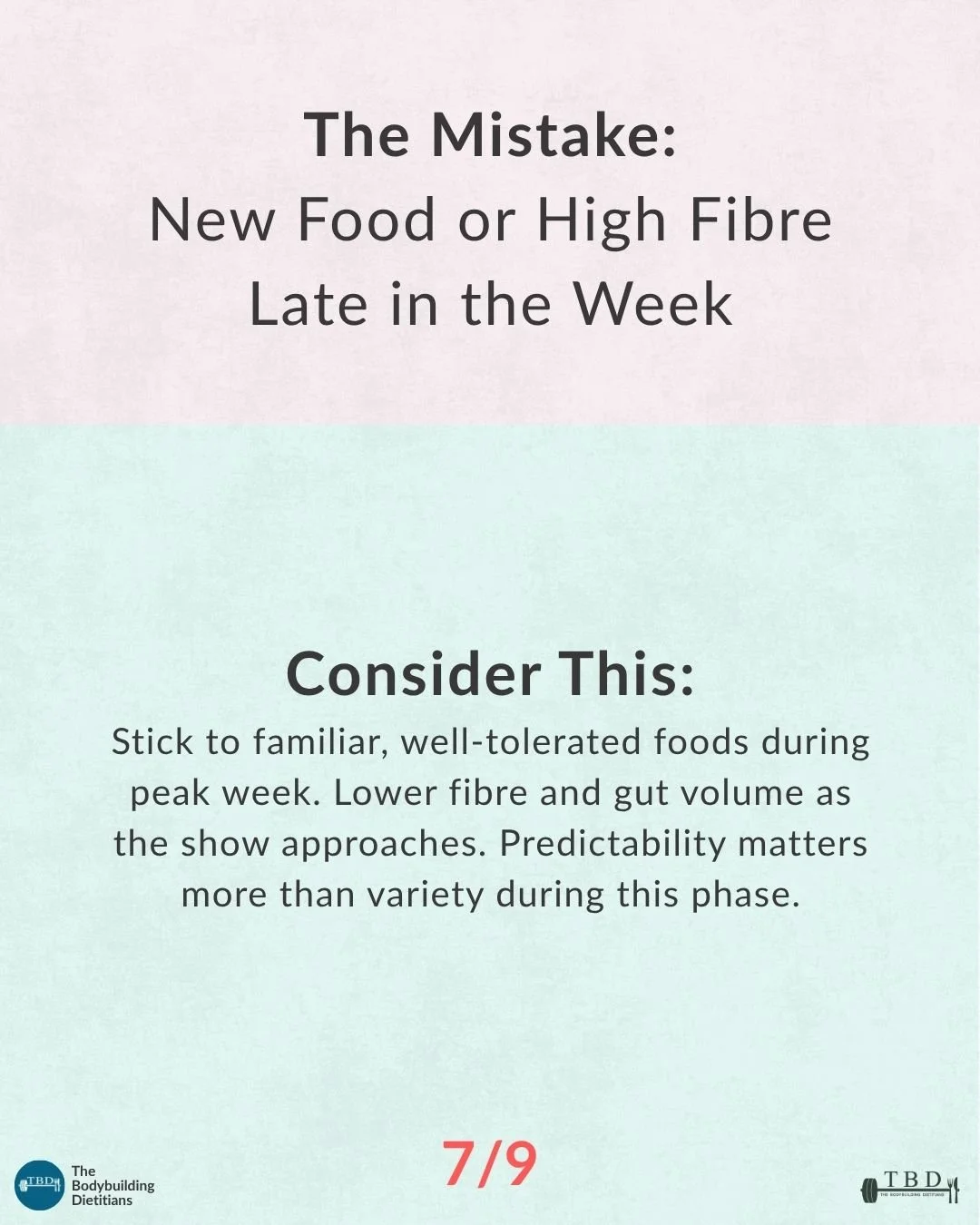
New foods or high fibre late in the week is the next. Digestion is individual, and unfamiliar foods or a jump in fibre can add gut volume and bloating that undermines the physique on the day. Sticking to familiar, well-tolerated foods and lowering fibre and gut volume as the show approaches keeps the variable of digestion predictable, which matters more than variety during this phase.
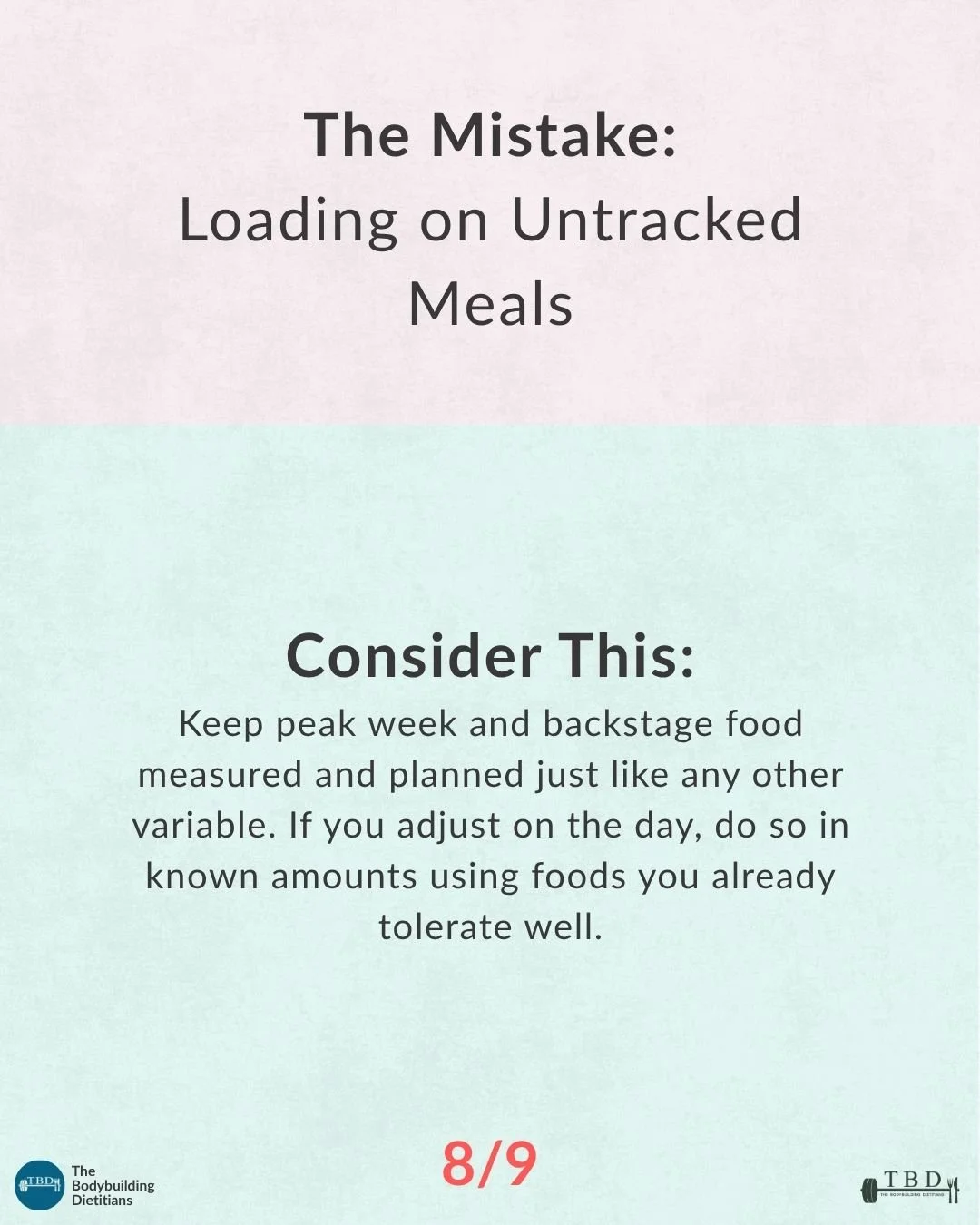
Loading on untracked meals introduces the same problem from a different direction. Peak week and backstage food deserve the same measurement and planning as any other variable in the prep. Palatable foods drive overeating and add variables that cannot be measured or predicted into a week built on control. If an adjustment is needed on the day, making it in known amounts with foods you already tolerate keeps the plan intact.
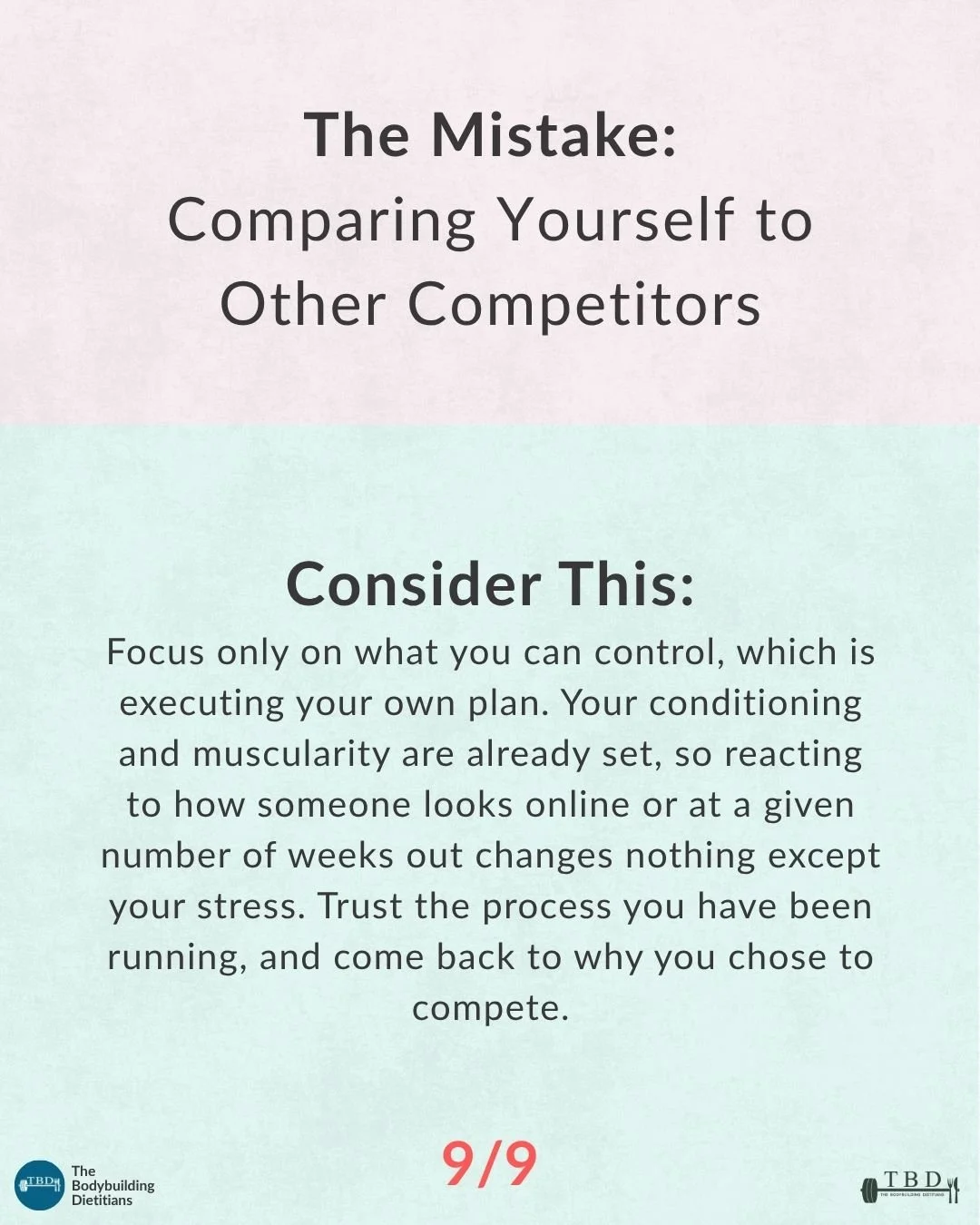
Comparing yourself to other competitors is the error that sits closest to the mind rather than the body, and it is often the most costly. By peak week your conditioning and muscularity are already set, so reacting to how someone looks online or at a given number of weeks out changes nothing except your stress and the quality of your decisions.
Days Out and Tempted to Change Everything?
The final week is where nerves push competitors toward drastic moves, and where a second set of eyes matters most. Our team makes these calls with our own competitors every prep, matched to how each individual has actually responded across the diet rather than to a generic protocol.
The correction for comparison is to narrow your focus to what you can control, which is executing your own plan. Trust the process you have been running, and come back to why you chose to compete in the first place. That reframing does more for stage presence than any last-minute physical change attempted out of anxiety.
How Should You Actually Approach Peak Week?
The most reliable approach is to keep the week calm, conservative, and built entirely on tested inputs. None of this means that any single approach above is inherently wrong for every athlete; it means that when the research is thin, principles are safer than protocols.
The most important principle is to avoid anything drastic. Peak week was never designed to deliver a large transformation, and treating it as a fine-tuning window rather than a rescue mission is what protects the work already done. The competitors who present best are usually the ones who arrive genuinely stage-lean through a well-structured prep and then change as little as possible in the final days.
Where a coach truly earns their place is here, because these calls are individual and difficult to make well for yourself under the stress of a show week. Managing fatigue, fluid, and fullness across the final days is one of the areas where our bodybuilding coaching provides the most value, since the right decision depends entirely on how a given athlete has responded across the whole prep. The broader determinants of how you present, including the ones set long before peak week, are covered in our guide to the factors that shape peak conditioning.
Practical Takeaways
Treat peak week as a fine-tuning window, not a transformation. Its purpose is to finish a physique already refined across the prep, not to rescue conditioning that is not there.
Avoid drastic moves in the final days. Aggressive water cutting, large sodium swings, alcohol, and last-minute aggressive dieting all add unpredictable variables at the worst time.
Only use strategies you have already tested. A carb load, a sodium adjustment, or a food should be something you know your response to, not a first attempt in the final week.
Taper training and reduce cardio to lower stress, fatigue, and inflammation, with some nuance for competitors running repeat peak weeks.
Keep food familiar, lower in fibre, and measured, including backstage, so digestion and gut volume stay predictable.
Focus only on what you can control. By peak week your conditioning is set, so comparison to others adds stress without changing the outcome.
Frequently Asked Questions
What is the most common peak week mistake?
The most common and costly mistake is attempting something drastic in the final days, most often aggressive water cutting. Because muscle is roughly 70 percent water, pulling fluid hard tends to reduce the fullness a competitor wants rather than improve it. The safer default is to stay well hydrated and change as little as possible.
Should you cut water before a bodybuilding show?
Aggressive water cutting is generally not worth the risk. The potential upside is small and unreliable, while the effect on muscle fullness and the added physiological stress can work against your look on the day. Staying well hydrated supports the fluid balance and fullness that present a physique at its best.
Do you need to carb load for a physique show?
Not necessarily, and if you do, it should be based on how you already know you respond to higher carbohydrate amounts. That information is best gathered from high days or diet breaks across the prep rather than attempted for the first time in peak week. Whether a load suits you also depends on your physique, conditioning, and category.
Should you train during peak week?
Most competitors benefit from tapering training and reducing cardio through peak week to lower stress, fatigue, and inflammation. There is some nuance for athletes running repeat peak weeks, where keeping training stimulatory has to be balanced against stacking too many tapered weeks in a row. For a single show, a taper is usually the right approach.
Why does peak week have so little research behind it?
Peak week has barely been studied directly, so most of what circulates is a mix of scientific principle and inherited practice from past competitors. Successful outcomes often get credited to a specific method even when that method may not have caused them. This is why relying on tested principles, rather than a fixed protocol, is the safer approach.
How do you handle nerves and comparison during peak week?
By peak week your conditioning and muscularity are already set, so comparing yourself to other competitors changes nothing except your stress and your decisions. Focusing only on executing your own plan, trusting the process you have run, and returning to why you chose to compete tends to support a better stage presence than any last-minute change made out of anxiety.
Peak week decisions are individual, and they are hard to make well for yourself under the pressure of a show week. If you would like that support for your own prep, our bodybuilding coaching provides the structure and outside perspective the final week rewards. You can enquire about working with our team or book a consultation to talk through your next prep.