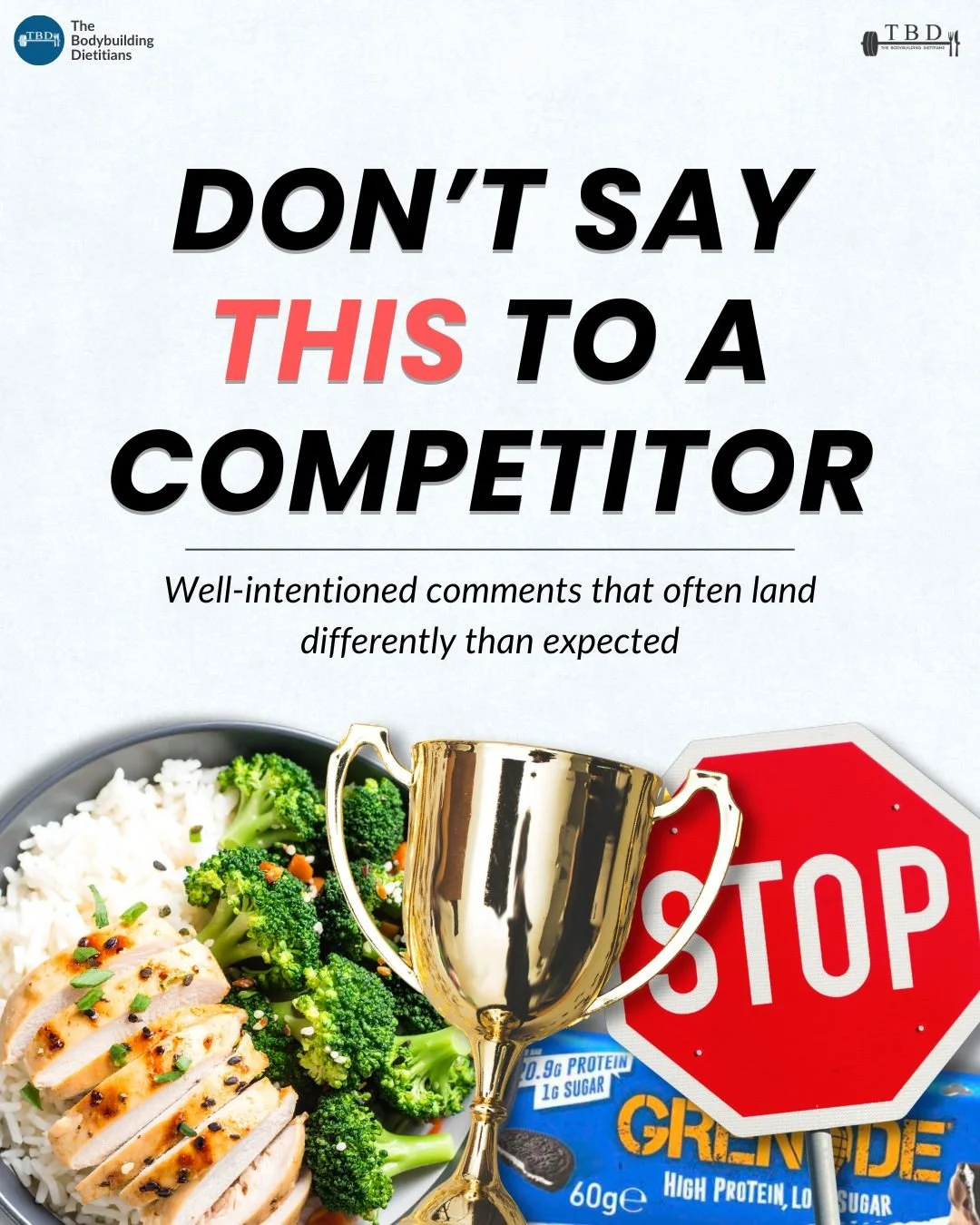
Well-intentioned comments can land differently than expected during contest preparation. Understanding why certain remarks carry more weight than they seem can help everyone around a competitor offer better support.
Bodybuilding competitors routinely hear well-meaning comments about their food, training, body, and lifestyle choices throughout contest preparation. While most of these remarks come from genuine curiosity or care, they can accumulate over the course of a long prep and add unnecessary psychological friction. The most effective way to reduce this is a combination of proactive communication from the athlete and a small amount of awareness from the people around them.
This post is not about being thin-skinned. Competitive bodybuilding demands resilience, discipline, and the ability to stay focused under significant physical and psychological stress. Managing external commentary is part of that process, and experienced competitors develop the ability to handle it well over time.
There is, however, a difference between handling something well and pretending it has no impact at all.
Contest preparation typically spans 16 to 24 weeks and involves progressively reducing energy intake, maintaining or increasing training volume, and sustaining a level of structure and discipline that most people outside the sport have never experienced firsthand. The physical demands of this process are well documented, but the psychological load is often underestimated, both by people on the outside and sometimes by the athletes themselves. During this period, the comments and questions a competitor hears from friends, family, colleagues, and acquaintances can either provide genuine support or become an additional source of stress, depending on how they land.
Some of these comments come from genuine curiosity. If someone has never been around a competitive athlete before, questions about training frequency, food choices, or lifestyle habits are natural and often well-intentioned. That is completely understandable, and most competitors are happy to explain what the sport requires when the question comes from a place of interest.
Where it becomes more difficult is when the remarks are repeated, dismissive, or designed to undermine rather than understand. Comments about being "too serious," jokes about food restrictions, or pressure to skip training may seem minor in isolation, but over the course of a full prep, they accumulate. Understanding why certain comments carry more weight than they appear to is useful for anyone who wants to be genuinely supportive of someone going through this process.
What Are the Most Common Things Competitors Hear During Prep?
The nine comments covered in this article represent some of the most frequently reported remarks competitors encounter during contest preparation. Each one is explored below, along with context about why it tends to land the way it does and how both competitors and the people around them can navigate it more effectively.
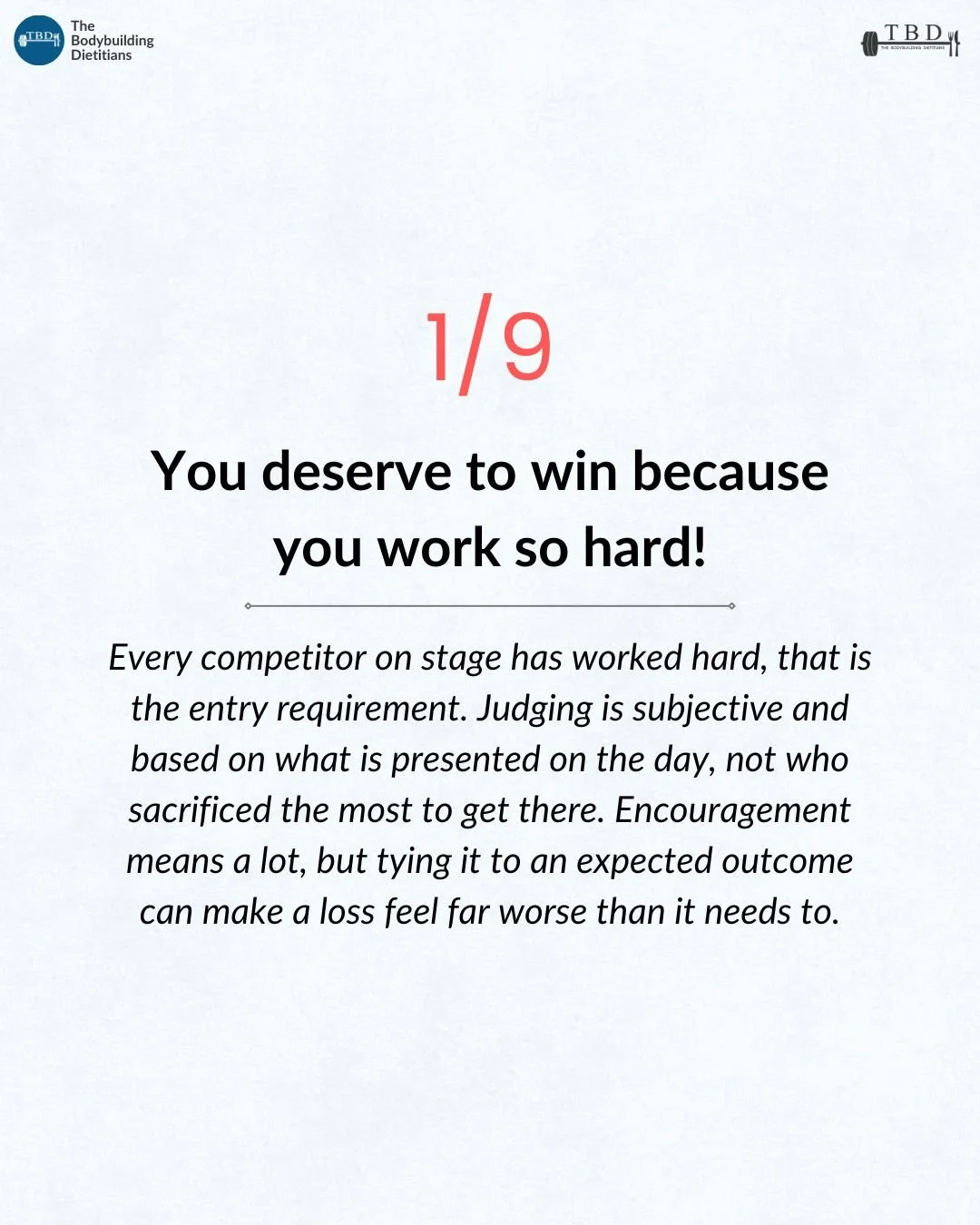
"You deserve to win because you work so hard!"
This is one of the most well-intentioned comments a competitor can hear, and it usually comes from someone who is trying to be supportive. The difficulty is that it ties encouragement to an expected outcome, which can make an unfavourable result feel far worse than it needs to.
Every competitor on stage has worked hard. That is the entry requirement, not a differentiator. Judging in physique sport is subjective and based on what is presented on the day, not on who sacrificed the most to get there. A competitor can do everything right across a 20-week prep, arrive in the best condition of their career, and still not place where they or their supporters expected, simply because the lineup on that particular day included physiques that matched the judges' criteria more closely.
Encouragement is valuable and appreciated, but framing it in a way that is not contingent on a specific result tends to land better. Acknowledging the effort, the consistency, and the commitment without attaching it to a placement allows the competitor to feel supported regardless of how the day unfolds. Something as simple as "you should be proud of how you have prepared" carries real weight without creating pressure around the outcome.
Contest preparation is the structured phase of training and nutrition leading into a physique competition, typically lasting 16 to 24 weeks and involving progressive energy restriction, sustained resistance training, and careful management of body composition to achieve stage-ready conditioning.
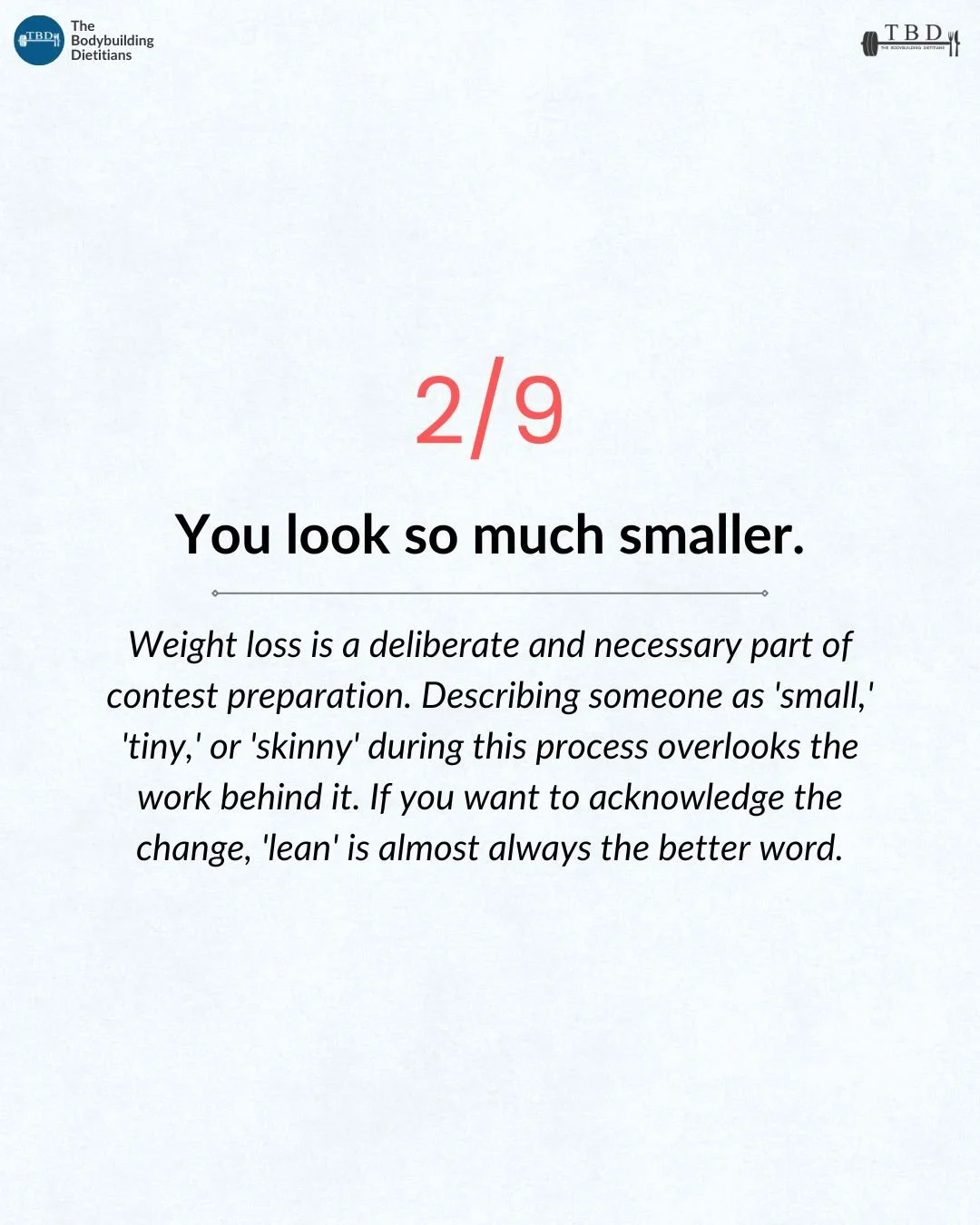
"You look so much smaller."
Weight loss is a deliberate and necessary part of contest preparation. Describing someone as "small," "tiny," or "skinny" during this process tends to overlook the work behind it and can feel dismissive of the effort involved. For many competitors, hearing that they look smaller registers as a comment about their muscle mass rather than their leanness, which is the opposite of what they are working toward.
If you want to acknowledge the physical change, the word "lean" is almost always a better choice. It recognises the process for what it is: a deliberate reduction in body fat to reveal the physique underneath, rather than a loss of the muscle that the athlete has spent months or years building. This distinction might seem subtle, but for someone deep into prep, it carries real significance.
In coaching settings, competitors often report that body-related comments from people outside their training environment are among the most difficult aspects of the social experience of prep. This is worth understanding, because it explains why a comment that seems neutral or even complimentary can land as something far less welcome.
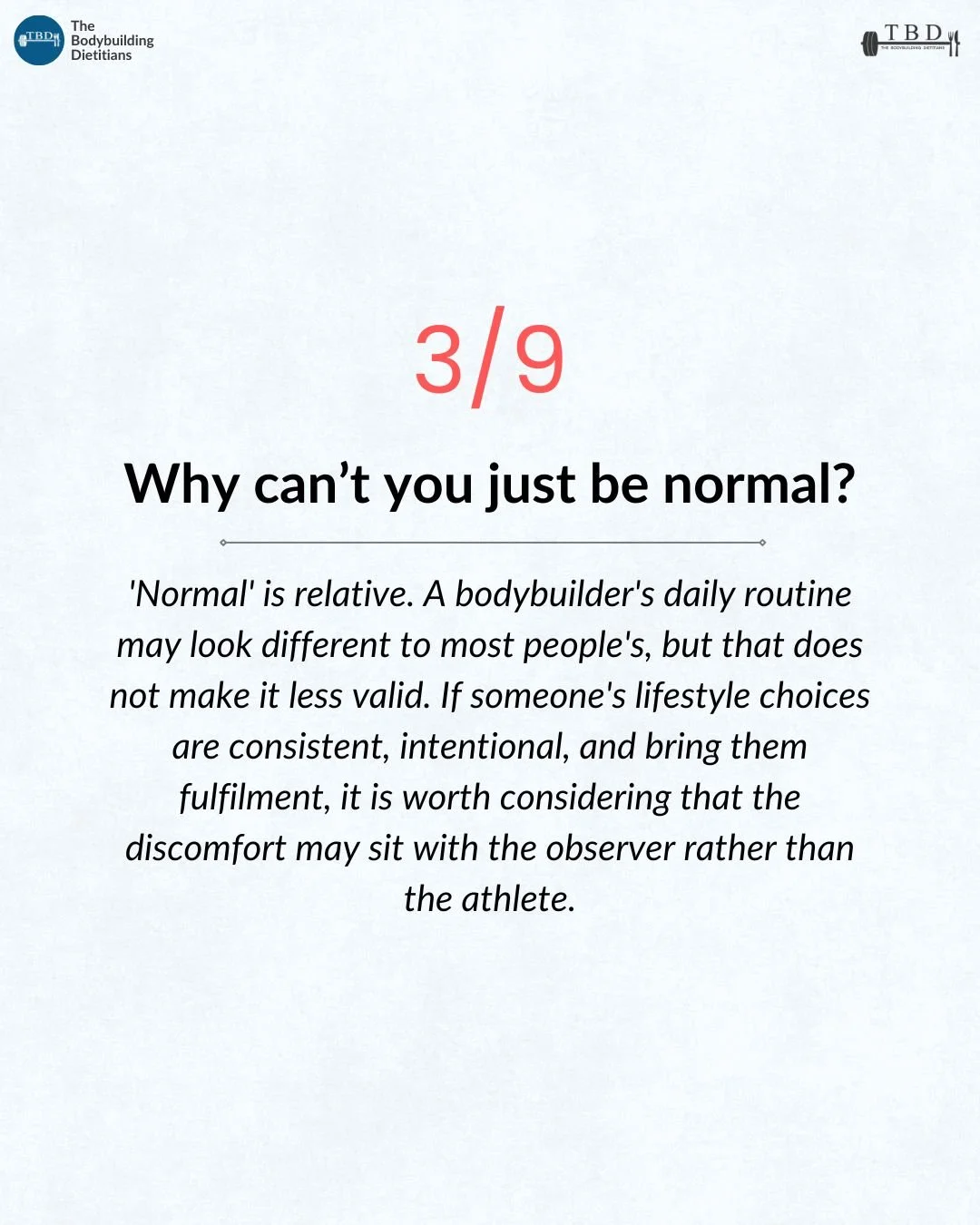
"Why can't you just be normal?"
"Normal" is relative. A bodybuilder's daily routine may look different to most people's, but that does not make it less valid. The structured eating, the consistent training, and the deliberate lifestyle choices that come with competing are not signs of dysfunction; they are the practical requirements of pursuing a specific goal within a specific sport.
If someone's lifestyle choices are consistent, intentional, and bring them fulfilment, it is worth considering that the discomfort may sit with the observer rather than the athlete. This comment tends to say more about the speaker's frame of reference than about the competitor's choices, and recognising that can help both parties navigate the conversation with less friction.
For competitors hearing this regularly, it can be helpful to remember that most people simply have no frame of reference for what structured contest preparation looks like. A short, calm explanation of the temporary nature of the process and the reasons behind it usually goes further than a defensive response, even when the comment feels frustrating in the moment.
"Are you sure you don't want a bite?"
Offering food is a generous instinct, and in most social contexts it is an expression of care. However, when someone is following a structured nutrition plan, repeated offers can feel like pressure, even when that is not the intention. The competitor has already made the decision about what they are eating, and being asked to reconsider that decision multiple times can make social situations unnecessarily stressful.
A useful approach for the people around a competitor is simply to offer once, respect the answer, and move on. There is no need to draw attention to it, apologise for eating something different, or make the competitor's food choices a topic of conversation. Most competitors genuinely do not mind being around food they are not eating; what becomes difficult is the repeated focus on it.
This is also an area where proactive communication from the athlete makes a significant difference. Letting the people in your life know early in prep that you will be following a specific plan, that you appreciate the offers but will not be deviating, and that you do not need anyone to modify their own eating around you tends to resolve most of these interactions before they start.
Managing the social and psychological dimensions of prep is one of the areas where having structured coaching support can be valuable, because the challenges of a long prep extend well beyond macros and training programming.
"Do you really have to go to the gym today?"
For most competitors, the gym serves multiple purposes beyond just training. It provides structure, routine, stress relief, and a sense of progress that becomes especially important during the more demanding phases of prep. Asking someone to skip a session might seem like a minor, casual suggestion, but it can feel like being asked to compromise on something that holds the rest of their day together.
It also helps to recognise that bodybuilding is a sport, and training sessions are the athlete's practice. Asking a competitor to skip the gym is no different to asking a footballer to miss a training session or a swimmer to skip a pool session. The fact that bodybuilding is an individual sport and often takes place in a commercial gym rather than a team facility can make it appear less structured or less important than it is, but the commitment and discipline involved are comparable.
If you are concerned about someone's training volume or recovery, that conversation is worth having, but it is best framed as a genuine question about their wellbeing rather than a suggestion to simply do less.
"You must be hungry eating just that..."
Competitors in a calorie deficit are likely experiencing some degree of hunger already. They are aware of it. Pointing it out or commenting on the size of their meals does not add anything useful; it simply draws more attention to something they are already managing.
Energy restriction during contest preparation involves a deliberate reduction in calorie intake below maintenance levels, sustained over an extended period, to reduce body fat while preserving as much lean mass as possible. Hunger is a normal physiological response to this process and tends to increase as the prep progresses and body fat levels decline.
In practice, competitors develop a range of strategies to manage hunger effectively, including food volume manipulation, meal timing, protein leverage, and fibre intake. These strategies are part of the skill set that a well-structured coaching plan develops over time. The hunger is real, but it is being managed, and most competitors would rather not have it highlighted by the people around them.
A more helpful approach is simply to not comment on the size or composition of someone's meals during prep. If you are curious about their nutrition plan, asking a genuine question ("how do you structure your meals during prep?") will be received far better than an observation about how little they appear to be eating.
"Wow, I would be miserable if I had to eat that every day!"
Most bodybuilders genuinely enjoy the structure and discipline of their nutrition. What looks monotonous or restrictive from the outside often feels purposeful and satisfying from the inside. Meal preparation, food selection, and the daily rhythm of eating toward a specific goal are part of the experience that many competitors find fulfilling rather than burdensome.
If structured eating is not something you would enjoy, that is completely fine. People have different relationships with food, different preferences, and different priorities, and none of those are wrong. What is worth being mindful of is projecting that perspective onto someone else's process. Telling a competitor that their food looks unappetising or that you could never eat that way does not serve any constructive purpose, and it positions their choices as a hardship when they may not experience them that way at all.
This also touches on a broader point about how bodybuilding nutrition is perceived from the outside. The sport has a long-standing stereotype of bland, repetitive "bro food," and while some competitors do eat simply during prep, many others eat a diverse and enjoyable diet within their macro targets. Assuming that a competitor's food is inherently unpleasant reinforces a stereotype that does not reflect the reality of how most well-coached athletes approach their nutrition.
"So when will you start cutting water?"
Deliberate dehydration before a competition is an outdated practice that carries genuine health risks and, in most cases, compromises the physique rather than improving it. Adequate hydration supports muscle fullness, vascularity, and overall stage presentation, which means that the practice of "water cutting" works against the very outcomes it is supposed to enhance.
Severe voluntary dehydration before physique competitions has been associated with impaired cardiovascular function, reduced cognitive performance, and in extreme cases, serious medical events. Current evidence-based approaches to peak week preparation generally emphasise maintaining adequate hydration rather than restricting it, with adjustments to sodium and carbohydrate intake used to influence subcutaneous water and muscle fullness.
Source: Chappell and Simper, 2018, Journal of the International Society of Sports Nutrition.
This comment often comes from people who have seen water manipulation discussed in bodybuilding media or documentaries and assume it is a standard part of preparation. For competitors working with evidence-based coaches, the question can feel frustrating because it reflects an outdated understanding of the sport. A simple, educational response, such as "we actually keep hydration up to support how the muscles look on stage," is usually enough to redirect the conversation.
This is one of the areas where our approach to bodybuilding coaching differs from traditional methods, because peak week strategies are built around the evidence rather than inherited practices that have been passed down without scrutiny.
"You take bodybuilding way too seriously."
The discipline required for bodybuilding can look extreme from the outside, but for most competitors it is a source of purpose, structure, and genuine satisfaction. Committing deeply to something that challenges you on a daily basis is worth respecting, even if it is not something you would choose for yourself.
This comment is perhaps the one that reveals the most about the gap in understanding between people inside and outside the sport. Bodybuilding requires a level of consistency and intentionality that most recreational activities do not, and that level of commitment can appear excessive when viewed through the lens of a more casual approach to fitness or health. For the competitor, though, the "seriousness" is the point. It is what makes the process meaningful, and dismissing it as excessive can feel like a dismissal of something they genuinely care about.
A useful reframe for people outside the sport is to consider how this comment would sound if directed at any other pursuit that someone had committed to deeply, whether that is music, a career, a creative project, or another sport. The level of dedication is comparable; the unfamiliarity of the context is what makes it feel unusual.
Research into the psychosocial experiences of natural bodybuilders during contest preparation has identified external social pressure and lack of understanding from friends and family as consistent sources of psychological stress. Athletes who report stronger social support networks and proactive communication strategies tend to experience less psychological disturbance during prep.
Source: Helms, Prnjak, and Linardon, 2019, Sports.
How Can Athletes Navigate These Conversations?
The most consistently effective strategy is proactive communication. Athletes who take the time to explain the process to friends, family, and colleagues early in their prep tend to experience far fewer of these interactions. Setting expectations about training schedules, social availability, and dietary requirements in advance gives the people around you the context they need to be supportive rather than inadvertently adding stress.
This does not need to be a formal conversation. Something as simple as letting people know that you are entering a structured training phase, that your routine will look different for a few months, and that you appreciate their patience and support is often enough to shift the dynamic. Most people respond well when they understand the "why" behind what they are seeing, and a brief explanation early on prevents the need for repeated individual conversations as the prep progresses.
For competitors who find that certain relationships consistently create friction during prep, it can also be helpful to discuss this with a coach or support person who understands the process. Part of the value of working with experienced coaching is that it extends beyond the training and nutrition plan itself into the broader management of the prep experience, including the social and psychological dimensions that can be just as demanding as the physical ones.
If you are considering competing for the first time, this is partly a preview of what to expect. These comments will come. Preparing for them mentally and communicating proactively with the people in your life will make a meaningful difference to how smoothly your prep runs.
How Can Friends and Family Be More Supportive?
For those on the outside looking in, a small amount of awareness goes a long way. You do not need to fully understand the sport to respect someone's commitment to it.
Some practical ways to offer genuine support include: acknowledging the effort without tying it to a specific competitive outcome, using language that reflects the process (such as "lean" rather than "small"), accepting the first answer when food or social invitations are declined, treating training with the same respect you would give to any other sport, and simply asking how the prep is going with genuine interest rather than scepticism.
The competitor in your life is not asking you to change your own habits, eat differently, or rearrange your schedule. They are simply asking for understanding during a temporary phase that requires more from them than usual. Offering that understanding, quietly and consistently, is one of the most valuable things you can do.
If you want to go a step further, asking your friend or family member to explain what they are working toward can be a powerful gesture. Most competitors are passionate about what they do and appreciate the opportunity to share it with someone who is willing to listen with an open mind.
Practical Takeaways
Well-intentioned comments about food, training, body composition, and lifestyle can accumulate over a long prep and become an additional source of stress for competitors, even when individual remarks seem minor.
The most effective way for athletes to reduce friction is proactive communication: explain the process early, set expectations clearly, and give the people around you the context they need to be supportive.
If you want to acknowledge a competitor's physical change, use the word "lean" rather than "small," "tiny," or "skinny," as it recognises the deliberate process rather than implying a loss.
Offer food once, respect the answer, and avoid making the competitor's dietary choices a recurring topic of conversation.
Treat training sessions with the same respect you would give to any other sport's practice schedule.
Deliberate dehydration before a show is an outdated practice with genuine health risks; evidence-based peak week strategies prioritise adequate hydration to support muscle fullness and stage presentation.
Frequently Asked Questions
How can I support someone going through contest prep?
The most helpful approach is a combination of genuine interest and practical awareness. Acknowledge the effort involved without tying your encouragement to a specific competitive result, respect their dietary and training structure without trying to change it, and ask how they are going with genuine curiosity rather than scepticism. You do not need to understand every detail of the process; simply showing respect for their commitment goes a long way.
Why do bodybuilders eat the same meals during prep?
Many competitors eat a relatively consistent set of meals during preparation because it simplifies tracking, supports adherence, and removes daily decision-making around food. However, this is a practical choice rather than a requirement, and plenty of well-coached athletes eat a varied diet within their macro targets. The perception that all competitors eat bland, repetitive food is a common stereotype that does not reflect the full range of approaches in modern physique nutrition.
Is water cutting before a bodybuilding show dangerous?
Severe dehydration protocols carry real health risks, including impaired cardiovascular function and reduced cognitive performance. Evidence-based approaches to peak week preparation now generally emphasise maintaining adequate hydration to support muscle fullness, vascularity, and stage presentation. Deliberate water restriction is an outdated practice that tends to compromise the physique rather than improve it.
How long does bodybuilding contest prep usually last?
Contest preparation typically spans 16 to 24 weeks, depending on the amount of body fat the athlete needs to lose and the rate at which they can safely reduce it while preserving lean mass. Longer preps at more moderate rates of weight loss tend to produce better outcomes for both muscle retention and psychological wellbeing compared to shorter, more aggressive approaches.
Do bodybuilders find their diet restrictive?
Many competitors report that the structure and discipline of contest nutrition is something they find purposeful and satisfying rather than restrictive. What looks monotonous or limiting from the outside often feels very different from the inside, particularly when the athlete understands the reasons behind their nutrition plan and is working toward a goal they care about. That said, the later stages of prep can become genuinely challenging, and hunger and food-related fatigue are normal experiences that well-coached athletes learn to manage over time.
Should I avoid eating certain foods around a competitor?
There is no need to change what you eat around someone who is competing. Most competitors do not expect the people around them to modify their own food choices. What tends to be more helpful is simply not drawing repeated attention to the differences between what you are eating and what they are eating, and not offering food multiple times after the initial offer has been declined.
If you are preparing for a competition and want structured, evidence-based support that covers nutrition, training, and the broader management of the prep experience, our team can help.