A calorie deficit is the foundation of fat loss, but energy output, food selection, meal timing, sleep quality, and life context all influence how manageable a deficit feels from day to day.
Fat loss requires a calorie deficit, but the variables that determine whether that deficit is sustainable are broader than food intake alone. Increasing daily movement through steps adds to energy output without driving the same hunger response as a larger dietary restriction. Choosing foods with high volume relative to their calories, prioritising protein and fibre, managing food palatability, and compressing the eating window are practical dietary strategies that make adherence more achievable. Sleep quality directly affects hunger hormones and food preferences the following day, the food environment shapes how much cognitive effort dieting requires, and the timing of a diet phase relative to life stressors meaningfully affects outcomes. Training performance is also a useful early indicator that a deficit has become more aggressive than the body can sustain productively.
Fat loss is, at its core, a matter of energy balance. Sustained calorie intake below expenditure produces fat loss over time, and no strategy changes that underlying reality. What strategies can change is how tolerable, sustainable, and productive that process feels across weeks and months of consistent effort.
A diet that is technically correct but practically miserable tends not to produce the results it should. Adherence breaks down, training suffers, hunger becomes overwhelming, or the timing simply does not suit the demands of the person's life at that point. The variables covered here do not override the calorie deficit, but they shape how manageable that deficit feels from one day to the next, which is where most fat loss phases actually succeed or fall apart.
Not every strategy on this list will be equally relevant to every person. The value is in identifying which ones apply to your specific situation and adjusting accordingly.
How Does Daily Movement Affect Fat Loss Beyond Structured Exercise?
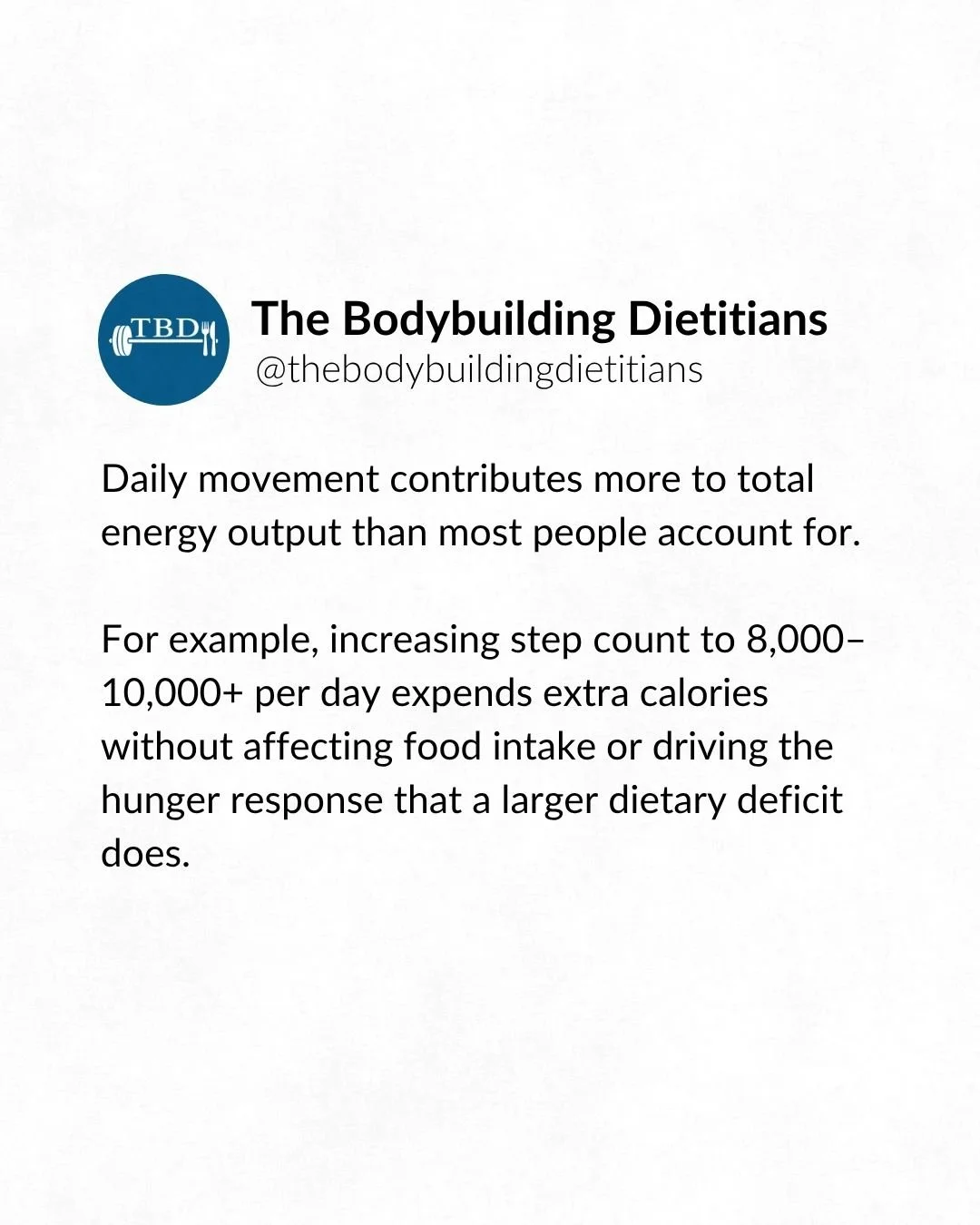
Daily non-exercise movement contributes more to total energy output than most people account for, and it is one of the more practical levers available for increasing the calorie deficit without increasing dietary restriction.
NEAT, or non-exercise activity thermogenesis, refers to the energy expended through daily movement outside of structured exercise, including walking, standing, incidental activity, and general restlessness. It varies considerably between individuals and can differ by several hundred calories per day between someone who is sedentary and someone who moves regularly throughout the day.
Increasing daily step count to 8,000 to 10,000 or more per day is one of the more reliable ways to raise NEAT meaningfully. The practical advantage is that walking at a moderate pace does not trigger the same compensatory hunger response that a larger dietary restriction does. Eating 300 fewer calories per day and burning 300 additional calories per day through walking both produce a similar energy deficit on paper, but the hunger and energy experience of each approach differs in ways that matter for long-term adherence.
For individuals in a fat loss phase, tracking daily steps alongside dietary adherence is a worthwhile habit. A consistent step target creates a second lever for managing energy balance that operates largely independently of food choices.
Why Does Food Palatability Affect How Much You Eat?
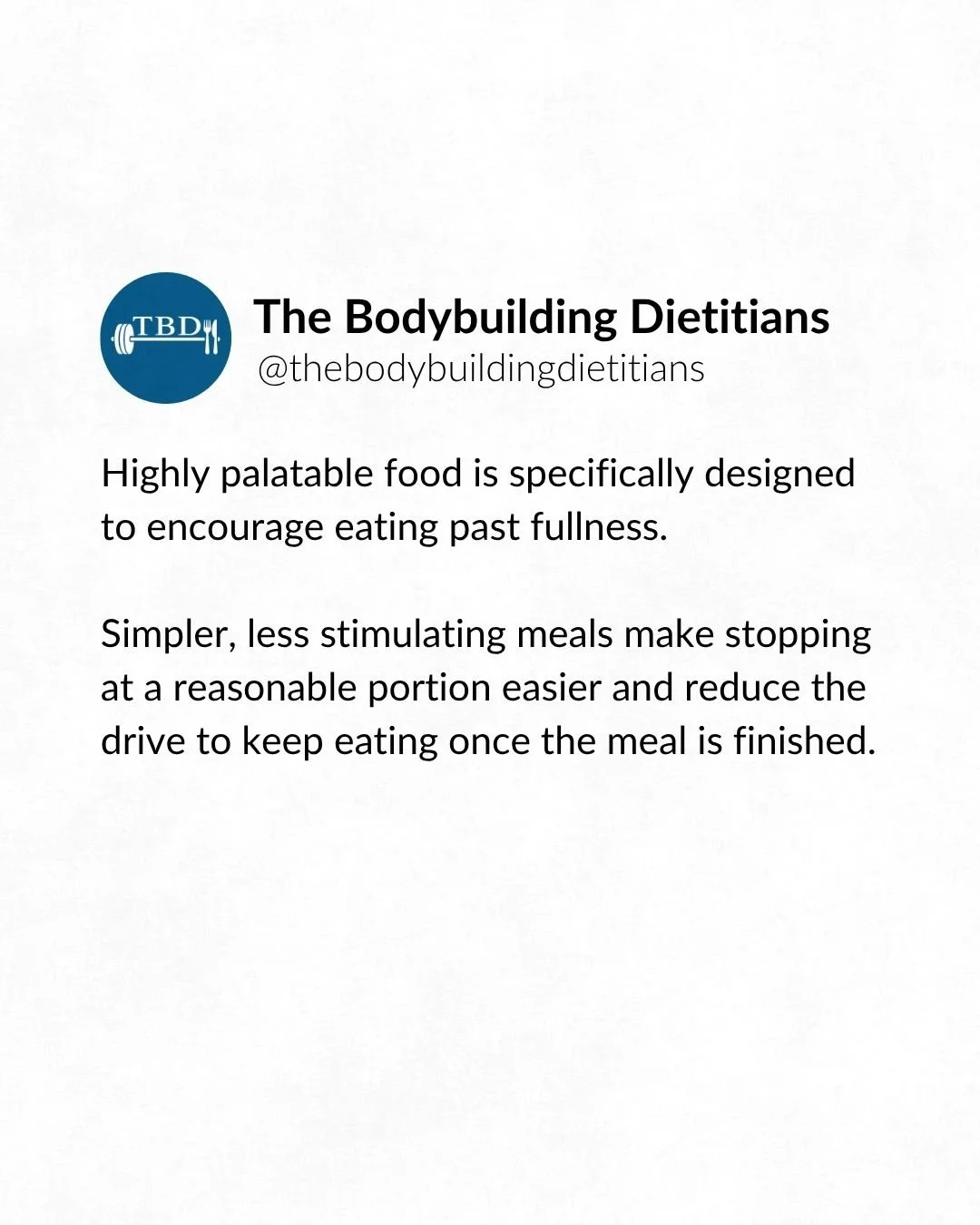
Highly palatable foods are specifically engineered to be difficult to stop eating. The combination of fat, salt, sugar, and refined texture found in many processed foods is not accidental; it is designed to override normal satiety signals and encourage continued consumption beyond a comfortable intake.
Palatability refers to the sensory pleasure a food provides, and highly palatable foods tend to produce a stronger reward response in the brain's dopamine system than simpler, less stimulating foods. This response is part of what makes it easier to eat past fullness on some foods and easier to stop at a reasonable portion on others.
During a fat loss phase, the practical implication is that a diet built predominantly around simpler, less stimulating foods reduces the moment-to-moment experience of food reward that drives overconsumption. This does not mean the diet needs to be monotonous or devoid of enjoyment. It means that meals which are flavourful, satisfying, and filling without being engineered for continuous consumption tend to support adherence better than those that make portion control a constant act of willpower.
This is one of the reasons food environment and meal structure matter so much during a diet. A home environment stocked with highly palatable, easy-to-overeat foods creates a constant test of restraint that is unnecessary if the environment is set up differently.
Do All Calories Keep You Equally Full?
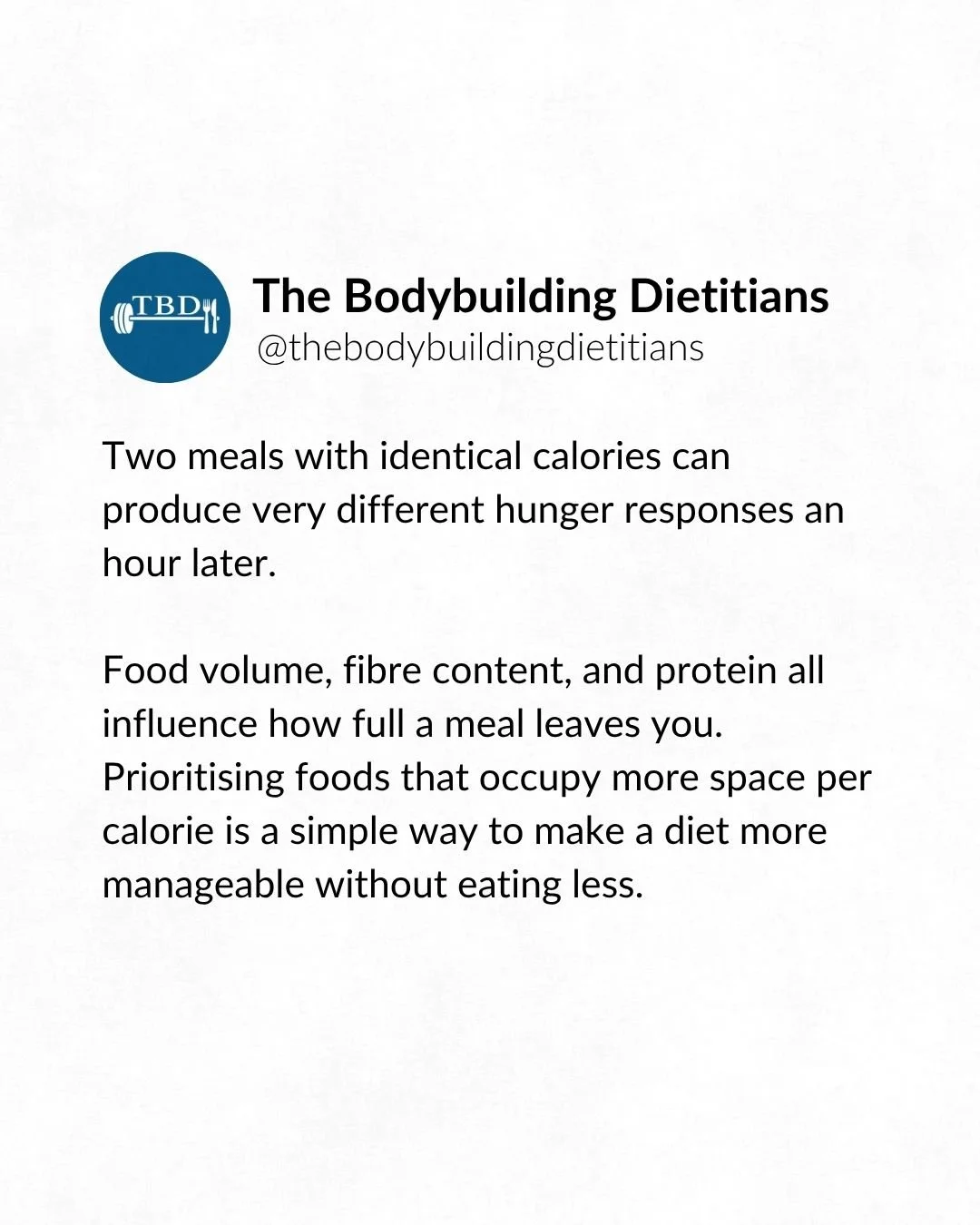
Two meals with identical calorie content can produce noticeably different levels of hunger an hour after eating, and the difference comes down primarily to three factors: food volume, fibre content, and protein.
Energy density refers to the number of calories a food provides relative to its weight or volume. Foods with low energy density, such as vegetables, lean proteins, and fruit, provide fewer calories per gram eaten and therefore occupy more physical space in the stomach for the same calorie cost. That physical stretch is one of the signals the stomach sends to the brain to indicate fullness.
Fibre slows gastric emptying, which extends the period of post-meal fullness and delays the return of hunger. Protein has the highest satiety value per calorie of any macronutrient, partly through its effect on gut hormones including GLP-1 and peptide YY that signal satiety to the brain, and partly through its relatively high thermic effect.
Building meals around foods that occupy more space per calorie, with adequate protein and fibre at each sitting, is a practical strategy for making a calorie-restricted diet feel more manageable without eating less in terms of total food volume. The structure of a meal matters as much as its total energy content for the hunger experience that follows.
Can Adjusting Meal Timing Help Reduce Calorie Intake?
Compressing the eating window, or reducing the number of hours in the day during which food is consumed, can be a practical tool for reducing total calorie intake in individuals for whom hunger is not evenly distributed across the day.
The mechanism is straightforward. Most people have predictable periods of lower hunger, often in the earlier parts of the morning or later in the evening, when food intake during those windows is driven more by habit than by genuine appetite. Removing a meal or snack from a period of low hunger saves calories without producing the same sense of sacrifice that cutting from a genuinely hungry period would.
This approach overlaps with intermittent fasting frameworks, though it is most usefully understood as a practical meal timing strategy rather than a metabolic intervention. The evidence does not support the idea that compressed eating windows produce fat loss through mechanisms beyond the calorie deficit they help create.
The main consideration when adjusting meal timing during a fat loss phase is ensuring that training is still adequately fuelled. For individuals who train in the morning, skipping all food before a session may compromise performance, particularly for longer or higher-volume sessions. Structuring the eating window around training rather than against it is the practical priority.
How Does the Food Environment Affect Dietary Adherence?
The food environment, meaning what foods are visible, accessible, and mentally present, has a meaningful impact on how cognitively demanding a diet feels and how likely adherence is to hold across a day.
Constantly being around highly palatable foods, browsing food-related content, or keeping tempting options within easy reach all add to the cognitive load of making repeated food decisions under calorie restriction. Willpower is not a fixed resource, and its depletion across a day is a real phenomenon. An environment that requires constant active resistance to food cues creates unnecessary difficulty that has nothing to do with the person's motivation or discipline.
Managing the food environment is an adherence strategy that often goes undiscussed in favour of more complicated interventions. At a practical level, this means keeping lower-calorie, high-volume foods visible and accessible, reducing the presence of frequently overeaten foods in the home, and being deliberate about the digital food environment, including recipe browsing and food content on social media, particularly in the evening when cognitive resources are lower.
The goal is not to create an environment so restrictive it becomes joyless, but to reduce the number of unnecessary decision points that make staying on target more effortful than it needs to be.
Does Sleep Quality Affect Fat Loss and Hunger?
Poor sleep directly affects the hormonal environment that regulates hunger and food preference the following day, and its impact on dietary adherence is well-supported by research.
Ghrelin is the primary hunger-stimulating hormone, and leptin is its counterpart, signalling satiety to the brain. Sleep deprivation raises ghrelin and suppresses leptin, producing a hormonal state that makes hunger more intense and the experience of fullness less reliable. Research also consistently shows that sleep-deprived individuals shift food preferences toward higher-calorie, more palatable options.
A controlled study by Spiegel et al. found that restricting sleep to four hours per night for two nights increased ghrelin concentrations by 28 percent and decreased leptin concentrations by 18 percent compared to a fully rested state, with participants reporting significantly increased appetite.
Source: Spiegel et al., 2004, Annals of Internal Medicine.
The practical implication is that sleep quality is not a passive background variable during a diet. It is an active determinant of how hungry a person feels, how strong their food cravings are, and how much cognitive effort adherence requires the following day. Treating sleep as part of the fat loss strategy, rather than separate from it, reflects how the physiology actually works.
Does the Timing of a Diet Phase Affect Its Success?
Life context influences fat loss outcomes in ways that rarely get discussed alongside the nutritional variables, but the timing of a diet phase relative to life stressors is a meaningful practical consideration.
Chronic psychological stress elevates cortisol, which increases appetite, drives cravings for energy-dense foods, disrupts sleep, and reduces the motivation and cognitive bandwidth needed to plan and track food consistently. Dieting through a period of high work stress, poor sleep, significant social demands, or major life disruption stacks those physiological and psychological challenges on top of the demands of a calorie deficit.
When fat loss phases fail despite technically adequate dietary adherence, it is often because the conditions surrounding the diet were not well-suited to sustaining it. The frustration that results tends to be attributed to willpower or motivation when the more accurate interpretation is that the timing created compounding difficulty that would have tested most people.
This does not mean a diet can only begin when life is perfect, which is rarely the case. It means that choosing a period with manageable stress, reasonable sleep, and a relatively stable social schedule gives the process a better foundation. For individuals with clear personal or competitive timelines, this becomes a question of how to structure the phase to minimise overlap with the most demanding periods, which is part of how we approach planning with our coaching clients.
How Does Training Performance Indicate Whether a Deficit Is Too Aggressive?
Declining performance in the gym is often the earliest reliable signal that a calorie deficit has become more aggressive than the body can sustain productively, and it tends to appear well before visible changes in muscle mass.
When energy availability falls too low, the body reduces output in training before it begins to visibly sacrifice muscle tissue. Strength drops, session quality deteriorates, recovery feels incomplete, and motivation to train hard declines. Each of these changes reflects the body's response to insufficient fuel rather than a failure of effort.
Energy availability refers to the amount of dietary energy remaining for physiological processes after the energy cost of exercise has been accounted for. When it falls too low, the body prioritises survival functions over performance and recovery, which produces the training decline that serves as a practical warning sign.
Monitoring session quality across a diet phase, alongside bodyweight and dietary adherence, gives a more complete picture of how the deficit is actually affecting the body. A sustained drop in performance despite consistent training is worth responding to with an adjustment to intake rather than attributing to a temporary off period. Catching that signal early protects muscle mass and training quality for the remainder of the diet.
Practical Takeaways
Increasing daily step count to 8,000 to 10,000 or more adds meaningfully to energy expenditure without triggering the same compensatory hunger response as a larger dietary restriction.
Meals built around simpler, less stimulating foods make portion control easier by reducing the reward-driven drive to eat past fullness that highly palatable foods produce.
Food volume, fibre content, and protein are the primary determinants of post-meal satiety. Prioritising foods that occupy more space per calorie makes the experience of a calorie deficit more manageable.
Compressing the eating window around periods of genuine hunger, and away from periods of low appetite, can reduce total intake without adding to the sense of restriction.
The food environment, including what is visible, accessible, and mentally present, shapes how cognitively demanding a diet feels across the day. Managing it is a legitimate adherence strategy.
Sleep quality directly affects ghrelin, leptin, food preferences, and dietary adherence the following day. Treating sleep as part of the fat loss strategy reflects how the physiology works.
The timing of a diet phase relative to life stressors matters. High stress, poor sleep, and a demanding social calendar all compound the difficulty of a calorie deficit in ways that get misattributed to willpower.
A sustained drop in training performance is one of the earliest and most reliable signals that a deficit has become too aggressive. Monitoring session quality provides important feedback alongside scale weight.
Frequently Asked Questions
Do I need to do cardio to lose fat?
Cardio is not required for fat loss, but it can be a useful tool for increasing energy expenditure without adding to dietary restriction. Structured cardio and daily movement such as walking both contribute to total energy output. The most sustainable form of additional activity during a fat loss phase is one that does not significantly compromise training performance or recovery, and for most people, increasing step count is a lower-impact starting point than adding formal cardio sessions.
Why am I so hungry during a calorie deficit?
Hunger during a calorie deficit is a normal physiological response and not a sign that something is going wrong. The primary drivers of elevated hunger include reduced leptin, elevated ghrelin, lower food volume, and reduced carbohydrate intake, all of which are consequences of eating less. Practical strategies for managing hunger include prioritising protein and fibre at each meal, choosing high-volume foods, managing the food environment, and protecting sleep quality, which directly regulates hunger hormones.
Is intermittent fasting better for fat loss than a regular meal pattern?
Intermittent fasting produces fat loss through the same mechanism as any other dietary approach: a calorie deficit. When total calorie intake is matched, intermittent fasting does not produce superior fat loss compared to a regular meal pattern. Its practical advantage is that compressing the eating window can make it easier to maintain a deficit for some individuals, particularly those with low appetite in the morning. For others, a longer fasting period increases hunger and makes adherence more difficult. The most effective meal pattern is the one that supports consistent intake adherence alongside adequate training fuelling.
How do I know if my calorie deficit is too large?
The most practical signals that a deficit has become too aggressive are declining training performance, persistent fatigue that does not resolve with adequate sleep, increasing hunger that feels difficult to manage, and unusually rapid scale weight loss beyond approximately 0.5 to 1 percent of bodyweight per week. A moderate, well-paced deficit of 300 to 500 calories below maintenance is a common starting range that balances the rate of fat loss with training sustainability and adherence over time.
Does stress really affect fat loss?
Yes, in several ways. Elevated cortisol from chronic stress increases appetite, drives cravings for energy-dense foods, disrupts sleep, and impairs the cognitive resources needed to plan and adhere to a diet consistently. Stress also tends to reduce training motivation and increase the likelihood of unplanned eating. While managing life stress is not always within full personal control, choosing a diet timing that minimises overlap with predictably high-stress periods is a practical way to reduce its impact on outcomes.
Why is my training suffering on a diet?
A reduction in training performance during a calorie deficit is normal to a degree, particularly during the later stages of a longer diet phase. However, a substantial or sudden drop in performance is often a sign that energy availability has become too low. The first practical step is to assess whether total calorie intake and carbohydrate availability around training sessions are sufficient to support the volume and intensity of training being performed. Adjusting intake upward modestly, even temporarily, often restores performance and protects muscle mass over the longer term.
If you are currently in a fat loss phase and want support identifying which of these variables are most relevant to your situation, our team works through exactly this kind of applied problem-solving with coaching clients.