The gap between the most and least fibre-efficient foods on this list is substantial, and understanding where common foods sit on that spectrum makes it considerably easier to hit fibre targets within a calorie budget.
Fibre efficiency (the amount of fibre a food delivers relative to its calorie content) varies dramatically across common whole foods. Vegetables like baby spinach, zucchini, broccoli, and carrots deliver meaningful fibre at very low caloric cost, while staple carbohydrate sources like white rice, pasta, and white bread provide comparatively little fibre for the calories they contribute. The most practical approach for most people is to anchor fibre intake around high-efficiency sources (vegetables, berries, and legumes) and use moderately efficient options (oats, quinoa, chia seeds) to close any remaining gap, rather than relying on low-efficiency staples to meet fibre targets.
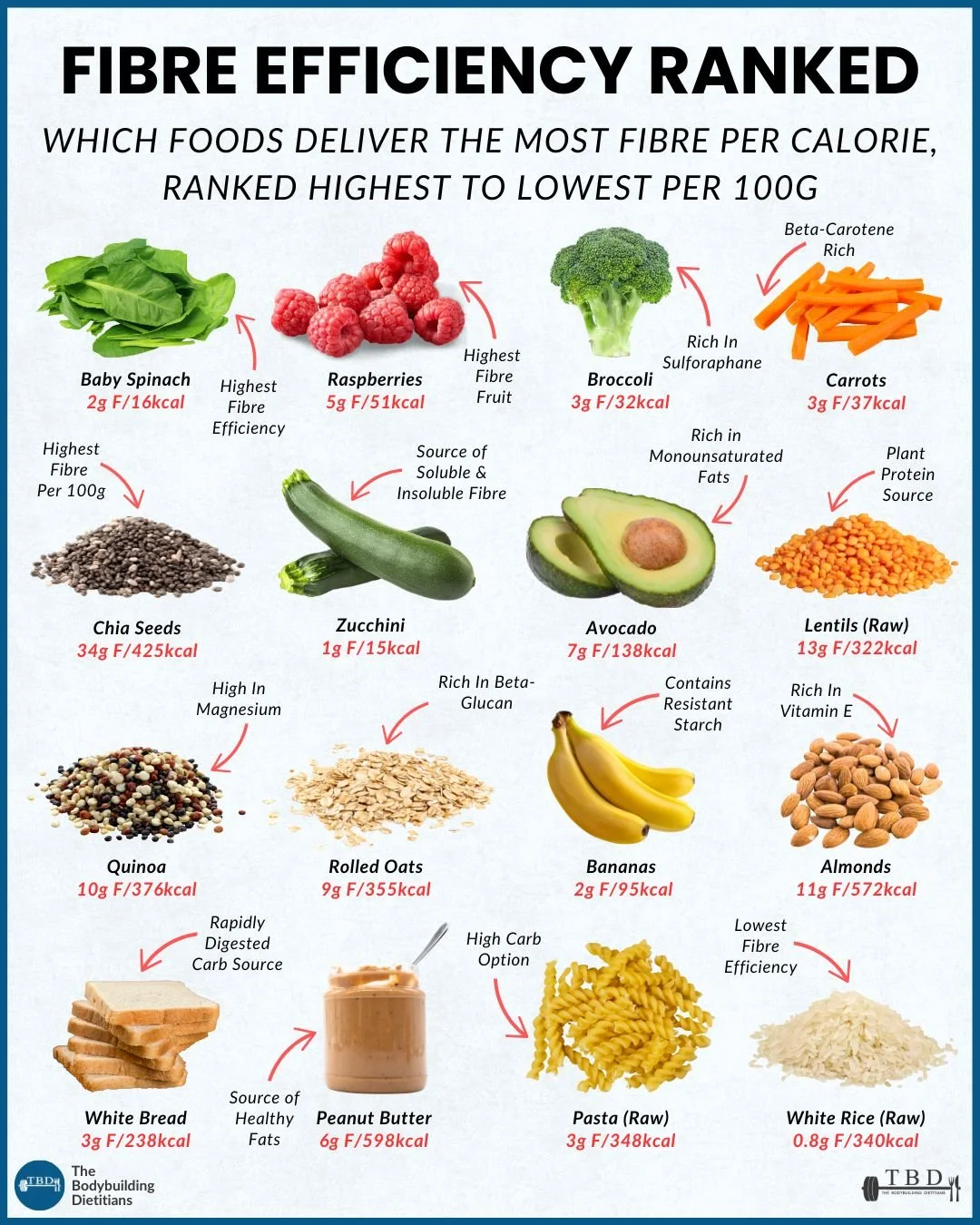
Twenty common whole foods ranked by fibre efficiency, showing how much fibre each delivers relative to its calorie content per 100 grams, alongside notable additional nutritional benefits.
WANT THE COMPLETE LIST?
Our free Fibre Guide ranks over 80 foods by fibre-per-calorie, so you can hit your target without overshooting your calories. You’ll also receive occasional nutrition and training insights from our dietitians, with the option to unsubscribe at any time.

Let’s talk about fibre efficiency
Fibre efficiency varies more than most people realise. The gap between the most and least efficient foods on this ranking is substantial, and it has real practical consequences for anyone trying to hit a fibre target within a specific calorie budget.
For people following structured nutrition plans, where protein and calorie targets tend to drive food selection, fibre often ends up as an afterthought. The assumption is usually that including some vegetables and eating whole grains will take care of fibre intake without much deliberate planning. In practice, whether that assumption holds depends entirely on which foods are selected, because the fibre contribution per calorie differs by a factor of more than ten between the top and bottom of this ranking. Baby spinach delivers 2 grams of fibre from just 16 kilocalories per 100 grams, while white rice provides 0.8 grams from 340 kilocalories. Understanding these differences makes it possible to meet fibre targets reliably without consuming excessive calories or overhauling the structure of the diet.
Fibre efficiency in this context refers to the amount of dietary fibre a food provides relative to its calorie content. A food with high fibre efficiency delivers a meaningful amount of fibre from a small calorie investment. A food with low fibre efficiency may contain some fibre, but delivers it alongside a much larger proportion of calories from other macronutrients, primarily starch and fat.
Which Foods Sit at the Top of the Fibre Efficiency Ranking?
Vegetables and berries dominate the top of the ranking because they provide meaningful fibre at very low caloric cost, making them the most efficient foundation for meeting fibre targets.
Baby spinach (2 grams of fibre per 16 kilocalories per 100 grams) has the highest fibre efficiency on this ranking. At just 16 kilocalories per 100 grams, it contributes fibre alongside iron, folate, and vitamin K at an almost negligible caloric cost. As a raw salad base or a cooked addition to meals, spinach is one of the simplest ways to increase both fibre and micronutrient intake without meaningfully affecting the calorie budget.
Zucchini (1 gram of fibre per 15 kilocalories per 100 grams) is similarly efficient. While the absolute fibre content per serve is modest, the caloric cost is so low that it can be included in large volumes, particularly useful during lower-calorie phases where food volume supports satiety and the goal is to maximise the nutritional return from every calorie consumed.
Raspberries (5 grams of fibre per 51 kilocalories per 100 grams) are the highest-fibre fruit on the ranking and one of the most fibre-dense commonly available foods by any measure. A 125-gram punnet provides over 6 grams of fibre for approximately 64 kilocalories, which is a substantial contribution from a single food. Frozen raspberries offer the same nutritional profile at lower cost and with less waste, making them a particularly practical option for daily use.
Broccoli (3 grams of fibre per 32 kilocalories per 100 grams) provides fibre alongside sulforaphane, a bioactive compound with emerging evidence for antioxidant and anti-inflammatory effects. Broccoli is one of the most versatile vegetables in physique-focused nutrition because it pairs well with virtually any protein source, can be prepared in bulk, and provides meaningful food volume.
Carrots (3 grams of fibre per 37 kilocalories per 100 grams) contribute fibre alongside beta-carotene, a precursor to vitamin A. They are affordable, shelf-stable, and require minimal preparation, making them a low-friction inclusion in most diets. Raw carrots also provide a satisfying crunch that serves as a useful textural element in meals built primarily around softer foods.
The practical takeaway from this tier is that vegetables and berries should form the foundation of fibre intake for anyone managing a calorie budget. Their efficiency means they contribute fibre without consuming meaningful calorie space, which leaves more of the budget available for protein, carbohydrates, and fats. Including two to three different vegetables across the day and a serve of berries provides a significant baseline of fibre before any other foods are even considered.
How Do Seeds, Legumes, and Grains Compare in the Middle Tier?
Seeds, legumes, and whole grains provide more fibre in absolute terms per serve but at a higher caloric cost, making them useful for closing the gap between vegetable-based fibre and the daily target.
Chia seeds (34 grams of fibre per 425 kilocalories per 100 grams) have the highest absolute fibre content of any food on the ranking, though their caloric density means they sit in the middle tier for efficiency rather than the top. The distinction matters: chia seeds are one of the most concentrated whole food fibre sources available, and a single tablespoon (approximately 12 grams) provides around 4 grams of fibre for roughly 50 kilocalories. As an addition to oats, yoghurt, smoothies, or salads, they are a low-effort, high-impact way to boost fibre intake. They also provide omega-3 fatty acids (in the form of alpha-linolenic acid), which adds nutritional value beyond fibre alone.
Lentils (13 grams of fibre per 322 kilocalories per 100 grams, raw weight) are among the most versatile and complete fibre sources available. They provide a mix of soluble, insoluble, and resistant starch fibre, alongside meaningful plant-based protein, iron, and folate. Cooked lentils are significantly lower in calories per 100 grams than the raw figure shown (approximately 116 kilocalories per 100 grams cooked), which makes their practical fibre efficiency even better than the raw ranking suggests.
Avocado (7 grams of fibre per 138 kilocalories per 100 grams) is one of the few high-fibre foods that is also a significant source of monounsaturated fat. Half a medium avocado provides approximately 5 grams of fibre alongside healthy fats, potassium, and folate. For people whose fat intake includes avocado, the fibre contribution is a meaningful bonus that is often underappreciated.
Rolled oats (9 grams of fibre per 355 kilocalories per 100 grams) provide a strong combination of beta-glucan (a soluble fibre with well-established evidence for cholesterol management and blood glucose regulation) and insoluble fibre. Oats are a staple in most physique-focused diets for their carbohydrate contribution, and the fibre they provide as a secondary benefit makes them a more useful carbohydrate choice than lower-fibre alternatives like white rice or cream of rice.
Beta-glucan, the primary soluble fibre in oats, has been shown to reduce LDL cholesterol when consumed consistently at approximately 3 grams per day (roughly equivalent to 75 grams of dry oats). This effect is well-established and forms the basis for approved health claims in Australia, the European Union, and the United States.
Source: Whitehead et al., 2014, American Journal of Clinical Nutrition.
Quinoa (10 grams of fibre per 376 kilocalories per 100 grams, raw weight) provides fibre alongside a complete amino acid profile, magnesium, and iron. Like lentils, its cooked weight is significantly lower in calories than the raw figure, which improves its practical efficiency. It serves as a useful grain rotation option for anyone looking to increase both fibre intake and dietary diversity.
Bananas (2 grams of fibre per 95 kilocalories per 100 grams) sit in the lower portion of the middle tier. Their fibre contribution per serve is modest, but they offer an additional benefit that the fibre figure alone does not capture: resistant starch. Less ripe (greener) bananas contain meaningfully more resistant starch than fully ripe ones, and this resistant starch is fermented by gut bacteria to produce short-chain fatty acids, particularly butyrate, that support colon health in ways that differ from traditional soluble and insoluble fibre.
Almonds (11 grams of fibre per 572 kilocalories per 100 grams) provide substantial fibre alongside vitamin E, magnesium, and monounsaturated fats. Their caloric density places them lower on the efficiency ranking, but a 30-gram serve (a small handful) still contributes approximately 3.3 grams of fibre, which is a useful addition, particularly as a snack that requires no preparation.
Why Do Common Staple Carbohydrates Rank So Low?
White rice, pasta, white bread, and peanut butter sit at the bottom of the ranking because the majority of their calories come from starch or fat with relatively little fibre per calorie.
White rice (0.8 grams of fibre per 340 kilocalories per 100 grams, raw) has the lowest fibre efficiency on the entire ranking. This does not make white rice a poor food choice in absolute terms. It is a useful, affordable, easily digestible carbohydrate source that has a practical role in many nutrition plans, particularly around training where rapid digestion is desirable. The point is that relying on white rice as a primary carbohydrate source, without deliberately including higher-fibre foods elsewhere in the diet, makes it very difficult to meet a fibre target of 25 to 30 grams per day without consuming excessive calories.
Pasta (3 grams of fibre per 348 kilocalories per 100 grams, raw) is marginally more fibre-efficient than white rice but still sits firmly in the low-efficiency tier. Switching to wholemeal pasta approximately doubles the fibre content per serve, which is one of the simplest substitutions available for increasing fibre intake within the same meal structure.
White bread (3 grams of fibre per 238 kilocalories per 100 grams) performs slightly better than rice and pasta on a per-calorie basis, but its fibre contribution per serve is still modest. Rye bread or wholegrain bread options provide substantially more fibre per slice and tend to be more satiating, making them a worthwhile swap for anyone looking to increase fibre intake from their bread choices.
Peanut butter (6 grams of fibre per 598 kilocalories per 100 grams) contains a reasonable absolute amount of fibre, but its high caloric density (primarily from fat) means the fibre comes at a significant calorie cost. A typical 20-gram serve provides only about 1.2 grams of fibre for approximately 120 kilocalories. Peanut butter is a useful food for its taste, healthy fats, and convenience, but it is best understood as a fat source that happens to contain some fibre rather than a fibre source.
The practical implication of this tier is clear: if the staple carbohydrate sources in your diet are white rice, pasta, and bread, your fibre intake will be low unless you are deliberately including higher-efficiency foods alongside them. This is the most common pattern in physique-focused nutrition plans, where these carbohydrate sources are selected for their macronutrient profile, digestibility, and convenience, and fibre ends up under-consumed as an unintended consequence.
How Do You Use This Ranking to Build a Higher-Fibre Diet?
The most practical approach is to build fibre intake across three tiers: anchor the foundation with high-efficiency vegetables and berries, add volume with moderately efficient grains, legumes, and seeds, and accept that low-efficiency staples contribute minimally and should not be relied upon for fibre.
A practical daily framework might look like this. Two to three serves of vegetables across the day (broccoli, spinach, carrots, or zucchini at different meals) provides a baseline of 6 to 10 grams of fibre for fewer than 100 kilocalories. A serve of berries (raspberries or mixed berries at breakfast or as a snack) adds 3 to 5 grams. A serve of oats or quinoa at one meal contributes another 3 to 5 grams. A tablespoon of chia seeds added to a meal provides 3 to 4 grams. A serve of lentils or another legume at one meal adds 4 to 6 grams. Together, this brings the total to approximately 19 to 30 grams, which meets or approaches the recommended target without requiring any dramatic dietary changes or excessive calorie investment.
The key insight is that this fibre comes from foods that are being added alongside the existing diet structure, not instead of it. The white rice, chicken breast, and protein shake that form the backbone of many physique-focused meal plans can remain in place. The fibre comes from the additions: the vegetables served alongside the protein, the berries added to breakfast, the chia seeds sprinkled on oats, and the occasional inclusion of legumes in a grain bowl or soup. These additions are individually small in both volume and calorie cost, but they compound meaningfully when maintained consistently across the week.
During lower-calorie phases where every calorie is more constrained, leaning more heavily on the high-efficiency tier (vegetables, berries, zucchini) and less on the calorie-dense middle tier (nuts, avocado, quinoa) helps preserve fibre intake while keeping the calorie budget intact. During higher-calorie phases, there is more room to include a broader range of fibre sources from all tiers, which supports both fibre quantity and the diversity of fibre types that promotes gut microbiome health.
What Additional Nutritional Benefits Do These Foods Provide?
Several foods on this ranking offer nutritional benefits beyond fibre that make them valuable inclusions regardless of where they sit on the efficiency spectrum.
The infographic annotates many of these, and they are worth highlighting because they illustrate an important principle: food selection should consider the full nutritional profile of a food rather than optimising for a single nutrient in isolation.
Broccoli is rich in sulforaphane, a bioactive compound with emerging evidence for antioxidant, anti-inflammatory, and potentially anti-cancer effects. Carrots provide beta-carotene, a precursor to vitamin A that supports vision, skin health, and immune function. Oats contribute beta-glucan, one of the most well-evidenced soluble fibres for cholesterol and blood glucose management. Chia seeds provide alpha-linolenic acid, a plant-based omega-3 fatty acid. Avocado delivers monounsaturated fat, potassium, and folate. Lentils contribute plant-based protein, iron, and folate. Quinoa provides a complete amino acid profile and meaningful magnesium. Almonds are rich in vitamin E and monounsaturated fat. Bananas offer resistant starch, particularly when less ripe.
This means that building a varied fibre intake from multiple food sources does more than hit a single nutrient target. It creates a broader nutritional profile that supports immune function, cardiovascular health, gut microbiome diversity, and the micronutrient adequacy that underpins long-term health and training adaptation. The fibre target is the entry point, and the broader nutritional quality is the compounding benefit.
If you are managing a structured nutrition plan and want to ensure that your food quality and fibre intake are supporting your health alongside your physique goals, a consultation with one of our dietitians can help you identify where practical adjustments to food selection can make the most difference.
A Note on the Comparison Method
All values shown in the infographic are per 100 grams. For most foods on the list, 100 grams represents a reasonable and realistic serving size. For a few items, particularly chia seeds and lentils, the comparison requires context. A typical chia seed serve is 10 to 15 grams, not 100, and lentils are shown at their raw weight, which is substantially more calorie-dense per 100 grams than the cooked equivalent (approximately 116 kilocalories per 100 grams cooked versus 322 raw). Similarly, pasta and quinoa are shown at raw weight and would yield a larger, less calorie-dense volume once cooked.
The per-100-gram basis provides a standardised framework that allows direct comparison across food types, but practical serving sizes should be considered when interpreting the results and applying them to meal planning.
Practical Takeaways
Fibre efficiency varies dramatically across common whole foods, with more than a tenfold difference between the most efficient (baby spinach, zucchini) and least efficient (white rice, peanut butter) options on this ranking.
Vegetables and berries form the most calorie-efficient foundation for fibre intake. Including two to three serves of vegetables and a serve of berries daily provides 9 to 15 grams of fibre for fewer than 150 kilocalories.
Seeds (chia seeds), legumes (lentils), and whole grains (oats, quinoa) are useful for closing the gap between vegetable-based fibre and the daily target of 25 to 30 grams.
Common staple carbohydrate sources (white rice, pasta, white bread) contribute very little fibre relative to their calorie content. If these form the backbone of your diet, fibre intake will be low unless higher-efficiency foods are deliberately included alongside them.
Fibre type matters alongside quantity. Oats provide beta-glucan for cholesterol management, bananas provide resistant starch for gut bacteria, and a varied intake from multiple food sources supports broader microbiome diversity.
During lower-calorie phases, lean more heavily on high-efficiency sources (vegetables, berries). During higher-calorie phases, broaden fibre sources to include more calorically dense options that add diversity and additional micronutrients.
Frequently Asked Questions
Which food has the most fibre per calorie?
Among commonly available whole foods, baby spinach and zucchini have the highest fibre-to-calorie ratios because they provide meaningful fibre at extremely low caloric cost (16 and 15 kilocalories per 100 grams respectively). Among foods with higher absolute fibre content, raspberries (5 grams of fibre per 51 kilocalories per 100 grams) and broccoli (3 grams per 32 kilocalories) are also highly efficient. The most practical approach is to include several of these high-efficiency sources across the day as the foundation of fibre intake.
Is white rice bad for fibre intake?
White rice is not a harmful food, but it contributes very little fibre relative to its calorie content (0.8 grams per 340 kilocalories per 100 grams raw). If white rice is a dietary staple, fibre intake will be low unless higher-fibre foods are deliberately included alongside it. Practical strategies include pairing rice-based meals with fibre-rich vegetables, rotating in higher-fibre carbohydrate alternatives (oats, quinoa, lentils) at some meals, or adding seeds like chia to other meals across the day.
Are chia seeds a good source of fibre?
Chia seeds are one of the most concentrated whole food fibre sources available, providing 34 grams of fibre per 100 grams. Their caloric density (425 kilocalories per 100 grams) places them in the middle tier for fibre efficiency rather than the top, but in practical serving sizes (10 to 15 grams, or about one tablespoon), they provide 3 to 5 grams of fibre for approximately 50 to 65 kilocalories, which is an excellent return on a very small calorie investment. They also provide omega-3 fatty acids and can be easily added to existing meals.
How can you increase fibre without adding too many calories?
The most effective approach is to prioritise high-efficiency fibre sources: vegetables (spinach, broccoli, carrots, zucchini), berries (raspberries), and small additions of seeds (chia). These foods deliver meaningful fibre at very low caloric cost. Including two to three different vegetables across the day, a serve of berries, and a tablespoon of chia seeds can add 12 to 18 grams of fibre for fewer than 200 kilocalories.
Do you need to eat whole grains to get enough fibre?
Whole grains are useful fibre contributors but not essential if fibre intake is adequate from other sources. Vegetables, fruits, legumes, and seeds can collectively provide sufficient fibre without any whole grain intake. However, whole grains like oats and quinoa offer the additional benefit of beta-glucan and resistant starch, and they serve as practical carbohydrate sources for physically active individuals who need both fibre and carbohydrate within their nutrition plan.
What is the difference between fibre efficiency and fibre density?
Fibre efficiency refers to the amount of fibre a food delivers relative to its calorie content, measuring how "expensive" the fibre is in caloric terms. Fibre density typically refers to the absolute amount of fibre per unit of weight (grams of fibre per 100 grams of food). A food can be fibre-dense (high grams per 100g) without being fibre-efficient (high grams per calorie) if it is also calorie-dense. Chia seeds are a good example: they are extremely fibre-dense (34g per 100g) but only moderately fibre-efficient because they are also calorie-dense (425 kilocalories per 100g).
If you would like help optimising your food selection for both fibre and macronutrient targets within your current calorie budget, our team of qualified dietitians can help.