A practical, evidence-based breakdown of how much dietary fat to eat, which sources to prioritise, and how to distribute fat across your meals for health, performance, and body composition.
Most adults benefit from consuming approximately 20 to 35 per cent of their total daily calories from fat, with a minimum of around 0.5 grams per kilogram of body weight to support hormonal function and overall health. Prioritising monounsaturated and polyunsaturated sources, such as oily fish, nuts, seeds, avocado, and extra virgin olive oil, while keeping saturated fat below roughly 10 per cent of total calories aligns with current evidence for both cardiovascular health and long-term dietary sustainability. Distributing fat intake across meals with consideration for digestion and training timing can further support nutrient absorption and performance.
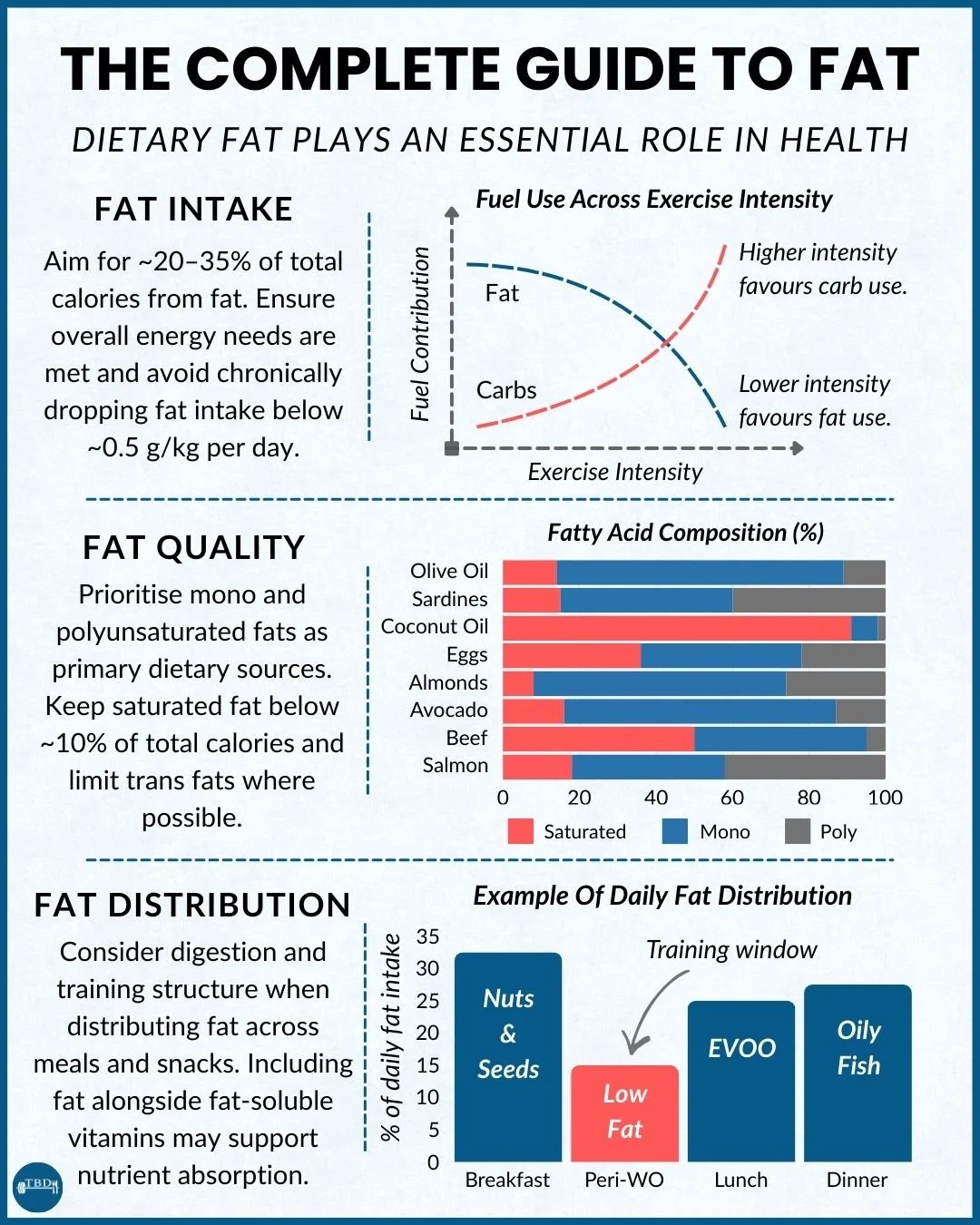
A visual summary of dietary fat intake, quality, and distribution, the three layers that shape how fat fits into a well-structured nutrition plan.
Fat tends to receive the least strategic attention of the three macronutrients, both in terms of the amount consumed and the quality of sources selected. While protein intake is often carefully tracked and carbohydrate timing is widely discussed, fat is frequently treated as whatever is left over once the other two macronutrients have been allocated. That approach can work in some cases, but it overlooks the fact that dietary fat serves essential physiological roles that go well beyond providing energy.
Every cell in your body is built from a lipid bilayer, which means fat is quite literally a structural requirement at the cellular level. Beyond that, it plays a critical role in hormone production, including testosterone and oestrogen, as well as immune function, cognitive performance, cardiovascular health, and thermoregulation. The fat-soluble vitamins A, D, E, and K all depend on dietary fat for absorption, which means consistently low fat intakes can compromise micronutrient status even when overall food quality is reasonable.
Fat is also the most energy-dense macronutrient, providing approximately 9 kilocalories per gram compared to 4 kilocalories per gram for both protein and carbohydrates. This energy density is part of the reason fat intake tends to be the smallest macronutrient by weight in most structured nutrition plans, particularly during periods of energy restriction. However, it also means that getting the amount, quality, and distribution of fat right can meaningfully influence how a nutrition plan performs over time, both in terms of health outcomes and day-to-day adherence.
The infographic above breaks dietary fat into three layers: intake, quality, and distribution. Each of these layers addresses a different aspect of how fat fits into a well-constructed nutrition plan, and the sections below explore each one in more detail.
How Much Dietary Fat Should You Eat Each Day?
Allocating approximately 20 to 35 per cent of total daily calories to fat is the range most commonly supported by current dietary guidelines and nutrition research. For someone consuming 2,000 kilocalories per day, this translates to roughly 44 to 78 grams of fat, or approximately 0.5 to 1.5 grams per kilogram of body weight depending on the individual's total energy intake and macronutrient priorities.
The lower end of this range, around 20 per cent of total calories or 0.5 grams per kilogram, represents a practical floor rather than an optimal target. Chronically dropping fat intake below this threshold can impair hormonal function, particularly in the context of already-restricted energy intake. This becomes especially relevant during extended fat loss phases or contest preparation, where total calorie intake is progressively reduced and the temptation to cut fat further in order to preserve protein and carbohydrate intake is common.
Research supports maintaining a minimum fat intake of approximately 0.5 grams per kilogram of body weight per day to preserve hormonal health during energy restriction. Chronically low fat intakes have been associated with suppressed testosterone levels in men and menstrual irregularities in women, particularly when combined with low overall energy availability.
Source: Helms, Aragon, and Fitschen, 2014, Journal of the International Society of Sports Nutrition.
Where an individual falls within the 20 to 35 per cent range depends on a number of factors, including total calorie intake, training demands, personal food preferences, and whether the current nutritional phase is focused on fat loss, muscle gain, or maintenance. In practice, people who enjoy higher-fat foods and respond well to moderate carbohydrate intakes often gravitate naturally toward the upper end of the range, while those with high training volumes or a strong preference for carbohydrate-rich meals may sit closer to the lower end. Neither end is inherently superior, the best approach is the one that supports adherence, performance, and health within the context of the individual's broader nutrition plan.
This is one of the areas where working with a dietitian through structured coaching can be particularly useful, because the right fat intake target depends on how it interacts with protein, carbohydrate, and total energy goals rather than existing in isolation.
The relationship between fat and carbohydrate as fuel sources is also worth understanding. At lower exercise intensities, the body relies more heavily on fat oxidation for energy, while higher-intensity efforts shift the fuel mix toward carbohydrate. This does not mean that eating more fat improves low-intensity performance, rather, it illustrates why carbohydrate availability matters more around high-intensity training and why fat intake can be distributed more flexibly throughout the rest of the day.
Which Types of Fat Should You Prioritise?
Prioritising monounsaturated and polyunsaturated fat sources, and keeping saturated fat below approximately 10 per cent of total calories, aligns with the majority of current evidence on cardiovascular health, inflammation, and long-term disease risk.
Dietary fat is not a single nutrient. It is a broad category that includes saturated fatty acids, monounsaturated fatty acids, and polyunsaturated fatty acids, each of which has different effects on health depending on the amount consumed and the dietary context in which it appears.
Monounsaturated fats, found in high concentrations in foods like extra virgin olive oil, avocado, and almonds, are consistently associated with favourable cardiovascular outcomes and tend to form the backbone of dietary patterns recognised for their health benefits, such as the Mediterranean diet. Polyunsaturated fats, including the omega-3 fatty acids found in oily fish like salmon and sardines, as well as the omega-6 fatty acids found in nuts, seeds, and certain plant oils, play important roles in inflammation regulation, cell membrane integrity, and brain function.
Omega-3 fatty acids are a family of polyunsaturated fats, the most well-studied of which are eicosapentaenoic acid (EPA) and docosahexaenoic acid (DHA), found primarily in oily fish. These fatty acids contribute to cardiovascular health, support cognitive function, and play a role in modulating the inflammatory response.
Saturated fat, found in higher proportions in foods like coconut oil, butter, and fatty cuts of meat, is the type most consistently linked to elevated LDL cholesterol when consumed in excess. The general recommendation to keep saturated fat below approximately 10 per cent of total calories, which equates to roughly 22 grams at a 2,000 kilocalorie intake, provides a practical ceiling rather than a suggestion to eliminate saturated fat entirely. Most whole food diets will include some saturated fat naturally, and the goal is to ensure it does not dominate the overall fat profile at the expense of unsaturated sources.
Replacing saturated fat with polyunsaturated fat has been shown to reduce LDL cholesterol and is associated with lower cardiovascular disease risk. Current guidelines from major health organisations, including the World Health Organization and the Australian Dietary Guidelines, recommend keeping saturated fat below 10 per cent of total energy intake.
The fatty acid composition chart in the infographic illustrates this well. Foods like olive oil, salmon, and almonds are composed predominantly of mono- and polyunsaturated fats, while coconut oil is overwhelmingly saturated. Eggs and beef sit somewhere in between, contributing a mix of all three types. Understanding this composition makes it easier to build a fat intake that supports both health and food enjoyment without needing to avoid any single food entirely.
In practical terms, a useful approach is to anchor most of your daily fat intake around a small number of high-quality sources, extra virgin olive oil for cooking and dressings, a handful of nuts or seeds, oily fish two to three times per week, and avocado when it suits the meal, and allow the remaining saturated fat to come incidentally from foods like eggs, dairy, and meat. This tends to produce a favourable fatty acid profile without requiring rigid tracking of individual fat subtypes.
How Should You Distribute Fat Across Your Meals?
Spreading fat intake relatively evenly across meals, with a deliberate reduction around training, tends to support digestion, satiety, and nutrient absorption more effectively than concentrating fat in one or two meals.
Fat slows gastric emptying, which is beneficial for sustained energy and fullness between meals but less desirable when rapid digestion and nutrient delivery are the priority. For this reason, reducing fat intake in the meal immediately before or after training, to around 10 to 15 per cent of total daily fat for that meal, is a common and practical strategy. This allows the peri-training meals to be built primarily around protein and carbohydrate, supporting both performance and recovery without the digestive discomfort that higher-fat meals can sometimes cause around intense exercise.
Outside of the training window, distributing the remaining fat across breakfast, lunch, and dinner in roughly equal portions, around 20 to 30 per cent of total daily fat per meal, provides a simple framework that supports consistent energy levels and helps with the absorption of fat-soluble vitamins throughout the day.
Fat-soluble vitamins: vitamins A, D, E, and K, require the presence of dietary fat to be effectively absorbed in the small intestine. Including a source of fat alongside meals that contain these vitamins, such as adding olive oil to a vegetable-based dish or pairing nuts with a salad, can meaningfully improve nutrient uptake.
The example distribution shown in the infographic, nuts and seeds at breakfast, a lower-fat peri-workout meal, extra virgin olive oil at lunch, and oily fish at dinner, illustrates how this might look in practice. The specific foods and proportions will vary depending on the individual's total fat target and personal preferences, but the underlying principle is consistent: distribute fat across the day, reduce it around training, and pair it with meals that benefit from its presence for absorption and satiety.
This kind of meal-level detail is one of the areas where our coaching process goes beyond setting daily macro targets, because how nutrients are distributed across the day can influence both how the plan feels and how well it performs over time.
Why Does Fat Intake Matter for Body Composition?
Fat often receives less attention than protein or carbohydrates in physique-focused conversations, but getting it right contributes meaningfully to hormonal health, dietary adherence, and long-term sustainability, all of which ultimately influence body composition outcomes.
During fat loss phases, it can be tempting to reduce fat intake aggressively in order to allocate more calories to protein and carbohydrates. While there is logic to prioritising those macronutrients, protein for muscle retention and satiety, carbohydrates for training performance, doing so at the expense of adequate fat intake can create problems that undermine the broader plan. Suppressed hormone levels, poor mood, reduced cognitive function, and difficulty adhering to the diet are all patterns that can emerge when fat is chronically under-consumed, particularly in the context of an already-restricted calorie intake.
In improvement seasons and muscle gain phases, where total calorie intake is higher, fat requirements are generally easier to meet. The primary consideration shifts from ensuring adequacy to ensuring quality, making sure that the additional calories coming from fat are contributing to a favourable health profile rather than simply accumulating from less nutrient-dense sources.
For physique athletes navigating longer prep phases, maintaining fat intake above the 0.5 grams per kilogram floor becomes especially important as calories decrease. In coaching settings, a common pattern is for athletes to inadvertently drift below this threshold as they chase tighter macro targets, and the downstream effects on energy, mood, and hormonal markers tend to become apparent within a few weeks. Proactively protecting a minimum fat intake is one of the simpler strategies that can meaningfully improve the experience and sustainability of a prep.
If you are working through a structured fat loss or contest preparation phase and want professional guidance on how to manage your macronutrient distribution as calories change, a consultation with one of our dietitians can help you navigate those decisions with confidence.
What Are the Best Food Sources of Dietary Fat?
The best fat sources combine a favourable fatty acid profile with practical benefits like cost, availability, versatility, and the micronutrients they provide alongside the fat itself.
Some of the most consistently useful sources include:
Extra virgin olive oil is one of the most well-researched dietary fat sources, rich in monounsaturated fat and polyphenols. It works well as a cooking oil, a dressing base, and a simple way to add fat to meals that would otherwise be very low in it.
Oily fish such as salmon, sardines, and mackerel provide a concentrated source of the long-chain omega-3 fatty acids EPA and DHA. Consuming oily fish two to three times per week is a practical way to meet omega-3 needs without supplementation for most people.
Nuts and seeds, including almonds, walnuts, chia seeds, and flaxseeds, offer a mix of monounsaturated and polyunsaturated fats alongside fibre, magnesium, and other micronutrients. They are also highly portable and easy to include in meals or as snacks.
Avocado provides monounsaturated fat along with potassium and fibre, and its creamy texture makes it a versatile addition to a wide range of meals.
Eggs contribute a balanced mix of saturated and unsaturated fats along with choline, B vitamins, and a complete amino acid profile. They remain one of the most cost-effective and nutrient-dense whole food sources available.
The goal is not to build a rigid list of approved foods but to develop a practical repertoire of fat sources that you enjoy, that fit your budget, and that collectively produce a fatty acid profile weighted toward unsaturated fats. This allows room for personal preference and cultural food traditions while still supporting the health outcomes that a well-constructed fat intake is designed to deliver.
Does the Type of Fat You Eat Affect Training Performance?
The type of fat you eat has relatively little direct impact on acute training performance, but it contributes to the broader physiological environment in which training adaptations occur.
Fat is not a primary fuel source during high-intensity resistance training, which relies predominantly on phosphocreatine and muscle glycogen. However, fat oxidation contributes more meaningfully during lower-intensity and longer-duration activities, and the overall quality of fat intake supports the hormonal milieu, inflammatory regulation, and recovery processes that underpin adaptation over time.
Energy density refers to the number of calories a food provides relative to its weight or volume. Because fat is the most energy-dense macronutrient at 9 kilocalories per gram, it occupies a unique position in nutrition planning, it contributes a meaningful proportion of total calories from a relatively small volume of food, which can be advantageous in higher-calorie phases and a consideration during lower-calorie phases where food volume supports satiety.
In practice, the most relevant performance-related consideration for fat is timing rather than type. Keeping fat intake lower around training, particularly before sessions where rapid gastric emptying supports comfort and performance, is a more impactful strategy than trying to select specific fatty acids for ergogenic benefit. The quality considerations discussed above are best understood through a health lens rather than a direct performance lens, even though the two are connected over longer timeframes.
Practical Takeaways
Aim for approximately 20 to 35 per cent of total daily calories from fat, and avoid chronically dropping below 0.5 grams per kilogram of body weight per day to protect hormonal health.
Prioritise monounsaturated and polyunsaturated fat sources, such as extra virgin olive oil, oily fish, nuts, seeds, and avocado, as the foundation of your fat intake.
Keep saturated fat below approximately 10 per cent of total calories as a general guideline, without needing to eliminate it entirely.
Distribute fat across meals relatively evenly, with a deliberate reduction in the meal immediately before or after training to support digestion and nutrient delivery.
Include a source of dietary fat alongside meals containing fat-soluble vitamins (A, D, E, and K) to support their absorption.
During fat loss or contest preparation phases, proactively protect a minimum fat intake rather than allowing it to drift too low as calories decrease.
Frequently Asked Questions
How much fat should you eat per day for muscle growth?
Most people focused on muscle growth benefit from consuming approximately 20 to 35 per cent of total calories from fat, which typically falls between 0.5 and 1.5 grams per kilogram of body weight depending on total energy intake. The exact amount is less critical than ensuring it remains adequate to support hormonal function and overall health, while leaving sufficient room for protein and carbohydrate to meet their respective roles in muscle protein synthesis and training performance.
Is saturated fat bad for you?
Saturated fat is not inherently harmful in moderate amounts, but excessive intake, particularly when it displaces unsaturated fat sources, is consistently associated with elevated LDL cholesterol and increased cardiovascular disease risk. Keeping saturated fat below approximately 10 per cent of total calories aligns with current evidence and allows room for whole foods that naturally contain some saturated fat, such as eggs, dairy, and meat, without compromising overall dietary quality.
What are the best sources of healthy fats?
The most consistently recommended sources include extra virgin olive oil, oily fish such as salmon and sardines, nuts, seeds, and avocado. These foods provide predominantly monounsaturated and polyunsaturated fats along with valuable micronutrients. Building a practical repertoire of these sources that suits your preferences, budget, and cooking habits tends to be more sustainable than rigidly following a prescriptive food list.
Should you eat less fat before training?
Reducing fat intake in the meal immediately before training is a practical strategy for most people, because fat slows gastric emptying and can cause digestive discomfort during intense exercise. Allocating around 10 to 15 per cent of total daily fat to the peri-training meal, while building it primarily around protein and carbohydrates, supports both comfort and performance without meaningfully affecting overall daily fat intake.
Can eating too little fat affect your hormones?
Chronically low fat intake, particularly below approximately 0.5 grams per kilogram of body weight per day, can impair hormonal function, including suppressed testosterone in men and menstrual irregularities in women. This risk increases when low fat intake is combined with overall energy restriction, which is why maintaining a minimum fat floor during fat loss phases and contest preparation is an important consideration.
Do you need to track fat subtypes like omega-3 and omega-6?
For most people, tracking individual fatty acid subtypes is unnecessary provided the overall dietary pattern includes regular consumption of oily fish, nuts, seeds, and plant-based oils. Consuming oily fish two to three times per week typically provides sufficient EPA and DHA for most health-related goals. If fish intake is consistently low, an omega-3 supplement may be worth considering, and a dietitian can help determine whether this is appropriate for your situation.
If you would like support structuring your fat intake alongside your broader nutrition, training, and body composition goals, our team of dietitians can help you build a plan that fits your context. Enquire about coaching or book a consultation to get started.