A practical comparison of how much protein common foods and marketed "high-protein" products actually deliver relative to their calorie cost, and what this means for structuring your diet.
The most calorie-efficient protein sources are whole and minimally processed foods: egg whites, whey protein isolate, chicken breast, tuna, lean mince, and low-fat cottage cheese all deliver a high proportion of their calories as protein. Many products marketed as "high protein" contain only 5 to 15 grams per serve, and when extrapolated to 30 grams of actual protein, the calorie cost of some marketed snacks exceeds 700 kilocalories, compared to approximately 141 kilocalories from chicken breast. Understanding protein efficiency helps inform food selection within a calorie budget, particularly during fat loss phases where every calorie needs to contribute meaningfully to macronutrient targets.
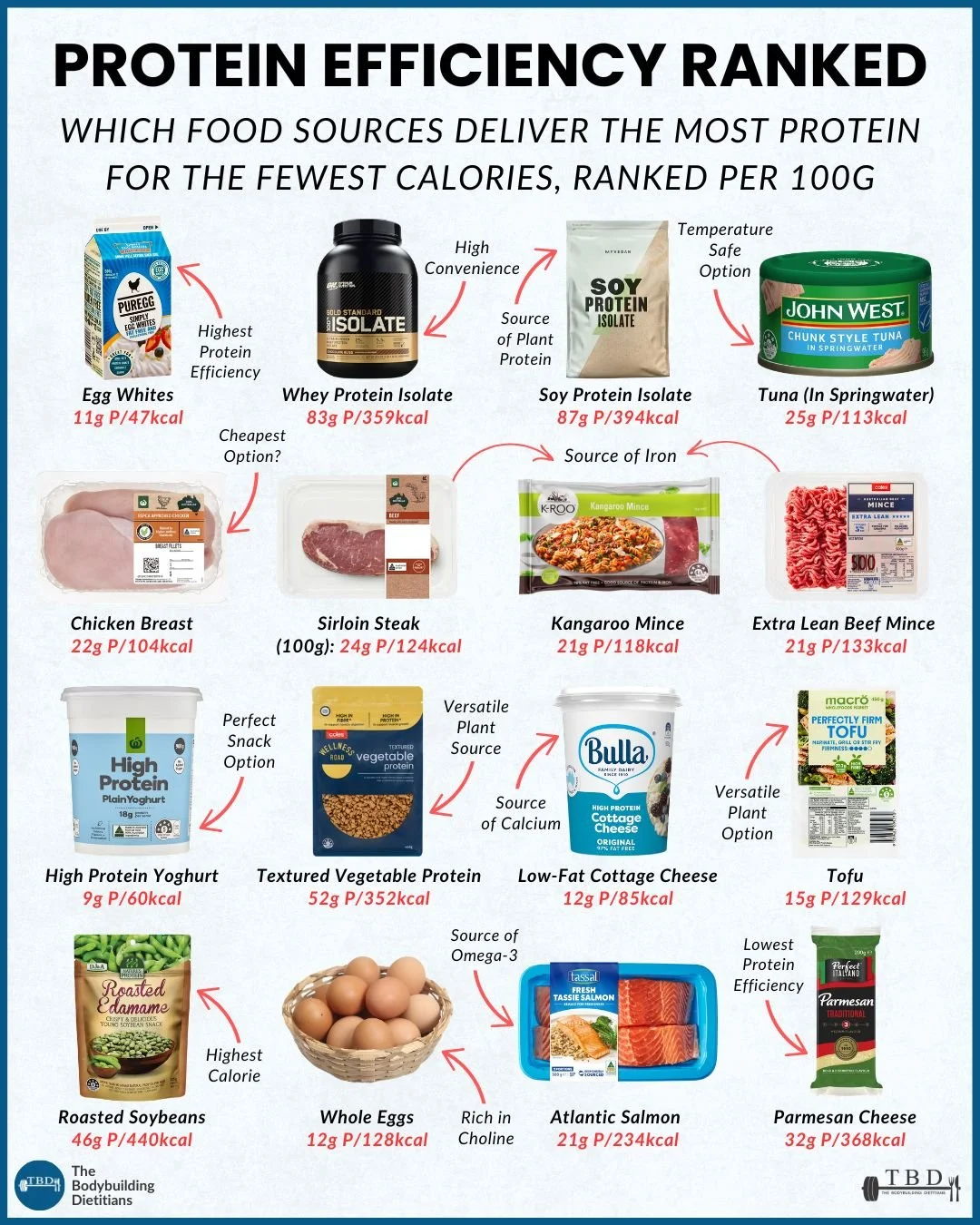
Sixteen common protein sources ranked by how much protein they deliver relative to their calorie content per 100 grams. The most efficient sources concentrate their calories in protein rather than fat or carbohydrate.
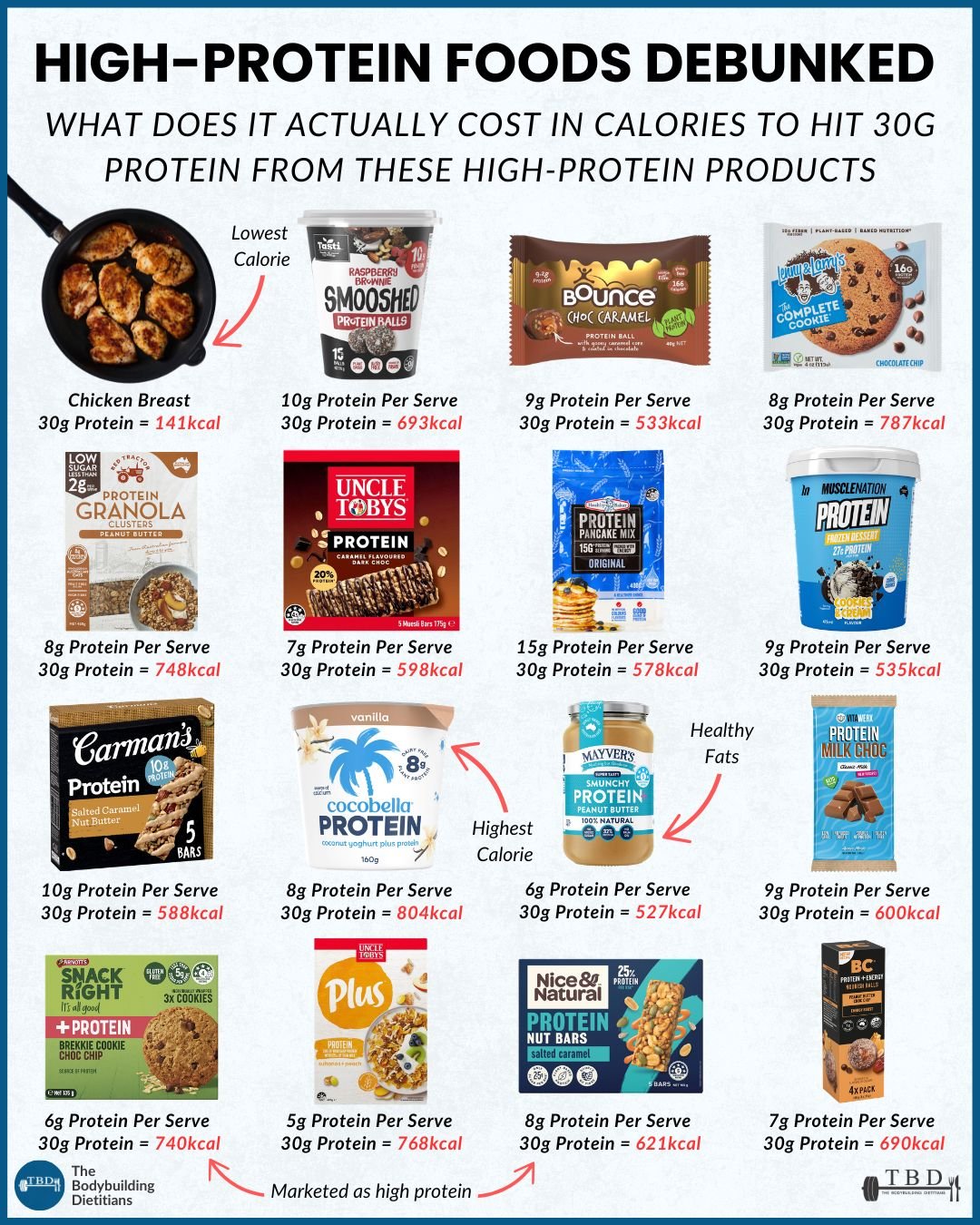
The calorie cost of reaching 30 grams of protein from marketed "high-protein" products compared to chicken breast. Most marketed products require four to six times the calories to deliver the same amount of protein.
Not every food marketed as high protein is actually a practical way to hit your protein targets. The word "protein" on a label tells you that the product contains some protein, but it tells you very little about how much that protein costs in terms of your overall calorie budget. For anyone managing their nutrition with specific goals in mind, whether fat loss, muscle gain, or body composition maintenance, this distinction matters considerably.
The two infographics above approach this from complementary angles. The first ranks whole and minimally processed foods by protein efficiency: how much protein they deliver relative to their calorie content per 100 grams. The second takes a selection of popular "high-protein" products and asks a simple question: how many calories would you need to consume to get 30 grams of actual protein from each one? The answers reveal a significant gap between what the marketing implies and what the numbers show.
Protein efficiency in this context refers to the proportion of a food's total calories that come from protein. A food with high protein efficiency delivers most of its calories as protein, with relatively little coming from fat or carbohydrate. A food with low protein efficiency may contain a meaningful amount of protein in absolute terms but delivers it alongside a much larger proportion of calories from other macronutrients.
Which Whole Foods Deliver the Most Protein Per Calorie?
Egg whites, whey protein isolate, chicken breast, tuna, and lean mince are among the most calorie-efficient protein sources available, with the majority of their calories coming directly from protein.
Egg whites sit at the top of the efficiency ranking because almost all of their calories come from protein: 11 grams of protein from just 47 kilocalories per 100 grams. They contain virtually no fat or carbohydrate, which makes them one of the purest protein sources available. This does not necessarily make them the best protein source in every context (they lack the choline, fat-soluble vitamins, and healthy fats found in whole eggs), but for pure protein efficiency per calorie, they are difficult to beat.
Whey protein isolate (83 grams of protein per 359 kilocalories per 100 grams) and soy protein isolate (87 grams of protein per 394 kilocalories per 100 grams) are both highly efficient, though the per-100-gram comparison is somewhat academic since typical serving sizes are 25 to 35 grams of powder. Their practical value lies in convenience and versatility: they can be added to meals, used in cooking, or consumed as shakes to boost protein intake without a significant calorie investment.
Tuna in springwater (25 grams of protein per 113 kilocalories per 100 grams) is one of the most efficient whole food protein sources and has the added advantage of being shelf-stable, making it a useful option for travel, work meals, and situations where refrigeration is not available.
Chicken breast (22 grams of protein per 104 kilocalories per 100 grams) remains one of the most widely used protein sources in physique-focused nutrition for good reason. It is affordable, versatile, widely available, and delivers protein with minimal accompanying fat. A single 150-gram serve provides approximately 33 grams of protein for around 156 kilocalories, which represents an excellent return on calorie investment.
Lean red meat (sirloin steak at 24 grams of protein per 124 kilocalories, kangaroo mince at 21 grams per 118 kilocalories, and extra lean beef mince at 21 grams per 133 kilocalories) occupies a similar efficiency range to chicken breast while offering additional nutritional benefits, particularly iron and zinc. Kangaroo is notable as one of the leanest commercially available red meats in Australia, and it provides a meaningful source of haem iron, which is particularly relevant for athletes at risk of iron deficiency.
Muscle protein synthesis is the biological process through which dietary protein stimulates the repair and growth of skeletal muscle. The rate of MPS is influenced by both the total amount of protein consumed and its amino acid profile, with leucine playing a particularly important role as the primary trigger for the signalling cascade that initiates MPS.
How Do Dairy and Plant Protein Sources Compare?
Dairy sources like low-fat cottage cheese and high-protein yoghurt offer strong protein efficiency with additional nutritional benefits, while plant sources like tofu, textured vegetable protein, and edamame provide protein alongside a higher calorie contribution from other macronutrients.
Low-fat cottage cheese (12 grams of protein per 85 kilocalories per 100 grams) is one of the most underutilised protein sources in physique-focused nutrition. It provides a strong protein-to-calorie ratio, a meaningful source of calcium, and a slow-digesting casein protein profile that makes it particularly useful as a pre-bed protein source or a base for meals where sustained amino acid delivery is desirable.
High-protein yoghurt (9 grams of protein per 60 kilocalories per 100 grams) serves as a convenient snack option that combines protein with probiotics and calcium. The efficiency varies significantly between products, so checking the nutrition panel is worthwhile, but the better options on the market deliver a genuinely useful protein contribution from a small calorie investment.
Tofu (15 grams of protein per 129 kilocalories per 100 grams) and textured vegetable protein (52 grams of protein per 352 kilocalories per 100 grams) are the most practical plant-based protein sources for individuals managing macro targets. Their protein efficiency is lower than most animal sources because a larger proportion of their calories come from fat (in the case of tofu) or carbohydrate (in the case of TVP), but they remain meaningful protein contributors within a plant-based or plant-inclusive diet.
Roasted soybeans (46 grams of protein per 440 kilocalories per 100 grams) are the highest-calorie option on the ranking due to their fat content, but they offer a convenient, shelf-stable, high-protein snack that requires no preparation. Their protein efficiency is lower than leaner options, but they contribute healthy fats and fibre alongside the protein.
The key practical insight is that plant protein sources are not inferior, but they do carry more accompanying calories per gram of protein than most animal sources. For someone with a generous calorie budget (during an improvement season, for example), this is unlikely to matter. For someone in a tight deficit, it means that plant-based protein requires more careful planning to hit protein targets without overshooting total calories, and it may warrant the strategic use of plant protein isolates (soy or pea protein powder) to bridge the gap efficiently.
What About Foods That Provide Protein Alongside Other Nutritional Benefits?
Some foods rank lower on pure protein efficiency but offer nutritional benefits that make them valuable inclusions despite their higher calorie cost per gram of protein.
Whole eggs (12 grams of protein per 128 kilocalories per 100 grams) are less protein-efficient than egg whites because approximately half of their calories come from fat. However, egg yolks are one of the richest dietary sources of choline (essential for brain function and liver health), provide fat-soluble vitamins A, D, E, and K, and contribute a complete amino acid profile. For most people, including whole eggs alongside egg whites or other lean protein sources provides the best balance of efficiency and overall nutritional quality.
Atlantic salmon (21 grams of protein per 234 kilocalories per 100 grams) is one of the least protein-efficient animal sources on the ranking because a significant proportion of its calories come from fat. However, that fat is predominantly omega-3 fatty acids (EPA and DHA), which are among the most well-supported nutrients in the research for cardiovascular health, cognitive function, and inflammation modulation. Including oily fish two to three times per week is a practical way to meet omega-3 needs, and the higher calorie cost is justified by the nutritional benefits the fat provides.
Omega-3 fatty acids are a family of polyunsaturated fats, the most well-studied of which are eicosapentaenoic acid (EPA) and docosahexaenoic acid (DHA), found primarily in oily fish. These fatty acids contribute to cardiovascular health, support cognitive function, and play a role in modulating the inflammatory response.
Parmesan cheese (32 grams of protein per 368 kilocalories per 100 grams) sits at the bottom of the efficiency ranking because the majority of its calories come from fat. It is not a practical primary protein source, but it is a flavourful addition that contributes protein, calcium, and umami flavour in small quantities. Understanding that parmesan is primarily a fat source that happens to contain protein, rather than a protein source that happens to contain fat, helps inform how it fits into a structured nutrition plan.
The broader principle here is that protein efficiency is one lens through which to evaluate food choices, but it is not the only lens. Micronutrient density, fatty acid profile, fibre content, food enjoyment, and dietary diversity all matter, and the most practical approach is to anchor the diet around a few highly efficient protein sources while including less efficient but nutritionally valuable foods in appropriate amounts. This is one of the areas where structured coaching adds value, because balancing protein efficiency with overall dietary quality requires the kind of applied judgement that goes beyond simply maximising protein per calorie.
What Do "High-Protein" Products Actually Deliver?
Many products marketed as "high protein" contain only 5 to 15 grams of protein per serve. When the calorie cost is extrapolated to 30 grams of actual protein, the inefficiency becomes clear.
The second infographic makes this comparison directly. Chicken breast delivers 30 grams of protein for approximately 141 kilocalories. By contrast, several popular marketed products require between 527 and 804 kilocalories to deliver the same 30 grams. A protein cookie that contains 8 grams per serve would require consuming nearly four cookies (787 kilocalories) to match the protein from a single chicken breast. A coconut yoghurt marketed as high protein (8 grams per serve) requires 804 kilocalories to reach 30 grams.
This is not to say these products are categorically bad choices. Many of them serve legitimate purposes in a well-structured diet: they provide variety, convenience, and a sense of indulgence that supports long-term adherence, particularly during restrictive phases. A protein bar as an afternoon snack or a protein pancake mix for a weekend breakfast can contribute positively to both protein intake and dietary satisfaction, and there is no reason to eliminate them from a plan that has room for them.
The issue arises when these products are relied upon as primary protein sources rather than supplementary ones. Someone who builds a significant portion of their daily protein intake around marketed "high-protein" products will consume substantially more calories to hit their protein target than someone who anchors their intake around whole food sources and uses marketed products strategically. Over the course of a fat loss phase, where the calorie budget is already constrained, this inefficiency can meaningfully reduce the amount of food available for other purposes (hunger management, micronutrient intake, dietary variety, food enjoyment).
Research on dietary protein sources and body composition outcomes supports prioritising whole food, minimally processed protein sources for the majority of dietary protein intake. Whole food protein sources tend to have higher thermic effects (the energy cost of digesting and absorbing the food), greater satiety per calorie, and more favourable micronutrient profiles compared to processed alternatives. However, no evidence suggests that moderate inclusion of processed protein products impairs outcomes when overall protein and calorie targets are met.
Source: van Vliet, Burd, and van Loon, 2015, Journal of Nutrition.
How Should You Think About Protein Efficiency When Planning Your Diet?
Protein efficiency is most useful as a planning tool that helps you allocate your calorie budget strategically, particularly during phases where calories are constrained and every food choice carries more weight.
During a fat loss phase, anchoring protein intake around highly efficient sources (chicken breast, egg whites, lean mince, tuna, whey protein isolate, low-fat cottage cheese) ensures that protein targets are met with minimal calorie expenditure, leaving more of the remaining budget available for carbohydrates (to support training), fats (to support hormonal health), fibre, and the variety of foods that make the diet enjoyable and sustainable.
During an improvement season or maintenance phase, where the calorie budget is larger, protein efficiency becomes less critical. There is more room for whole eggs, salmon, cheese, nuts, and other foods that deliver protein alongside meaningful fat or carbohydrate contributions. The extra calories from these foods are not wasted; they contribute to overall dietary quality, micronutrient intake, and food enjoyment, all of which matter for long-term adherence and health.
A practical framework for most people is to build the majority of daily protein intake (roughly 70 to 80%) around efficient whole food sources and to fill the remaining 20 to 30% with a combination of less efficient but nutritionally valuable whole foods and, where useful, marketed protein products. This ensures that protein targets are met reliably and efficiently while preserving enough flexibility for variety, convenience, and enjoyment.
If you are unsure how to balance protein efficiency with overall food quality and enjoyment within your current calorie budget, a consultation with one of our dietitians can help you build a practical approach that fits your phase, preferences, and goals.
A Note on the Comparison Method
A few limitations of the comparisons above are worth being transparent about. The efficiency ranking in the first infographic uses 100 grams as the basis for comparison, which is not always a realistic serving size for every food on the list. Nobody consumes 100 grams of whey protein isolate in a sitting, and 100 grams of parmesan is far more than a typical serve. The per-100-gram basis provides a standardised framework for comparison, but the practical serving size should be considered when interpreting the results.
The calorie costs in the second infographic are extrapolated from per-serve figures, which means they reflect a mathematical exercise rather than how anyone would actually consume these foods. Nobody eats four protein cookies in a sitting to reach 30 grams of protein. The point of the extrapolation is to illustrate the calorie cost of the protein these products contain, not to suggest that this is how they should be consumed. The practical takeaway is that when protein content per serve is low, the product's primary contribution to the diet is coming from something other than protein, and the label may be creating a misleading impression of its role.
Practical Takeaways
The most calorie-efficient protein sources are whole and minimally processed foods: egg whites, whey protein isolate, chicken breast, tuna, lean mince, low-fat cottage cheese, and high-protein yoghurt. Anchoring the majority of daily protein intake around these sources ensures targets are met without excessive calorie expenditure.
Plant protein sources (tofu, TVP, edamame, soy protein isolate) provide meaningful protein but carry more accompanying calories per gram of protein than most animal sources. This requires more deliberate planning during lower-calorie phases.
Foods that rank lower on protein efficiency (whole eggs, salmon, parmesan) often contribute valuable micronutrients, healthy fats, or other nutritional benefits that justify their inclusion despite their higher calorie cost per gram of protein.
Many marketed "high-protein" products contain only 5 to 15 grams per serve and require 500 to 800 kilocalories to deliver 30 grams of protein, compared to approximately 141 kilocalories from chicken breast. They are best used as supplementary inclusions rather than primary protein sources.
Protein efficiency matters most during lower-calorie phases (fat loss, contest prep) where the calorie budget is constrained. During higher-calorie phases, the priority can shift toward dietary quality, variety, and enjoyment alongside protein adequacy.
A practical framework is to build roughly 70 to 80% of daily protein intake around efficient whole food sources and fill the remaining 20 to 30% with nutritionally valuable whole foods and strategic use of marketed products for variety and adherence.
Frequently Asked Questions
What is the most calorie-efficient protein source?
Egg whites are the most calorie-efficient whole food protein source, providing 11 grams of protein from just 47 kilocalories per 100 grams. Among supplements, whey protein isolate and soy protein isolate deliver the highest protein-to-calorie ratios. Among commonly consumed whole foods, chicken breast and tuna in springwater are the most practical high-efficiency options for daily use.
Are high-protein snacks worth buying?
High-protein snacks can serve a useful role in supporting adherence, variety, and convenience within a structured nutrition plan. However, most marketed products contain relatively modest protein per serve (5 to 15 grams) alongside a significant calorie contribution from fat and carbohydrate. They are best understood as snacks that happen to contain some protein rather than as efficient protein sources, and they should supplement rather than replace whole food protein sources in most diets.
Is chicken breast better than protein bars for hitting protein targets?
From a pure protein efficiency perspective, chicken breast is substantially more effective: 30 grams of protein costs approximately 141 kilocalories from chicken breast compared to 500 to 800 kilocalories from most protein bars. However, protein bars offer convenience and portability that chicken breast does not, and they can serve a genuine adherence purpose in certain situations. The most practical approach is to rely on whole food sources for the majority of protein intake and use bars strategically where convenience or variety is the primary need.
Can you build muscle on plant-based protein?
Muscle growth is achievable on a plant-based diet provided total protein intake is adequate (generally 1.6 to 2.2 grams per kilogram per day) and protein is consumed from a variety of plant sources to ensure a complete amino acid profile. The lower protein efficiency of most plant sources means that more total calories are needed to hit protein targets compared to animal-based diets, which is a practical consideration for calorie management but not a barrier to muscle growth itself.
How much protein do you need per meal?
Research suggests that distributing protein across three to five meals per day, with each meal providing approximately 0.4 to 0.55 grams per kilogram of bodyweight (roughly 25 to 40 grams per meal for most people), supports muscle protein synthesis more effectively than consuming the same total in fewer, larger doses. However, total daily protein intake remains more important than per-meal distribution, and consistent daily targets should be prioritised over precise per-meal optimisation.
Does protein efficiency matter during a bulk?
Protein efficiency is less critical during a calorie surplus because the overall calorie budget is larger and there is more room for foods that deliver protein alongside meaningful fat and carbohydrate contributions. During an improvement season, the priority often shifts from maximising protein per calorie toward maximising dietary quality, variety, and enjoyment, which means including whole eggs, salmon, dairy, and other less efficient but nutritionally valuable foods more freely.
If you would like help building a nutrition plan that balances protein efficiency, food quality, and enjoyment within your current goals and calorie budget, our team of qualified dietitians can help.