Two athletes can follow an identical prep structure and arrive at completely different outcomes. The difference usually comes down to the habits, decisions, and mindset patterns they bring to the process.
The habits and decisions that shape a contest prep experience fall into broadly predictable patterns. Reactive approaches (responding emotionally to daily scale weight, dropping calories without data, comparing progress to other athletes, using cardio to compensate for adherence issues) tend to produce more stressful, less sustainable, and less effective preps. Proactive approaches (tracking weekly trends, making data-driven adjustments, trusting an individualised timeline, collaborating with a coach, and planning recovery in advance) tend to produce more consistent outcomes with less psychological friction. Most athletes move through both patterns at different stages of their development, and the goal is to recognise which habits are costing you and progressively build the ones that compound in your favour over time.
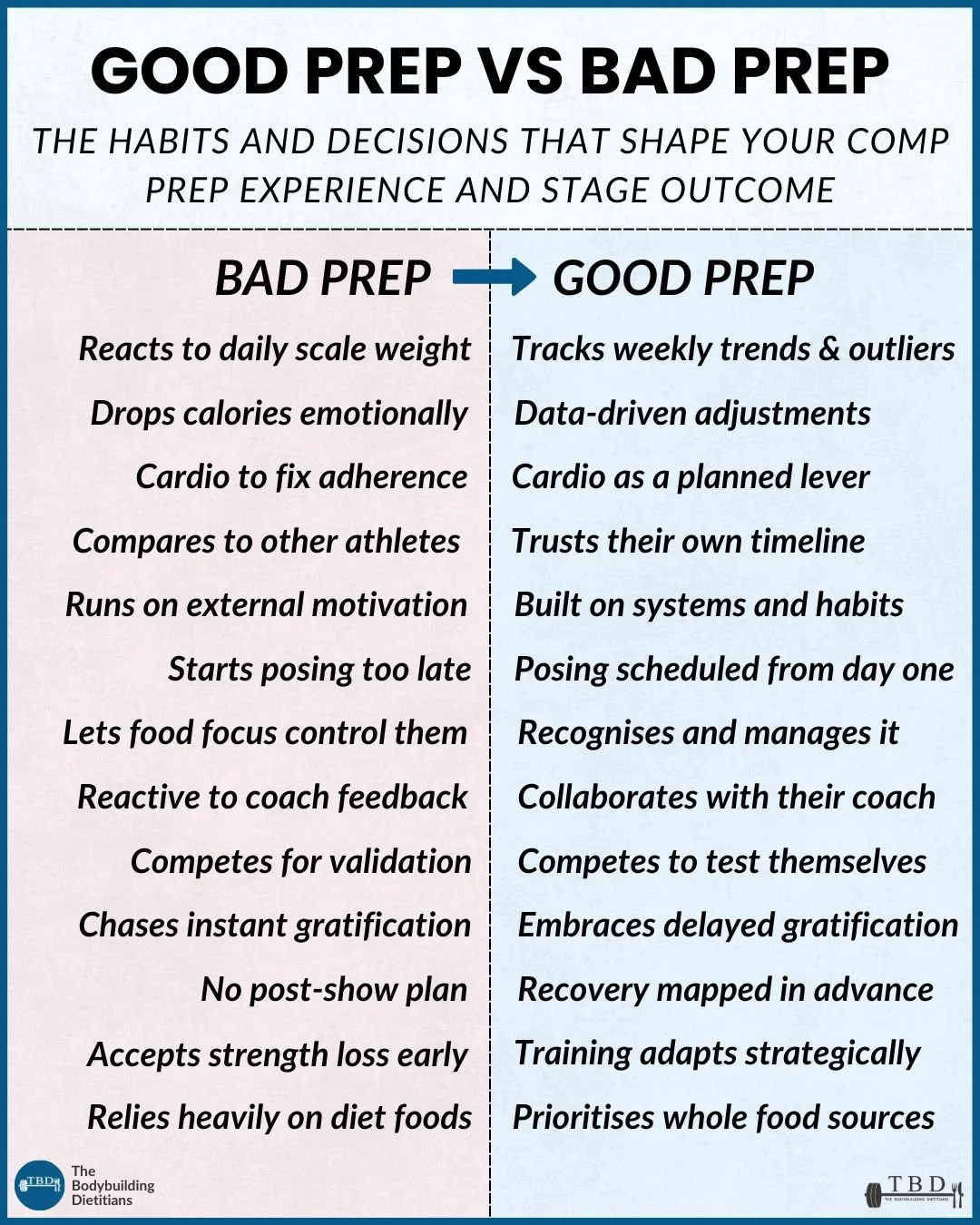
Thirteen habit pairs that tend to define the contest prep experience. The left column describes reactive patterns that most athletes move through at some point. The right column reflects what typically emerges with experience, perspective, and a clearer reason for competing.
Two athletes can follow an identical prep and arrive at completely different outcomes. Same coach, same macro targets, same training program, same timeline. One arrives on stage in strong condition feeling like the process was demanding but manageable. The other arrives depleted, stressed, and wondering whether the experience was worth it. The difference between these two outcomes almost always comes down to the habits, decisions, and psychological patterns the athlete brings to the process rather than the plan itself.
The comparison chart above outlines thirteen of these patterns, and it is worth stating clearly what it is and what it is not. The left column is not intended to describe a bad athlete. It describes patterns that many athletes move through at some point, particularly earlier in their competitive development or during preps where their motivation is driven primarily by external factors like validation, comparison, or the pressure of a deadline they were not truly ready for. Prep experienced from that place tends to feel like something happening to you rather than something you have chosen and are navigating with intention.
The right column reflects what tends to emerge with experience, perspective, and a clearer internal reason for being in the sport. These athletes are not necessarily more talented or even more disciplined. They have usually just learned, through enough preps, that reacting emotionally to short-term discomfort produces worse outcomes than staying the course and making measured adjustments when the data actually supports it.
If you find yourself in the left column on a few of these, that is a genuinely normal place to be. The goal is simply to recognise which patterns are costing you and start building the ones that compound in your favour over time. The sections below expand on the most impactful of these patterns and explain why they matter.
Should You React to Daily Scale Weight or Track Weekly Trends?
Daily scale weight is too noisy to make reliable decisions from. Tracking weekly averages and identifying genuine trends provides a far more useful and less stressful basis for adjusting your prep.
Bodyweight fluctuates daily for reasons that have nothing to do with fat loss or muscle change. Sodium intake, carbohydrate timing, hydration status, bowel habits, sleep quality, training volume, menstrual cycle phase, and stress can all shift scale weight by one to three kilograms in either direction on any given day. Reacting emotionally to a single morning weigh-in, particularly by making impulsive changes to calorie intake or cardio, introduces unnecessary volatility into a process that rewards consistency and patience.
Body composition refers to the relative proportions of fat mass, lean mass, water, and other tissues that make up total body weight. Changes in scale weight do not necessarily reflect changes in body composition, because fluctuations in water, glycogen, and gut content can mask or exaggerate the underlying trend in fat and lean mass over short timeframes.
The more effective approach is to weigh daily (ideally first thing in the morning, after using the bathroom, before eating or drinking) and then calculate a weekly average. Comparing weekly averages across time reveals the genuine trajectory: is weight trending down at the intended rate, holding steady, or increasing? This week-level view filters out the day-to-day noise and provides a reliable basis for making informed adjustments if they are needed.
In coaching settings, one of the most common sources of unnecessary stress during prep is the athlete's relationship with the scale. Athletes who learn to treat daily weigh-ins as data points rather than verdicts tend to experience significantly less psychological friction throughout their prep. This shift in perspective sounds simple, but it is one of the most impactful changes a competing athlete can make.
Are Your Calorie Adjustments Data-Driven or Emotionally Driven?
Dropping calories in response to frustration, impatience, or comparison rather than in response to genuinely stalled progress is one of the most common and costly patterns in contest prep.
The instinct to "do more" when progress feels slow is understandable, but acting on that instinct without data to support it often makes the situation worse. Premature calorie drops reduce the amount of food available later in prep when it is needed most, accelerate metabolic adaptation, increase hunger and food focus, and leave fewer levers to pull if progress genuinely does stall in the final weeks.
A data-driven adjustment process involves establishing clear criteria for when a change is warranted (for example, the weekly weight average has not moved in the expected direction for two to three consecutive weeks, photo comparisons show no visible change, and adherence has been confirmed as consistent), making a single measured adjustment, and then allowing enough time to assess its effect before considering further changes. This approach requires patience, but it preserves options and keeps the prep sustainable across its full duration.
Adaptive thermogenesis refers to the body's tendency to reduce energy expenditure in response to sustained energy restriction. Each time calories are dropped during a prep, the body's adaptive response increases, which means that the metabolic "runway" available for further adjustments shortens. Protecting that runway by making changes only when genuinely warranted is one of the strategic advantages that separates well-managed preps from reactive ones.
Research on the metabolic and hormonal consequences of aggressive versus moderate energy restriction during contest preparation supports more gradual, data-driven approaches. Athletes who diet at moderate rates of loss (approximately 0.5 to 1.0% of bodyweight per week) tend to retain more lean mass, experience less hormonal disruption, and report better psychological wellbeing than those who use more aggressive deficits.
Source: Helms, Aragon, and Fitschen, 2014, Journal of the International Society of Sports Nutrition.
Is Cardio a Planned Lever or a Compensation Tool?
Using cardio strategically as a planned energy expenditure lever produces better outcomes than using it reactively to compensate for dietary lapses or to accelerate progress beyond what the deficit alone is delivering.
A common pattern in less well-managed preps is for cardio to be added or increased in response to a "bad" eating day, a weekend that went over target, or a sense that the scale is not moving fast enough. In this reactive model, cardio functions as punishment or compensation rather than as a planned component of the energy balance equation. This creates an unpredictable and often escalating cardio load that is difficult to sustain, interferes with resistance training recovery, and introduces unnecessary physiological and psychological stress.
In a well-structured prep, cardio is introduced at a planned level and adjusted according to predetermined criteria, typically when a calorie reduction alone is no longer sufficient or practical, or when the coach determines that additional energy expenditure is a better strategic choice than a further reduction in food. This planned approach keeps cardio manageable, preserves it as a lever for later in prep when it may be needed more urgently, and prevents the accumulation of excessive training volume that can impair recovery and muscle retention.
The distinction between these two approaches is significant because the total training load (resistance training plus cardio) must be managed alongside the calorie deficit. An athlete who has gradually escalated to ten or twelve cardio sessions per week by mid-prep has far less room to manoeuvre than one who has been doing three to four planned sessions and has the option to increase if necessary. Protecting future flexibility is a strategic consideration that is easy to overlook in the moment but has meaningful consequences across the full duration of a prep.
Are You Comparing Your Prep to Other Athletes?
Comparing your progress to other competitors is one of the most psychologically destructive habits during prep and provides essentially no useful information for decision-making.
Every athlete starts their prep from a different body composition baseline, with a different metabolic profile, different genetic predispositions for fat distribution and muscle insertion points, a different competitive history, and a different rate of response to energy restriction. Two athletes who begin prep on the same date with the same target show can be on entirely different trajectories and both be exactly where they need to be. Comparing your progress to someone else's provides no actionable insight and introduces anxiety, self-doubt, and pressure that undermines the process.
Social media amplifies this significantly. Athletes in prep are surrounded by images and updates from other competitors who appear to be leaner, more conditioned, or further ahead, without any way to verify the accuracy of those comparisons (lighting, angles, editing, and selective posting all distort the picture). The most useful reference point during prep is always your own data: your weekly weight trend, your photos taken under consistent conditions, your performance in the gym, and the feedback from your coach.
Trusting your own timeline, meaning accepting that your prep will take as long as it takes based on where you started and how your body is responding, is one of the markers of a psychologically mature approach to competing. It does not require ignoring other athletes entirely. It simply requires recognising that their process has no bearing on yours and that the only useful comparison is between your current self and your previous data points.
What Does It Mean to Compete to Test Yourself Rather Than for Validation?
Athletes who compete to test themselves against the standard they have set internally tend to have more sustainable and psychologically healthier prep experiences than those whose primary motivation is external validation.
This distinction is subtle but consequential. When the primary motivation for competing is validation (proving something to others, earning approval, seeking recognition), the entire prep becomes contingent on a specific outcome. If the result does not match the expectation, the experience feels like failure regardless of how well the process was executed. This is a fragile motivational structure because the outcome is ultimately determined by factors outside the athlete's control, including the lineup, the judges' preferences, and the subjective nature of physique assessment.
When the primary motivation is self-testing (seeing what your body is capable of, pushing your discipline and consistency over an extended period, experiencing the full process from start to stage), the outcome becomes one part of a broader experience that has value regardless of the placement. The athlete can still want to win, still prepare with full commitment, and still be disappointed by an unfavourable result. The difference is that the value of the experience is not entirely dependent on the result, which creates a more resilient and sustainable relationship with competing.
Research on self-determination theory in sport consistently shows that athletes with more internalised (autonomous) motivation tend to experience greater wellbeing, more adaptive coping strategies, and better long-term engagement with their sport compared to athletes whose motivation is primarily externally regulated (contingent on approval, recognition, or outcomes they cannot control).
Source: Deci and Ryan, 2000, American Psychologist.
In coaching settings, the athletes who navigate prep most effectively, particularly their first or second competition, are typically those who have clearly articulated why they are doing it before the prep begins and whose reasons are grounded in personal challenge rather than external approval. This is not to say that wanting to win is problematic. It is to say that competing primarily for validation tends to create a prep that feels like it is happening to you, while competing to test yourself tends to create a prep that you are navigating with intention.
Why Does Food Focus Increase During Prep and How Should You Manage It?
Elevated food focus is a normal physiological and psychological response to sustained energy restriction, not a sign of weakness or failure. Recognising it and managing it proactively produces better outcomes than trying to suppress or ignore it.
As a calorie deficit extends and body fat decreases, the brain receives increasingly strong signals that energy availability is low. Leptin falls, ghrelin rises, and the neural circuits involved in appetite and reward become more sensitive to food-related cues. The result is that food occupies a progressively larger share of mental space: thinking about meals, planning what to eat, watching food content online, and experiencing stronger cravings all tend to intensify as the prep progresses.
Leptin is a hormone produced by fat cells that signals energy status to the brain. As body fat decreases during prep, leptin levels decline, which the brain interprets as a signal of energy insufficiency. This triggers a cascade of adaptive responses including increased hunger, elevated food focus, and reduced energy expenditure, all of which serve to defend against further fat loss.
Athletes who recognise this as a predictable, physiological phenomenon tend to manage it far more effectively than those who interpret it as a personal failing. Practical strategies include: reducing exposure to food-related social media content during the later stages of prep, keeping the environment around meals structured and predictable, maintaining a short list of planned higher-volume meals that satisfy cravings within the macro framework, and openly communicating with a coach about the intensity of food focus so that adjustments (such as a structured refeed or a diet break) can be made when appropriate.
Allowing food focus to drive behaviour, particularly through unplanned eating, compensatory restriction, or escalating cycles of control and loss of control, is one of the patterns that most reliably undermines the final weeks of a prep. The alternative is to acknowledge it, normalise it, and manage it with the same deliberate attention given to nutrition, training, and recovery.
Why Should Recovery Be Planned Before the Prep Ends?
Planning the post-show recovery phase before the prep concludes is one of the most consistently overlooked elements of a well-managed competitive cycle, and one of the most consequential.
The period immediately after a show is one of the highest-risk phases of the entire competitive cycle. The athlete's hormonal environment is suppressed, their relationship with food is at its most strained, and the psychological relief of the show being over can combine with elevated hunger signals to produce rapid, uncontrolled rebound eating. Without a structured recovery plan, the most common outcome is significant fat regain in the first four to eight weeks post-show, which undermines the subsequent improvement season and creates a longer, harder prep for the next competition.
A well-structured recovery plan involves a gradual, controlled increase in calorie intake toward maintenance and eventually a mild surplus, guided by the athlete's physical and psychological response. It accounts for the restoration hierarchy that the body follows after severe energy restriction: restoring essential body fat and energy availability first, normalising sleep and energy levels, allowing hormonal markers to recover, addressing psychological recovery around food, and only then transitioning into a dedicated muscle-building phase.
This is one of the areas where our bodybuilding coaching includes structured post-show support as a standard component of the prep, because managing the recovery phase is just as important as managing the prep itself, and arguably more consequential for long-term athlete development.
How Should Training Adapt During Prep?
Training should adapt strategically during prep to maintain the stimulus that preserves muscle, rather than being either left entirely unchanged or overhauled in response to declining performance.
As the deficit progresses and energy availability decreases, recovery capacity diminishes. Small declines in strength, particularly on isolation movements and later sets, are expected and normal. The appropriate response is a measured reduction in training volume (typically 20 to 40% across the prep) while maintaining intensity (load) on the key compound movements that provide the strongest muscle-retention signal.
The pattern that tends to produce worse outcomes is accepting significant strength loss early in the prep and either reducing loads prematurely or switching to lighter, higher-rep training in an attempt to "tone" or "condition" the muscle. As covered in the outdated bodybuilding practices article, the training stimulus that built the muscle is the strongest signal to retain it during a deficit. Reducing that stimulus before it is necessary sacrifices lean mass retention for no meaningful benefit.
Strategic adaptation means: keeping the key compound movements and their loads as close to off-season levels as possible for as long as possible, reducing total volume by removing supplementary sets or accessory movements when recovery becomes a limiting factor, and accepting small performance fluctuations without interpreting them as a reason to overhaul the program.
Why Does Food Quality Matter During Prep?
Prioritising whole food sources over processed diet foods during prep supports gut health, micronutrient intake, satiety, and long-term digestive function in ways that become increasingly important as the deficit deepens.
Protein bars, sugar-free confectionery, diet soft drinks, and similar products have a practical role in many prep diets. They can support adherence by providing variety and perceived indulgence within tight macro constraints. However, heavy reliance on these products at the expense of whole foods creates several downstream problems.
Processed diet foods are typically lower in fibre and micronutrients than their whole food equivalents. They often contain sugar alcohols, artificial sweeteners, and emulsifiers that can affect gut motility and comfort, particularly when consumed frequently. They also tend to be less satiating per calorie than whole foods, which means they provide less hunger management at a time when every calorie needs to work as hard as possible.
The approach that tends to work best in practice is to build the majority of the diet around minimally processed whole foods (lean proteins, vegetables, fruits, whole grains, legumes, nuts, seeds, and healthy fats) and to use diet products strategically where they serve a genuine adherence purpose rather than as dietary staples. This supports gut microbiome diversity, ensures micronutrient adequacy, and provides the food volume and satiety that become increasingly valuable as the deficit deepens.
How Does the Coach-Athlete Relationship Affect Prep Outcomes?
Athletes who collaborate with their coach, engaging in open communication, sharing honest feedback, and contributing to decision-making, tend to have more effective and psychologically sustainable preps than those who are purely reactive to instructions.
The coaching relationship during prep is not a one-directional process where the coach prescribes and the athlete complies. The athlete is the only person who has access to the subjective experience of the prep: how hungry they are, how their energy feels, how their training is performing, how their mood and food focus are tracking, and how their life outside of prep is affecting their capacity to adhere. This information is essential for making good coaching decisions, and it can only reach the coach through honest, proactive communication from the athlete.
Athletes who withhold information (underreporting food intake, downplaying psychological difficulty, failing to mention missed sessions or sleep disruptions) inadvertently undermine their own prep by preventing their coach from making informed adjustments. Athletes who communicate openly and honestly, even when the information is not flattering, give their coach the best possible basis for decision-making and create a collaborative dynamic that tends to produce better outcomes for both the process and the result.
Practical Takeaways
Track weekly weight averages rather than reacting to daily scale fluctuations. Daily weigh-ins provide useful data, but the weekly trend is the only reliable basis for decision-making.
Make calorie adjustments based on data (two to three weeks of stalled progress with confirmed adherence) rather than in response to frustration, impatience, or comparison to other athletes.
Treat cardio as a planned energy expenditure lever that is introduced and adjusted strategically, rather than as a reactive tool for compensating for dietary lapses or accelerating progress.
Trust your own timeline and resist the urge to compare your progress to other competitors. The only useful reference point is your own data under consistent conditions.
Recognise that elevated food focus is a normal physiological response to energy restriction, not a sign of weakness. Manage it proactively through environmental strategies and structured refeeds rather than trying to suppress it.
Plan the post-show recovery phase before the prep ends. The transition out of competition conditioning is one of the highest-risk periods of the competitive cycle and benefits enormously from deliberate structure.
Prioritise whole food sources as the foundation of your prep diet, using processed diet foods strategically where they serve a genuine adherence purpose rather than as staples.
Frequently Asked Questions
How do you know if your contest prep is going well?
A prep that is going well is typically characterised by a consistent, predictable rate of weight loss that aligns with the planned timeline, maintained or only modestly reduced training performance, manageable hunger and food focus, stable mood and sleep quality, and a collaborative relationship with your coach. No prep is free from difficulty, but the overall trajectory should feel controlled and intentional rather than chaotic or reactive.
How fast should you lose weight during contest prep?
A rate of approximately 0.5 to 1.0% of bodyweight per week is generally recommended for physique competitors during preparation. Faster rates of loss increase the risk of lean mass loss, hormonal disruption, and psychological difficulty, while slower rates preserve muscle more effectively but require a longer prep timeline. The appropriate rate depends on the athlete's starting body fat, the amount of fat to be lost, and the time available before the competition.
Should you do cardio during contest prep?
Cardio can be a useful component of a contest prep when used as a planned energy expenditure lever alongside dietary adjustments. The most effective approach is to introduce cardio at a manageable level and increase it only when dietary changes alone are no longer sufficient or practical. Excessive cardio, particularly when added reactively in response to frustration or comparison, can impair resistance training recovery and accelerate lean mass loss.
How important is posing practice during prep?
Posing practice should ideally be scheduled from the beginning of prep rather than introduced in the final weeks. Stage presentation is a skill that requires consistent practice to develop, and athletes who begin posing early tend to present more confidently and effectively on show day. Posing also provides useful proprioceptive feedback about conditioning that supplements photo comparisons and scale data.
What should you do after a bodybuilding show?
The post-show period should involve a structured, gradual increase in calorie intake toward maintenance and eventually a mild surplus, guided by the athlete's physical and psychological response. Rushing this transition typically leads to rapid and excessive fat regain. A well-managed recovery phase allows the body to restore hormonal function, normalise energy and sleep, recover psychologically, and eventually transition into a productive improvement season. This phase typically spans one to four months depending on the severity of the prep.
How do you deal with food focus during prep?
Food focus is a normal physiological response to energy restriction driven by changes in leptin, ghrelin, and neural reward sensitivity. Practical management strategies include reducing exposure to food-related social media content, maintaining structured meal timing, using high-volume meals within the macro framework, communicating openly with your coach about intensity, and utilising structured refeeds or diet breaks when appropriate. Recognising food focus as a predictable part of the process rather than a personal failing is the most important first step.
If you are preparing for a competition and want to build the habits and systems that lead to a well-managed, sustainable prep, our team of qualified dietitians can help.