Years of messaging designed to sell convenience, supplements, and shortcuts has made it difficult to know what actually matters for body composition. These nine evidence-based principles cut through the noise.
The nutrition and training principles that most reliably drive body composition outcomes are often at odds with what the fitness industry promotes. Pre-exercise fuel directly influences training quality, and fasted training compromises performance for most sessions over 45 minutes. Plant-based diets require more deliberate planning to meet micronutrient needs. Chronic underfuelling undermines both fat loss and muscle gain. Weekend overconsumption can erase a weekday deficit. Genetics influence individual responses but do not negate the value of consistency. If weight is not changing, the deficit is not sufficient. Superfoods do not compensate for an overall poor dietary pattern. Most supplements are not worth the investment. And muscle gain is far slower than the industry implies, measured in years of consistent effort rather than weeks.
Some nutrition realities are uncomfortable to sit with. Not because they are complicated, but because they run counter to the messaging that most people have been absorbing for years. The fitness industry has a financial interest in making things feel more complex, more urgent, and more product-dependent than they actually are, because complexity and urgency sell supplements, programs, and quick-fix solutions. Simplicity and patience do not.
Most of what drives body composition outcomes over time is genuinely straightforward: consistent training, adequate protein, a manageable calorie intake, sufficient sleep, and enough patience to let the process work across months and years rather than weeks. The nine points below do not introduce new concepts so much as they reframe familiar ones in ways that are more aligned with the evidence and more useful for long-term decision-making. They will not all apply to everyone, but the ones that resonate tend to resonate for a reason.
Does Training Fasted Compromise Your Performance?
For most sessions lasting longer than 45 minutes or involving moderate to high intensity, training without pre-exercise fuel is likely leaving performance on the table.
Pre-exercise nutrition directly influences training output. Carbohydrate availability supports the glycogen stores that fuel high-intensity resistance training, and training in a glycogen-depleted state can reduce the number of quality reps performed, decrease training volume, and impair the overall stimulus applied to the muscle. For sessions that are short, low intensity, or primarily aerobic, the impact of fasting is less meaningful. For the kind of training that most lifters and physique athletes do (moderate to high intensity resistance training lasting 60 to 90 minutes), arriving fuelled tends to produce better sessions and, over time, better outcomes.
A meta-analysis of studies comparing fed versus fasted resistance training found that consuming a meal containing carbohydrate and protein before training was associated with greater total training volume and improved performance markers compared to training in a fasted state, with the effect being more pronounced in sessions lasting longer than 60 minutes.
Source: Aird, Davies, and Carson, 2018, Journal of the International Society of Sports Nutrition.
This does not mean that a large meal immediately before training is necessary or even desirable. A moderate pre-training meal consumed one to three hours before the session, built primarily around carbohydrate and protein with lower fat to support digestion, is sufficient to support performance for most people. The specific food choices matter far less than the principle of providing the body with fuel before asking it to perform.
Does a Plant-Based Diet Require More Effort for Adequate Nutrition?
A plant-based diet can absolutely support muscle growth, fat loss, and long-term health, but it does require more deliberate planning to meet certain micronutrient needs than an omnivorous diet.
Iron, zinc, calcium, iodine, vitamin B12, and omega-3 fatty acids are all harder to obtain in adequate quantities or to absorb efficiently from plant sources compared to animal sources. Non-haem iron (the form found in plants) is less bioavailable than haem iron from animal foods. Plant-based zinc and calcium sources often come packaged with phytates and oxalates that reduce absorption. Vitamin B12 is essentially absent from plant foods and requires supplementation for anyone following a strict vegan diet. Long-chain omega-3 fatty acids (EPA and DHA) are found primarily in oily fish, and the conversion rate from the plant-based precursor ALA is low (typically less than 10%).
This is not an argument against plant-based eating. It is an acknowledgement that the nutritional planning required to avoid deficiency is more involved when animal products are excluded, and that approaching a plant-based diet with the assumption that it automatically covers all nutritional bases creates unnecessary risk. Deliberate inclusion of fortified foods, strategic supplementation (B12, omega-3, potentially iron and zinc), and attention to protein complementarity make plant-based diets entirely viable for physique-focused goals, but the effort required to get there should not be underestimated.
Is Eating as Little as Possible the Fastest Way to Lose Fat?
Eating as little as possible is not the fastest route to a better physique, because chronic underfuelling undermines both fat loss and muscle gain by impairing the physiological systems that drive adaptation.
Fat loss and muscle gain are different goals that require different caloric contexts, but both share a common requirement: enough energy to train effectively and enough protein to support the muscle tissue you have. When energy intake drops too low, training quality suffers (because glycogen stores are depleted and recovery is impaired), muscle protein synthesis rates decline (because the body is in a state of physiological stress), hormonal function is suppressed (testosterone, thyroid hormones, and leptin all decrease), and the adaptive metabolic responses that slow fat loss accelerate.
Relative energy deficiency in sport (REDs) is a clinical syndrome resulting from insufficient energy availability to support the physiological functions required for optimal health and performance. Chronic underfuelling, whether intentional or inadvertent, increases the risk of hormonal disruption, impaired bone health, reduced immune function, and diminished training adaptation.
The practical alternative is to use a moderate, sustainable deficit (typically 300 to 600 kilocalories below maintenance, or a rate of loss of approximately 0.5 to 1.0% of bodyweight per week) that preserves training quality, supports protein requirements, and maintains enough dietary flexibility to sustain the approach over the timeframe required. More aggressive approaches may produce faster scale weight changes in the short term, but the composition of that weight loss shifts unfavourably toward muscle rather than fat, and the rebound risk increases substantially.
Can Weekend Overconsumption Erase a Weekday Deficit?
A planned, structured weekday with an unstructured weekend is rarely sufficient for meaningful fat loss, because energy balance does not reset on Monday.
Research consistently shows that people underestimate their weekend calorie intake significantly. The shift from structured weekday routines to less controlled weekend eating, combined with social meals, dining out, alcohol, and the general relaxation of dietary attention, often produces a weekend surplus that partially or fully offsets the weekday deficit. The result is a weekly energy balance that is close to maintenance rather than in the deficit required for fat loss, despite the individual feeling like they are dieting five days out of seven.
Studies on self-reported dietary intake have found that weekend calorie consumption is significantly higher than weekday intake, with the increase driven primarily by larger portion sizes, higher-fat food choices, alcohol, and less structured meal timing. The magnitude of the difference is often large enough to meaningfully reduce or eliminate the weekly deficit.
Source: Haines et al., 2003, Obesity Research.
Do Genetics Influence Your Results?
Genetics meaningfully influence the rate and extent of muscle gain and fat loss, and acknowledging this is more productive than pretending everyone starts from the same baseline.
Muscle fibre type distribution, hormonal profiles, insulin sensitivity, myostatin levels, bone structure, limb proportions, and fat distribution patterns all vary between individuals and all influence how the body responds to training and nutrition. Two people following the same program with the same adherence can achieve genuinely different outcomes because their genetic starting points are different. This is a well-established finding in exercise physiology research, and ignoring it creates unrealistic expectations that lead to frustration and, in some cases, abandonment of the process.
Myostatin is a protein that acts as a negative regulator of muscle growth, limiting the amount of muscle tissue the body develops. Myostatin levels vary between individuals, and lower levels are associated with greater muscle mass and a more favourable response to resistance training.
The important qualification is that genetic variation does not make effort and consistency irrelevant. It means that the most useful comparison is always with your own previous data points rather than with someone else's results. The person with more favourable genetics still needs to train consistently, eat appropriately, and recover adequately to express that potential. The person with less favourable genetics can still make meaningful, visible progress over years of consistent effort. The difference is the ceiling and the rate at which progress occurs, not whether progress is possible.
If You Are Not Losing Weight, Are You Actually in a Deficit?
If bodyweight is not trending downward over a period of two to three weeks with confirmed adherence, the most likely explanation is that the calorie deficit is not large enough to produce measurable fat loss at this point.
This is one of the most straightforward principles in nutrition, and also one of the most emotionally difficult to accept. There are three common explanations for a stalled weight trend in someone who believes they are in a deficit. Metabolic adaptation has reduced total daily energy expenditure (through decreased NEAT, reduced thermic effect of food, and hormonal adjustments) to the point where the original deficit has narrowed or closed. Tracking inaccuracy (underestimating intake, missing incidental calories, portion drift over time) has allowed actual intake to creep above the target. Or activity compensation (reduced non-exercise movement as a subconscious response to restricted energy intake) has decreased total daily expenditure.
Non-exercise activity thermogenesis (NEAT) refers to the energy expended through all physical activity that is not structured exercise, including walking, fidgeting, household tasks, and occupational movement. NEAT can decrease substantially during energy restriction, often without the individual's awareness, and represents one of the most significant sources of metabolic adaptation during a fat loss phase.
In the absence of an underlying medical condition affecting metabolism (which is genuinely rare and typically presents with other identifiable symptoms), the answer is to create a larger net deficit through reduced food intake, increased energy expenditure, or a combination of both. This is where working with a coach or dietitian provides value, because objectively assessing which of the three explanations is most likely and responding appropriately requires honest data analysis rather than emotional decision-making.
Are Superfoods Worth the Hype?
Blueberries, acai, spirulina, and similar foods marketed as "superfoods" are nutritious foods, but they do not have the power to compensate for an overall poor dietary pattern.
The superfood concept is primarily a marketing construct rather than a scientific classification. The foods typically labelled as superfoods do contain beneficial nutrients, antioxidants, and phytochemicals, and there is nothing wrong with including them in the diet. The issue arises when the marketing creates the impression that consuming specific foods can meaningfully offset the effects of an otherwise poorly structured diet, because it redirects attention from the overall dietary pattern (which is what actually drives health and body composition outcomes) toward individual food choices (which have a comparatively modest influence when viewed in isolation).
Systematic reviews of the relationship between dietary patterns and health outcomes consistently find that overall dietary quality, characterised by adequate energy balance, sufficient protein, diverse plant food intake, appropriate fibre, and limited ultra-processed food consumption, is a far stronger predictor of health and body composition outcomes than the inclusion or exclusion of any single food or food group.
Source: Schwingshackl et al., 2018, Advances in Nutrition.
The practical implication is that spending additional money on marketed superfoods while the fundamentals of the diet (protein adequacy, calorie management, fibre intake, food diversity) remain unaddressed is a poor return on investment. Getting the basics right consistently will always outperform adding exotic ingredients to a diet that is not otherwise well-constructed.
Are Most Supplements a Waste of Money?
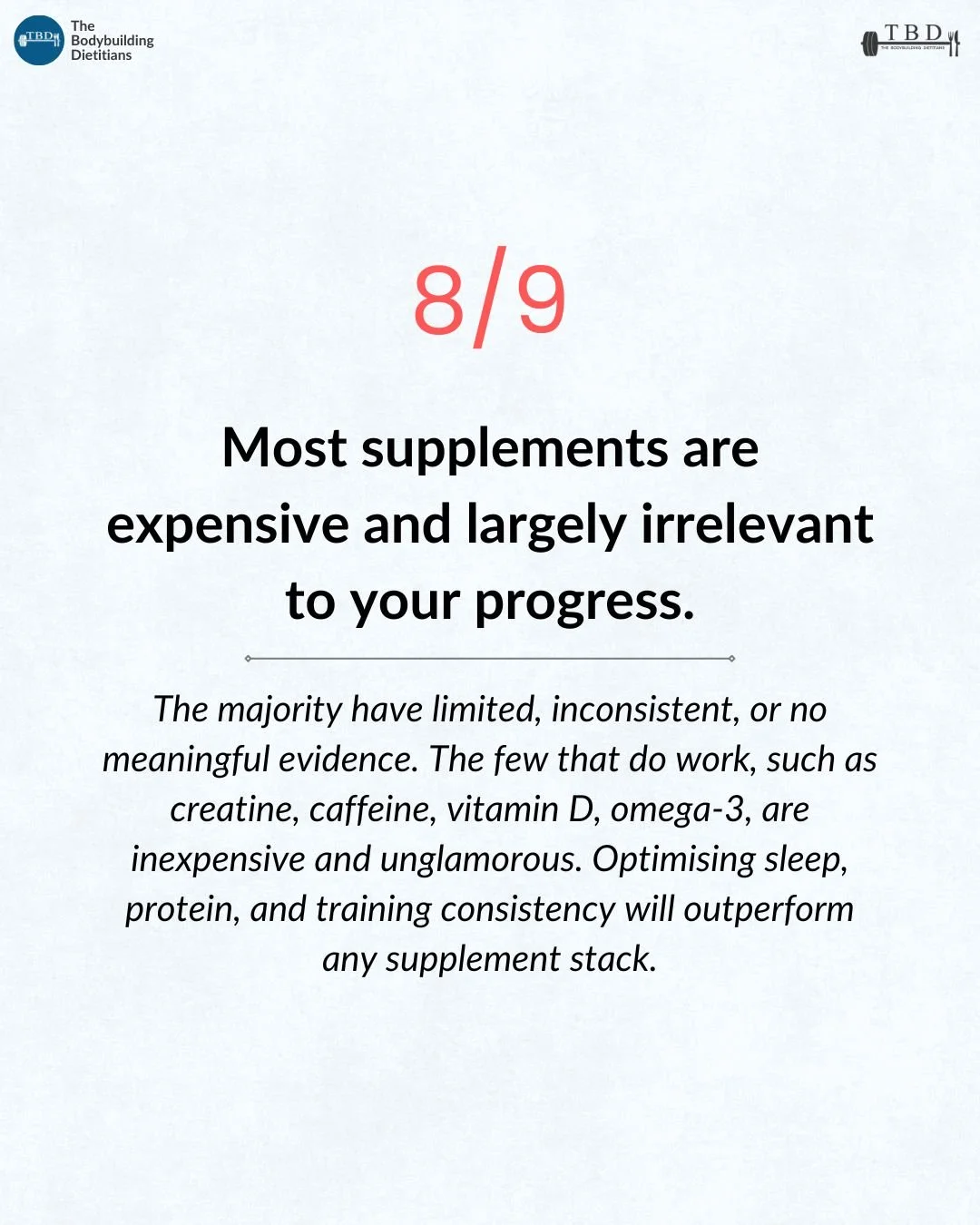
The majority of supplements have limited, inconsistent, or no meaningful evidence supporting their use for the outcomes they claim to deliver. The few that do work are inexpensive and unglamorous.
The supplement industry thrives on the gap between consumer expectations and the evidence base for most products. Optimising sleep, protein intake, and training consistency will outperform any supplement stack, and the supplements that do have robust evidence behind them (creatine monohydrate, vitamin D3, omega-3 fatty acids, magnesium, and caffeine) are among the least expensive and least marketed products on the shelf.
How Fast Can You Actually Build Muscle?
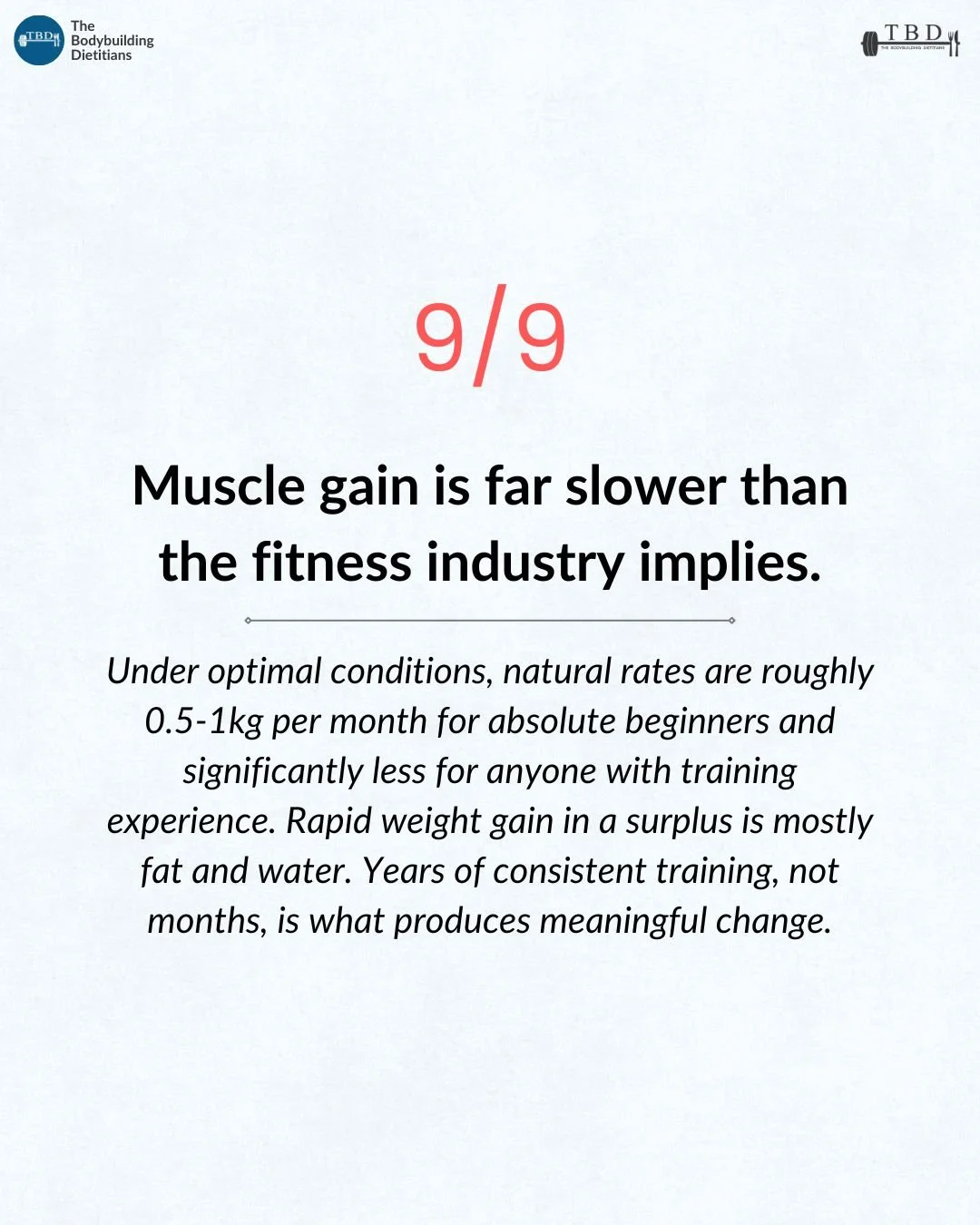
Muscle gain is far slower than the fitness industry implies. Under optimal conditions, natural rates of muscle accrual are roughly 0.5 to 1 kilogram per month for absolute beginners and significantly less for anyone with training experience.
This is perhaps the most important expectation to set correctly, because unrealistic expectations about the rate of muscle gain lead to two common mistakes: either the individual abandons the process prematurely because they interpret normal progress as failure, or they increase their calorie surplus excessively in an attempt to accelerate growth, which primarily accelerates fat gain rather than muscle gain.
Muscle protein synthesis is the biological process through which dietary protein and the mechanical stimulus from resistance training combine to drive the repair and growth of skeletal muscle tissue. The rate of MPS, and therefore the rate of muscle accrual, is constrained by hormonal environment, training stimulus quality, energy and protein availability, sleep and recovery, and genetic factors. These constraints mean that the process cannot be meaningfully accelerated beyond its physiological ceiling by simply eating more.
Rapid weight gain during a calorie surplus is predominantly fat and water rather than muscle tissue. An athlete gaining 2 kilograms per month in a surplus is almost certainly accumulating significantly more fat than muscle, which will need to be dieted off later at a cost to the subsequent fat loss phase. A controlled surplus of approximately 200 to 500 kilocalories above maintenance, maintained consistently with adequate protein and progressive training, maximises the proportion of weight gained as lean tissue while minimising unnecessary fat accumulation.
Years of consistent training, not months, is what produces meaningful, visible muscle development. The fitness industry's emphasis on short-term transformation timelines creates a distorted perception of what is achievable and at what rate, and accepting a more realistic timeline is one of the most psychologically liberating adjustments a lifter can make.
This is one of the areas where structured coaching provides particular value, because managing expectations, calibrating surplus size, and monitoring the rate of gain to ensure it is productive rather than excessive requires the kind of experienced oversight that prevents wasted time and unnecessary fat accumulation across muscle gain phases.
Why Do These Realities Matter?
The nine principles above share a common thread: each one redirects attention from the things the fitness industry tends to amplify (supplements, specific foods, dramatic transformations, fasted training protocols, extreme restriction) toward the fundamentals that actually drive outcomes (consistent training, adequate nutrition, sufficient recovery, realistic expectations, and patience).
Demystifying these topics and applying clear, evidence-based thinking to your own situation is more valuable than any single product, protocol, or shortcut. The gap between what the industry sells and what the evidence supports is where most people's confusion, frustration, and wasted effort lives. Closing that gap, even partially, tends to produce better outcomes with less friction.
If you would like support applying these principles to your own training and nutrition, a consultation with one of our dietitians can help you identify which areas of your current approach would benefit most from adjustment and build a plan grounded in the fundamentals that matter.
Practical Takeaways
Pre-exercise fuel supports training quality. Unless your session is low intensity or under 45 minutes, eating before training tends to produce better performance and better outcomes over time.
Plant-based diets can support physique goals but require more deliberate planning for iron, zinc, calcium, iodine, B12, and omega-3. Supplementation and fortified foods are often necessary to close the gaps.
Chronic underfuelling impairs both fat loss and muscle gain by compromising training quality, muscle protein synthesis, and hormonal function. A moderate, sustainable deficit outperforms an aggressive one across any meaningful timeframe.
Weekend overconsumption can partially or fully offset a weekday deficit. Building weekend flexibility into the plan deliberately, rather than hoping it resolves itself, protects the weekly energy balance.
Genetics influence the rate and ceiling of muscle gain and fat loss, but they do not eliminate the value of consistency. Compare your progress to your own previous data rather than to someone else's.
If weight is not trending downward over two to three weeks, the deficit is not sufficient. Metabolic adaptation, tracking inaccuracy, and activity compensation are the most common explanations.
Superfoods are nutritious but do not compensate for a poorly constructed overall dietary pattern. The fundamentals of the diet matter far more than any single food.
Most supplements are not worth the investment. The few with robust evidence (creatine, vitamin D, omega-3, magnesium) are inexpensive, and optimising sleep, protein, and training consistency will outperform any supplement stack.
Natural muscle gain is approximately 0.5 to 1 kilogram per month for beginners and significantly less for trained individuals. Rapid weight gain in a surplus is predominantly fat and water. Years of consistent effort, not months, is what produces meaningful change.
Frequently Asked Questions
Should you eat before training?
For most resistance training sessions lasting longer than 45 minutes, consuming a meal containing carbohydrate and protein one to three hours before training supports better performance and greater training volume compared to training fasted. The specific food choices matter less than ensuring the body has fuel available. For short, low-intensity sessions, the impact of fasting is less significant.
Can you build muscle on a plant-based diet?
Muscle growth is achievable on a plant-based diet provided total protein intake is adequate, protein is sourced from a variety of plants to ensure amino acid completeness, and micronutrient gaps (iron, zinc, B12, omega-3, calcium, iodine) are addressed through deliberate food selection and supplementation. The process requires more nutritional planning than an omnivorous approach but is entirely viable with appropriate attention.
Why am I not losing weight even though I'm dieting?
The most common explanations are metabolic adaptation (your body has reduced energy expenditure in response to the deficit), tracking inaccuracy (actual intake is higher than you believe), or activity compensation (reduced non-exercise movement). In the absence of a medical condition, the solution is to create a larger net deficit through reduced intake, increased activity, or both. Working with a professional can help identify which factor is most relevant.
How fast can you build muscle naturally?
Under optimal conditions (adequate protein, appropriate calorie surplus, progressive resistance training, sufficient sleep), natural rates of muscle gain are approximately 0.5 to 1 kilogram per month for beginners, with the rate declining significantly as training experience increases. Rapid weight gain beyond these rates is predominantly fat and water rather than muscle tissue.
Do superfoods help with weight loss?
No individual food, including those marketed as superfoods, has a meaningful independent effect on weight loss. Fat loss is driven by sustained energy balance, and the overall dietary pattern (calorie management, protein adequacy, food quality, fibre intake) determines outcomes far more than the inclusion or exclusion of any specific food.
Are supplements necessary for building muscle?
Supplements are not necessary for building muscle, but a small number can support the process. Creatine monohydrate has the strongest evidence for enhancing training quality and lean mass gains. Vitamin D and omega-3 support the physiological environment in which adaptation occurs. Protein powder is a practical tool for meeting protein targets but offers no advantage over whole food protein when intake is adequate. Sleep, protein, and training consistency will always matter more than any supplement.
If you would like support cutting through the noise and building a nutrition and training approach grounded in the fundamentals that actually matter, our team of dietitians can help.