How dietary fibre influences gut health, body composition, and long-term disease risk, and why most structured nutrition plans make it harder to achieve adequate intake than it needs to be.
Dietary fibre encompasses three functionally distinct types (soluble, insoluble, and resistant starch), each of which serves a different physiological role in digestion, metabolic health, and microbiome support. Current guidelines recommend 25 to 30 grams per day, or approximately 14 grams per 1,000 kilocalories, yet fewer than 30% of adults meet this target. Higher fibre intakes (25 to 29 grams per day versus 15 to 19 grams) are associated with a 17 to 31% reduced risk of coronary heart disease, 11 to 22% reduced risk of colorectal cancer, and 10 to 22% reduced risk of type 2 diabetes. Consuming fibre from a variety of plant sources, distributed across the day, supports both gut microbiome diversity and long-term health outcomes.
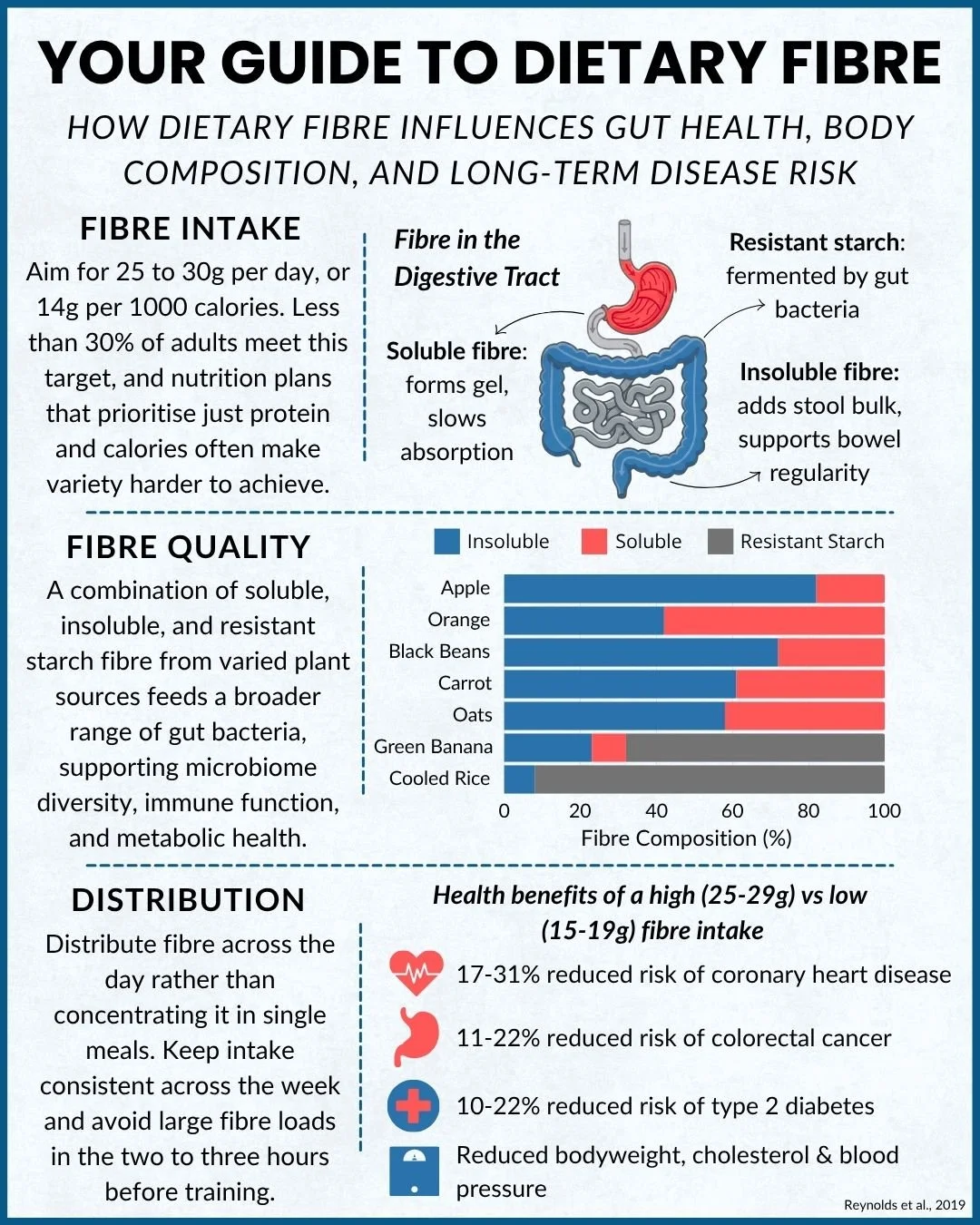
A visual guide to the three types of dietary fibre, how common foods differ in their fibre composition, and the health outcomes associated with meeting recommended intake targets.
Many people associate dietary fibre primarily with digestion, which is understandable but misses the majority of what the research actually shows. Fibre's role extends well beyond bowel regularity into blood glucose regulation, cholesterol management, immune function, microbiome diversity, systemic inflammation, and long-term disease risk reduction. For anyone focused on body composition, these are not abstract health metrics. They are the physiological foundations that determine how effectively the body responds to training and nutrition over time.
Despite this, fibre remains one of the most consistently under-consumed nutrients in developed countries, and the problem is often more pronounced among people following structured nutrition plans. When protein and calorie targets dominate food selection, higher-fibre, more diverse plant foods tend to get pushed to the margins. The result is a diet that hits its macronutrient targets precisely while falling meaningfully short on the fibre intake needed to support the health outcomes that underpin long-term performance and wellbeing.
The infographic above breaks dietary fibre into three layers: intake, quality (fibre type), and distribution. Each of these layers addresses a different aspect of how fibre fits into a well-constructed nutrition plan, and the sections below explore each one in the context of both health and physique-focused nutrition.
How Much Fibre Should You Eat Each Day?
Current guidelines recommend 25 to 30 grams of dietary fibre per day, or approximately 14 grams per 1,000 kilocalories consumed, yet fewer than 30% of adults in most developed countries meet this target.
Dietary fibre refers to the non-digestible carbohydrate components of plant foods that resist digestion and absorption in the small intestine. Unlike other carbohydrates, fibre passes through the upper gastrointestinal tract largely intact, reaching the large intestine where it is either fermented by gut bacteria (producing beneficial metabolites) or excreted. Fibre is found exclusively in plant foods: fruits, vegetables, legumes, grains, nuts, seeds, herbs, and spices.
The 25 to 30 gram recommendation is not an arbitrary number. It is the intake range most consistently associated with meaningful reductions in chronic disease risk in large epidemiological studies and meta-analyses. The scalable alternative of approximately 14 grams per 1,000 kilocalories provides a useful benchmark that adjusts automatically with total energy intake, which is particularly practical for physique-focused individuals whose calorie targets change across different nutritional phases.
For someone consuming 2,000 kilocalories per day, this translates to approximately 28 grams of fibre. At 2,500 kilocalories, the target rises to roughly 35 grams. During a lower-calorie phase of 1,600 kilocalories, the target is approximately 22 grams, which becomes harder to achieve from food alone and may warrant the strategic use of fibre-dense foods or supplementary sources like psyllium husk.
The practical challenge for most people following structured nutrition plans is that protein and calorie targets tend to dominate food selection. Lean protein sources (chicken breast, white fish, egg whites, protein powder) contain essentially no fibre. Many popular carbohydrate sources in physique-focused nutrition (white rice, cream of rice, rice cakes) are also very low in fibre. When these foods form the backbone of the diet, reaching fibre targets requires deliberate effort to include higher-fibre foods alongside them, rather than assuming fibre will take care of itself.
A landmark systematic review and meta-analysis of 185 prospective studies and 58 clinical trials found that higher fibre intakes (25 to 29 grams per day) were associated with a 15 to 30% reduction in all-cause mortality and cardiovascular-related mortality, along with reduced incidence of coronary heart disease, stroke, type 2 diabetes, and colorectal cancer compared to lower intakes. The relationship was dose-dependent, with greater intakes associated with greater benefit, and no upper threshold of benefit was identified within the range studied.
Source: Reynolds et al., 2019, The Lancet.
This study remains one of the most comprehensive and widely cited pieces of evidence in the fibre research landscape, and the specific risk reductions shown in the infographic (17 to 31% reduced risk of coronary heart disease, 11 to 22% reduced risk of colorectal cancer, 10 to 22% reduced risk of type 2 diabetes) are drawn directly from its findings. The comparison is between intakes of 25 to 29 grams per day versus 15 to 19 grams, which puts the recommended targets into direct, quantified context.
What Are the Three Types of Dietary Fibre and Why Does Each One Matter?
Dietary fibre is not a single substance. It encompasses three functionally distinct types, each of which interacts with the body in a different way and supports different aspects of health.
Soluble Fibre
Soluble fibre dissolves in water to form a viscous, gel-like substance in the small intestine. This gel slows the absorption of glucose into the bloodstream, contributing to improved blood sugar control after meals, and binds bile acids, which supports cholesterol management by reducing LDL cholesterol levels. Soluble fibre is found in high concentrations in oats, legumes (particularly black beans, lentils, and chickpeas), apples, oranges, carrots, and psyllium husk.
The blood sugar regulation effect of soluble fibre is particularly relevant for physique-focused individuals, because more stable blood glucose levels tend to support more consistent energy throughout the day and reduce the sharp hunger spikes that can occur after meals that are digested and absorbed rapidly. During a calorie deficit, where hunger management is already one of the most challenging aspects of the process, including adequate soluble fibre in meals can meaningfully improve the subjective experience of the diet.
Beta-glucan, a specific form of soluble fibre found in oats and barley, has been shown to reduce LDL cholesterol when consumed consistently at approximately 3 grams per day. This effect is well-established and forms the basis for the approved health claim on beta-glucan and cholesterol reduction in Australia, the European Union, and the United States.
Source: Whitehead et al., 2014, American Journal of Clinical Nutrition.
Insoluble Fibre
Insoluble fibre does not dissolve in water. Instead, it passes through the digestive tract largely intact, adding bulk to stool and stimulating peristalsis (the rhythmic contractions of the intestinal walls that move food through the digestive system). This supports bowel regularity, reduces transit time, and helps prevent constipation, which is a more common issue among physique-focused individuals than is often acknowledged, particularly during lower-calorie phases where total food volume may decrease.
Insoluble fibre is found in high concentrations in vegetables, whole grains, wheat bran, the skins and seeds of fruits, and nuts. The structural components of plant cell walls, including cellulose and lignin, are primarily insoluble.
Resistant Starch
Resistant starch is arguably the most interesting of the three fibre types from a health standpoint. Unlike regular starch, which is digested and absorbed in the small intestine, resistant starch reaches the colon intact, where it is fermented by gut bacteria. This fermentation process produces short-chain fatty acids, particularly butyrate, which are central to colon health, immune regulation, and the modulation of systemic inflammation.
Short-chain fatty acids (SCFAs) are metabolic byproducts produced when gut bacteria ferment dietary fibre, particularly resistant starch. Butyrate, the most well-studied SCFA, is the primary energy source for the cells lining the colon and plays important roles in maintaining gut barrier integrity, modulating local and systemic inflammation, and supporting immune function.
Resistant starch is found naturally in green (unripe) bananas, cooked and cooled rice, cooked and cooled potatoes, and legumes. The cooling process is noteworthy because it increases the resistant starch content of cooked starches through a process called retrogradation, where the starch molecules rearrange into structures that resist digestion. This means that a bowl of rice that has been cooked, cooled, and reheated contains more resistant starch than the same rice eaten immediately after cooking, a practical insight for anyone who meal preps.
Why Does Fibre Quality Matter as Much as Fibre Quantity?
A combination of soluble, insoluble, and resistant starch fibre from varied plant sources feeds a broader range of gut bacteria, supporting microbiome diversity, immune function, and metabolic health more effectively than the same total fibre from a single source.
The fibre composition chart in the infographic illustrates this clearly. Different foods have very different ratios of the three fibre types. Apples and oranges are predominantly insoluble with a meaningful soluble fraction. Black beans provide a mix of all three types. Oats are high in soluble fibre (particularly beta-glucan). Green bananas and cooled rice are notable for their resistant starch content. Carrots are predominantly insoluble.
This variation matters because different bacterial populations in the gut specialise in fermenting different fibre types. A diet that provides fibre from only one or two sources supports a narrower range of bacterial species, while a diet that includes a diverse range of fibre types from multiple plant foods promotes the broader microbial diversity that is consistently associated with better health outcomes.
The gut microbiome refers to the complex community of trillions of microorganisms, predominantly bacteria, that live in the digestive tract. The diversity of this community is one of the strongest predictors of overall gut health, and higher microbial diversity is associated with better immune function, improved metabolic health, reduced systemic inflammation, and greater resilience to dietary change and environmental stress.
The practical implication is that hitting a daily fibre target of 25 to 30 grams from a single food (oats alone, for example, or a psyllium husk supplement alone) does not produce the same microbiome benefits as reaching the same target from a diverse range of vegetables, fruits, legumes, whole grains, nuts, and seeds. Both approaches meet the quantitative target, but the latter supports a broader and more resilient microbial community.
How Should You Distribute Fibre Across the Day?
Distributing fibre intake relatively evenly across meals, rather than concentrating it in a single sitting, tends to support more consistent digestion, better blood sugar control, and improved tolerance, with a deliberate reduction in the two to three hours before training.
When a large proportion of daily fibre is consumed in one meal, the digestive system faces a concentrated workload that can result in bloating, gas, and discomfort, particularly for individuals who are not accustomed to high-fibre meals. Spreading the same total fibre across three to four meals reduces the per-meal load and allows the gut to process it more comfortably.
This distribution approach also supports more stable blood glucose levels throughout the day, because the glucose-slowing effect of soluble fibre is most useful when it accompanies each carbohydrate-containing meal rather than being confined to a single one.
The exception is the peri-training window. Fibre slows gastric emptying, which is beneficial for sustained energy and satiety between meals but less desirable when rapid digestion and nutrient delivery are the priority. Reducing fibre intake in the meal consumed in the two to three hours before training can improve digestive comfort during the session and support faster availability of the carbohydrate and protein consumed in that meal. After training, a moderate fibre intake is generally well-tolerated and supports the overall daily target.
Keeping fibre intake consistent across the week is also worth considering. Sharp increases or decreases in fibre from day to day (for example, very low fibre on weekdays and very high fibre on weekends, or vice versa) can create digestive variability that mimics the symptoms of food intolerance. The gut adapts most effectively to consistent exposure, and maintaining a relatively stable fibre intake across the week, rather than oscillating between extremes, tends to produce more comfortable and predictable digestion.
What Are the Best Food Sources of Dietary Fibre for Lifters?
The most practical fibre sources for physique-focused individuals combine a favourable fibre density with manageable caloric cost, versatility, and compatibility with structured nutrition plans.
Legumes (black beans, lentils, chickpeas, pinto beans, and peas) are among the most consistently useful fibre sources available. They provide a mix of all three fibre types, deliver fibre at a low caloric and financial cost, and contribute plant-based protein, resistant starch, and a range of micronutrients. Canned legumes are particularly practical because they require no preparation beyond draining and rinsing, and they can be added to meals that already exist in the plan (stirred into a grain bowl, added to a salad, blended into a sauce) without significantly altering the macronutrient profile.
Oats provide a strong combination of soluble fibre (particularly beta-glucan) and moderate insoluble fibre, alongside a meaningful carbohydrate contribution. They are versatile, affordable, and widely available, making them one of the most practical fibre sources for daily use.
Vegetables (broccoli, spinach, carrots, brussels sprouts, peas, and sweet potato) provide primarily insoluble fibre alongside significant micronutrient content. While their fibre density per calorie is lower than legumes or concentrated fibre sources, they contribute essential food volume, vitamins, minerals, and phytochemicals that support overall health.
Fruits (berries, apples, pears, oranges, and kiwi fruit) provide a mix of soluble and insoluble fibre alongside vitamins, antioxidants, and water content. Raspberries are particularly fibre-dense relative to their caloric cost, and frozen mixed berries offer a convenient, cost-effective way to include diverse fruit fibre in the diet year-round.
Whole grains (wholemeal bread, wholemeal pasta, brown rice, buckwheat, and rye bread) provide fibre alongside carbohydrate, making them practical for individuals who need both. Swapping a low-fibre carbohydrate source (white rice, white bread) for a higher-fibre alternative at one or two meals per day can meaningfully increase total fibre intake with minimal impact on the broader plan.
Green bananas and cooled rice are notable for their resistant starch content. Including cooked and cooled rice (such as in meal-prepped meals that are reheated) and occasionally using green or less-ripe bananas in smoothies or oats provides resistant starch that specifically supports butyrate production and colon health.
Psyllium husk is a concentrated soluble fibre supplement that delivers a large amount of fibre with essentially no calories. It is most useful as a targeted tool when whole food fibre intake is falling short, particularly during lower-calorie phases, rather than as a primary fibre strategy.
How Does Fibre Intake Affect Body Composition?
Fibre contributes to body composition outcomes primarily through its effects on satiety, blood sugar regulation, gut microbiome health, and overall dietary quality, rather than through any direct fat-burning mechanism.
Higher fibre intakes are consistently associated with better hunger management during energy restriction, because fibre adds food volume without proportional caloric cost, slows gastric emptying and glucose absorption, and promotes the production of satiety-related gut hormones. For someone in a calorie deficit, these effects can meaningfully improve the day-to-day experience of the diet and support more consistent adherence.
The microbiome effects of adequate fibre intake also have indirect relevance to body composition. The short-chain fatty acids produced through fibre fermentation (particularly butyrate) influence insulin sensitivity, inflammatory status, and energy metabolism in ways that, over time, contribute to a physiological environment that is more favourable for lean mass maintenance and fat oxidation. These effects are modest on a day-to-day basis but compound meaningfully over months and years of consistently adequate fibre intake.
The Reynolds et al. meta-analysis specifically identified reduced bodyweight and reduced blood pressure as outcomes associated with higher fibre intakes, alongside the disease risk reductions covered above. While the bodyweight effect is likely driven primarily by the satiety and dietary quality improvements that come with higher fibre intake rather than by fibre itself, the practical outcome is the same: people who eat more fibre tend to maintain a healthier body weight and composition over time.
This is one of the areas where structured coaching goes beyond setting macro targets, because optimising fibre intake within a physique-focused plan requires thoughtful food selection that considers health, performance, and adherence alongside the numbers.
What Happens When Fibre Intake Is Too Low?
Chronically low fibre intake is associated with reduced gut microbiome diversity, impaired bowel function, less favourable metabolic markers, and increased long-term disease risk.
For physique-focused individuals, the consequences of inadequate fibre tend to manifest first as digestive changes: constipation, bloating, increased sensitivity to dietary variation, and a general decline in digestive comfort and predictability. Over time, reduced microbial diversity can impair immune function, increase susceptibility to gastrointestinal disturbance during dietary transitions (such as moving into prep or adjusting macros), and contribute to the kind of chronic low-grade inflammation that subtly undermines recovery and adaptation.
The Reynolds et al. data puts a sharper point on the long-term health implications. The difference between 15 to 19 grams per day and 25 to 29 grams per day is associated with meaningful reductions in coronary heart disease risk (17 to 31%), colorectal cancer risk (11 to 22%), and type 2 diabetes risk (10 to 22%). These are not trivial differences, and they represent the gap between what most people consume and what the evidence supports as a minimum target.
For athletes and lifters, the temptation to dismiss long-term health outcomes as less relevant than short-term physique goals is understandable but misguided. The physiological systems that support long-term health (cardiovascular function, metabolic flexibility, immune resilience, gut integrity) are the same systems that support the ability to train effectively, recover well, and sustain the consistency that body composition change requires. Investing in fibre intake is not a trade-off against physique goals. It is a foundation that supports them.
Practical Takeaways
Aim for 25 to 30 grams of dietary fibre per day, or approximately 14 grams per 1,000 kilocalories consumed. Most people, particularly those following structured nutrition plans, fall meaningfully short of this target.
Fibre is not a single substance. Soluble fibre (found in oats, legumes, and fruits) supports blood sugar and cholesterol management. Insoluble fibre (found in vegetables, whole grains, and fruit skins) supports bowel regularity. Resistant starch (found in green bananas, cooled rice, and legumes) feeds beneficial gut bacteria and produces butyrate.
Consuming fibre from a diverse range of plant sources supports broader microbiome diversity than the same total fibre from a single source. Variety of fibre types matters independently of total fibre quantity.
Distribute fibre across the day rather than concentrating it in a single meal, and reduce fibre intake in the two to three hours before training to support digestive comfort.
Legumes, oats, vegetables, fruits, whole grains, and psyllium husk are among the most practical and versatile fibre sources for physique-focused nutrition plans.
Higher fibre intakes (25 to 29 grams versus 15 to 19 grams per day) are associated with a 17 to 31% reduced risk of coronary heart disease, 11 to 22% reduced risk of colorectal cancer, and 10 to 22% reduced risk of type 2 diabetes, alongside reduced bodyweight, cholesterol, and blood pressure.
Frequently Asked Questions
How much fibre should you eat per day?
Current guidelines recommend at least 25 to 30 grams of fibre per day for most adults, with Australian guidelines specifying 25 grams for women and 30 grams for men. A scalable alternative of approximately 14 grams per 1,000 kilocalories consumed adjusts automatically with total energy intake and is particularly practical for individuals whose calorie targets change across different nutritional phases. Meeting this target from a range of different fibre sources is more beneficial than relying on a single food.
What is the difference between soluble and insoluble fibre?
Soluble fibre dissolves in water and forms a gel-like substance in the small intestine, slowing glucose absorption and binding bile acids to support cholesterol management. Insoluble fibre does not dissolve in water and instead adds bulk to stool and stimulates bowel movements. Both types are important, and most whole plant foods contain a combination of the two in varying proportions. A diet that includes a range of vegetables, fruits, legumes, and whole grains naturally provides both types.
What is resistant starch and why does it matter?
Resistant starch is a type of fibre that resists digestion in the small intestine and reaches the colon intact, where it is fermented by gut bacteria. This fermentation produces short-chain fatty acids, particularly butyrate, which serves as the primary energy source for colon cells and plays important roles in immune regulation and inflammation modulation. Resistant starch is found in green bananas, cooked and cooled rice and potatoes, and legumes.
Does fibre help with fat loss?
Fibre does not directly cause fat loss, but it supports the process through several mechanisms. Higher fibre intakes improve satiety (helping manage hunger during a deficit), slow glucose absorption (stabilising energy levels), and support gut microbiome health (which influences metabolic function). Higher fibre intakes are also associated with reduced bodyweight at a population level, likely because fibre-rich diets tend to be higher in food volume and nutrient density while being lower in overall energy density.
Can you eat too much fibre?
Very high fibre intakes (substantially above 40 to 50 grams per day) can cause digestive discomfort including bloating, gas, and altered bowel habits, particularly if the increase is rapid rather than gradual. Extremely high intakes may also interfere with the absorption of certain minerals (iron, zinc, calcium) through the binding effects of phytates present in high-fibre foods. For most people, the risk of excessive fibre intake is far lower than the risk of insufficient intake, and a gradual increase toward the recommended target is well-tolerated.
Should you take a fibre supplement?
Fibre supplements such as psyllium husk can serve a practical role in bridging the gap between actual and target fibre intake, particularly during lower-calorie phases where meeting targets from food alone becomes more difficult. However, supplements provide a limited range of fibre types and lack the micronutrients, phytochemicals, and prebiotic diversity found in whole plant foods. They work best as a complement to dietary fibre rather than a replacement for it.
If you would like support building a nutrition plan that meets your fibre, macronutrient, and body composition goals without unnecessary complexity, our team of qualified dietitians can help.