The foundations going into a calorie deficit shape how the phase unfolds and whether results are maintained afterward. Four variables, covering training consistency, life context, dietary history, and relationship with food, determine whether a fat loss phase is structurally set up to succeed.
A fat loss phase is most likely to succeed when four foundational conditions are in place: consistent nutrition and training habits that give the deficit a stable baseline to work from; stress, sleep, and recovery that are manageable enough to tolerate the additional physiological load a deficit places on the body; meaningful time spent at maintenance or above since the last dieting phase, allowing metabolism, hormones, and appetite regulation to function normally; and a relationship with food and body image that is stable enough to engage with structured restriction without reinforcing problematic patterns. Assessing where these variables sit before beginning a fat loss phase changes what gets prioritised first and increases the likelihood that the phase produces durable results.
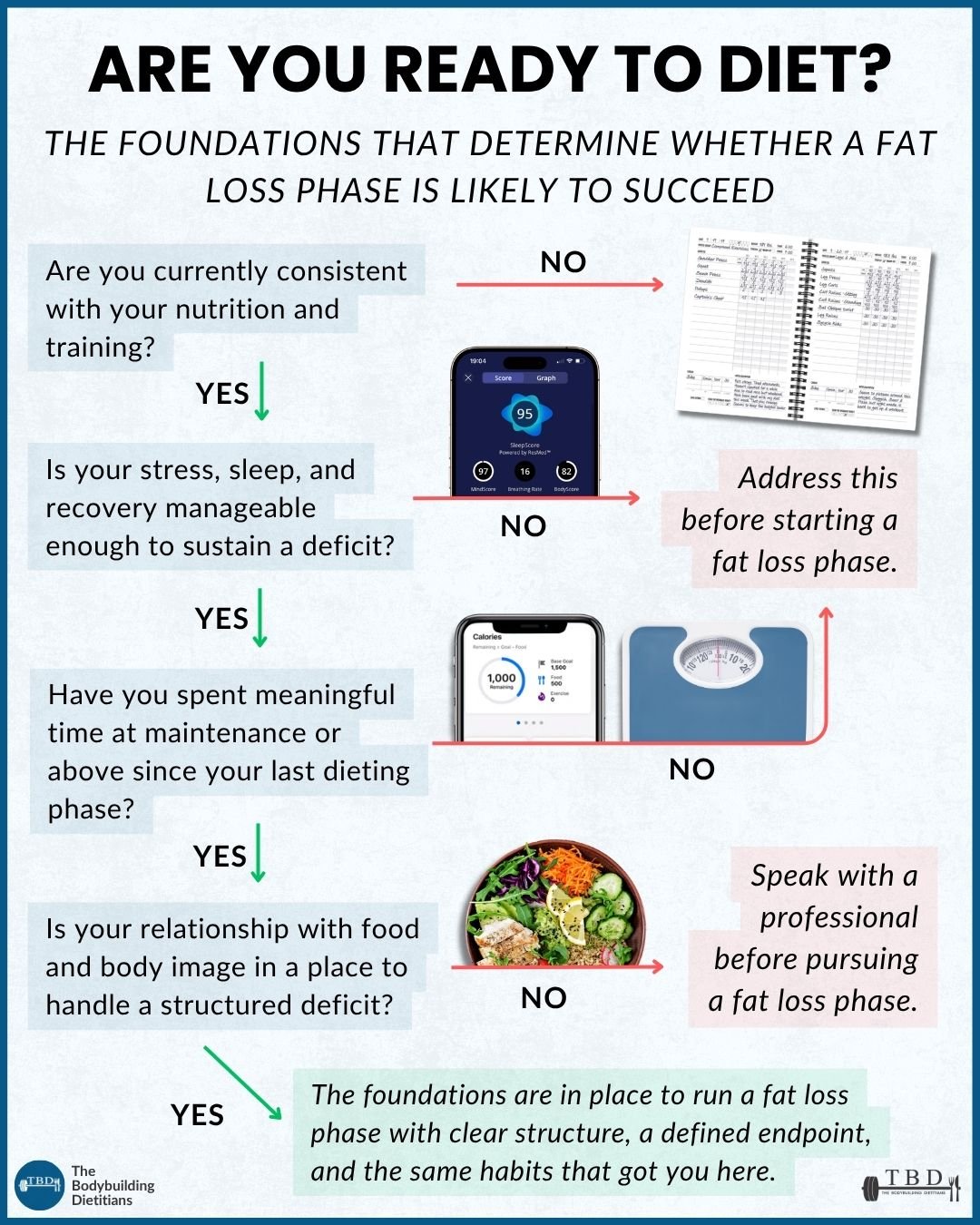
A four-question framework for assessing readiness to begin a structured fat loss phase.
The outcome of a fat loss phase depends considerably on the conditions in place when it starts. A well-designed deficit applied to a well-prepared foundation produces meaningful body composition change that can be maintained. The same deficit applied without adequate preparation tends to produce a harder and less durable experience, often because the variables that determine whether a diet is sustainable were not stable to begin with.
The framework below addresses four questions in sequence. Each one reflects a genuine prerequisite rather than an arbitrary checklist, and for each one, the rationale is worth understanding rather than just the question itself. When the answer to any of them is not clearly yes, addressing it before beginning a deficit produces better long-term outcomes than attempting to manage the gap during the phase itself.
Is Your Nutrition and Training Currently Consistent?
A calorie deficit functions by creating a measurable and sustained gap between energy intake and expenditure. For that mechanism to work predictably, the baseline it is applied to needs to be stable. Consistency in nutrition and training before a deficit begins means that the changes being made are legible: when intake decreases and the scale responds, the relationship between the two is interpretable. When adjustments become necessary, there is a reliable starting point to adjust from.
Applying a deficit to an already inconsistent routine tends to compound the difficulty of each component rather than resolving it. Adherence becomes harder to assess because it was never clearly established to begin with. Progress data is harder to read against a noisy baseline. The necessary adjustments that every fat loss phase requires, recalibrating calories when progress stalls, managing diet fatigue, deciding when to incorporate a break, all become more difficult when the underlying habits are not yet stable.
The practical implication is that someone who is not yet consistent with their nutrition and training is better served by establishing those habits first, at maintenance or above, before beginning a deficit. The habits that are in place at the start of a fat loss phase are the same habits the phase will rely on for its duration. Building them during a deficit rather than before it means building them under the additional physiological and psychological load that restriction creates, which is a harder and less efficient way to develop them.
Is Your Stress, Sleep, and Recovery Currently Manageable?
The physiological load a calorie deficit places on the body compounds with the physiological load of other stressors that are already present. When stress, sleep, and recovery are already compromised, the additional demands of a deficit accelerate the adaptations that make fat loss phases difficult: cortisol rises faster, muscle protein synthesis slows, performance declines more steeply, and the hormonal mechanisms that regulate hunger and satiety are further disrupted.
Sleep in particular plays a direct role in how well a deficit is tolerated. Poor sleep elevates ghrelin, suppresses leptin, impairs insulin sensitivity, and shifts food preferences toward higher-calorie options, all of which make a calorie deficit harder to maintain and more physiologically costly. Entering a deficit with already disrupted sleep means starting the phase with these hormonal pressures already elevated, before the deficit adds to them.
Chronic psychological stress elevates cortisol, which promotes central fat storage, increases appetite for energy-dense foods, disrupts sleep quality, and reduces the cognitive resources that managing a structured diet requires. A fat loss phase that begins during a period of high chronic stress stacks those costs on top of the ones the deficit itself creates, and the compounding effect on adherence and body composition outcomes is meaningful.
The question to assess is not whether stress and sleep are perfect, because they rarely are. The question is whether they are manageable enough that the additional load of a structured deficit can be carried without the phase becoming unsustainable. When the honest answer is that they are not, addressing the most significant stressors first produces a more productive starting point than attempting to diet through them.
Have You Spent Meaningful Time at Maintenance or Above Since Your Last Deficit?
Repeated fat loss phases without adequate time at maintenance between them tend to leave metabolism, hormones, and appetite regulation in a progressively less favourable state for the next attempt. This is a well-documented pattern: the hormonal consequences of sustained restriction, including suppressed leptin, elevated ghrelin, reduced thyroid activity, and lowered resting metabolic rate, take meaningful time at maintenance to normalise after a deficit ends. Beginning another deficit before they have recovered means starting from a compromised metabolic position.
Total daily energy expenditure refers to the total energy the body expends across all processes in a day, including basal metabolic rate, the thermic effect of food, and activity. After a sustained deficit, total daily energy expenditure is lower than it would be at the same bodyweight in someone who has not recently dieted, reflecting the adaptive thermogenesis that developed during restriction. This lower expenditure means that the same calorie intake that produces a deficit for someone entering their first phase may barely produce a deficit at all for someone who has been in and out of restriction repeatedly.
The consequence of consecutive fat loss phases with minimal recovery between them is often diminishing returns on each successive attempt: more effort, more restriction, less fat loss, and greater difficulty maintaining the result. A meaningful period at maintenance, allowing bodyweight to stabilise, hunger to normalise, and training performance to recover, restores the conditions under which a subsequent deficit can be run productively.
How long constitutes meaningful time at maintenance varies depending on the depth and duration of the previous phase. A brief, moderate deficit may require only a few weeks of maintenance before the next phase. A prolonged, aggressive prep-style deficit may require many months before the metabolic and hormonal environment has normalised sufficiently.
Is Your Relationship with Food and Body Image in a Stable Place?
A structured calorie deficit involves deliberate restriction of food intake, regular monitoring of food choices, and sustained attention to body composition change. For someone whose relationship with food and body image is already a source of significant distress, a structured deficit can reinforce patterns of restriction and body scrutiny that are harmful regardless of the body composition outcome it produces.
Dietary restriction does not improve a troubled relationship with food or body image. In individuals who are already prone to restrictive patterns, preoccupation with food, rigid dietary thinking, or distress around body-related feedback, a structured fat loss phase tends to intensify those patterns rather than resolve them. The technical result, a reduction in body fat, does not produce the psychological relief it might appear to promise, because the underlying relationship with food and body image is unchanged or worsened by the process.
This is the foundation that receives the least routine attention in discussions of fat loss readiness, and it is also the one that, when unaddressed, most reliably produces outcomes that are difficult to sustain and psychologically costly. The appropriate step when the honest answer to this question is no is professional support from a dietitian, psychologist, or health professional with experience in disordered eating and body image, before pursuing a fat loss phase. This is not a barrier to body composition goals but a more productive sequencing: building a stable relationship with food and body first, and then approaching a fat loss phase from that foundation, produces outcomes that are both more durable and less harmful.
What Happens When All Four Foundations Are in Place?
When nutrition and training are consistent, stress and sleep are manageable, adequate time has been spent at maintenance, and the relationship with food and body image is stable, the conditions for a productive fat loss phase are genuinely in place. The phase can be structured with a clear deficit, a defined endpoint, and the same habits that established the baseline, extended into the specific demands of the dieting period.
From this foundation, the deficit produces reliable and interpretable progress data, adjustments can be made with confidence when the data calls for them, training can be maintained at a level that protects lean mass, and the psychological experience of the phase is considerably more manageable than it is when the foundations are absent.
A fat loss phase entered from a well-prepared position also tends to produce more durable results, because the habits that were in place before the phase are the same habits that sustain the outcome afterward. The body composition change is built on top of a stable lifestyle pattern rather than achieved through a temporary departure from normal habits that ends when the phase ends.
Assessing where someone sits across these four variables before beginning a fat loss phase, and deciding what needs to be in place first, is how we structure the early stages of working with new clients in our coaching practice. The goal is not to delay getting started unnecessarily, but to ensure that when the phase begins, the conditions are favourable enough that the effort invested produces a result that holds.
Practical Takeaways
A fat loss phase produces better outcomes when four foundational variables are stable: consistent nutrition and training habits, manageable stress and sleep, adequate time at maintenance since the last deficit, and a stable relationship with food and body image.
Applying a calorie deficit to an already inconsistent dietary and training routine compounds the difficulty of each component rather than resolving the inconsistency.
Poor sleep and elevated chronic stress amplify the hormonal adaptations that make fat loss phases difficult, including raised ghrelin, suppressed leptin, and elevated cortisol.
Repeated fat loss phases without meaningful time at maintenance between them tend to produce diminishing returns because the metabolic and hormonal environment does not fully recover between phases.
A structured calorie deficit tends to reinforce existing patterns around food and body image rather than resolve them. Professional support before beginning a deficit is the appropriate step when this variable is not in a stable place.
When all four foundations are genuinely in place, a fat loss phase can be run with clear structure, a defined endpoint, and the same habits that established the baseline.
Frequently Asked Questions
How do I know if I am ready to start a fat loss phase?
A practical readiness check involves four questions: whether nutrition and training are currently consistent; whether stress, sleep, and recovery are manageable enough to tolerate a deficit; whether meaningful time has been spent at maintenance since the last dieting phase; and whether the relationship with food and body image is stable enough to engage with structured restriction productively. When the honest answer to all four is yes, the conditions for a productive fat loss phase are genuinely in place.
Does it matter how long I have been at maintenance before starting a diet?
The length of time needed at maintenance depends on the depth and duration of the previous fat loss phase. After a moderate and relatively brief deficit, a few weeks of stable maintenance may be sufficient for metabolic and hormonal recovery. After a prolonged or aggressive deficit such as a contest prep, many months may be needed before hunger, hormones, and metabolic rate have normalised adequately. The signs that recovery is sufficient include stable bodyweight at maintenance calories, normalised appetite and food relationship, restored training performance, and consistent sleep quality.
Can I start a fat loss phase if my sleep is not great?
Poor sleep significantly increases the difficulty of maintaining a calorie deficit by elevating ghrelin, suppressing leptin, elevating cortisol, and shifting food preferences toward higher-calorie options. Beginning a deficit when sleep is already disrupted means starting the phase with these physiological pressures already elevated before the deficit adds to them. If sleep disruption is temporary and improving, beginning the phase may be appropriate. If it reflects chronic patterns that are not being addressed, working to improve sleep quality first produces a more favourable starting position and a more manageable phase.
Is yo-yo dieting a concern for long-term body composition?
Repeated fat loss and regain cycles can progressively impair the metabolic and hormonal environment in which subsequent phases are run. Each cycle of sustained restriction followed by weight regain tends to leave adaptive thermogenesis, appetite-regulating hormones, and the ratio of fat to lean mass in a slightly less favourable state than the previous cycle. The practical consequence is that body composition outcomes from consecutive phases often diminish over time relative to the effort involved. Adequate time at maintenance between phases, and careful management of the rate and depth of each deficit, reduces this pattern.
What should I do if my relationship with food is not in a healthy place?
A structured fat loss phase is not the appropriate first step when the relationship with food, eating, or body image is already a source of significant distress or disordered patterns. Professional support from a dietitian, psychologist, or health professional with experience in disordered eating and body image provides a more productive pathway. Building a stable and non-distressing relationship with food first creates a foundation from which body composition goals can be pursued more safely and with outcomes that are genuinely sustainable.
Does training need to be perfect before starting a fat loss phase?
Training does not need to be perfect, but it needs to be consistent enough to serve as a reliable baseline. The specific program, volume, and intensity can continue to be refined during a fat loss phase. What matters is that training is occurring regularly and with enough structure that performance can be monitored as a feedback signal on how the deficit is being tolerated. Training that is already inconsistent or sporadic makes it difficult to use performance data as a meaningful indicator of whether the phase is structured appropriately.
Assessing where these variables sit for a specific individual, and deciding what needs to be in place before a fat loss phase begins, is how we structure the early stages of working with new clients. If you want that kind of individual assessment before building a plan, you can enquire about coaching or book a consultation to get started.