A dietitian explains when body recomposition realistically works, when sequential fat loss and muscle gain phases produce better results, and how training experience, body composition, and diet structure should shape the choice.
Body recomposition, the simultaneous loss of fat and gain of muscle, is well documented in beginners, returning lifters, people with higher body fat percentages, and most individuals in their first year of structured resistance training. In these populations, the training stimulus is novel enough and internal energy reserves are sufficient enough for both processes to occur in parallel at meaningful rates. For lean and experienced lifters, recomposition is still possible under specific conditions (adequate protein at 1.6 to 2.4 g/kg, progressive training, and a modest energy deficit or maintenance), but the rate of muscle gain during a deficit is generally slow, and sequential fat loss and muscle gain phases tend to produce cleaner results. A modest energy surplus of approximately 5 to 10 percent above maintenance supports muscle gain in trained lifters without adding disproportionate body fat, and a moderate deficit with adequate protein and training stimulus can largely preserve muscle during fat loss. The energy balance strategy should match the goal being prioritised and the population the lifter sits within.
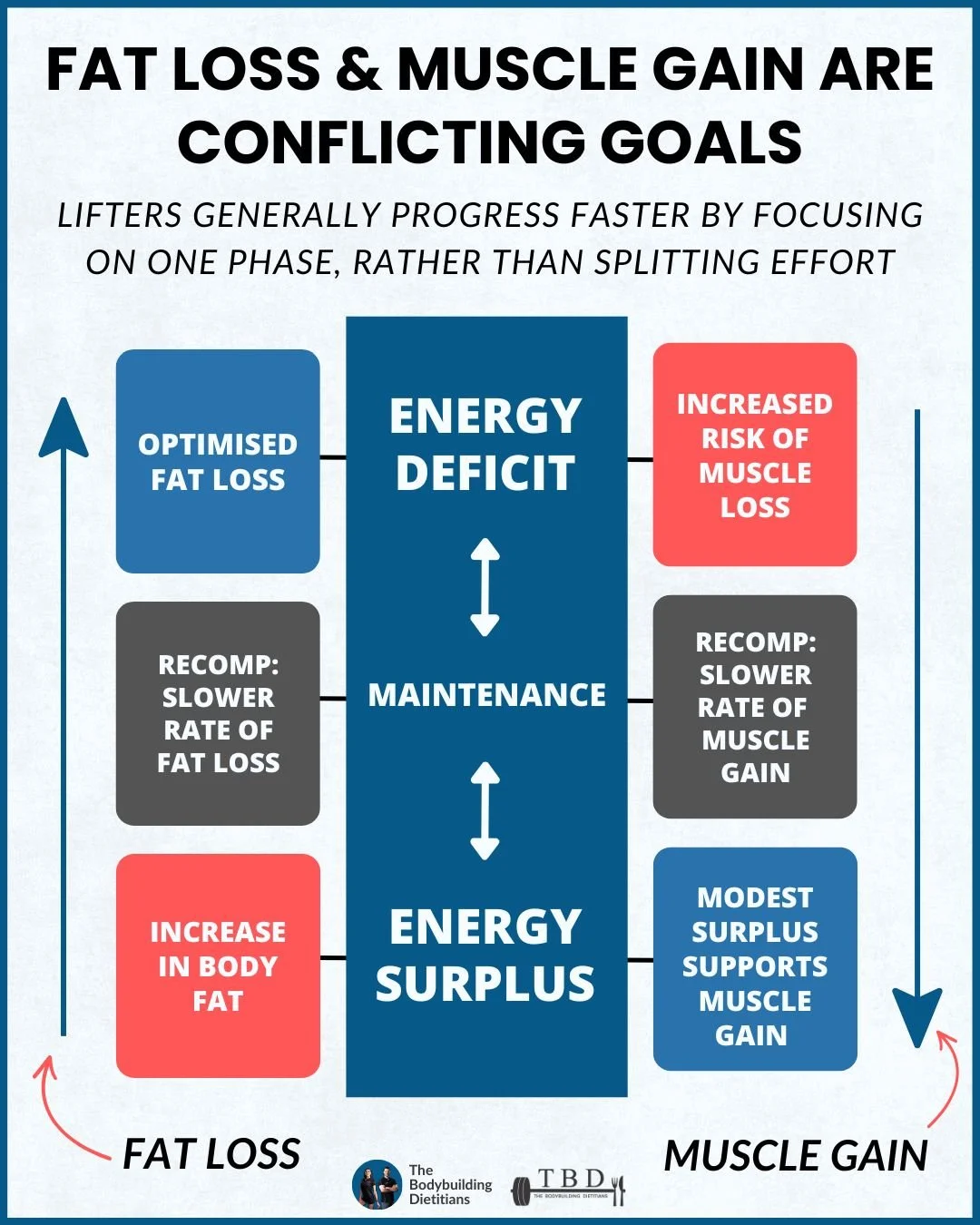
The relationship between energy balance and body composition outcomes. Energy deficits favour fat loss but carry some muscle loss risk, energy surpluses favour muscle gain but carry some fat gain risk, and maintenance sits between the two with recomposition possible for specific populations.
The question of whether it is possible to build muscle and lose fat at the same time is one of the most persistent in physique nutrition, and the answer has real practical stakes. A lifter who assumes recomposition is impossible may run sequential phases when a parallel approach would have worked better for their situation. A lifter who assumes recomposition is always possible may spend years splitting effort between two goals and progress slowly on both.
A more useful framework acknowledges that recomposition is real, well documented in the literature, and clearly achievable for specific populations, while also recognising that the rate of parallel progress slows considerably for lean and experienced lifters. The decision between recomposition, a dedicated fat loss phase, or a dedicated muscle gain phase should reflect where a lifter sits in their training career, their current body composition, and the goal they are prioritising over the next several months.
What Is Body Recomposition?
Body recomposition is the simultaneous loss of body fat and gain of skeletal muscle mass, typically occurring at or near maintenance calories. Unlike traditional bulking (a deliberate calorie surplus for muscle gain) or cutting (a deliberate calorie deficit for fat loss), recomposition targets both outcomes at once, with body weight often remaining stable while the underlying composition shifts.
The physiological basis for recomposition is that the body can draw on stored fat to supply the energy required for muscle protein synthesis, particularly when the training stimulus is novel or the individual has substantial fat reserves to mobilise. The lifter is essentially running two parallel processes: an energy deficit at the whole-body level while creating conditions for muscle growth locally, funded partly by internal energy stores rather than dietary intake.
Whether this works well or slowly depends on several factors that separate the populations who recomp reliably from those who tend to progress faster with sequential phases.
Who Can Realistically Recomp?
Body recomposition works most reliably for four populations: untrained beginners, returning lifters after time away from training, individuals with higher body fat percentages, and most people in their first year of structured resistance training.
Untrained beginners experience what is often called "newbie gains," a period of rapid adaptation where the body responds strongly to any well-structured training stimulus. During this window, muscle protein synthesis is elevated across a broader range of energy balance conditions than in trained lifters, which is why beginners can add meaningful muscle even at maintenance or in a small deficit.
Returning lifters benefit from muscle memory, a set of epigenetic and myonuclear adaptations that persist after previous training and allow faster re-acquisition of muscle when training resumes. Someone returning to consistent training after months or years away can often regain lost muscle while simultaneously losing fat, because the physiological infrastructure for the muscle already exists.
Individuals with higher body fat percentages carry substantial internal energy reserves that can fund muscle protein synthesis during a deficit. The larger the fat mass relative to lean mass, the more the body can draw on stored energy to support anabolism, which shifts the recomposition math in favour of parallel progress.
First-year lifters with structured training overlap with the "beginner" category but are worth separating because the effect extends past the first few weeks. Meaningful muscle gain and fat loss can occur in parallel for most of the first year of consistent, progressive training in most individuals, even those without particularly high starting body fat.
A systematic review of the body recomposition literature concluded that simultaneous muscle gain and fat loss is well documented in resistance training research across multiple populations, including untrained individuals, individuals with higher body fat percentages, and (under specific conditions including high protein intake and appropriate training stimulus) trained lifters. Two key variables influencing recomposition were progressive resistance training and evidence-based nutrition strategies, particularly protein intake. Source: Barakat et al., 2020, Strength and Conditioning Journal, 42(5):7-21.
For trained lifters with several years of structured training and lower body fat percentages, the picture becomes more nuanced. Recomposition is still possible under specific conditions, but the rate of muscle gain during a deficit is generally slow, and the trade-offs of splitting effort become more pronounced. This is the population most likely to progress faster through dedicated sequential phases than through parallel recomposition.
Why Does Recomposition Work Well for Some Populations but Not Others?
The gap between recomposition-friendly and recomposition-limited populations comes down to two variables: how strongly the training stimulus drives muscle protein synthesis, and how much internal energy the body has available to fund that synthesis during an energy deficit.
In beginners and returning lifters, both variables are favourable. The training stimulus is novel enough to elicit a strong anabolic response, and the required energy for muscle protein synthesis can be drawn substantially from body fat stores. In individuals with higher body fat, the second variable dominates: even without a particularly novel training stimulus, the sheer size of the fat reserves allows the body to fund muscle protein synthesis during a deficit more effectively than it can in leaner individuals.
For lean and trained lifters, both variables become less favourable. The training stimulus has been present for years, so muscle protein synthesis rates in response to any given session are more modest than they were early in the training career. Body fat is lower, so the internal energy reserves available to fund muscle protein synthesis during a deficit are smaller. Muscle protein synthesis is the biological process through which dietary protein and resistance training stimulate the repair and growth of skeletal muscle, and its rate depends heavily on both the training stimulus and the available energy.
The practical implication is that the same energy deficit produces different composition outcomes in different populations. A trained lifter running the same deficit as a beginner with high body fat will typically lose more absolute muscle relative to fat, because the physiological environment for parallel progress is less permissive. Neither population is doing anything wrong; the difference reflects underlying physiology rather than adherence or effort.
For trained lifters who still want to attempt recomposition, the conditions matter. Adequate protein intake at 1.6 to 2.4 g/kg of bodyweight per day, progressive resistance training with sufficient volume and intensity, and either a modest deficit or maintenance calories are the key variables. Meeting all three consistently can produce recomposition in trained lifters, but the rate is meaningfully slower than what a dedicated muscle gain phase would produce.
How Aggressive Should a Fat Loss Phase Be?
The risk of muscle loss during a fat loss phase depends more on how the deficit is structured than on the presence of a deficit itself. A well-managed cut with adequate protein, appropriate training stimulus, and a moderate deficit can largely preserve muscle in most trained lifters.
Protein intake is the single most important variable. Research consistently supports intakes of 1.6 to 2.4 g/kg of bodyweight per day during fat loss, with the upper end of this range appropriate for leaner lifters, competitive physique athletes, or those running deeper deficits. Below this range, muscle loss risk increases substantially even when other variables are managed well.
Training stimulus is the second key variable. Maintaining resistance training volume and intensity during a deficit signals to the body that muscle mass is functionally required, which shifts the physiological response toward preservation. Reducing training volume disproportionately during a cut removes part of this signal and increases the risk that some of the weight lost comes from lean tissue. For more detail on how to structure protein targets across meals and training days, our complete article on protein overs the daily distribution alongside total intake targets.
Deficit size matters, but not always in the direction assumed. Small to moderate deficits (roughly 300 to 750 calories below maintenance for most lifters, depending on body size and training volume) are generally well tolerated with minimal muscle loss when protein and training are adequate. Aggressive deficits (over 1000 calories below maintenance in most cases) increase muscle loss risk, accumulate fatigue faster, and reduce the sustainability of the phase.
Muscle loss during a deficit is not a default outcome; it is a signal that one or more of these variables was managed poorly. For a more detailed framework on how deficit size should relate to training expenditure and physiological capacity, our article on energy availability covers the reference points that distinguish a productive deficit from a counterproductive one.
How Large Should a Muscle Gain Surplus Be?
A modest energy surplus of approximately 5 to 10 percent above maintenance supports muscle gain in trained lifters without adding disproportionate body fat. Larger surpluses do not accelerate muscle gain meaningfully in most cases and produce a higher fat-to-muscle ratio in the weight gained.
The physiological logic is that muscle protein synthesis is not linearly limited by total energy availability once maintenance is met with adequate protein and training. Adding calories past the point required to support muscle protein synthesis and recovery does not further accelerate muscle gain in trained lifters, because other variables (training stimulus, protein intake, recovery capacity) become the rate-limiting factors. The additional calories are more likely to be stored as fat than converted into additional muscle tissue.
For most trained lifters, this translates to roughly 100 to 300 calories above maintenance during a muscle gain phase, with the higher end appropriate for larger athletes or those with higher training volumes. A useful weekly weight gain target for trained lifters is approximately 0.2 to 0.4 percent of bodyweight per week, which corresponds to slow but predictable muscle accrual with limited fat gain.
For lifters earlier in their training career (with more anabolic capacity and less accumulated training age), slightly larger surpluses can be justified because the muscle gain potential is higher and the additional energy is more likely to be partitioned favourably. Newer lifters can often gain at 0.4 to 0.7 percent of bodyweight per week without accumulating disproportionate body fat.
The practical framework here matters because many lifters default to substantially larger surpluses during muscle gain phases, then spend disproportionate time cutting the resulting body fat. A smaller surplus over a longer duration typically produces a better ratio of muscle to fat gained, and shortens the time needed in the subsequent cut.
When Does Splitting Effort Between Fat Loss and Muscle Gain Slow Both Down?
For trained lifters with structured training history and lower body fat percentages, attempting to maximise fat loss and muscle gain simultaneously often produces the slowest version of both. This is the population that most reliably benefits from sequential phases: a dedicated fat loss phase followed by a dedicated muscle gain phase, or vice versa.
The reasoning is that the physiological requirements for fast fat loss and fast muscle gain pull in different directions for trained lifters. A meaningful energy deficit optimises fat loss but slows muscle gain to negligible rates in this population. A meaningful energy surplus optimises muscle gain but adds body fat. Splitting the difference at maintenance produces slow versions of both processes, and for trained lifters, "slow" often means so slow that meaningful progress takes years rather than months.
In coaching settings, a common pattern is a trained lifter frustrated by three or four years of essentially flat body composition, having spent most of that time attempting to recomp at maintenance. Shifting to sequential phases (four to twelve week fat loss phases followed by three to six month muscle gain phases, structured with appropriate protein and training) typically produces more visible progress in six to twelve months than the previous years of parallel effort.
The framing that fat loss and muscle gain are "conflicting goals" is directionally accurate for this population but slightly overstated for others. For beginners, returning lifters, and individuals with higher body fat, the goals do not conflict meaningfully; parallel progress is realistic and often the best use of time. For trained and lean lifters, the goals conflict enough that committing to one at a time produces cleaner results.
For lifters uncertain about which population they sit within, or how to structure phase transitions across a season, our approach to coaching is built around matching phase selection to individual training status, body composition, and goals.
How Should Training Status and Body Composition Guide Phase Selection?
The practical framework for choosing between recomposition, a fat loss phase, or a muscle gain phase comes down to three questions: how experienced is the lifter, what is their current body composition, and what is their primary goal for the next several months.
A relatively new lifter with higher body fat is well-positioned for body recomposition at or slightly below maintenance. The combination of newbie gains, muscle memory (if applicable), and available fat reserves creates conditions where parallel progress is realistic and time-efficient. Committing to this approach for the first year of structured training often produces significant improvements in both body fat and muscle mass without the psychological and practical demands of alternating dedicated phases.
A trained lifter at a moderate body fat percentage (roughly 15 to 20 percent for males, 22 to 28 percent for females) faces a more open decision. If the goal is primarily muscle gain, a modest surplus with appropriate protein and training will produce meaningful progress over three to six months. If the goal is primarily fat loss, a moderate deficit with adequate protein will produce visible leaning-out over eight to twelve weeks. Recomposition is possible but slower than either dedicated phase, and only worth pursuing if the lifter is genuinely comfortable with slow progress in both directions rather than faster progress in one.
A trained lifter at a lower body fat percentage (below 12 percent for males, below 20 percent for females, roughly) typically benefits most from dedicated phases. In this population, muscle gain during a deficit is minimal, and attempting to lean out further at maintenance can produce prolonged plateaus and accumulated fatigue without meaningful visual change. A structured muscle gain phase of four to six months at a modest surplus, followed by a targeted fat loss phase, produces cleaner results than extended maintenance at the current body composition.
A physique athlete in improvement season should almost always run a dedicated muscle gain phase rather than attempting recomposition. The improvement season exists specifically to accrue new muscle tissue in preparation for the next contest prep, and running at maintenance sacrifices the primary purpose of the phase. Deliberate structured improvement seasons at a modest surplus produce the muscle tissue that later contest prep can then reveal.
The decision framework also has to account for adherence, life demands, and psychological factors. A lifter who finds dedicated deficits stressful and unsustainable may progress faster through recomposition at maintenance than through a technically superior sequential approach they cannot adhere to. Matching the strategy to what the lifter can execute consistently often matters more than optimising the strategy in the abstract, which is part of why individualised guidance tends to outperform generic templates.
For lifters navigating this decision for the first time, or transitioning from a long recomp phase to a more structured periodised approach, booking a consultation with our team can help clarify which approach best fits the specific training status, body composition, and goal.
Practical Takeaways
Body recomposition (simultaneous fat loss and muscle gain) is well documented and reliably achievable for untrained beginners, returning lifters after time away, individuals with higher body fat percentages, and most people in their first year of structured resistance training.
For trained lifters with lower body fat, recomposition is still possible under specific conditions (protein at 1.6 to 2.4 g/kg, progressive training, modest deficit or maintenance) but progress is slow, and sequential fat loss and muscle gain phases typically produce cleaner results.
A well-managed fat loss phase with adequate protein and training stimulus preserves muscle effectively. Muscle loss during a deficit is a signal that one of these variables was managed poorly, not a default outcome of being in a deficit.
A modest energy surplus of 5 to 10 percent above maintenance (roughly 100 to 300 calories above maintenance for most trained lifters) supports muscle gain without adding disproportionate fat. Larger surpluses do not meaningfully accelerate muscle gain and add avoidable body fat.
Trained and lean lifters typically progress faster by committing to one goal at a time, while less experienced lifters and those with higher body fat percentages often progress fastest through parallel recomposition at maintenance.
Phase selection should match training status, body composition, primary goal, and sustainability. The right strategy is the one that fits both the physiology and the lifter's ability to adhere consistently.
Frequently Asked Questions
Can trained lifters build muscle and lose fat at the same time?
Yes, but slowly. Systematic reviews of the body recomposition literature confirm that trained lifters can achieve simultaneous muscle gain and fat loss under specific conditions, including adequate protein intake at 1.6 to 2.4 g/kg per day, progressive resistance training, and either a modest deficit or maintenance calories. The rate of parallel progress is meaningfully slower than what a dedicated muscle gain phase would produce, which is why trained lifters often progress faster through sequential phases.
Who is body recomposition best suited for?
Body recomposition works most reliably for untrained beginners, returning lifters after time away from training, individuals with higher body fat percentages, and most people in their first year of structured resistance training. In these populations, the combination of a novel training stimulus, muscle memory (where applicable), and substantial internal energy reserves creates conditions where simultaneous fat loss and muscle gain occurs at meaningful rates. For lean and experienced lifters, recomposition is slower and sequential phases often produce better results.
How much protein do you need for body recomposition?
Research supports protein intakes of 1.6 to 2.4 g/kg of bodyweight per day for body recomposition, with the upper end of this range appropriate for lifters in a deficit or with lower body fat percentages. Higher protein intake helps preserve muscle during fat loss and supports muscle protein synthesis during muscle gain, and it is one of the most consistently important variables for successful recomposition across the literature.
What size energy surplus is best for muscle gain?
A modest surplus of approximately 5 to 10 percent above maintenance (roughly 100 to 300 calories above maintenance for most trained lifters) supports muscle gain without adding disproportionate body fat. Larger surpluses do not meaningfully accelerate muscle gain in trained lifters and produce a higher fat-to-muscle ratio in the weight gained. A target weekly weight gain of 0.2 to 0.4 percent of bodyweight per week reflects a good balance for most trained lifters.
How aggressive should a fat loss phase be?
A moderate deficit of roughly 300 to 750 calories below maintenance (depending on body size and training volume) with adequate protein at 1.6 to 2.4 g/kg and maintained training stimulus is generally well tolerated with minimal muscle loss. Aggressive deficits above 1000 calories below maintenance accumulate fatigue faster, increase muscle loss risk, and reduce the sustainability of the phase. The deficit size should also reflect training expenditure, not just calorie targets, which is one of the practical values of the energy availability framework.
Should beginners recomp or focus on one goal at a time?
Beginners are one of the populations best positioned for body recomposition, particularly during the first year of structured training when newbie gains provide a strong anabolic response even at maintenance calories. Committing to recomposition during the first year, with adequate protein and progressive resistance training, typically produces significant improvements in both body composition variables without the practical and psychological demands of alternating dedicated phases.
If you want help choosing between a fat loss phase, muscle gain phase, or recomposition approach, and structuring the nutrition and training to match, our team can build a plan that fits your training status, body composition, and goals. You can enquire about coaching or book a consultation with our team below.