A comparison of ten common protein sources ranked by cost per 30 grams of protein, with calorie content included for each, based on average retail prices.
The cost of obtaining 30 grams of protein varies roughly sevenfold across common sources, from approximately $0.98 for textured vegetable protein to $6.98 for liquid egg whites, based on average Australian retail prices. Chicken breast, whey protein isolate, and high protein yoghurt consistently occupy the low-cost, lower-calorie end of the comparison, making them practical anchors for physique-focused diets. Salmon and liquid egg whites sit at the higher end of cost but bring nutritional value beyond protein that less expensive sources do not provide. These figures reflect typical retail prices at time of publication and will shift with sales, inflation, and store choice, so the relative spread between sources is more useful than any specific dollar figure.
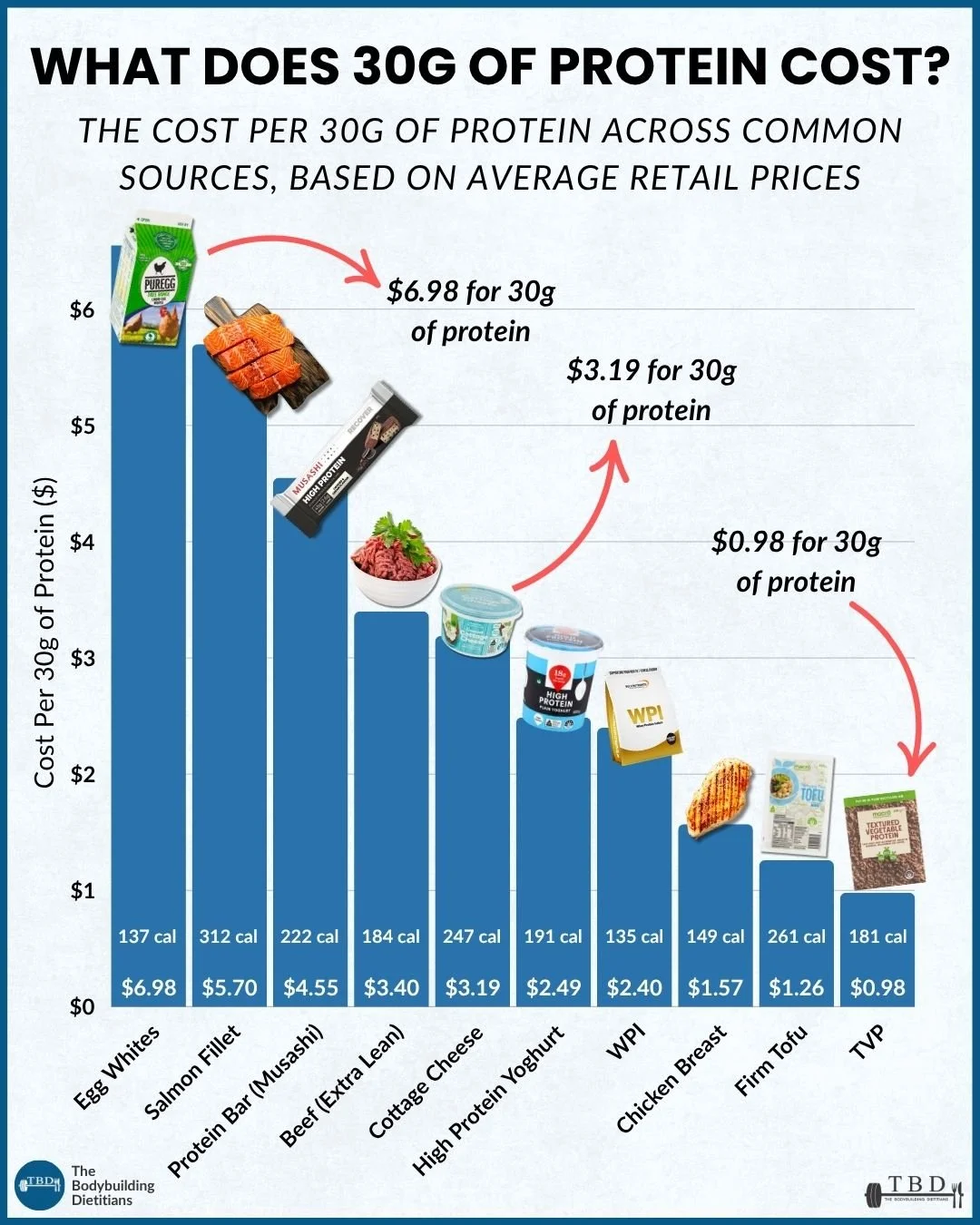
The cost per 30 grams of protein across ten common sources, with calories included for context. Based on average Australian retail prices at time of publication.
The cost of meeting daily protein targets is a practical consideration that sits alongside the nutritional one, particularly for anyone following a structured dietary approach across multiple months or years. When the gap between the most and least expensive protein sources spans roughly sevenfold, the choice of which sources anchor the diet has a meaningful cumulative impact on the food budget.
This comparison ranks ten common protein sources by the cost of obtaining 30 grams of protein from each, based on average Australian retail prices at time of publication. Each bar also shows the calories that come with those 30 grams of protein, which adds a second dimension to the comparison: the cheapest source is not always the leanest, and the most expensive is not always the most calorie-dense.
These figures will shift with sales, inflation, bulk purchasing, and store choice, so the relative spread between sources is more useful as a reference point than any specific dollar figure. The chart uses specific products at typical retail prices, which means cheaper bulk options or specialty products may land differently.
How Do the Most and Least Expensive Sources Compare?
The spread across the ten sources runs from $0.98 for textured vegetable protein at the lower end to $6.98 for liquid egg whites at the upper end. Several observations are worth drawing from that range.
Egg whites ($6.98, 137 calories): Liquid egg whites are the most expensive protein source on this chart at $6.98 per 30 grams of protein, though they are also among the leanest at only 137 calories for that protein yield. The high cost reflects the processing and convenience of the liquid format. Whole eggs would land considerably cheaper on the same metric, though the calorie cost would rise with the fat content of the yolk. The nutritional value of egg whites extends to their amino acid profile and high leucine content, which support muscle protein synthesis effectively regardless of the cost consideration.
Salmon fillet ($5.70, 312 calories): Salmon is the second most expensive source at $5.70 per 30 grams of protein, and it also carries the highest calorie cost of any food on the chart at 312 calories. That calorie content reflects the fat in the fish, which is predominantly the long-chain omega-3 fatty acids EPA and DHA, with well-established cardiovascular and anti-inflammatory benefits that no other source on this chart provides at comparable concentration. The cost and calorie profile of salmon needs to be understood in the context of what else it delivers, since it functions as a nutritionally multidimensional food rather than simply a protein source.
Protein bar (Musashi) ($4.55, 222 calories): The protein bar sits third on cost at $4.55 per 30 grams of protein. Its position on the chart is useful context for anyone who relies on protein bars as a primary protein source: the cost per gram of protein is meaningfully higher than most whole food alternatives, and the calorie content at 222 calories is moderate rather than particularly lean. The practical advantage of a protein bar is convenience rather than cost or nutritional efficiency.
Which Sources Offer the Best Combination of Cost and Leanness?
The most practically useful zone of this chart for physique-focused individuals is the lower-cost, lower-calorie region, where protein is obtained economically without a large accompanying calorie cost. Several sources cluster there.
Whey protein isolate ($2.40, 135 calories): Whey protein isolate provides 30 grams of protein for $2.40 and only 135 calories, making it one of the most calorie-efficient sources on the chart while sitting comfortably in the mid-to-lower cost range. WPI is processed to remove most of the fat and lactose present in whole-milk sources, which accounts for the low calorie profile. Its leucine content is high, supporting muscle protein synthesis effectively, and its convenience as a mixed drink or addition to meals makes it a practical tool in higher-volume protein diets.
Chicken breast ($1.57, 149 calories): Chicken breast is the most cost-efficient whole food on the chart at $1.57 per 30 grams of protein, with a lean calorie profile of 149 calories. It is a complete protein source with meaningful leucine content, widely available, and highly versatile across different meal formats. The combination of low cost, low calorie density, and high protein concentration per gram is why chicken breast appears so consistently in structured physique diets, and the chart illustrates that the practical case for its inclusion is as much economic as it is nutritional.
High protein yoghurt ($2.49, 191 calories): High protein yoghurt sits between WPI and chicken breast on both cost and calorie metrics, providing 30 grams of protein for $2.49 and 191 calories. It is a dairy-based source that also contributes calcium and, in the case of live culture varieties, gut microbiome benefit through probiotic bacteria. Its positioning as a convenient, ready-to-eat option at modest cost makes it a practical addition for individuals who want protein variety across the day without significantly affecting the food budget.
How Do Plant-Based Sources Compare?
The two plant-based sources on the chart, firm tofu and textured vegetable protein, occupy the lower end of the cost range but carry a higher calorie cost per 30 grams of protein than the leanest animal options.
Firm tofu ($1.26, 261 calories): Firm tofu provides 30 grams of protein for $1.26, the second cheapest source on the chart, though the 261-calorie figure reflects the fat content of the whole bean product. Tofu is a complete protein source in that it provides all essential amino acids, which distinguishes it from many other plant proteins. Its versatility across different cooking methods and cuisines makes it a practical and cost-effective protein anchor for plant-forward diets or as a complement to animal protein sources.
Textured vegetable protein ($0.98, 181 calories): TVP is the least expensive source on the chart at $0.98 per 30 grams of protein. Made from defatted soy flour, it is sold in a dry form that absorbs flavour well and can be used in place of ground meat in many meal formats. The calorie profile at 181 calories per 30 grams of protein is reasonable, sitting between chicken breast and high protein yoghurt. For budget-conscious protein strategies in plant-forward diets, TVP is a useful and practical option.
The practical consideration for plant protein sources in a physique-focused diet is that their leucine content per gram of protein is generally lower than animal sources, which is relevant for muscle protein synthesis stimulation. This is addressed either by consuming slightly larger servings to achieve an equivalent leucine dose or by combining plant sources with leucine-dense animal protein across the day.
What Does the Calorie Data Add to the Comparison?
The calorie figures at the base of each bar add an important dimension to a cost-only comparison, because the calorie cost of 30 grams of protein varies considerably even among sources at similar price points.
Cottage cheese ($3.19, 247 calories) and salmon ($5.70, 312 calories) both cost significantly more than chicken breast or WPI, but they also deliver many more calories alongside their protein. During a calorie deficit, where every calorie in the budget needs to contribute maximally to protein or satiety targets, a food that requires more calories to deliver the same protein contribution has a higher practical cost than its dollar figure alone reflects.
Conversely, during a muscle gain phase where calorie sufficiency is the goal, the higher calorie density of salmon or cottage cheese is less of a constraint and their other nutritional properties, such as omega-3s in salmon and the slow-digesting casein protein in cottage cheese, become more relevant selection factors.
The appropriate protein source for a given individual depends on where they are in their dietary phase, how much calorie budget is available, what the rest of the diet looks like, and how much they enjoy eating each food consistently. Cost per gram of protein is a useful input, and the calorie data alongside it makes the comparison more complete, but neither dimension fully captures the food's value on its own. Working out which protein sources fit a specific person's budget, calorie targets, and food preferences, and building a diet around those choices that is practical and sustainable, is part of how we approach nutrition planning with coaching clients.
Practical Takeaways
The cost of obtaining 30 grams of protein varies roughly sevenfold across common sources, from $0.98 for TVP to $6.98 for liquid egg whites, based on average Australian retail prices.
Chicken breast and whey protein isolate consistently occupy the low-cost, lean-calorie end of the comparison, delivering 30 grams of protein for under $2.50 and under 150 calories.
Salmon is the most expensive whole food source and the highest in calories per 30 grams of protein, but it provides long-chain omega-3 fatty acids that no other source on the chart delivers at comparable concentration.
Protein bars are more expensive per gram of protein than most whole food alternatives and offer convenience as their primary advantage rather than cost efficiency.
Plant-based sources including tofu and TVP are cost-effective but carry slightly more calories per 30 grams of protein than the leanest animal options, and their lower leucine concentration per gram of protein is worth accounting for in muscle-focused diets.
These are approximate retail prices that will shift with sales, bulk purchasing, and store choice. The relative spread between sources is a more durable reference point than any specific dollar figure.
Cost per gram of protein is one input among several: the broader nutrition a food provides, how it fits the calorie budget, and how enjoyably and consistently it can be eaten are all part of the complete picture.
Frequently Asked Questions
What is the cheapest protein source per gram?
Of the ten sources compared here, textured vegetable protein (TVP) is the least expensive at approximately $0.98 per 30 grams of protein based on average Australian retail prices. Chicken breast is the cheapest whole animal protein source at approximately $1.57 per 30 grams and firm tofu at $1.26 is cheaper on this metric among plant sources. Bulk whey protein isolate typically falls at a similar or lower cost per 30 grams of protein depending on the product and size purchased.
Is whey protein worth buying compared to whole food protein sources?
Whey protein isolate provides one of the lower cost-per-gram-of-protein ratios on this chart alongside a very low calorie cost of approximately 135 calories per 30 grams of protein. It is a complete protein with high leucine content that effectively supports muscle protein synthesis. For individuals who find meeting daily protein targets difficult through whole food alone, or who need a convenient portable protein source, it sits favourably against most whole food alternatives on both cost and efficiency. It is not nutritionally superior to whole food sources but is a practical and cost-effective complement to them.
Why is salmon so expensive compared to other protein sources?
Salmon costs more per gram of protein than most other sources on this chart, and it also delivers the highest calorie total per 30 grams of protein at 312 calories. Much of that calorie content is fat, specifically the long-chain omega-3 fatty acids EPA and DHA that have well-established cardiovascular and anti-inflammatory benefits. Salmon is best understood as a nutritionally dense whole food with strong health properties rather than simply a protein source, and its cost reflects the value of what it delivers beyond protein. Including it regularly in the diet provides nutrients that the cheaper sources on this chart do not.
Are plant proteins as good as animal proteins for muscle building?
Plant proteins are effective contributors to a muscle-building diet, but they generally provide less leucine per gram of protein than animal sources, which is relevant because leucine is the primary amino acid signal for muscle protein synthesis. This can be addressed by consuming slightly larger serves to reach an equivalent leucine dose, or by combining plant protein sources with leucine-rich animal sources across the day. TVP and tofu are both made from soy, which has the most complete amino acid profile among plant proteins and produces comparable muscle protein synthesis responses to animal proteins when leucine-matched doses are compared.
How do protein bars compare to whole food protein sources on cost?
Protein bars sit near the higher end of the cost range on this chart at approximately $4.55 per 30 grams of protein for the Musashi bar used as the reference product. Most whole food protein sources, including chicken breast, WPI, high protein yoghurt, and tofu, deliver 30 grams of protein at a lower cost. The practical case for protein bars lies in their convenience and shelf stability rather than cost efficiency, and they are best used as a portable option when whole food sources are not available rather than as a primary protein anchor in the daily diet.
Should I choose protein sources based only on cost?
Cost per gram of protein is a practical and useful metric for building a sustainable dietary approach within a budget, but it is one input among several. The broader nutrition a food delivers, its calorie density relative to the rest of the diet, its leucine content and amino acid profile, how enjoyably and consistently it can be eaten, and how it fits within the overall meal structure all matter alongside the dollar figure. The most cost-effective approach is generally to anchor the diet around affordable, lean, and high-quality protein sources like chicken breast and WPI while including more expensive options like salmon periodically for their broader nutritional value.
Working out which protein sources fit a specific person's budget, calorie targets, and food preferences, and building a dietary approach around those choices in a way that is both nutritionally sound and practically sustainable, is part of what we work through with every client. You can enquire about coaching or book a consultation to get started.