RPE and reps in reserve give coaches and athletes a shared, precise language for describing training intensity. Understanding how to apply them makes a meaningful difference to how consistently and productively you train.
RPE, or rating of perceived exertion, is a scale from 1 to 10 used to describe how close to failure a set is. Reps in reserve, or RIR, is the complementary measure of how many additional repetitions could have been completed before reaching failure. For most working sets aimed at muscle growth, finishing at an RPE of 7 to 10, corresponding to 0 to 3 reps in reserve, provides sufficient stimulus for hypertrophy while allowing enough recovery to maintain quality across the session. Training consistently below this range tends to leave adaptation on the table. RIR accuracy improves significantly with training experience, which means beginners often underestimate how much further they could push and consequently train at lower intensities than intended.
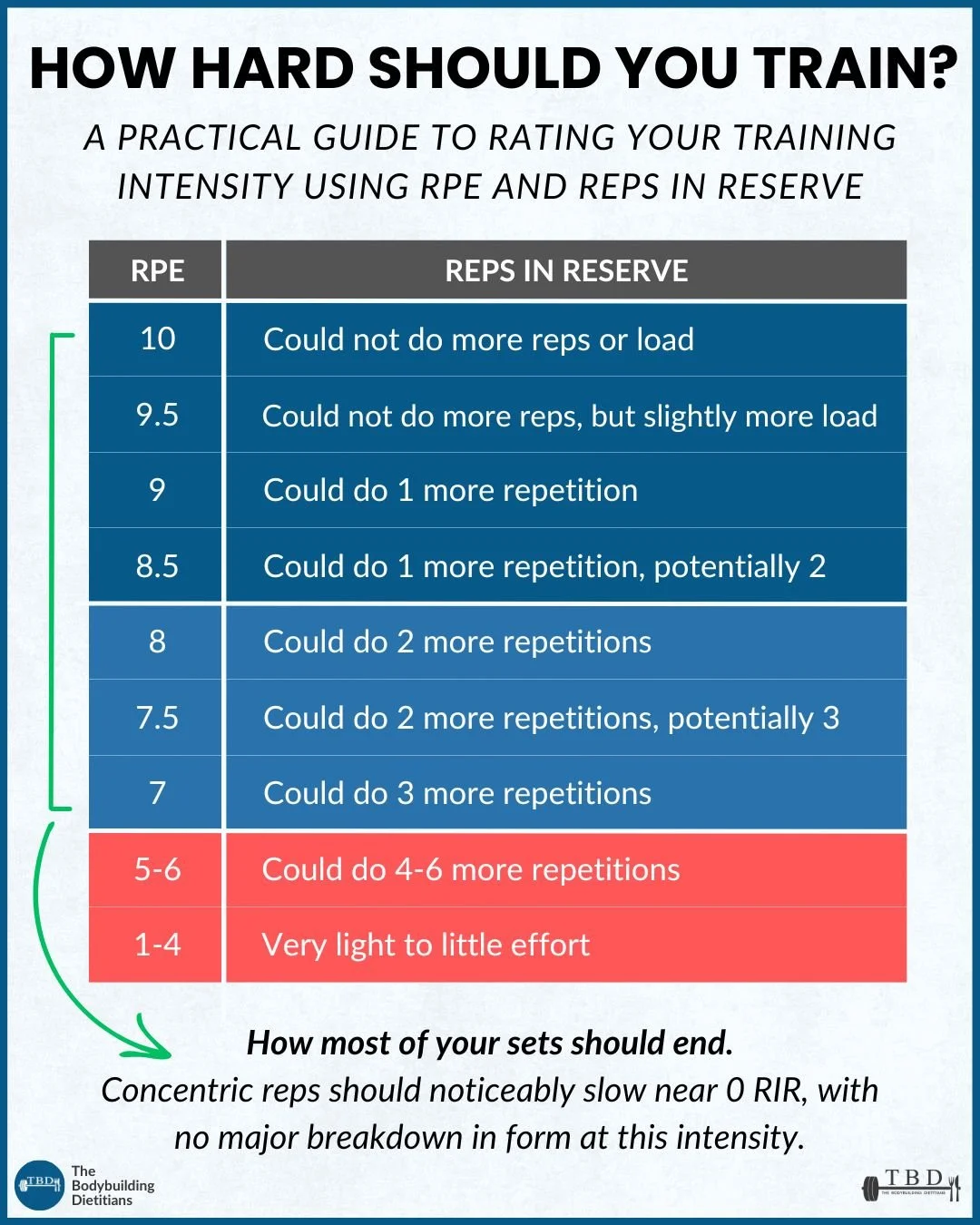
Training hard and training hard enough are not the same thing. Many people who train consistently and with genuine effort still fall short of the intensity required to drive meaningful adaptation, not because they are not trying, but because effort and proximity to failure are not the same variable. A set that feels difficult at 60 percent of your true capacity is genuinely hard in a subjective sense, but it is not providing the same stimulus as a set that ends close to failure.
RPE and reps in reserve are tools designed to bridge that gap, giving athletes a more precise way to gauge where their sets are landing and giving coaches a more reliable language for prescribing and monitoring training intensity. Neither tool requires any equipment, and both improve considerably with practice.
What Is RPE in the Context of Resistance Training?
RPE stands for rating of perceived exertion. In the context of resistance training, it refers to a 1 to 10 scale that describes how demanding a set was relative to the maximum effort the individual could have produced.
An RPE of 10 indicates that no further repetitions or additional load would have been possible at the end of the set. An RPE of 9 indicates that one more repetition could have been completed. An RPE of 8 indicates two more, and so on down the scale. RPE values of 5 to 6 correspond to sets with 4 to 6 reps remaining, and values of 1 to 4 represent very low to minimal effort relative to capacity.
The scale was originally developed for cardiovascular exercise by Gunnar Borg, where it tracked heart rate and ventilatory responses to exercise intensity. Its application to resistance training has been refined considerably in the exercise science literature, where it now functions primarily as a proxy for proximity to muscular failure rather than cardiovascular demand.
Rating of perceived exertion in resistance training is distinct from percentage of one-rep maximum approaches to intensity prescription. Where percentage-based programming assigns a fixed load relative to a tested maximum, RPE-based prescription adjusts to the individual's state on a given day, accounting for variation in readiness, recovery, and fatigue in a way that percentage-based systems cannot.
What Is Reps in Reserve and How Does It Relate to RPE?
Reps in reserve, or RIR, is the complementary and often more intuitive expression of the same concept. Where RPE assigns a number to the difficulty of a completed set, RIR describes how many additional repetitions could have been performed at the same load before reaching failure.
A set completed with 0 reps in reserve equates to an RPE of 10: complete failure, nothing left. A set completed with 1 rep in reserve equates to an RPE of 9. Two reps in reserve equates to an RPE of 8, three to an RPE of 7, and so on. The two scales are directly interchangeable, and most coaches use them in combination rather than choosing one exclusively.
The practical advantage of RIR framing is that it tends to feel more concrete during a set. Asking "how many more reps could you do?" is often easier to answer accurately in the moment than asking "what number would you assign to how hard that was?" Both arrive at the same place, but the RIR formulation tends to produce more consistent self-reporting across athletes.
Proximity to failure is central to both frameworks. Failure in this context refers to the point at which a repetition cannot be completed with appropriate technique, sometimes called technical failure, rather than absolute failure where the load cannot be moved at all. Training to and around technical failure is the relevant reference point for hypertrophy purposes.
Where Should Most Working Sets Land on the RPE Scale?
For most working sets targeted at muscle growth, finishing at an RPE of 7 to 10, corresponding to 0 to 3 reps in reserve, provides sufficient stimulus for hypertrophy while still allowing enough recovery to maintain quality across subsequent sets and the remainder of the session.
The relationship between proximity to failure and hypertrophic stimulus is well-supported in the literature. Sets that end well short of failure, particularly those with 4 or more reps in reserve, produce a meaningfully lower hypertrophic stimulus per set compared to those completed close to failure, because the final repetitions of a set are where the highest-threshold motor units are recruited and mechanical tension on the muscle is greatest.
A meta-analysis by Schoenfeld found that training closer to failure produced greater muscle hypertrophy compared to training further from failure when volume was equated, with the relationship between proximity to failure and stimulus becoming more pronounced as sets approached 0 to 2 reps in reserve.
Source: Schoenfeld and Grgic, 2019, Journal of Strength and Conditioning Research.
This does not mean every set needs to reach failure. Training consistently to absolute failure across all sets and exercises increases fatigue accumulation, which can compromise the quality of subsequent sets and recovery between sessions. An RPE of 7 to 9, or 1 to 3 reps in reserve, across most working sets represents a practical balance between sufficient stimulus and manageable fatigue, with occasional sets pushed to RPE 10 where appropriate for specific exercises or training phases.
The physical sign that a set is approaching 0 RIR is characteristic and worth knowing: concentric reps, the lifting phase, slow noticeably in the final 1 to 2 repetitions. This velocity drop is an external indicator of proximity to failure that can be observed even without access to velocity tracking technology. Importantly, this slowing should occur without a major breakdown in form, because maintaining technique integrity matters for both safety and the reliability of the stimulus being applied to the target muscle.
Why Does RPE Accuracy Improve With Training Experience?
One of the most practically important limitations of RPE and RIR as self-reported tools is that accuracy improves considerably with training experience, and beginners tend to underestimate how many reps they have remaining.
This means that a beginner who believes they are finishing at an RPE of 8, with 2 reps in reserve, may in reality have 4 to 6 repetitions remaining. The subjective experience of effort at submaximal intensity is similar regardless of actual proximity to failure, particularly for those who have not yet developed a refined sense of the specific sensations that accompany the final repetitions before failure. As a result, self-prescribed intensity in less experienced athletes often falls meaningfully short of where it needs to be for effective stimulus, even when the intention is to train hard.
This is an important practical consideration for several reasons. Programs that prescribe intensity using RPE or RIR targets assume that the athlete can accurately self-assess their proximity to failure. When that assessment is unreliable, the actual training stimulus being applied may be considerably lower than the program intends. Coaches working with less experienced athletes often account for this by prescribing higher target RPE values than they would for experienced athletes, or by using more conservative RIR targets with the expectation that the actual RIR is being underestimated.
For athletes early in their training career, spending time deliberately exploring what genuine proximity to failure feels like, including carefully pushing occasional sets to technical failure to develop that reference point, accelerates the development of RPE accuracy. This is one reason that supervised training environments or structured coaching programs can compress the learning curve considerably, by providing external feedback on whether stated RPE values are consistent with observed performance.
How Does RPE Prescription Differ From Percentage-Based Programming?
Percentage-based programming assigns loads as a proportion of a tested one-rep maximum, for example, working at 75 percent of one-rep max for a given rep range. It has the advantage of objectivity and is the basis for many structured strength and powerlifting programs. Its limitation is that it assumes the athlete's capacity on a given day matches the capacity recorded when the maximum was tested, which is not always the case.
Fatigue, sleep quality, nutritional status, accumulated training volume, life stress, and time of day all influence how much force an athlete can produce on a given session. A load that represents 75 percent of a fresh, well-rested maximum may feel considerably heavier, and sit at a higher RPE, after a week of high training volume and poor sleep.
RPE prescription accounts for this variation automatically. Because the target is proximity to failure rather than a fixed load, the athlete adjusts the load to match the prescribed intensity on that day, whether that means using the same weight as last session, more, or occasionally less. This makes RPE-based programming more responsive to the day-to-day fluctuation in readiness that affects every athlete.
In practice, many programs use a combination of the two approaches, prescribing a load range based on percentage of maximum and using RPE to refine within that range or to gauge whether the prescribed volume is appropriate given the athlete's current state. How training intensity is prescribed, applied, and monitored across a program is something we work through in detail with clients, particularly when progress has stalled or fatigue management has become an issue.
How Should RPE Change Across Different Exercises and Phases?
RPE targets are not uniform across all exercises, and applying the same intensity prescription indiscriminately across every movement in a session is not always appropriate.
Compound barbell movements, particularly those involving high systemic load and technical demands such as squats, deadlifts, and barbell rows, carry a higher injury risk when pushed consistently to very high RPE values. The fatigue they generate is also more substantial than isolation movements, which means sets taken to RPE 9 to 10 on these exercises accumulate fatigue more rapidly and can compromise the quality of subsequent movements in the same session. Many experienced coaches prescribe slightly lower RPE targets for primary compound movements and allow higher relative intensity on isolation exercises where fatigue management is less of a concern.
During a fat loss phase or any period of calorie restriction, maintaining RPE targets is important for muscle retention. A common pattern in dieting athletes is that session quality declines gradually as training feels harder at a given load, which represents the deficit reducing recovery capacity. Monitoring RPE targets in this context provides useful feedback: if loads that previously required an RPE of 8 now feel closer to a 9 or 10, the energy deficit may be affecting recovery more significantly than the broader performance picture suggests. This relationship between dietary status and training performance is one of the reasons that nutrition and training programming are most productively managed together rather than as separate systems.
Practical Takeaways
RPE is a 1 to 10 scale describing how close to failure a set was. Reps in reserve is the directly corresponding measure of how many additional repetitions could have been completed before failure.
An RPE of 10 means no more reps or load were possible. RPE 9 equals 1 rep in reserve, RPE 8 equals 2, and RPE 7 equals 3. Values of 5 to 6 correspond to 4 to 6 reps remaining and represent insufficient intensity for meaningful hypertrophic stimulus.
For most working sets aimed at muscle growth, finishing at an RPE of 7 to 10, or 0 to 3 reps in reserve, provides sufficient stimulus while allowing recovery across the session.
The final 1 to 2 reps before failure are characterised by noticeable slowing of the concentric phase. This is the external indicator that a set is approaching 0 RIR, and it should occur without major technical breakdown.
Beginners consistently underestimate how many reps they have remaining, which means self-reported RPE often falls short of the intended intensity target. This is a normal limitation of inexperience and improves with deliberate practice.
RPE-based programming is more responsive to day-to-day variation in readiness than percentage-based programming, because the intensity target adjusts to the athlete's actual capacity on a given day rather than assuming a fixed maximum.
RPE targets can reasonably be lower for demanding compound movements and higher for isolation exercises, reflecting the different fatigue contributions and injury risk profiles of each.
Frequently Asked Questions
What does RPE 7 mean in weightlifting?
An RPE of 7 in resistance training means the set was completed with approximately 3 reps in reserve, meaning 3 more repetitions could have been performed before reaching technical failure at the same load. It represents a hard but comfortably sub-maximal effort and is within the range considered sufficient for hypertrophic stimulus when applied consistently across working sets.
Should you always train to failure for muscle growth?
Training to failure on every set is not necessary for muscle growth and may be counterproductive in terms of fatigue accumulation and session quality. Research indicates that training within 0 to 3 reps of failure across most sets provides a stimulus comparable to failure training, with less total fatigue generated. Occasional sets to failure can be useful as a reference point for calibrating RPE accuracy, but consistent failure training across all exercises increases injury risk and reduces the quality of subsequent sets.
How do beginners get better at judging RPE?
RPE accuracy in beginners improves primarily through deliberate exposure to genuine proximity to failure. Periodically pushing a set to technical failure, where form begins to break down, establishes the reference point against which all other efforts can be calibrated. Keeping a training log that records stated RPE alongside load and reps also helps identify patterns over time. Working with a coach who can provide external feedback on whether observed performance is consistent with stated RPE accelerates this process considerably.
What is the difference between RPE and 1RM percentage?
Percentage of one-rep maximum prescribes load based on a fixed tested maximum, while RPE describes intensity relative to actual capacity on a given day. The two are related but not interchangeable, because a given percentage of maximum will correspond to different RPE values depending on fatigue, recovery, and readiness on that day. RPE-based prescription adjusts automatically to the athlete's actual state, making it more flexible and responsive to the variation that affects real-world training.
Is RPE the same for all exercises?
The RPE scale applies to any exercise, but the appropriate RPE target may vary between movements. High-load compound exercises with significant systemic fatigue contribution and greater technical demand, such as heavy squats and deadlifts, are often prescribed at slightly lower RPE targets than isolation movements, to manage fatigue accumulation and reduce injury risk. Isolation exercises, where fatigue is more localised and technical failure less consequential, are often appropriate at higher RPE targets.
Can nutrition affect RPE during a training session?
Yes, meaningfully so. Calorie restriction, low carbohydrate availability, and inadequate protein intake can all affect performance in ways that show up as elevated RPE at a given load. A weight that previously required an RPE of 8 may feel like a 9 or 10 during an aggressive diet phase, reflecting reduced recovery capacity and energy availability rather than any change in the load itself. Monitoring RPE across a diet phase is therefore a useful indicator of whether the deficit is affecting training quality more than the calorie and scale data might suggest.
If you want support applying RPE-based intensity targets within a structured program, or if training progress has stalled and you want to assess whether intensity or nutrition are contributing factors, our team can help.