The body processes protein, carbohydrates, and fat simultaneously, with each macronutrient following distinct metabolic pathways that shift depending on energy availability, exercise intensity, and fed or fasted state.
Carbohydrates are broken down to glucose, which is used immediately for energy, stored as glycogen in muscle and liver tissue, or converted to fat via lipogenesis when intake consistently exceeds demand. Dietary fat is broken down to glycerol and fatty acids, which are used for energy production or stored in adipose tissue. Protein is broken down to amino acids, which primarily support tissue repair and protein synthesis, but can also enter energy pathways through gluconeogenesis when total calorie intake or carbohydrate availability is insufficient. All three macronutrients contribute to fat storage when consumed in excess of total energy requirements. No single macronutrient causes fat gain in isolation.
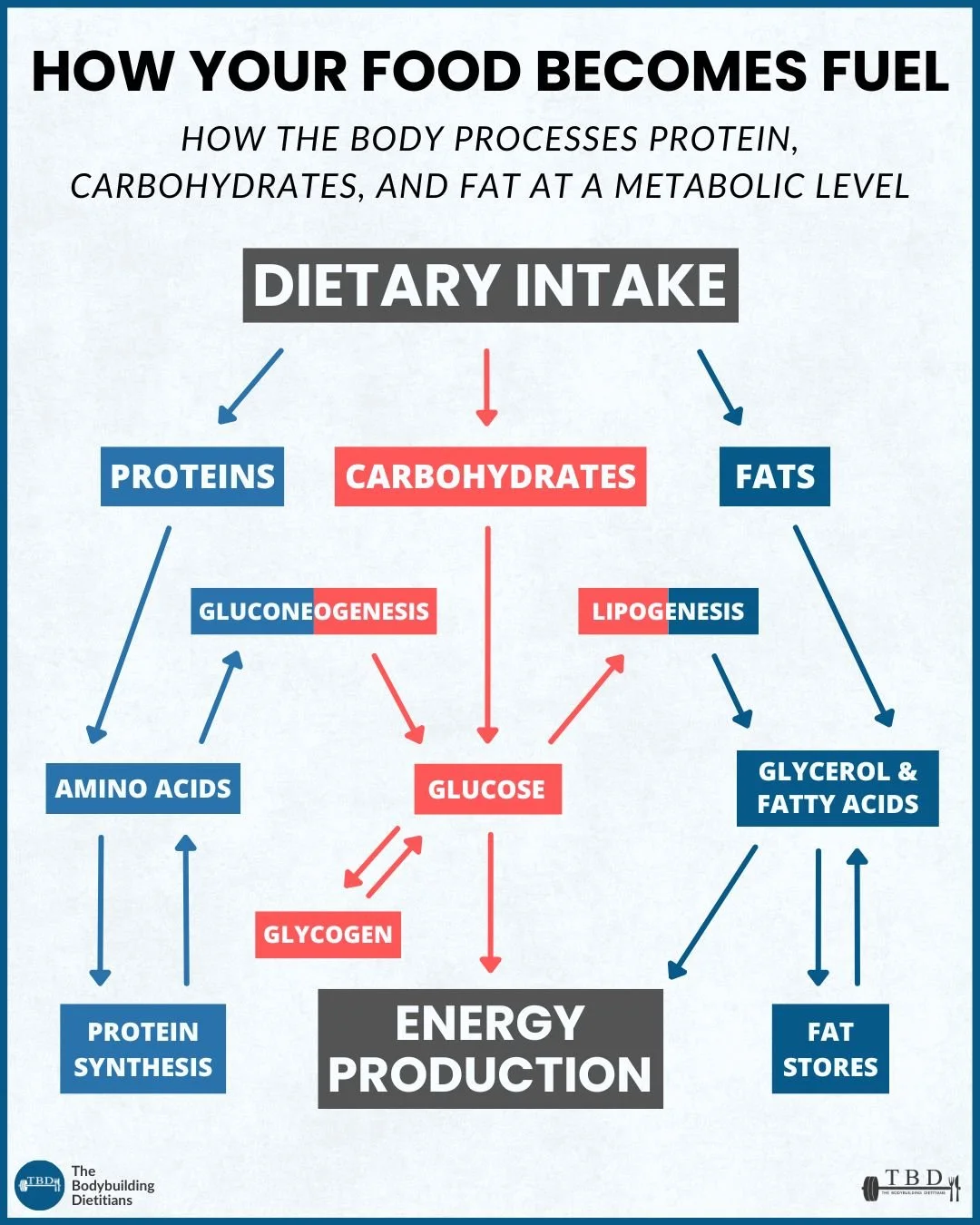
A simplified overview of how protein, carbohydrates, and fat are processed at a metabolic level, showing the pathways to energy production, glycogen storage, protein synthesis, and fat storage.
One of the most persistent misconceptions in nutrition is that the body runs on one fuel source at a time, or that a particular macronutrient is uniquely responsible for fat gain or fat loss. The reality is more integrated and more interesting than that. Carbohydrates, protein, and fat are all being processed simultaneously, with the relative contribution of each shifting depending on the body's current energy demands, hormonal state, and how much of each substrate is available.
Understanding the broad metabolic pathways of each macronutrient is practically useful because it provides the physiological reasoning behind nutritional principles that might otherwise feel arbitrary. Why does carbohydrate availability affect training performance? Why does protein protect against muscle loss in a deficit? Why does consistent calorie surplus lead to fat gain regardless of which macronutrient produces it? The metabolic diagram answers all of these questions, and the answer to each has direct application to how nutrition is structured across different goals and training phases.
The explanation below is intentionally applied rather than exhaustive. The full scope of intermediary metabolism includes many pathways and regulatory mechanisms not captured here, and the diagram itself is a simplified model. The purpose is to give a clear and accurate account of the broad strokes, not to replicate a biochemistry textbook.
How Does the Body Process Carbohydrates?
Carbohydrates are the body's preferred and most readily available fuel source for high-intensity work. When dietary carbohydrate is consumed, it is digested and broken down to its component monosaccharides, predominantly glucose, which enter the bloodstream and trigger an insulin response.
Glucose has several possible fates depending on the body's current energy status. When energy demand is high, such as during or immediately after training, glucose is used directly for energy production through a series of metabolic processes including glycolysis and, ultimately, oxidative phosphorylation. This is the most efficient route and the one the body prioritises when energy is needed acutely.
When immediate energy demand is lower but glucose is still available, it is stored as glycogen. Glycogen is the stored form of carbohydrate found primarily in skeletal muscle and liver tissue. Muscle glycogen serves as a local fuel reserve for contracting muscle during exercise, while liver glycogen helps maintain blood glucose levels between meals. Glycogen storage is finite: muscle and liver can hold approximately 400 to 500 grams of glycogen in total, which is the primary reason that carbohydrate periodisation and timing matter for training performance.
The two-way arrow between glucose and glycogen in the diagram represents an important physiological reality: glycogen can be broken down back to glucose when blood glucose falls or when muscle energy demand increases during training. This process, called glycogenolysis, is regulated by glucagon and adrenaline and is the mechanism by which stored carbohydrate is mobilised.
When carbohydrate intake consistently exceeds both immediate energy demand and glycogen storage capacity, the surplus glucose can be converted to fat through a process called lipogenesis. Lipogenesis refers to the conversion of excess acetyl-CoA, derived from glucose metabolism, into fatty acids for storage in adipose tissue. This process requires a meaningful and sustained calorie surplus above glycogen saturation, and is less efficient than direct fat storage from dietary fat, but it does occur and is the mechanism by which high carbohydrate intake in a calorie surplus contributes to fat accumulation.
How Does the Body Process Dietary Fat?
Dietary fat undergoes digestion in the small intestine, where lipase enzymes break down triglycerides into their component glycerol and fatty acid molecules. These are absorbed primarily via the lymphatic system before entering the bloodstream.
Once in circulation, fatty acids have two primary destinations. When energy demand is present, fatty acids undergo beta-oxidation in the mitochondria, producing acetyl-CoA which enters the citric acid cycle to generate ATP for energy production. Fat oxidation is the dominant fuel pathway at lower exercise intensities, during rest, and in the fasted state, where carbohydrate availability is lower and the body relies proportionally more on fat as its energy substrate.
When energy intake exceeds demand, dietary fat is stored as triglycerides in adipose tissue. This pathway is direct and metabolically efficient: dietary fat requires relatively little energy to convert into stored body fat compared to the energetic cost of converting either carbohydrate or protein to fat. This is reflected in the thermic effect of fat, which is the lowest of the three macronutrients at approximately 0 to 3 percent of calories consumed, compared to carbohydrate at 5 to 10 percent and protein at 20 to 30 percent.
The glycerol component of triglyceride breakdown is also worth noting. Glycerol can enter the gluconeogenesis pathway and be converted to glucose in the liver, contributing to blood glucose maintenance during fasting or prolonged exercise when carbohydrate availability falls. This is one of several mechanisms by which the body maintains glucose homeostasis without dietary carbohydrate.
How Does the Body Process Protein?
Protein is primarily a structural and functional macronutrient rather than a fuel source. It is digested into its component amino acids in the stomach and small intestine, which are then absorbed and distributed to tissues where they are needed for protein synthesis, enzyme production, hormone manufacturing, immune function, and numerous other roles.
Muscle protein synthesis is the biological process through which dietary amino acids stimulate the repair and construction of skeletal muscle fibres following resistance training. Adequate protein intake, particularly leucine, which acts as a primary signal for muscle protein synthesis, is necessary for this process to occur at a rate that supports lean tissue maintenance and growth. This is the dominant fate of dietary protein in a well-nourished individual with adequate total calorie intake.
Amino acids can also enter energy metabolism through gluconeogenesis, the process by which non-carbohydrate substrates are converted to glucose in the liver. Gluconeogenesis becomes more relevant when carbohydrate intake is insufficient to maintain blood glucose, such as during prolonged fasting, very low carbohydrate diets, or when total calorie intake is significantly restricted. Under these conditions, glucogenic amino acids, including alanine and glutamine, are preferentially mobilised to produce glucose, which can compromise the amino acid availability for muscle protein synthesis and contribute to lean tissue loss.
This is the physiological basis for one of the most practically important principles in fat loss nutrition: adequate protein intake protects lean mass not only by providing substrate for muscle protein synthesis, but also by reducing the reliance on muscle-derived amino acids to meet gluconeogenic demand. When protein intake is sufficient, the body has less need to break down muscle tissue to maintain blood glucose.
Does the Source of Calories Affect Fat Storage?
The metabolic pathways described above make clear that all three macronutrients can ultimately contribute to fat storage under conditions of energy surplus. This has a direct and important practical implication: no single macronutrient causes fat gain in isolation, and the question of whether a food causes fat gain is answered by its contribution to total energy balance rather than by which macronutrient category it belongs to.
Carbohydrate does not cause fat gain uniquely. Fat does not cause fat gain uniquely. Protein, which has the highest thermic effect and the greatest satiety value per calorie, is the least likely macronutrient to contribute to fat gain under normal dietary conditions, but it is not metabolically exempt from storage. Sustained surplus energy across any combination of the three is what drives fat accumulation, and sustainable fat loss requires a calorie deficit rather than the elimination of any specific macronutrient.
This understanding is also the physiological basis for why diet quality matters beyond macronutrient ratios. Foods with high energy density, low satiety value, and low thermic effect make it easier to accumulate a calorie surplus without registering hunger. Foods with high protein content, high fibre, and high water content produce a stronger satiety signal per calorie and support the maintenance of a deficit over time.
How Does Exercise Shift Macronutrient Utilisation?
The relative contribution of each macronutrient to energy production is not fixed. It shifts dynamically in response to exercise intensity, duration, and the fed or fasted state.
At lower exercise intensities, such as walking and light aerobic activity, fat oxidation is the dominant fuel pathway. The body has sufficient time to mobilise and oxidise fatty acids, and the energy demand is low enough that the slower rate of fat oxidation relative to carbohydrate is not limiting. This is why prolonged lower-intensity exercise is often described as fat-burning activity.
As exercise intensity increases, the body shifts progressively toward carbohydrate as the primary fuel source. High-intensity resistance training and interval-based cardio rely heavily on glycolytic pathways that produce energy from glucose rapidly, and glycogen availability becomes an increasingly important determinant of sustained performance. This is the physiological basis for carbohydrate timing around training: having adequate glycogen available before a high-intensity session and replenishing it afterwards supports both performance and recovery.
In the fasted state or when carbohydrate intake is low, the body increases fat oxidation and gluconeogenesis to compensate for reduced glucose availability. This is a normal adaptive response, but it has limits in the context of high-intensity training: fat cannot be oxidised fast enough to fully meet the energy demands of very high-intensity effort, which is why performance on low-carbohydrate diets tends to be compromised for effort above the moderate-to-high intensity threshold.
Understanding how these metabolic shifts operate is part of how macronutrient targets are set and adjusted relative to training demands. For individuals whose training involves consistent high-intensity resistance or cardiovascular work, carbohydrate availability before and after sessions is more consequential than it would be for someone whose primary activity is lower-intensity movement. How these variables are applied in practice is something we work through in detail with our coaching clients, where training structure and nutrition are planned together rather than separately.
Practical Takeaways
Carbohydrates are broken down to glucose, which is used for energy, stored as glycogen, or converted to fat via lipogenesis when intake consistently exceeds demand and glycogen stores are full.
Glycogen stored in muscle and liver tissue serves as the primary fuel reserve for high-intensity training. Glycogen storage is finite, which is why carbohydrate availability before and after hard sessions affects performance and recovery.
Dietary fat is broken down to glycerol and fatty acids, used for energy at lower intensities and in the fasted state, or stored in adipose tissue when total energy intake exceeds demand.
Protein is broken down to amino acids, which primarily support muscle protein synthesis and tissue repair. Amino acids can enter gluconeogenesis to produce glucose when carbohydrate intake is insufficient, which is one mechanism by which lean tissue is lost in aggressive deficits.
No single macronutrient causes fat gain in isolation. Surplus energy across any combination of protein, carbohydrates, and fat drives fat storage. The same principle applies in reverse for fat loss.
Exercise intensity shifts macronutrient utilisation: fat is the dominant fuel at lower intensities, carbohydrate becomes progressively more important as intensity increases.
Adequate protein intake in a calorie deficit protects lean mass both by providing substrate for muscle protein synthesis and by reducing the body's need to break down muscle tissue for gluconeogenesis.
Frequently Asked Questions
Does eating carbohydrates make you store fat?
Carbohydrates do not uniquely cause fat storage. Dietary glucose is converted to fat via lipogenesis only when intake consistently exceeds both immediate energy demand and glycogen storage capacity. In the context of a total diet where energy intake matches or falls below expenditure, carbohydrate consumption does not cause fat accumulation. Surplus energy across any macronutrient is what drives fat storage.
What is glycogen and why does it matter for training?
Glycogen is the stored form of carbohydrate found primarily in skeletal muscle and liver tissue. Muscle glycogen is the primary fuel source for high-intensity resistance and cardiovascular training, and insufficient glycogen availability reduces the capacity to sustain effort at high intensities. Depleted glycogen stores are one of the main contributors to training fatigue and reduced session quality during a calorie deficit or low-carbohydrate period.
What is gluconeogenesis and when does it occur?
Gluconeogenesis is the process by which the liver converts non-carbohydrate substrates, including amino acids, glycerol, and lactate, into glucose. It occurs primarily during fasting, prolonged exercise, very low carbohydrate diets, and when total calorie intake is significantly restricted. In the context of a calorie deficit, gluconeogenesis from amino acids is one mechanism by which lean tissue can be lost when protein intake is insufficient to offset the demand.
Does protein turn into fat?
Protein can contribute to fat storage when total calorie intake exceeds expenditure, though it is the least likely macronutrient to do so under normal dietary conditions. Its high thermic effect means that approximately 20 to 30 percent of the calories in protein are expended in processing it, which reduces its net caloric contribution. At realistic protein intakes within a controlled energy budget, the risk of protein contributing meaningfully to fat gain is low.
Why is fat oxidation dominant at low exercise intensities?
At lower exercise intensities, the energy production rate required is low enough that the body can meet it through fat oxidation, which is a slower but higher-yield process than carbohydrate metabolism. As intensity increases, the rate at which energy must be produced exceeds the capacity of fat oxidation alone, and the body shifts toward glycolytic pathways that produce energy from carbohydrate more rapidly. This is why carbohydrate availability becomes increasingly important as training intensity rises.
Is a calorie from fat the same as a calorie from carbohydrate?
At the level of energy provided per gram, fat provides approximately 9 calories and carbohydrate provides approximately 4 calories. At the level of metabolic effect, the two macronutrients differ in thermic effect, satiety value, substrate utilisation, and hormonal response. However, the fundamental principle of energy balance holds: surplus energy from either source drives fat storage, and a deficit from either source drives fat loss. The practical difference between macronutrients in terms of body composition outcomes is primarily mediated through their effects on satiety, training performance, and adherence rather than through unique metabolic properties.
If you want support translating these metabolic principles into a practical nutrition plan aligned with your training and body composition goals, our team works through exactly this kind of applied problem-solving with every client.