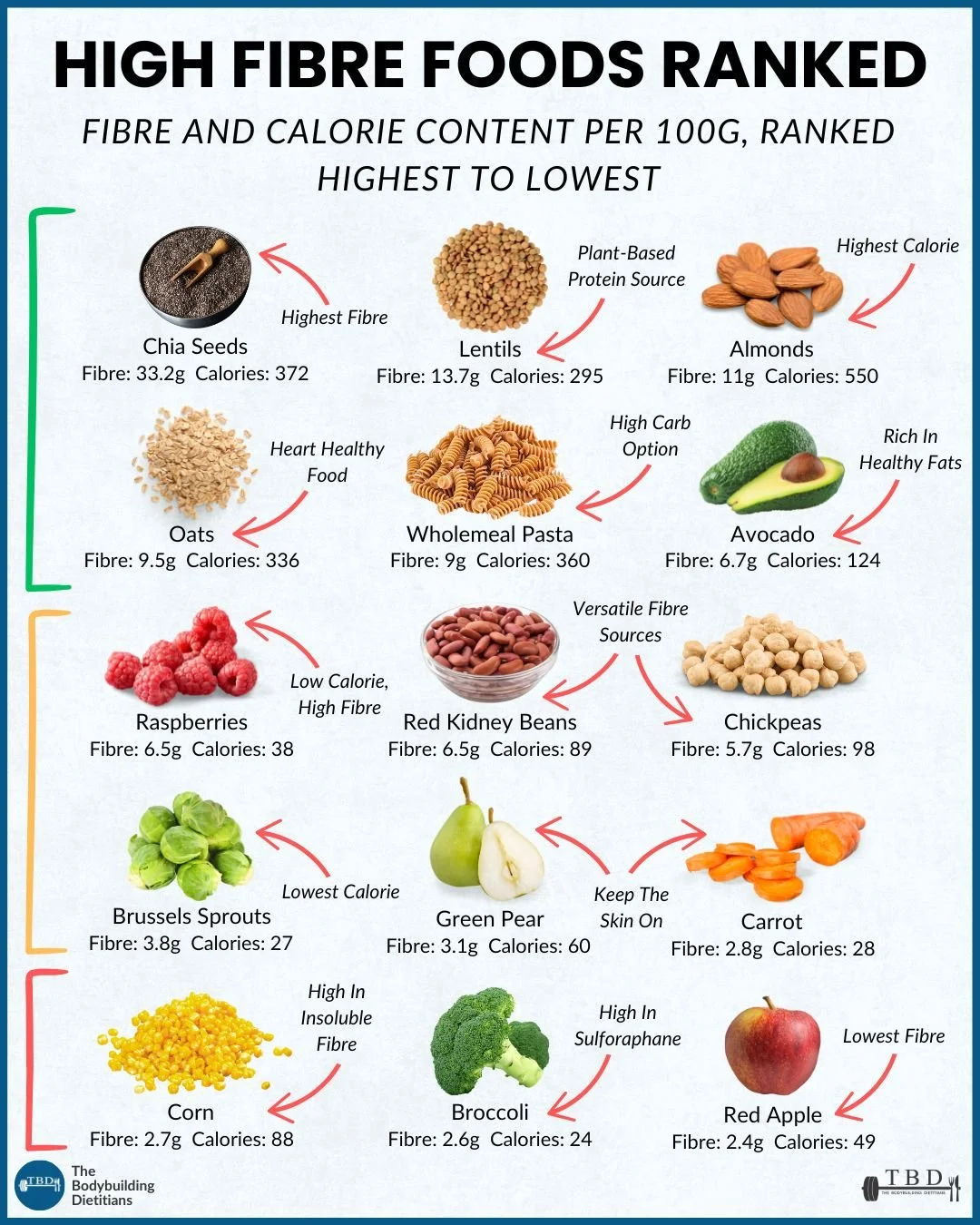
A data-driven comparison of 15 whole foods ranked by fibre content per 100 grams, with calorie values included to give a more complete picture of each food's nutritional context.
Fibre targets of 30 grams per day for males and 25 grams per day for females are well supported by research, and most people eating a typical Western diet fall short of these. Chia seeds provide the highest fibre content at 33.2 grams per 100 grams, followed by lentils at 13.7 grams and oats at 9.5 grams. For individuals in a calorie deficit, raspberries offer one of the better fibre-to-calorie ratios on the list at 6.5 grams of fibre for only 38 calories per 100 grams. All values are based on uncooked weight, which is relevant for foods like oats, lentils, and pasta where weight increases considerably once cooked.
WANT THE COMPLETE LIST?
Our free Fibre Guide ranks over 80 foods by fibre-per-calorie, so you can hit your target without overshooting your calories. You’ll also receive occasional nutrition and training insights from our dietitians, with the option to unsubscribe at any time.

LET’S TALK ABOUT FIBRE
Fibre is among the most underconsumed nutrients in the typical Western diet, despite having one of the strongest and most consistent evidence bases for health benefit. Targets of 30 grams per day for males and 25 grams per day for females are well supported, and research consistently shows that most people eating a standard Western dietary pattern fall meaningfully short of these. The gap between recommended and actual intake is not a minor shortfall; population data suggests average adult fibre intake sits closer to 20 to 22 grams per day in Australia and the United Kingdom.
Understanding which foods deliver fibre efficiently, and in what caloric context, is practically useful for anyone trying to close that gap without overhauling their entire diet. The ranking below uses data from the Australian Food Composition Database and lists fibre content per 100 grams of uncooked food alongside calorie content, which provides a more complete nutritional picture than fibre alone.
Why Does Fibre Intake Matter?
Dietary fibre refers to the indigestible carbohydrate components of plant foods that pass through the small intestine largely intact and are fermented or partially fermented in the large intestine. This broad category includes soluble fibre, which dissolves in water to form a gel and is associated with improved glycaemic management and LDL cholesterol reduction, and insoluble fibre, which adds bulk to stool and supports bowel regularity.
The health associations with adequate fibre intake are extensive and well-replicated. A landmark meta-analysis by Reynolds et al. published in The Lancet in 2019, drawing on 185 prospective studies and 58 clinical trials, found that higher dietary fibre intakes were associated with a 17 to 31 percent reduction in cardiovascular disease risk, an 11 to 22 percent reduction in colorectal cancer risk, and a 10 to 22 percent reduction in type 2 diabetes risk compared to lower intakes. The benefits were dose-responsive, meaning that exceeding minimum targets continued to show value rather than plateauing.
Reynolds et al. found dose-response relationships between fibre intake and reduced risk across cardiovascular disease, colorectal cancer, and type 2 diabetes, with the strongest risk reductions observed at intakes above 25 to 29 grams per day compared to intakes below 15 grams per day.
Source: Reynolds et al., 2019, The Lancet.
For physically active individuals and those managing body composition, fibre also plays a direct practical role. It supports satiety per calorie, slows gastric emptying, moderates the glycaemic response to meals, and serves as substrate for the beneficial bacteria that maintain gut microbiome diversity. During a calorie deficit, where food volume decreases and hunger management becomes a genuine challenge, the satiety value of fibre-rich foods becomes particularly relevant.
How to Interpret the Fibre Rankings
Before reading the ranked data, two things are worth understanding.
First, all values are based on uncooked weight. For foods like oats, lentils, and wholemeal pasta, weight increases considerably once cooked as they absorb water. A 100-gram serving of dry oats becomes approximately 250 to 300 grams once prepared, which means the fibre and calorie content per cooked gram is proportionally lower than the uncooked values shown. This is relevant when translating the data to actual eating occasions.
Second, the per 100-gram comparison is useful for comparison purposes but does not always represent a realistic serving size. Chia seeds rank highest on the list at 33.2 grams of fibre per 100 grams, but a typical serving is closer to 15 to 20 grams. Reading the per 100-gram values alongside what a realistic portion of each food looks like gives a more accurate sense of how much each contributes to daily fibre targets in practice.
Which Foods Provide the Most Fibre per 100g?
Chia seeds: 33.2g fibre, 372 calories Chia seeds provide the highest fibre content per 100 grams of any food on this list by a considerable margin. Their fibre is predominantly soluble and forms a gel when mixed with liquid, which is useful for the preparation of overnight oats, smoothies, and puddings. Given that a typical serving is 15 to 20 grams, a single tablespoon-sized addition to meals can contribute 5 to 7 grams of fibre in a low-volume, calorie-manageable way. They also provide omega-3 fatty acids, calcium, and magnesium, which makes them a nutritionally dense addition even in small amounts.
Lentils: 13.7g fibre, 295 calories Lentils are the strongest plant-based protein and fibre combination on this list, providing 13.7 grams of fibre and a meaningful protein contribution per 100 grams uncooked. They are also one of the more cost-effective whole foods available. The combination of protein and fibre makes them particularly effective for satiety, and they are versatile enough to be incorporated across soups, curries, salads, and bolognese-style dishes without significantly disrupting existing meal structures. Red, green, and brown lentil varieties all offer broadly similar nutritional profiles.
Almonds: 11g fibre, 550 calories Almonds provide the highest calorie content of any food on this list at 550 calories per 100 grams, which is worth noting in the context of calorie management. Their fibre content is meaningful at 11 grams per 100 grams, but the calorie density means that portion awareness matters more here than for most other foods on the list. A 30-gram serve, which is a realistic handful, provides around 3.3 grams of fibre alongside approximately 165 calories. Almonds also provide monounsaturated fat, vitamin E, and magnesium, making them a nutritionally valuable food when kept to appropriate portions.
Oats: 9.5g fibre, 336 calories Oats are a particularly useful fibre source for cardiovascular health specifically, as their fibre is predominantly beta-glucan, a soluble fibre type with well-established LDL cholesterol-lowering effects at intakes of around 3 grams per day. A 40-gram dry serving provides approximately 3.8 grams of fibre and around 135 calories, making them a calorie-efficient base for breakfast. Their satiety effect is well-documented and is partly attributable to the viscous gel beta-glucan forms in the digestive tract, which slows gastric emptying and moderates post-meal glucose rise.
Wholemeal pasta: 9g fibre, 360 calories Wholemeal pasta provides comparable fibre to oats per 100 grams uncooked and is a practical high-carbohydrate option for individuals with higher training volumes who want to meet both carbohydrate and fibre targets simultaneously. As with all pasta, the cooked weight increases significantly from the dry weight, which dilutes the per-gram calorie and fibre density considerably. Swapping refined pasta for wholemeal is one of the lower-effort dietary changes available for improving fibre intake without altering meal structure.
Avocado: 6.7g fibre, 124 calories Avocado is the richest source of fat on this list and provides its fibre primarily as a mix of soluble and insoluble types. At 124 calories per 100 grams, it is calorie-moderate relative to other fat-dense foods, which reflects its high water content. Its combination of monounsaturated fat, fibre, potassium, and folate makes it nutritionally well-rounded. A half avocado of around 75 grams provides approximately 5 grams of fibre alongside roughly 90 calories, which is a reasonably efficient trade for a whole-food fat source.
Which Foods Offer the Best Fibre-to-Calorie Ratio?
For individuals managing calorie intake, the fibre-to-calorie ratio is often more practically useful than absolute fibre content per 100 grams. The foods that rank highest on this measure tend to be those with high water content relative to their dry weight.
Raspberries: 6.5g fibre, 38 calories Raspberries offer one of the strongest fibre-to-calorie ratios on this list, and are worth highlighting specifically for this reason. At only 38 calories per 100 grams and 6.5 grams of fibre, they provide more fibre per calorie than any other food here. A 150-gram serve contributes nearly 10 grams of fibre for around 57 calories, which is a meaningful contribution to daily targets with minimal calorie cost. They also provide vitamin C, folate, and a range of anthocyanin polyphenols associated with antioxidant activity. Their practicality during a fat loss phase is significant, and they fit easily into yoghurt, oats, smoothies, or as a standalone snack.
Brussels sprouts: 3.8g fibre, 27 calories Brussels sprouts provide the lowest calorie content of any food on this list at 27 calories per 100 grams, making them one of the most volume-efficient fibre sources available. A 200-gram serve, which represents a substantial portion, contributes 7.6 grams of fibre for approximately 54 calories. They also provide vitamin C, vitamin K, folate, and glucosinolate compounds including sulforaphane precursors, which share the bioactive profile associated with other cruciferous vegetables.
Carrot: 2.8g fibre, 28 calories Carrots are broadly similar to Brussels sprouts in their calorie density and offer a practical raw snacking option that requires no preparation. Their fibre is a mix of soluble pectin and insoluble cellulose. They also contribute beta-carotene, a precursor to vitamin A, and potassium.
Broccoli: 2.6g fibre, 24 calories Broccoli is noted for its sulforaphane content, a bioactive compound from the glucosinolate family that has been associated with anti-inflammatory and potentially anti-cancer properties in research. Its fibre content per 100 grams is modest compared to the upper end of this list, but its calorie density is extremely low, and its micronutrient profile includes vitamin C, folate, vitamin K, and calcium. Steaming rather than boiling preserves more of the glucosinolate content.
Red kidney beans and chickpeas: 6.5g and 5.7g fibre, 89 and 98 calories Both red kidney beans and chickpeas sit in a mid-range calorie bracket while providing meaningful fibre, a combination that makes them among the more versatile fibre sources on the list. They also contribute plant protein and resistant starch, which serves as substrate for beneficial gut bacteria. Their inclusion across curries, stews, salads, and grain bowls is practically straightforward, and they are among the most cost-effective whole foods available.
How Does Fibre Type Affect Food Choice?
A varied fibre intake, drawing across different food categories and fibre types, supports gut health more effectively than relying on a single high-fibre food.
Soluble fibre, found at higher concentrations in oats, legumes, chia seeds, and fruit, forms a gel in the digestive tract that slows gastric emptying, moderates blood glucose rise after meals, and is fermented by gut bacteria into short-chain fatty acids including butyrate, which supports the health of the intestinal lining. Beta-glucan in oats specifically has robust evidence for LDL cholesterol reduction.
Insoluble fibre, found at higher concentrations in wholegrains, corn, and many vegetables, adds physical bulk to stool, shortens intestinal transit time, and supports bowel regularity. Corn is specifically noted in the infographic as being high in insoluble fibre.
Green pear is noted for retaining more fibre when eaten with the skin intact, which is a practical reminder that applies to most fruit. Apple skin, pear skin, and the outer layer of many vegetables contain a meaningfully higher concentration of fibre and phytonutrients than the flesh alone. This is relevant enough to inform food preparation habits without requiring any additional effort beyond choosing not to peel.
Building fibre intake across a combination of categories, wholegrains, legumes, fruit, and vegetables, provides a broader substrate diversity for the gut microbiome than any single high-fibre food can offer alone. This is something we assess and address early in our approach to coaching, because digestive health, satiety, and micronutrient intake are rarely optimised in isolation from one another.
What Does Reaching 30 Grams of Fibre Per Day Look Like in Practice?
Reaching 30 grams of fibre per day is achievable within a normal food pattern but does require deliberate attention to food selection, particularly for individuals eating in a calorie deficit where food volume is reduced.
A practical structure that reaches the target without excessive food volume might look something like: oats at breakfast contributing around 3 to 4 grams; a piece of fruit mid-morning contributing 2 to 3 grams; a meal containing lentils or legumes at lunch contributing 6 to 8 grams; a vegetable-based side at dinner contributing 4 to 6 grams; and a serve of raspberries or a tablespoon of chia seeds added to yoghurt contributing another 5 to 7 grams. That pattern gets most people to target without any single meal feeling dominated by fibre-focused foods.
Where the gap most often appears in coaching practice is in individuals who eat a largely processed or convenience-food diet, where fibre-rich whole foods have been displaced by lower-fibre alternatives, and in individuals in aggressive calorie deficits who have reduced food volume to the point where incidental fibre intake has fallen significantly. In both cases, the solution tends to involve identifying where fibre-rich foods can be anchored into existing meals rather than building an entirely different dietary structure.
Practical Takeaways
Fibre targets of 30 grams per day for males and 25 grams per day for females are well-supported by research, and most people eating a typical Western diet fall meaningfully short of these.
All values in the ranking are based on uncooked weight. For oats, lentils, and pasta, cooked weight is significantly higher, which dilutes the per-gram calorie and fibre density in practice.
Chia seeds provide the highest fibre content at 33.2 grams per 100 grams, but a realistic serving is 15 to 20 grams. Lentils and oats offer the most practical large-serving fibre contribution in typical meal contexts.
Raspberries offer one of the strongest fibre-to-calorie ratios on the list at 6.5 grams of fibre for only 38 calories per 100 grams, making them a particularly useful option during a fat loss phase.
Legumes, including lentils, red kidney beans, and chickpeas, combine meaningful fibre with plant protein and resistant starch, making them among the more nutritionally versatile high-fibre foods available.
Varying fibre sources across wholegrains, legumes, fruit, and vegetables provides a broader substrate diversity for the gut microbiome than relying on a single high-fibre food.
Eating fruit with the skin intact, including pears and apples, retains more fibre and phytonutrients than peeling them.
Frequently Asked Questions
What food has the highest fibre content per 100g?
Of the whole foods in this ranking, chia seeds provide the highest fibre content at 33.2 grams per 100 grams. However, because typical serving sizes of chia seeds are 15 to 20 grams rather than 100 grams, lentils and oats tend to contribute more fibre in realistic eating occasions when consumed as a primary meal component.
Which high fibre foods are best for weight loss?
Foods with a high fibre-to-calorie ratio are most useful during a calorie deficit because they provide satiety without a large calorie cost. Raspberries, Brussels sprouts, carrots, broccoli, and red kidney beans all sit at the favourable end of that ratio. Legumes are also particularly useful because their combination of protein and fibre produces a strong satiety effect relative to their calorie contribution.
How much fibre does a serve of oats provide?
A 40-gram dry serving of oats provides approximately 3.8 grams of fibre. Oats are predominantly a source of beta-glucan, a soluble fibre type with well-established evidence for LDL cholesterol reduction at intakes of around 3 grams per day. A standard breakfast portion of oats contributes meaningfully to daily fibre targets while also providing a moderate calorie base for the morning meal.
Are lentils a good source of both fibre and protein?
Yes. Lentils are one of the stronger plant-based combinations of protein and fibre available. At 13.7 grams of fibre and approximately 24 to 26 grams of protein per 100 grams uncooked, they provide both macronutrients in a single, cost-effective food. Their protein is not a complete amino acid source on its own, but within a mixed diet containing other protein sources, they contribute meaningfully to both protein and fibre targets.
Why do raspberries have so little fibre when fruit seems sugary?
Raspberries have an unusually high fibre-to-calorie ratio because of their very low overall energy density. Much of their weight is water, which dilutes calorie content while the fibre from their seed structure and cell walls remains intact. Their sugar content is relatively low compared to higher-sugar fruits such as grapes or mango. At 38 calories per 100 grams with 6.5 grams of fibre, they are one of the more nutritionally efficient fruit choices available.
Does cooking reduce the fibre content of vegetables?
Cooking can modestly reduce fibre content in some vegetables, primarily through the softening of cell wall structure, but the effect is relatively minor for most standard cooking methods. The more significant effect of cooking on fibre is through changes in how accessible it is to gut bacteria, with some cooking methods increasing fermentability of certain fibre types. For most people, the priority is consuming adequate total fibre rather than optimising cooking method, and the practical accessibility of cooked vegetables means they remain a valuable fibre source regardless.
If you want support building a dietary pattern that meets fibre targets alongside your body composition and training goals, our team works through exactly this kind of nutritional planning with every client.