Body recomposition is the simultaneous reduction of fat mass and gain of lean tissue. Understanding who it works for, how to structure it, and how to track progress accurately makes the difference between a productive phase and a frustrating one.
Body recomposition refers to the simultaneous loss of fat mass and gain of lean tissue. It is most achievable for beginners, those returning to training after a break, individuals at higher body fat percentages, and those optimising key variables such as protein intake for the first time. The conditions required are: energy intake at or slightly below maintenance, protein targets of 1.6 to 2.4 grams per kilogram of bodyweight, and consistent progressive resistance training. Scale weight may change very little during a successful recomposition phase, because fat loss and muscle gain can offset each other in total mass. Tracking training performance, body measurements, progress photos, and periodic DEXA scanning provides a more accurate picture of progress than scale weight alone.

Body recomposition is more achievable than most people realise, and less universally achievable than a great deal of social media content suggests. Both of those things are true simultaneously, and the tension between them is why the topic generates so much confusion.
The physiological conditions that support simultaneous fat loss and muscle gain are well understood, and for a meaningful proportion of people those conditions are accessible. Where most people struggle is not in understanding the concept but in applying the variables correctly for their specific situation, and in holding accurate expectations about the pace at which progress occurs. Recomposition is a slower process than a dedicated surplus or deficit phase by design, and understanding why helps make the experience considerably less frustrating.
What Is Body Recomposition?
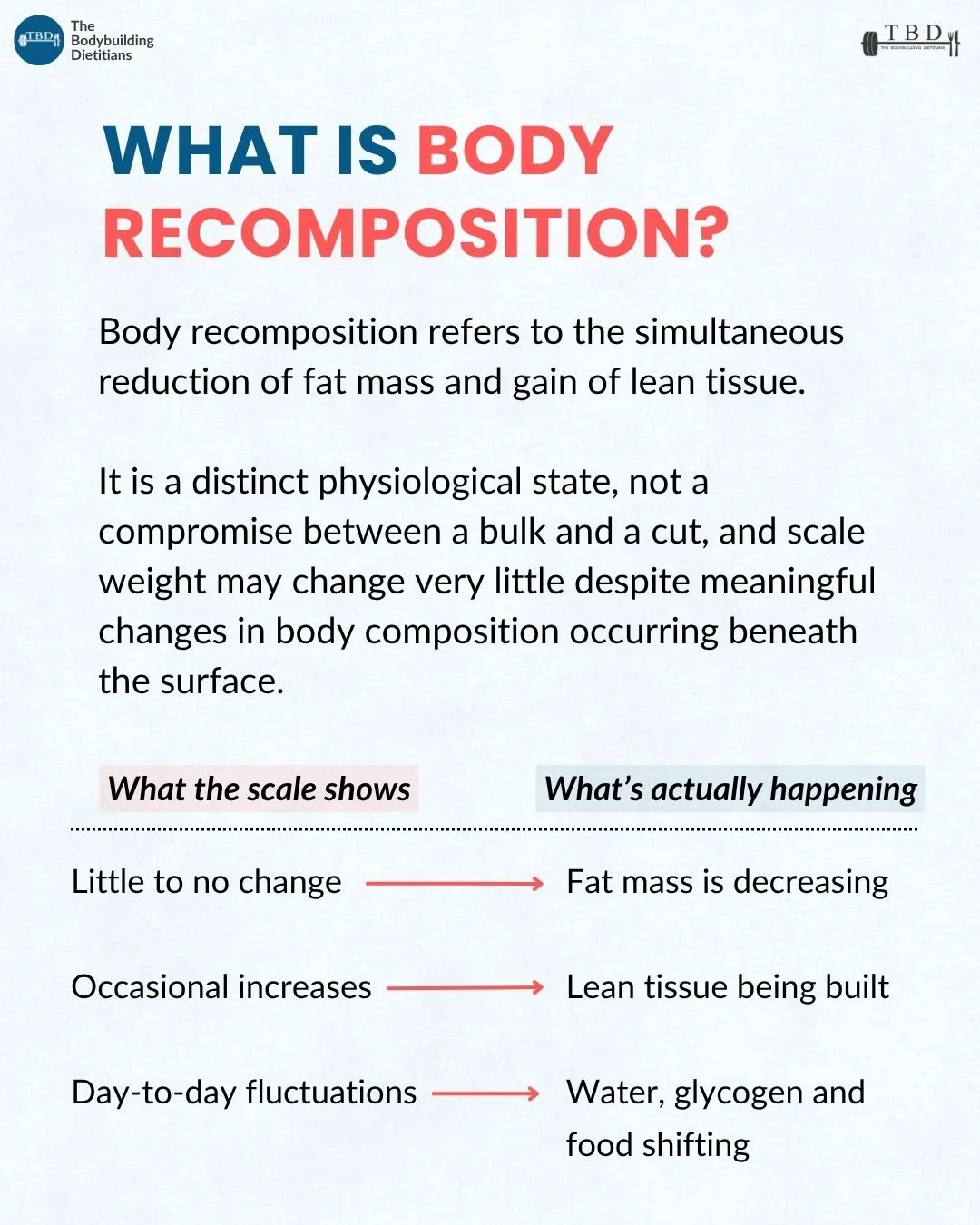
Body recomposition refers to the simultaneous reduction of fat mass and gain of lean tissue. It is distinct from a standard fat loss phase or a muscle gain phase in that both processes are occurring concurrently rather than sequentially, and it produces a characteristic and often confusing progress pattern: scale weight may change very little, or barely at all, over weeks and months during which meaningful changes in body composition are actually occurring beneath the surface.
This creates a monitoring problem that catches many people off guard. A person in a well-structured recomposition phase who gains 1 kilogram of lean tissue while losing 1 kilogram of fat will register no net change on the scale. If they are tracking progress by scale weight alone, they may conclude that nothing is working, when in fact the physiology is performing exactly as intended. This is one of the reasons that recomposition specifically requires a broader tracking framework than the approaches most people default to.
The day-to-day scale fluctuations that characterise a recomposition phase, sometimes flat, sometimes slightly up, sometimes slightly down, largely reflect shifts in water retention, glycogen storage, and the weight of food and waste in the digestive system rather than changes in fat or muscle mass. Reading individual daily weigh-ins during this phase is not particularly useful. Weekly averages tracked over months tell a more accurate story.
Body recomposition is not a compromise between a bulk and a cut. It is a distinct physiological state with its own nutritional and training requirements, and approaching it as a half-hearted version of either extreme tends to produce underwhelming results.
Who Does Body Recomposition Work For?
Recomposition is not equally achievable for everyone, and the conditions that make it more or less accessible are well characterised in the research.
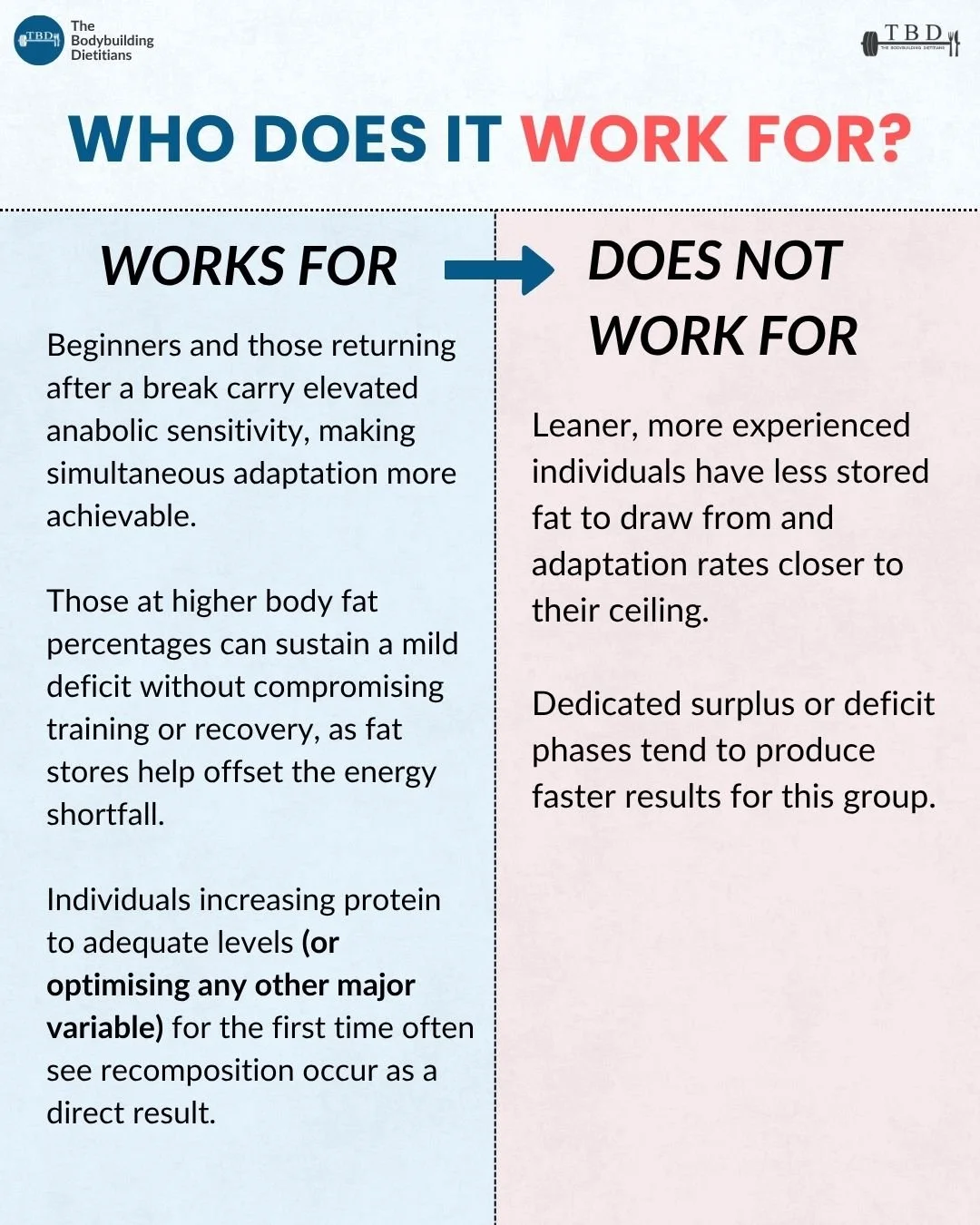
Beginners to resistance training and individuals returning to training after a meaningful break represent the group for whom recomposition is most readily achievable. The mechanism is anabolic sensitivity: untrained muscle tissue responds to a resistance training stimulus with a more pronounced adaptive response than trained muscle that has already accommodated to similar demands. This elevated responsiveness means that the same training and nutritional conditions that would produce modest adaptations in an experienced athlete produce considerably more in a beginner, and the rate of simultaneous fat loss and muscle gain reflects that.
Individuals at higher body fat percentages have a practical physiological advantage in recomposition. A meaningful fat mass provides a reservoir of stored energy that can partially offset the energy demands of muscle building without requiring a calorie surplus. This means a mild energy deficit can be maintained without compromising training performance or recovery to the degree it would in a leaner individual, because fat stores are contributing to meeting energy demand alongside dietary intake.
Individuals who are optimising a major nutritional or training variable for the first time, such as increasing protein intake to evidence-based levels after a period of inadequate intake, often experience recomposition as a direct result of that change alone. The improvement in muscle protein synthesis that follows adequate protein provision in a previously protein-insufficient diet creates conditions for simultaneous adaptation that do not require everything else to be perfectly aligned.
Leaner and more experienced individuals, by contrast, have less stored fat to draw from and adaptation rates that sit closer to their physiological ceiling. For this group, the rate of progress achievable through recomposition tends to be slower than through dedicated phases, and alternating between structured surplus and deficit periods typically produces faster results in both directions. This is not an argument against recomposition for experienced athletes, but a realistic framing of when dedicated phases are likely to be the more efficient approach.
Not sure whether recomp is right for where you are?
Whether recomposition or a dedicated phase suits you depends on your training history, your current body fat, and how patient you can realistically be with slower scale progress. Working out which approach fits your situation, and setting the protein, energy, and training variables to match, is what our team does with every client.
Why Is Progress During a Recomposition Phase Slower?
Recomposition is inherently slower than either a dedicated deficit or a dedicated surplus, and understanding the reason for that makes it easier to commit to the process without abandoning it prematurely.
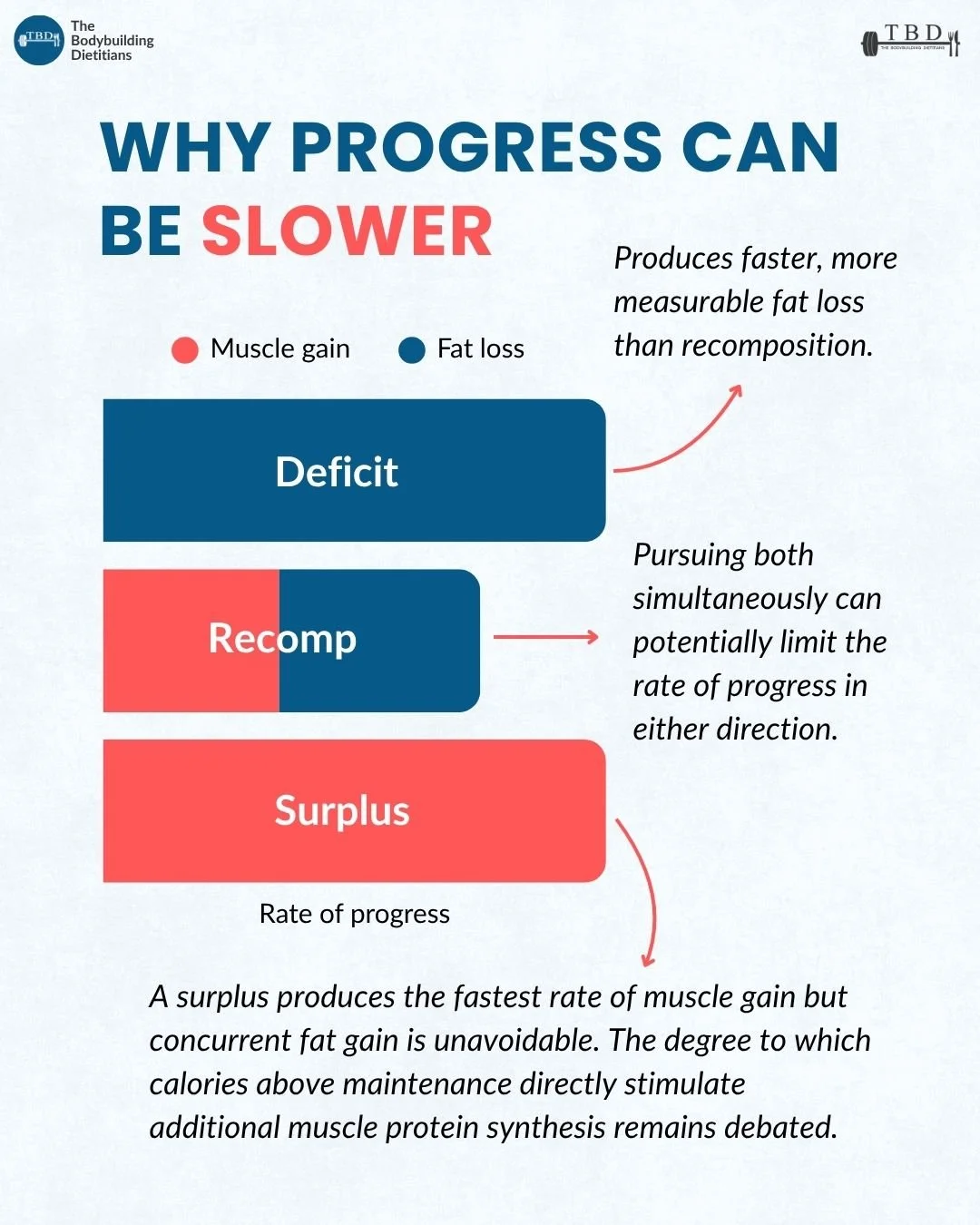
A calorie deficit optimises the conditions for fat loss but limits the substrate available for muscle protein synthesis. A calorie surplus optimises the conditions for muscle gain but makes some concurrent fat accumulation unavoidable. Recomposition attempts to accomplish both simultaneously while operating in neither of those optimised states. The outcome is that both processes are occurring, but at a rate slower than each would achieve in its dedicated phase.
A calorie surplus produces the fastest rate of muscle gain, but fat gain during a surplus is unavoidable, and the degree to which calories above maintenance directly stimulate additional muscle protein synthesis, beyond what adequate protein and training already provide, is a question the research has not resolved with complete certainty. A calorie deficit produces faster and more measurable fat loss than recomposition, and the visible rate of change on the scale is higher. Recomposition sits between those two on every measure of speed.
The practical implication is that recomposition requires patience at a level that dedicated phases do not. Scale weight will move slowly or not at all. Changes in body composition will accumulate over months rather than weeks. Training performance should be progressing, measurements should be shifting, and photos taken several months apart should look different even when weekly comparisons show very little. The monitoring framework matters as much as the structure of the diet and training.
How Should a Recomposition Phase Be Structured?
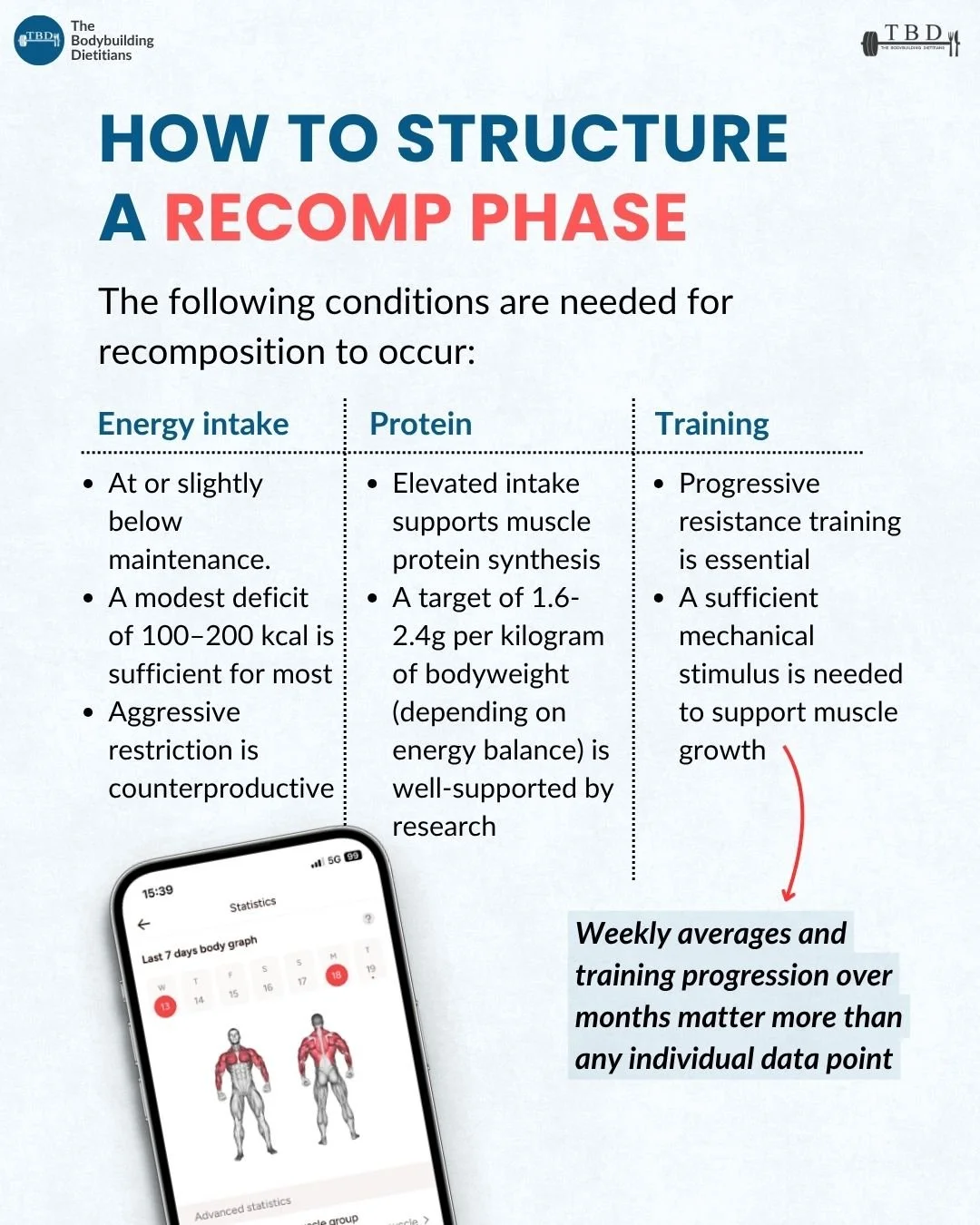
Three conditions are required for recomposition to occur consistently: energy intake managed appropriately relative to maintenance, protein intake elevated to support muscle protein synthesis, and progressive resistance training providing the mechanical stimulus that drives muscular adaptation.
Energy intake: Energy intake during a recomposition phase should sit at or slightly below maintenance. A modest deficit of approximately 100 to 200 calories below maintenance is sufficient for most individuals and creates the conditions for gradual fat loss without meaningfully compromising recovery or training quality. Aggressive restriction is counterproductive in this context: cutting calories more aggressively shifts the phase away from recomposition and toward a standard fat loss phase, at the cost of the muscle-building conditions that make recomposition possible. The goal is to create a mild energy deficit, not to optimise fat loss speed.
Maintenance energy intake is the amount of food required to sustain current bodyweight over time, and it varies considerably between individuals based on body composition, activity level, and metabolic rate. Establishing an accurate maintenance estimate before setting a recomposition target is a useful starting point, and tracking scale weight as a weekly average over two to three weeks while keeping intake consistent provides a practical method for calibrating that estimate.
Protein intake: Elevated protein intake is arguably the single most important nutritional variable in a recomposition phase. Muscle protein synthesis, the biological process through which dietary protein stimulates the repair and construction of muscle fibres, requires adequate amino acid availability to proceed at a rate that supports lean tissue gain. In an energy deficit, protein also provides a protective effect against muscle breakdown, which is relevant even in the mild deficit that characterises recomposition.
A protein target of 1.6 to 2.4 grams per kilogram of bodyweight is well-supported by research for individuals in conditions of energy restriction or maintenance. Toward the higher end of that range is often more appropriate during recomposition, where the dual requirements of supporting muscle protein synthesis and protecting lean mass under a mild deficit both pull toward higher intake.
Training: Progressive resistance training is non-negotiable for recomposition. Without a sufficient mechanical stimulus to signal the need for muscular adaptation, the nutritional conditions for muscle gain produce no muscle gain. The training structure does not need to be complex, but it does need to provide progressive overload over time, meaning that load, volume, or proximity to failure increases across training blocks.
For individuals earlier in their training journey, the bar for a sufficient stimulus is lower, and even relatively simple programs produce the anabolic signal needed for adaptation. For more experienced individuals, stimulus quality matters more, and training intensity tracked through RPE or reps in reserve is useful for ensuring working sets are landing in the productive range rather than consistently falling short of it.
How Should Progress Be Tracked During a Recomposition Phase?
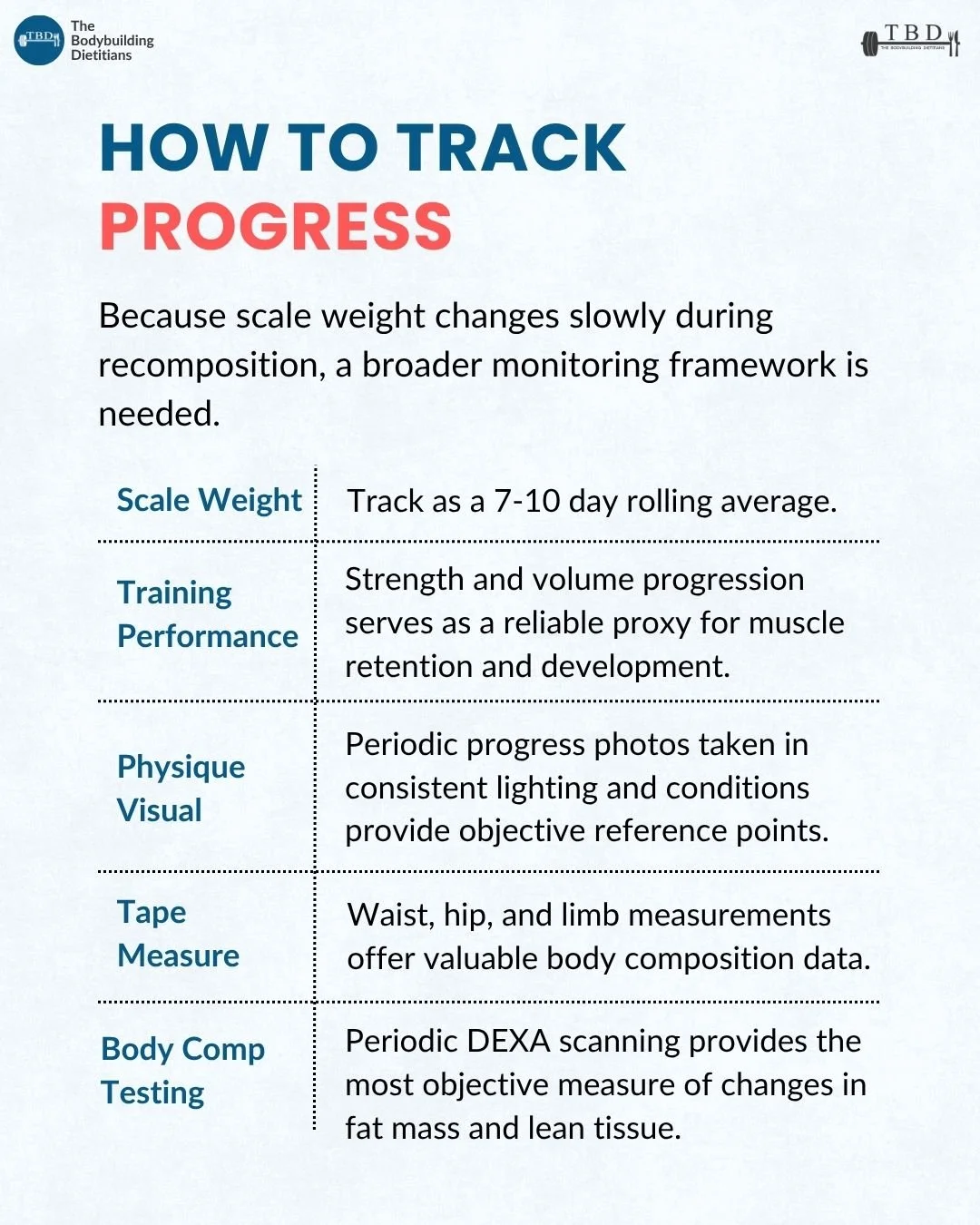
Because scale weight changes very little or not at all during a successful recomposition phase, relying on it as the primary measure of progress is likely to produce a misleading picture. A broader monitoring framework gives a more accurate and more motivating account of what is actually happening.
Scale weight remains useful but needs to be interpreted as a weekly rolling average rather than as individual daily data points. Day-to-day variation of 0.5 to 2 kilograms is normal and largely reflects water, glycogen, and digestive content rather than changes in fat or lean tissue. Tracking the average of seven to ten consecutive daily weigh-ins and comparing that average to the previous week's average reduces the noise and makes the underlying trend, if any exists, more visible.
Training performance is one of the more reliable proxies available for muscle development during recomposition. Consistent strength and volume progression across a training block suggests that muscle tissue is being maintained or developed, which is meaningful positive feedback even when the scale is not moving. A sustained plateau in training performance, particularly if combined with fatigue, is worth investigating as a possible indicator that energy or protein intake needs adjustment.
Progress photos taken periodically in consistent lighting, at the same time of day, and in the same conditions provide an objective reference point that the subjective daily experience of looking in the mirror cannot. The difference between photos taken two or three months apart is often more visible and more informative than any week-to-week comparison.
Body measurements including waist, hip, and limb circumferences add another data stream that complements scale weight. A decreasing waist measurement alongside a stable or increasing limb measurement is a pattern consistent with concurrent fat loss and lean tissue development, and it provides tangible evidence of recomposition that scale weight would not capture.
For individuals who want the most objective available measure of changes in fat mass and lean tissue, periodic DEXA scanning provides direct body composition data that removes the ambiguity inherent in all other tracking methods. A baseline scan at the start of a recomposition phase and a follow-up scan three to six months later gives a clear picture of what has actually changed, independent of scale weight or visual assessment.
Practical Takeaways
Body recomposition is the simultaneous reduction of fat mass and gain of lean tissue. Scale weight may change very little during a successful phase, because fat loss and muscle gain can offset each other in total mass.
Recomposition is most achievable for beginners, those returning from a training break, individuals at higher body fat percentages, and those optimising major variables such as protein intake for the first time.
Leaner and more experienced individuals tend to progress faster through dedicated surplus and deficit phases than through recomposition. Understanding which approach is appropriate for the current situation is a worthwhile starting point.
Energy intake during a recomposition phase should sit at or slightly below maintenance. A modest deficit of 100 to 200 calories is sufficient; aggressive restriction is counterproductive and shifts the phase away from the conditions that support muscle building.
Protein intake of 1.6 to 2.4 grams per kilogram of bodyweight supports muscle protein synthesis and protects lean mass under the mild deficit of a recomposition phase. Toward the higher end of this range is often appropriate.
Progressive resistance training is essential. Without a sufficient mechanical stimulus, the nutritional conditions for muscle gain produce no muscle gain.
Tracking scale weight as a weekly average, monitoring training performance, taking periodic progress photos, measuring body circumferences, and using DEXA scanning periodically provides a far more accurate picture of recomposition progress than scale weight alone.
Frequently Asked Questions
Is body recomposition actually possible or is it a myth?
Body recomposition is well-supported in the research literature and has been documented in multiple controlled trials. It is most pronounced in beginners to resistance training, individuals returning from a break, and those at higher body fat percentages, where the physiological conditions for simultaneous fat loss and muscle gain are most accessible. For leaner and more experienced individuals it remains possible but occurs at a slower rate, and dedicated phases tend to produce faster results in each direction.
Why is my weight not changing during a recomposition phase?
A stable or slowly changing scale weight during a recomposition phase is often a sign that the process is working as expected, not that it is failing. Fat loss and muscle gain can offset each other in total mass, producing little net change on the scale while meaningful body composition changes accumulate beneath the surface. Tracking training performance, body measurements, and periodic progress photos provides a more accurate picture of what is actually happening than scale weight alone.
How much protein do you need for body recomposition?
A protein target of 1.6 to 2.4 grams per kilogram of bodyweight is well-supported for individuals in a recomposition phase. Toward the higher end of that range is often more appropriate given the dual requirements of supporting muscle protein synthesis and protecting lean mass under a mild energy deficit. Protein is the single most important nutritional variable for recomposition and is the first thing worth auditing if the phase is not producing expected results.
How long does body recomposition take?
Recomposition is a slow process by nature, and expecting changes on the same timescale as a dedicated fat loss phase leads to premature abandonment of a working approach. Meaningful changes in body composition typically accumulate over three to six months of consistent effort. Weekly averages tracked over that period, alongside training performance and periodic measurements, provide the most accurate sense of whether the approach is working.
Should I do cardio during a recomposition phase?
Cardio is not required for recomposition but can be a useful tool for managing energy balance without reducing food intake. Low-impact cardio such as walking has the practical advantage of increasing energy expenditure without meaningfully affecting recovery from resistance training. Higher-intensity cardio adds to fatigue load and should be managed carefully to avoid compromising training performance, which is the primary driver of the muscle-building side of the recomposition equation.
How do I know if I should recomp or do separate bulk and cut phases?
The decision depends primarily on training experience, current body fat percentage, and time horizon. Individuals early in their training career or returning after a break are generally well-served by a recomposition approach. More experienced individuals at lower body fat percentages tend to make faster progress through dedicated phases. If the primary goal is maximal muscle gain and fat gain is acceptable in the short term, a structured surplus phase followed by a deficit is typically more efficient. If the goal is to improve body composition gradually without significant fat gain, recomposition is appropriate provided expectations about rate of change are realistic.
Understanding whether recomposition is the right goal at a given point, and structuring it properly when it is, is something we work through regularly with clients. If you want support getting the variables right for your specific situation, you can enquire about coaching below.